Last Updated on 10/09/2026 by Nicole Alba
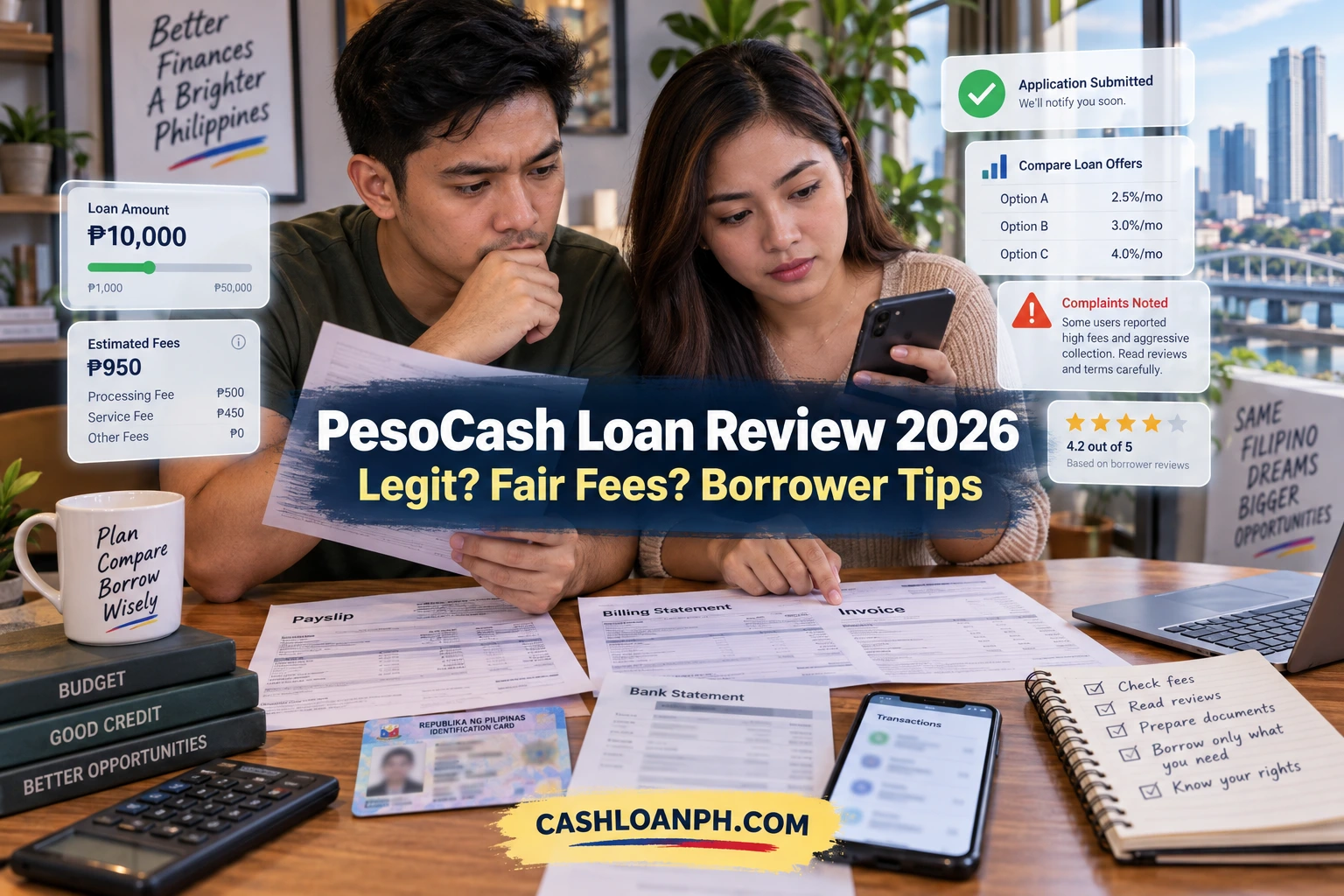
If you are reading PesoCash complaints because money is already tight, the worst thing you need is another page telling you simply that an app is “legit” or “a scam.” Those labels are too crude for a lending decision. A registered lender can still produce a loan that is expensive for your cash flow, and a frightening borrower review is not automatically proof that the lender violated the law.
I reviewed PesoCash’s current public disclosures, its Google Play listing updated in August 2026, its published loan agreement and privacy policy, recent borrower reviews, and Philippine SEC/BSP/NPC rules. One point deserves emphasis from the start: ordinary failure to pay a civil loan does not, by itself, mean imprisonment in the Philippines. Article III, Section 20 of the 1987 Constitution states that no person shall be imprisoned for debt. Fraud or a separate criminal offense is a different legal issue. (Lawphil)
What are the Key Takeaways from this PesoCash Loan review complaints 2026?
PesoCash has identifiable corporate and regulatory details, but registration alone does not guarantee that every loan offer, collection interaction, or borrower experience will be satisfactory. Your safest decision depends on the exact net proceeds, repayment schedule, EIR, permissions, and contract displayed before disbursement.
| Issue | What I found | Borrower risk level | What you should do |
|---|---|---|---|
| Operator identity | MyLoan Lending Investors Inc.; CS201900197; CA 2866 | Low verification risk | Match these details against your contract |
| Advertised loan size | ₱1,500 – ₱8,000 | Moderate | Borrow only what your next pay cycles can carry |
| Advertised term | 120, 150 or 210 days | Moderate | Check actual due dates, not just “months” |
| Published pricing | 0.05% daily, stated 18.25% maximum APR; ₱25 – ₱130 transaction fee | Moderate | Calculate cost from cash actually received |
| Repayment disclosure | App-store example shows installments; public loan template contains lump-sum wording | Needs clarification | Screenshot the exact schedule before confirming |
| Privacy/data use | ID images, location and financial SMS are discussed; public documents contain differing address-book language | Needs careful review | Deny permissions you do not understand until clarified |
| 2026 complaints | Reviews mention unclear schedules, pricing concerns, repeated contact and poor support | Moderate to high if experienced personally | Preserve screenshots and escalate documented issues |
| Debt collection | Threats, public shaming and improper contact-list use are restricted | High consumer-protection importance | Document conduct and complain to SEC/NPC where appropriate |
Is PesoCash legitimate in the Philippines, and who actually operates it?
PesoCash presents substantial evidence of a real lending-company identity, rather than an anonymous loan app. Its website and Google Play listing identify MyLoan Lending Investors Inc., registration number CS201900197, and Certificate of Authority No. 2866. (PesoCash)
An SEC list published previously also recorded PesoCash as an online lending platform associated with MyLoan Lending Investor Inc. Current Credit Information Corporation records accessible in 2026 list MyLoan Lending Investors Inc. among CIC accessing entities, which is another institutional footprint worth noting. (Securities and Exchange Commission)
That does not mean “SEC registered” should be read as “SEC guarantees this loan is cheap, suitable, or problem-free.” The SEC regulates lending companies and their online lending platforms, but borrower treatment and compliance still have to be assessed transaction by transaction.
There is also a public-document housekeeping issue I would want clarified before sending formal correspondence. PesoCash’s current homepage lists a 12th Floor, Aseana Three Building address, while the Google Play listing and privacy policy identify a 9th Floor, Sinocan Corporate Center address. This could simply reflect an office move with documents updated at different times, but borrowers filing notices should ask support which legal/business address is current. (PesoCash)
That kind of detail matters when a complaint becomes serious. A clean lender record should make it easy for the borrower to identify the corporate entity, regulator, service address and complaint channel without detective work.
What loan amount, term, interest and fees does PesoCash advertise in 2026?
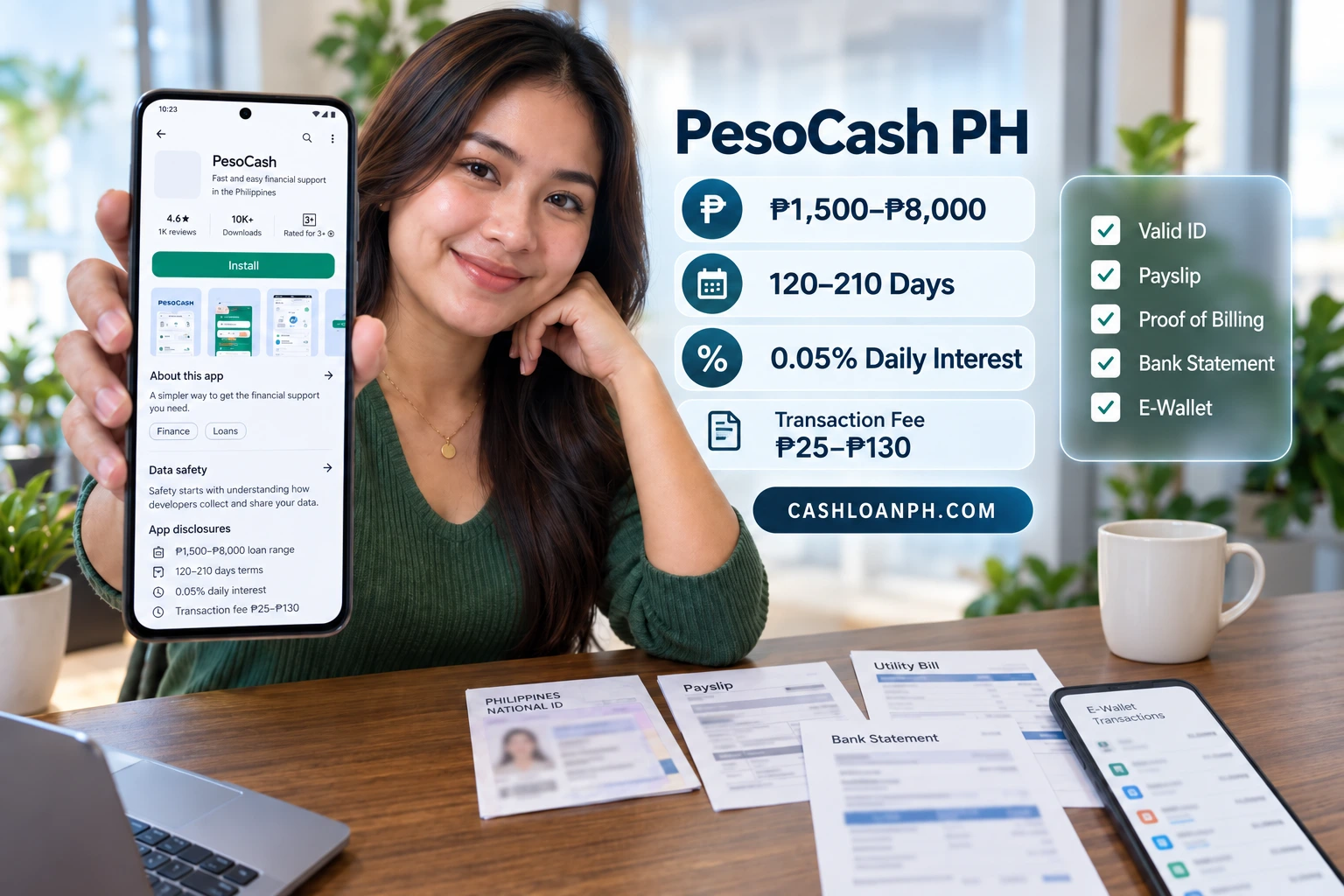
As of its August 13, 2026 Google Play update, PesoCash advertises loans from ₱1,500 to ₱8,000, terms of 120, 150 or 210 days, a 0.05% daily rate, stated maximum APR of 18.25%, and ₱25 – ₱130 transaction fees. (Google Play)
The published example uses an ₱8,000 loan over 150 days. PesoCash states:
| Published example item | Amount |
|---|---|
| Contract loan amount | ₱8,000 |
| Transaction fee | ₱25 |
| Cash received | ₱7,975 |
| Stated interest over 150 days | ₱600 |
| Total scheduled repayment | ₱8,600 |
| Illustrative monthly installment | ₱1,720 × 5 |
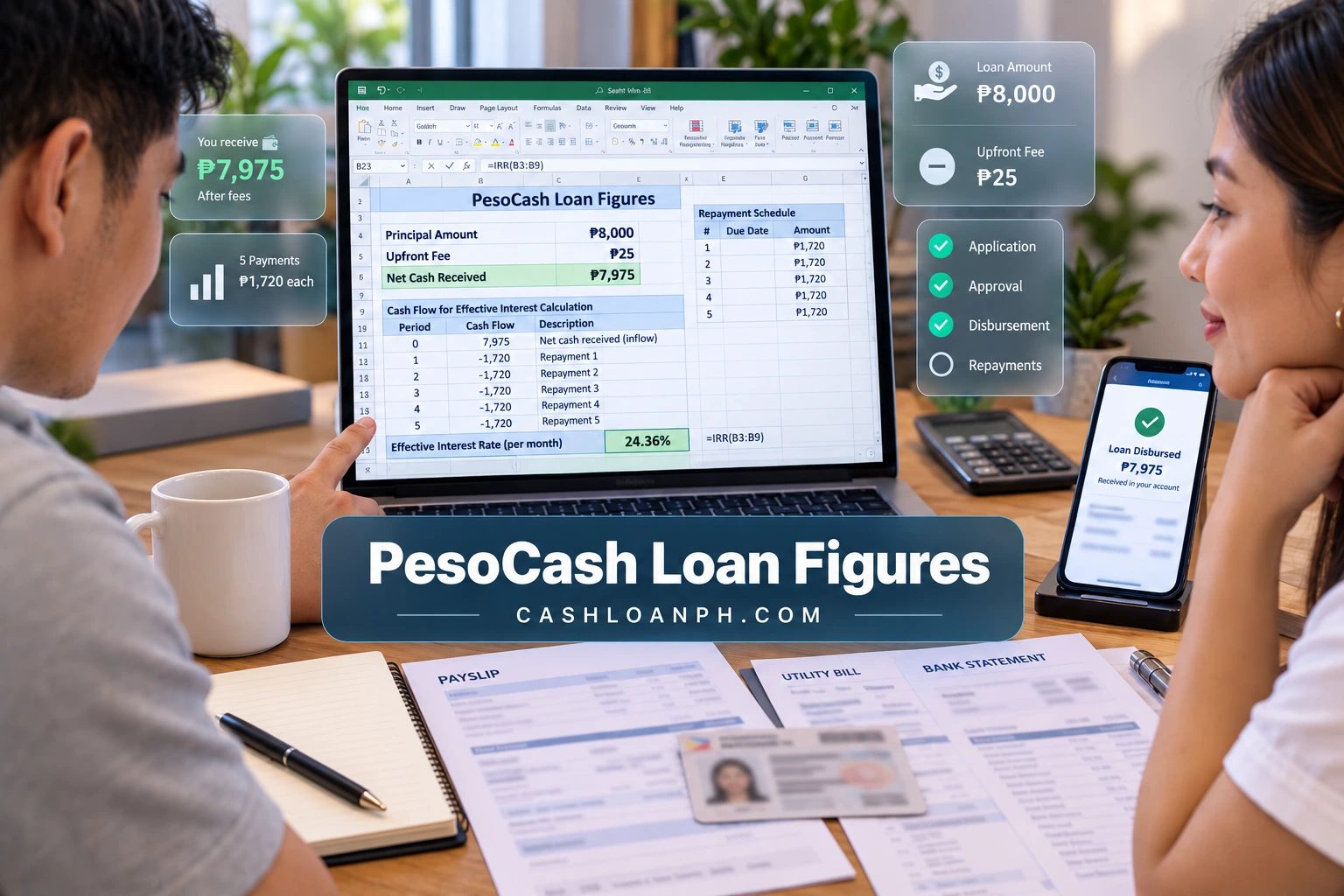
That example is much more useful than a marketing phrase such as “low interest,” because the borrower can see that the economic starting point is not ₱8,000 of usable money. It is ₱7,975 received against ₱8,600 scheduled repayments, assuming the published example is applied exactly. (Google Play)
Why can PesoCash’s advertised 18.25% APR still be misunderstood?
A headline APR does not necessarily tell you the full economic cost created by upfront deductions and installment timing. Borrowers should calculate from the cash received today against every payment leaving their wallet later.
This is one of the most common places where online-loan borrowers get hurt without realizing it.
PesoCash’s example derives 18.25% from a 0.05% daily rate. Yet the ₱25 transaction fee is deducted before the borrower receives the money. If I model the published ₱8,000/150-day example as ₱7,975 received today followed by five monthly payments of ₱1,720, the cash-flow internal rate is roughly 2.57% per month, or about 35.6% annual effective rate when compounded monthly.
That is my calculation based on the publicly disclosed example and assumed month-end payments; it is not an EIR figure quoted by PesoCash and it is not an allegation that the example is unlawful. The exercise simply demonstrates why a simple annualized rate and a cash-flow effective rate are not interchangeable.
This distinction becomes even more important when a lender deducts processing, channel, management, verification or service fees before release.
What do PesoCash complaints in 2026 actually tell borrowers?
Recent complaints are useful warning signals, but they should be treated as borrower allegations rather than regulatory findings. The strongest pattern in 2026 reviews concerns pricing clarity, repayment information, unwanted contact and customer-service friction. (Google Play)
Which complaint patterns appear in recent PesoCash reviews?
Several 2026 reviewers report difficulty reconciling what they expected with the repayment information or communications they later received. PesoCash has publicly responded to some complaints and invited borrowers to contact support. (Google Play)
One August reviewer said the repayment schedule was difficult to locate and described an unsatisfactory customer-service interaction. A July reviewer said calls and messages continued after an unfinished application. Another reviewer challenged the interest shown in the app.
Those are not trivial complaints when someone is borrowing for food, medicine, rent or a family emergency. A borrower under pressure usually looks first at “How much can I get?” The more important questions are “How much lands in my account?”, “Exactly when does every installment fall due?” and “What happens if my salary is one day late?”
One useful correction is necessary. A 2026 Google Play reviewer cited SEC Memorandum Circular No. 18 when discussing the 6% monthly interest ceiling. MC No. 18 concerns unfair debt-collection practices; the small-loan interest ceilings come from BSP Circular No. 1133 and SEC Memorandum Circular No. 3, Series of 2022. A complaint can contain a genuine concern even when the legal citation used by the reviewer is wrong.
Which PesoCash complaint claims remain unproven?
A review saying “harassment,” “illegal interest” or “privacy violation” does not establish that a legal violation occurred. To assess a particular case, you need the signed disclosure, actual disbursement, payment schedule, messages, timestamps and permissions involved.
This distinction protects borrowers as much as lenders. It gives a regulator something concrete to investigate.
There were also older Philippine government FOI records in which borrowers named PesoCash when alleging harassment, contact-list use or debt shaming. Those archive pages show that complaints have existed historically, but they are complaint records, not SEC findings that every allegation was proven. (Freedom of Information Philippines)
Are PesoCash’s public repayment disclosures completely consistent?
Not entirely. One public-facing example describes monthly installments, while PesoCash’s published loan-agreement template contains wording that repayment of principal and interest occurs in one lump sum when the bill is due. Your individual contract should control the schedule you actually accept. (Google Play)
I would not infer wrongdoing from a template mismatch by itself. Different products or versions may use different structures.
I would, however, refuse to press the final “confirm” button until I could clearly see:
net amount received → exact installment amounts → exact calendar due dates → total repayment → all upfront fees → late-payment formula.
Save screenshots before the money arrives. Do not rely on your memory of a rapidly changing phone screen.
PesoCash’s general terms also contain provisions about audited accounts, inspecting borrower premises and books, maintaining business operations, pari passu obligations, sanctions and restrictions involving gold. That reads more like broad lending boilerplate than plain-language documentation designed specifically for a small ₱1,500 – ₱8,000 consumer loan. (PesoCash)
For a borrower, this creates a practical problem even if a clause never becomes relevant: material financial information can become harder to distinguish from legal boilerplate.
What personal data and phone permissions should PesoCash borrowers examine?
PesoCash’s privacy disclosures discuss identity images, device information, location and financial SMS data, while its public documents use differing language regarding address-book information. That is a good reason to review every permission rather than automatically tapping “Allow.” (PesoCash)
What does PesoCash say it collects during underwriting?
The privacy policy says financial SMS data may be analyzed to identify accounts, cash-flow patterns and transactions for credit-risk assessment, while identity images may be used for AI-assisted identity verification. Location information may also be collected with consent. (PesoCash)
This gives some insight into how digital underwriting differs from bank lending.
For a salaried employee, traditional underwriting may lean heavily on payroll evidence. For a delivery rider, freelancer or online seller, automated underwriting may place more weight on observed cash-flow signals and transaction notifications.
That creates a hidden friction point. A borrower can have real income yet look weak to an automated model if earnings arrive mostly in cash, transfers have inconsistent descriptions, or the system cannot interpret the transaction pattern cleanly. More data does not automatically mean a better score.
Where do PesoCash’s privacy disclosures deserve clarification?
The privacy policy says PesoCash only collects emergency-contact information entered by users and does not collect contact-permission information, yet another section mentions address-book permission, while its loan-agreement template refers to verifying an electronic address book. (PesoCash)
I would treat that as a disclosure inconsistency requiring clarification, not automatic proof of unlawful access.
There is another point worth checking. Google Play’s data-safety section states that the app may share device or other IDs with third parties, while the PesoCash privacy policy describes limits on third-party sharing. These descriptions may refer to different technical circumstances, but borrowers have every right to ask what is shared, with whom, and under what lawful basis. (Google Play)
The March 2026 joint DICT-NPC-SEC advisory is especially relevant here. It says unnecessary processing, excessive contact-list processing and contacting people on a borrower’s contact list other than permitted guarantors for collection are prohibited.
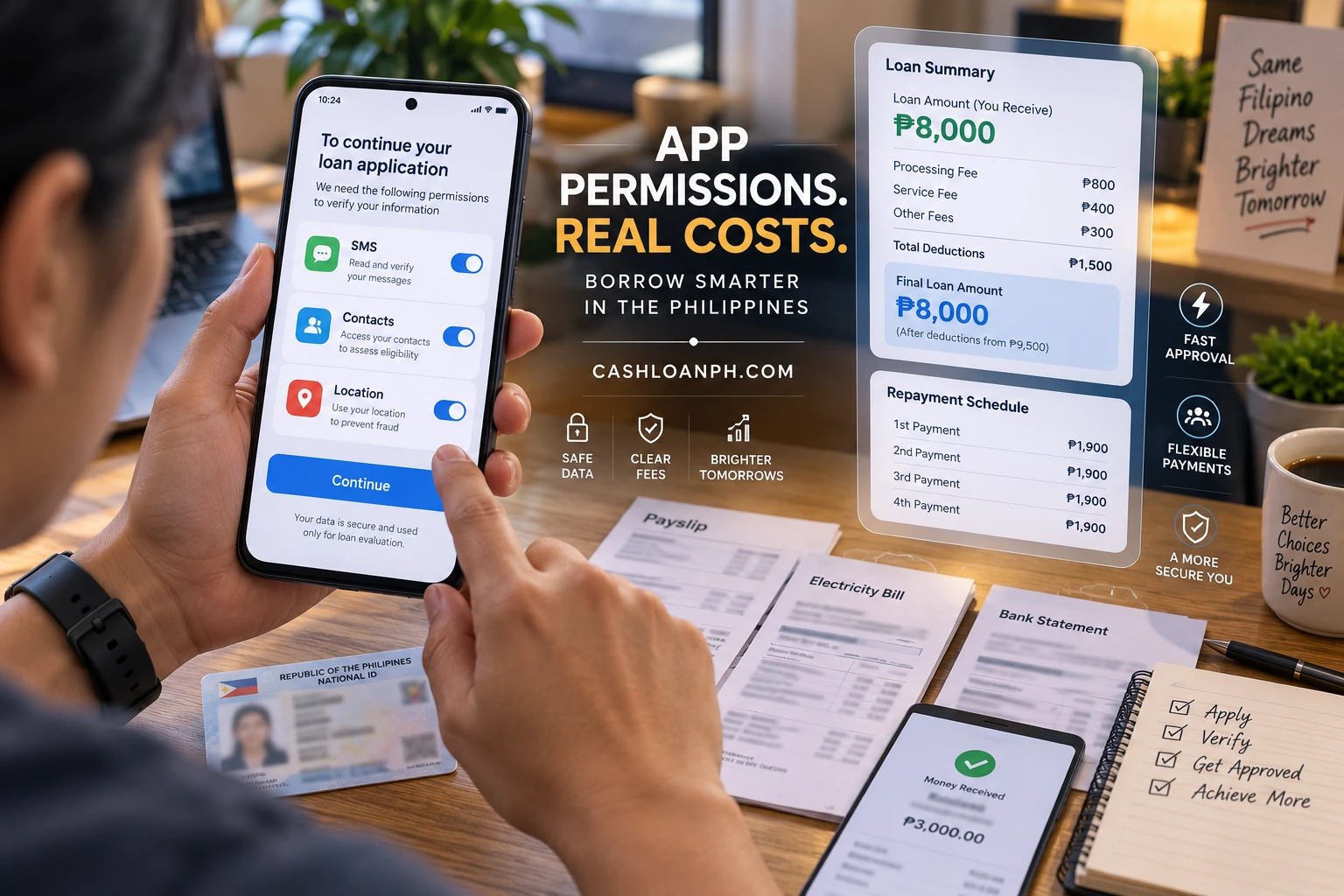
How do Philippine BSP and SEC interest caps apply to a PesoCash loan?
The well-known 6% and 15% monthly ceilings do not apply to every Philippine loan. BSP Circular No. 1133 targets unsecured, general-purpose lending-company loans of ₱10,000 or less with terms up to four months.
Which advertised PesoCash terms fall near the small-loan ceiling rules?
PesoCash’s advertised amounts are below ₱10,000, but its tenors differ. The 120-day option is around the four-month boundary, while the advertised 150- and 210-day products extend beyond the specific four-month tenor covered by Circular 1133.
For any 120-day offer, I would look at the actual start and maturity dates rather than assuming “120 days” automatically settles the regulatory classification.
For a loan that satisfies all Circular 1133 coverage conditions, the ceilings include:
- 6% per month nominal interest
- 15% per month effective interest, including relevant fees other than late-payment penalties
- 5% per month cap on penalties for late/nonpayment on the outstanding scheduled amount due
- 100% total cost cap on interest, fees, charges and penalties relative to the amount borrowed.
A longer loan falling outside that specific four-month cap does not become a free-for-all. Disclosure, fair-treatment and responsible-pricing obligations remain relevant under Philippine consumer-protection laws, including the Financial Products and Services Consumer Protection Act and Truth in Lending Act. (Lawphil)
Why should you calculate the effective cost instead of reading only the interest rate?
Fees deducted before disbursement increase the real cost because you repay obligations tied to a larger contractual amount than the cash available for you to spend.
Suppose the screen says:
Contract principal: ₱5,000
Amount actually credited: ₱4,250
Required repayment: ₱5,600
Do not calculate your burden only from ₱5,000 to ₱5,600. From the household’s perspective, ₱4,250 arrived and ₱5,600 must leave.
Ask for the disclosure statement and calculate from net proceeds.
That simple habit catches a large share of online-loan pricing misunderstandings.
Can PesoCash or a collector have you jailed simply because you cannot pay?
No person should be imprisoned merely for an unpaid civil debt. The Philippine Constitution expressly protects against imprisonment for debt, though separate acts involving fraud or another criminal offense must be assessed independently. (Lawphil)
A message saying “you will be arrested today” deserves careful scrutiny. A private collection agent does not create a warrant by sending a text message.
This does not cancel your debt. A legitimate lender can pursue lawful collection and civil remedies. You should still communicate, ask for a statement of account, propose a realistic payment arrangement when necessary, and preserve proof of every payment.
Do not disappear because a collector frightened you. But do not send money blindly to a personal bank or e-wallet number simply because the sender threatens immediate arrest. Verify the payment destination through the official app or official customer-service channel first.
What collection behavior should a PesoCash borrower document and report?
Threats, intimidation, public shaming and disproportionate use of personal data can cross Philippine consumer-protection and privacy rules. In 2026, DICT, NPC and SEC specifically reiterated restrictions concerning online lenders’ treatment of borrower data and contacts.
Keep the complete evidence chain: screenshot the sender’s number, timestamp, wording, call logs, names of third parties contacted, payment receipts and your own attempts to resolve the issue.
For a lending-company pricing, disclosure or collection complaint, the SEC is the central financial regulator involved. The SEC’s iMessage system includes a complaint channel for financing and lending companies. For misuse of personal data, the NPC provides a complaint process; its rules normally require evidence that you first gave the company an opportunity to address the privacy concern, subject to the applicable procedural rules. (Securities and Exchange Commission)
If there are credible threats of physical harm, extortion, impersonation or other potentially criminal conduct, consider the appropriate law-enforcement channel as well.
What should you check before pressing “Accept” on a PesoCash loan?
Do not decide from the credit limit or advertised APR. Decide from the complete repayment cash flow and the permissions the app requests.
Before accepting, I would record one screenshot containing – or several screenshots clearly proving – the approved principal, net cash to be received, deductions, interest, EIR if shown, every installment date, every installment amount, total repayment and late-payment terms.
Then ask one personal question that no app can answer for you: If my salary, remittance or gig income arrives seven days late, can I still make this payment without borrowing from another loan app?
If the answer is no, the loan is already too fragile.
A ₱4,000 emergency can turn into a debt cycle when Loan B is used to settle Loan A and Loan C is needed to cover household food after repaying Loan B. Approval is not proof of affordability.
What should you do if you already have a PesoCash loan and the amount looks wrong?
Do not argue from memory. Rebuild the transaction from documents and cash flows, then dispute specific numbers in writing.
Start with four numbers: contractual principal, cash actually received, total payments already made, and current amount demanded.
Then attach the disclosure statement, loan agreement, disbursement record, repayment receipts and screenshots showing what you saw before acceptance. Ask PesoCash to provide a written itemization separating principal, ordinary interest, transaction or platform fees, penalties, extension fees and any other charge.
If the figures change depending on who answers customer support, save every version.
If the dispute concerns a covered small loan, compare the itemized costs against the applicable BSP/SEC caps rather than repeating a social-media claim about “legal interest.” Regulators work better with math than adjectives.
How should gig workers and irregular-income borrowers interpret PesoCash approval?
An approval does not mean the lender has proved that repayment will be comfortable for your household. Digital credit scoring can estimate repayment probability while still failing to capture rent, food, school expenses, informal debts or a sudden drop in gig income.
PesoCash says it may analyze financial SMS information for cash-flow and credit-risk purposes. That may make digital underwriting more flexible for people who lack conventional payslips, but automated cash-flow signals have limits. (PesoCash)
For example, a rider who earns ₱1,000 on a good day and ₱300 during heavy rain does not have the same affordability profile as an employee earning a fixed payroll amount twice monthly, even if their average monthly inflow looks similar.
Borrow according to your bad-week income, not your best-week income.
Is PesoCash safe enough for an emergency loan in 2026?
PesoCash appears to have a real corporate and regulatory footprint, but I would not treat that fact as sufficient reason to borrow. The present public documents contain enough disclosure inconsistencies that I would require a very clear final contract screen before accepting funds.
The advertised Google Play example itself is relatively transparent about amount received and repayment, which is positive. Yet the repayment wording differs from the public loan-agreement template, public addresses are not fully harmonized, privacy documents use differing language around address-book access, and recent reviewers continue to raise service, pricing and communication concerns. (PesoCash)
That combination does not justify calling PesoCash fraudulent. It does justify careful verification rather than impulsive borrowing.
One final E-E-A-T disclosure matters here: I reviewed the live public app-store listing, official website documents, complaint material and regulatory sources, and I independently modeled the published loan cash flows. I did not submit a fake KYC application or deliberately incur a real PesoCash debt simply to create a review. Doing so would require personal identity information and could create a genuine financial obligation. I therefore will not claim to have seen private in-app approval screens that were not publicly available.
For borrowers, that is also the safer standard for financial reviews: documented evidence is more valuable than theatrical claims of “testing.”
What is the safest verdict from this PesoCash Loan review complaints 2026?
PesoCash is not an anonymous app with no identifiable operator, but borrowers should separate “registered company” from “good loan for me.” Verify the exact net proceeds, repayment schedule, fees, permissions and complaint contacts before accepting any offer.
If you are already struggling with repayment, protect your position by communicating in writing, requesting an itemized statement and preserving screenshots rather than borrowing again immediately to silence collection pressure.
If collection messages become humiliating or threatening, remember two things at the same time: you still need to address a legitimate debt, and you still have rights while doing so. Philippine consumer-protection rules do not require a distressed borrower to surrender dignity or privacy simply because money is owed. (Lawphil)
References
- Bangko Sentral ng Pilipinas
Organization: Bangko Sentral ng Pilipinas
Resource: Circular No. 1133 – Ceilings on Interest Rates and Other Fees Charged by Lending Companies, Financing Companies and OLPs
URL: https://www.bsp.gov.ph/Regulations/Issuances/2021/1133.pdf - Securities and Exchange Commission Philippines
Organization: Securities and Exchange Commission
Resource: List of Financing and Lending Companies Registered with the SEC and Their Online Lending Platforms
URL: SEC recorded online lending platform list - Securities and Exchange Commission Philippines
Organization: Securities and Exchange Commission
Resource: Lending Companies and Financing Companies – Advisories and Notices
URL: SEC lending and financing company advisories - National Privacy Commission / DICT / SEC
Organization: National Privacy Commission, Department of Information and Communications Technology, Securities and Exchange Commission
Resource: 2026 Joint Advisory on Online Lending Platforms
URL: 2026 Online Lending Platforms public advisory - National Privacy Commission
Organization: National Privacy Commission
Resource: File a Complaint
URL: NPC complaint procedure - PesoCash
Organization: MyLoan Lending Investors Inc.
Resource: PesoCash Official Website, General Terms, Privacy Policy and Loan Agreement
URL: PesoCash official website - Google Play
Organization: Google / MyLoan Lending Investors Inc.
Resource: Pesocash – Safe Online Loans
URL: PesoCash Google Play listing - LawPhil Project
Organization: Philippine legal reference repository
Resource: 1987 Philippine Constitution, Article III, Section 20
URL: 1987 Philippine Constitution


![Pesoredee Loan PH Review: Is it Legit? Repayment Options, App APK, and Contact Information [New Update]](https://cashloanph.com/wp-content/uploads/2023/10/pesoredee-loan-philippines-review-cashloanph-438x246.jpg "Pesoredee Loan PH Review: Is it Legit? Repayment Options, App APK, and Contact Information [New Update]")