Last Updated on 12/10/2026 by Nicole Alba
Legit Online Lending Apps in the Philippines (2026 Review): How to Verify SEC Authorization, Real Loan Costs, and Borrower Risks
Applying for a short-term cash loan on your phone often happens under urgent financial pressure – a medical bill, a school tuition deadline, or a gap between paychecks. In that hurry, many Filipino borrowers discover too late that an app advertising “₱25,000 in 5 minutes at 0.5% daily interest” actually disburses only ₱1,400 out of a ₱2,000 approved principal, demands repayment in 7 to 14 days rather than the 90 days shown on its store page, and begins messaging phone contacts the day before the due date. Worse, many apps displaying a Securities and Exchange Commission (SEC) company registration number on their banners do not actually hold a valid Certificate of Authority to operate as a lending or financing company.
This review examines how legitimate online lending apps operate in the Philippines in 2026, separating verified regulatory requirements and statutory interest caps from app-store marketing claims. Because our editorial standard prohibits fabricating live borrowing tests or inventing unpublished fee schedules, our analysis relies on Philippine statutory frameworks (Republic Act No. 9474, Republic Act No. 3765, and Republic Act No. 11765), Bangko Sentral ng Pilipinas (BSP) circulars, SEC Memorandum Circulars, and standardized financial cost modeling. Where exact figures depend on an individual borrower’s risk tier or a specific lender’s proprietary underwriting, we explicitly state those limitations and show you how to calculate the real peso cost before you tap “Accept.”
| Borrower question | Current finding | Why it matters |
| What makes a loan app legally authorized? | The operator must hold an SEC Certificate of Authority (CA) to operate as a Lending or Financing Company (or a BSP banking license), and its specific app must be a recorded Online Lending Platform (OLP). | An SEC corporate registration number (e.g., CS202X…) only proves a company exists; without a CA, lending to the public is illegal. |
| Is there a legal cap on interest and fees? | Yes, for covered loans: 6% per month nominal interest and 15% per month effective rate (including processing/service fees), plus a 5% per month late penalty cap on overdue amounts. | These caps (BSP Circular No. 1133 / SEC MC No. 3, s. 2022) apply strictly to unsecured, general-purpose loans not exceeding ₱10,000 with tenors up to 4 months. Larger or longer loans are not covered by this specific ceiling. |
| Why did I receive less cash than my approved loan? | Many lending apps deduct “service,” “processing,” or “system” fees upfront from the approved principal before transferring funds. | If you are approved for ₱5,000 with a ₱500 upfront deduction, you receive ₱4,500 in cash, but your interest and repayment are calculated on the full ₱5,000. |
| How much can first-time borrowers realistically get? | Despite ads claiming up to ₱25,000 or ₱50,000, initial credit limits on non-bank apps typically start between ₱1,000 and ₱5,000. | Relying on an advertised maximum limit to cover a large emergency expense can leave you short of funds while still incurring high upfront fees. |
| Can a lending app legally message my contacts? | No. SEC Memorandum Circular No. 18 (s. 2019) and National Privacy Commission (NPC) rules strictly prohibit contacting people in your phonebook who are not guarantors or co-makers. | Only the contact references you explicitly nominate – or legally bound co-makers – may be contacted under specific conditions; harvesting your entire address book is unlawful. |
| Can I go to jail for failing to pay an online loan? | No person may be imprisoned for non-payment of a purely civil debt under Article III, Section 20 of the 1987 Philippine Constitution. | Collection agents who threaten police arrest warrants or barangay detention for simple inability to pay are violating SEC unfair collection rules – though issuing bounced checks (B.P. 22) or committing identity fraud remains criminal. |
How do you verify if an online lending app is legitimate in the Philippines?
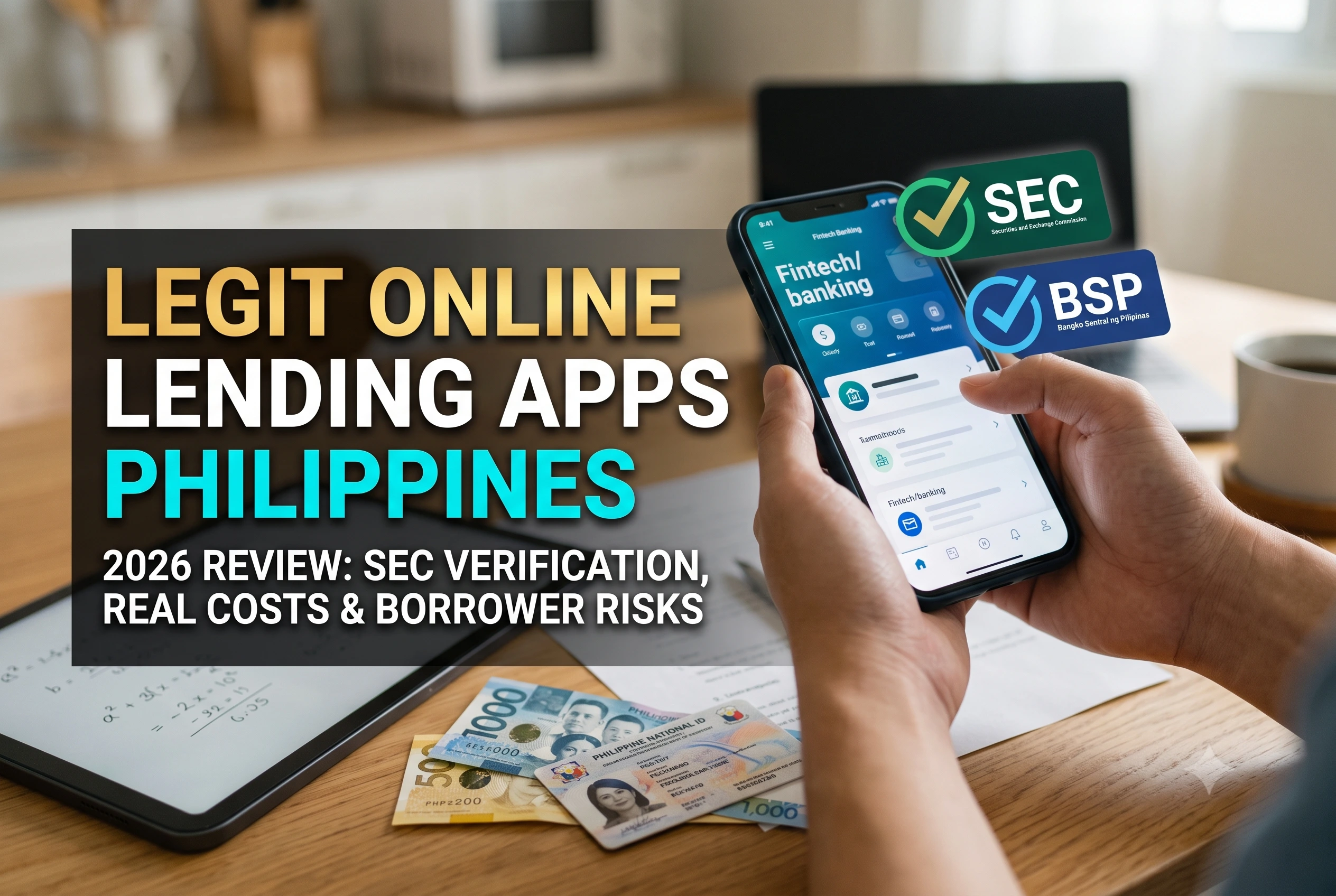
An online lending app is legally authorized in the Philippines only if its corporate operator holds a secondary Certificate of Authority (CA) from the SEC as a Lending or Financing Company – with the specific app recorded as an Online Lending Platform (OLP) – or operates under a Bangko Sentral ng Pilipinas (BSP) banking or EMI license.
Many Filipino borrowers check an app’s website, see an “SEC Registration Number,” and assume the app is safe. In Philippine corporate law, there is a major legal distinction between primary corporate registration and secondary lending authorization.
SEC company registration vs. Certificate of Authority (CA) vs. OLP registration
Under the Lending Company Regulation Act of 2007 (Republic Act No. 9474) and the Financing Company Act of 1998 (Republic Act No. 8556), registering a corporation with the SEC only grants the entity juridical personality – it does not authorize that company to lend money to the public. To legally engage in lending or financing, the company must obtain a separate Certificate of Authority (CA) from the SEC Corporate Governance and Finance Department.
Even if a company holds a valid CA, it cannot simply launch unlimited apps on Google Play or the Apple App Store. Under SEC Memorandum Circular No. 19, Series of 2019, and subsequent moratorium orders (such as SEC MC No. 10, Series of 2021), lending and financing companies must specifically register and disclose their Online Lending Platforms (OLPs) with the SEC. An illegal operator sometimes hijacks or cites the SEC registration number of a dormant or unrelated corporation to make an unregistered app appear legitimate.
How to distinguish the consumer brand from the legal lending entity
In the Philippine fintech market, the app name on your phone screen (the consumer-facing brand) is rarely the legal name of the company funding the loan. Legitimate lending apps fall into three distinct regulatory categories, each offering a different level of cost and consumer protection:
| Lender Category | Primary Regulator | Required License / Authority | Typical Examples in PH Market | Typical Cost & Tenor Profile |
| Digital Banks & Rural/Thrift Bank Apps | Bangko Sentral ng Pilipinas (BSP) | Digital Bank License, Rural/Thrift/Universal Bank License | Maya Bank (Maya Easy Credit / Personal Loan), Tonik Digital Bank, CIMBank (GCash GLoan/GCredit partner), UnionDigital Bank, GoTyme Bank | Lower monthly effective rates (typically 1.5% to 5% per month); longer installment tenors (3 to 24 months). |
| SEC-Licensed Financing Companies & Installment Finteches | Securities and Exchange Commission (SEC) – some also hold BSP OPS/EMI registration | SEC Registration + Certificate of Authority as a Financing Company (R.A. 8556) | Home Credit Philippines (HC Consumer Finance Philippines, Inc.), Billease (First Digital Finance Corporation), Tala (Tala Financing Philippines Inc. – also operates via partner/licensing structures), SeaMoney (Credit) Finance Philippines, Inc. (SLoan/SPayLater) | Moderate to regulated effective rates; transparent installment schedules (typically 1 to 12 months); strict KYC. |
| SEC-Licensed Short-Term Lending Companies (OLPs) | Securities and Exchange Commission (SEC) | SEC Registration + Certificate of Authority as a Lending Company (R.A. 9474) + Recorded OLP | Digido Finance Corp. (note: verify current SEC status of individual OLPs before borrowing), JuanHand (WeFund Lending Corp.), OLP-model cash loan apps | Often price right at the BSP Circular 1133 ceiling (up to 15% per month effective cost including fees); shorter tenors (14 to 90 days). |
Note on platform vs. funder: Some fintech apps operate strictly as technology platforms, credit brokers, or Operators of Payment Systems (OPS) registered with the BSP, while the actual loan agreement is funded and underwritten by a partner financing company or rural bank (for instance, JuanHand’s platform matches borrowers with WeFund Lending Corp. or partner institutional funders; GCash’s lending products are funded by Fuse Lending Inc. or partner banks like CIMB). Before signing, scroll to the very top and bottom of the electronic Promissory Note or Disclosure Statement to identify the exact legal corporation extending the credit.
How much can you actually borrow compared to advertised limits?
While Philippine lending apps routinely advertise maximum loan limits between ₱25,000 and ₱50,000, first-time borrowers without an established repayment record on that specific platform typically receive initial offers between ₱1,000 and ₱5,000, often for shorter repayment periods than advertised.
Google Play and social media advertisements highlight the highest possible credit ceiling available to top-tier repeat borrowers. New applicants almost never qualify for those headline figures on their first disbursement.
Why first-time borrowers receive lower limits and shorter tenors
Online lenders do not publicly disclose their proprietary credit-scoring algorithms, but public application flows and underwriting disclosures show that initial limits are constrained by automated risk tiering. Because most non-bank lending apps provide unsecured credit without physical collateral or traditional face-to-face verification, they manage default risk through “credit laddering.” A first-time borrower might apply for ₱10,000 over 90 days, only to be approved for ₱2,000 payable in 14 or 30 days. Only after repaying several cycles on time – and paying the associated transaction fees on each cycle – does the app gradually unlock higher principal tiers.
How underwriting differs by employment and income profile
Even when applying on the exact same app, your approval odds and starting credit limit vary depending on how easily the platform can verify your cash flow:
- Salaried employees (BPO, corporate, and government workers): Applicants who can upload a clear company ID, latest payslip, Certificate of Employment (COE), or show consistent payroll credits into a traditional bank account generally pass automated underwriting faster and qualify for better starting tiers, particularly on financing-company apps like Billease or digital banks.
- Freelancers, gig workers, and online sellers: Because platform workers and freelancers rarely have traditional BIR Form 2316 tax slips or corporate IDs, traditional bank apps may reject their applications automatically. SEC-licensed fintech apps often accept alternative proof – such as Upwork/Payoneer transaction histories, active e-wallet cash-in records (GCash/Maya), or courier settlement histories – but may assign a conservative starting limit until repayment behavior is proven.
- Unbanked or thin-file applicants: Borrowers presenting only a single primary government ID (such as a PhilSys National ID, UMID, Passport, or Driver’s License) and an e-wallet account can still get approved on short-term OLP apps, but they face the lowest initial principal caps and the highest fee structures permitted by law.
What does an online loan really cost in pesos?
Under BSP Circular No. 1133 and SEC Memorandum Circular No. 3 (Series of 2022), covered loans up to ₱10,000 with tenors up to four months are capped at a 6% monthly nominal interest rate and a 15% monthly effective interest rate (including processing fees), plus a maximum 5% monthly late penalty.
The biggest mistake a borrower can make is looking only at the “interest rate” shown on an app’s home screen. Under the Truth in Lending Act (Republic Act No. 3765), every lender is legally required to provide a clear breakdown of finance charges and net proceeds prior to loan consummation.
Statutory rate caps vs. loans outside the regulatory ceiling
In late 2021 and early 2022, the Bangko Sentral ng Pilipinas (via Circular No. 1133) and the SEC (via MC No. 3, s. 2022) implemented mandatory ceilings to curb predatory lending by online apps. However, you must check whether your loan falls inside the legal scope of this cap:
- Loan type: Unsecured, general-purpose loans offered by lending companies, financing companies, and their Online Lending Platforms (OLPs).
- Principal limit: Loans not exceeding ₱10,000.
- Tenor limit: Loan terms up to four (4) months (120 days).
For loans within this threshold:
- Nominal Interest Rate Ceiling: Maximum of 6% per month (approximately 0.2% per day).
- Effective Interest Rate (EIR) Ceiling: Maximum of 15% per month (approximately 0.5% per day). Crucially, the EIR ceiling includes nominal interest plus all mandatory fees, service charges, processing fees, and system fees, excluding only late payment penalties.
- Late Payment Penalty Ceiling: Maximum of 5% per month on the overdue amount.
- Total Cost Cap: The total cost of the loan (including all interest, fees, and late penalties) cannot exceed 100% of the total amount borrowed (meaning a borrower can never be forced to pay back more than double the principal, regardless of how long the loan remains in default).
Important qualification: If you borrow ₱12,000 or agree to a 6-month installment term, your loan falls outside the specific scope of BSP Circular No. 1133. While general civil law principles against unconscionable interest still apply via Philippine Supreme Court jurisprudence, the strict 6% nominal / 15% effective monthly cap applies specifically to the ≤₱10,000 and ≤4-month bracket.
Sample peso calculation: Advertised principal vs. net cash received
To see how upfront deductions alter your real borrowing cost, consider two realistic mathematical scenarios for a ₱5,000 loan over 30 days operating right at the statutory ceiling under SEC MC No. 3 (s. 2022):
- Nominal Interest (6% for 30 days):
$$\text{Interest} = ₱5,000 \times 0.06 = ₱300$$
- Processing / Service Fee (9% for 30 days – bringing total charges to the 15% EIR cap):
$$\text{Service Fee} = ₱5,000 \times 0.09 = ₱450$$
- Total Finance Charge:
$$₱300 + ₱450 = ₱750$$
How the lender applies that ₱450 fee drastically changes your cash in hand:
| Cost Component | Model A: Fee Added to Repayment (Add-On) | Model B: Fee Deducted Upfront (Net Disbursement) |
| Approved Principal | ₱5,000 | ₱5,000 |
| Upfront Processing Fee Deducted | ₱0 | −₱450 (9%) |
| Actual Cash Received (Net Proceeds) | ₱5,000 | ₱4,550 |
| Nominal Interest Added (6%) | ₱300 | ₱300 |
| Processing Fee Added at Due Date | ₱450 | ₱0 (already deducted) |
| Total Repayment Due at Day 30 | ₱5,750 | ₱5,300 |
| Total Peso Borrowing Cost | ₱750 | ₱750 (₱5,300 repaid minus ₱4,550 received) |
| Cost Relative to Cash Actually Received | $$\frac{₱750}{₱5,000} = 15.0\%$$ | $$\frac{₱750}{₱4,550} = \mathbf{16.48\%}$$ |
In Model B, if you needed exactly ₱5,000 to pay a hospital bill, receiving ₱4,550 leaves you ₱450 short – yet you still owe ₱5,300 in 30 days. Worse, some short-term apps divide a “30-day loan” into two 15-day installments without reducing the full monthly fee, meaning half of your principal is due in just two weeks, effectively doubling the cash-flow pressure on your next payday.
How fast is approval and disbursement in practice?
Automated credit scoring can approve an application within minutes, but actual cash disbursement depends on eKYC verification checks and external banking rails (InstaPay vs. PESONet), meaning funds can take anywhere from 15 minutes to two business days to reach your account.
Marketing banners frequently promise “instant cash in 5 minutes.” While automated underwriting systems can evaluate a repeat borrower’s application in seconds, several operational friction points frequently delay first-time applications and fund transfers.
Operational friction during application and eKYC
Based on public application workflows across Philippine lending platforms, applicants commonly encounter delays or rejections due to technical verification barriers rather than creditworthiness alone:
- Optical Character Recognition (OCR) and Liveness Failures: Automated ID scanners frequently reject blurry photos, laminated IDs with glare, or secondary IDs (like PhilHealth or Tin IDs) when the app’s system is configured to accept only primary biometric IDs (PhilSys ID, Passport, Driver’s License, UMID).
- Exact Name and Account Mismatches: To prevent identity theft and money laundering, disbursement systems require the registered name on your receiving bank account or e-wallet (GCash/Maya) to match your government ID character-for-character. A missing middle name, a “Jr.” suffix discrepancy, or using a spouse’s GCash number will trigger an automatic disbursement failure.
- Manual Review Triggers: If an automated system flags an inconsistent employer phone number or a shared device IP address, the application is routed to a human verification queue. Manual verification calls usually occur only during standard Philippine business hours (Monday to Friday, 9:00 AM to 6:00 PM).
Why bank and e-wallet settlement can delay your cash
Once a loan is approved and the electronic contract is signed, the speed of cash arrival depends on the payment rail used by the lender’s disbursing partner:
- InstaPay / Direct E-Wallet API (GCash, Maya): Transfers up to ₱50,000 routed via InstaPay arrive in real time, 24/7, including weekends. However, if the borrower’s GCash or Maya account is not fully verified (Basic level) or has reached its monthly incoming wallet limit (typically ₱100,000 for basic verified wallets), the transfer will bounce back to the lender. When a disbursement fails, the loan may already appear as “Active” in the app while the returned funds take 3 to 5 business days to be reconciled and re-disbursed or canceled.
- PESONet Transfers: Some financing companies disburse bank transfers via PESONet to save on transaction fees. PESONet does not operate on weekends or Philippine public holidays; it processes in batch cut-offs on banking days. A loan approved at 4:30 PM on a Friday via PESONet will not reach your bank account until Monday afternoon.
- Over-the-Counter Cash Pick-up (M Lhuillier, Cebuana Lhuillier, Palawan Express, RD Pawnshop): While reference numbers are generated quickly, you are restricted by physical branch operating hours, branch cash availability, and strict ID matching at the pawnshop window.
How does repayment work, and what happens if you pay late?
Borrowers can repay through e-wallets, online banking via Dragonpay or direct billers, and over-the-counter centers (7-Eleven CLiQQ, pawnshops), but late payments trigger penalties capped at 5% per month on the overdue amount for covered loans and negative reporting to the Credit Information Corporation (CIC).
Repaying on time requires understanding not just where to pay, but when the lender’s system credits your transaction.
Payment posting delays and channel traps
Public repayment instructions across major Philippine OLPs highlight a critical distinction between real-time API billers and batch-processed channels:
- Real-Time Reference Channels (7-Eleven CLiQQ, GCash Bills Pay via Dragonpay/Paynamics, Maya): When you generate a lifetime ID or a one-time reference code (often starting with prefixes used by payment aggregators like Dragonpay or Skyro/Billease direct billers), payments usually post within 5 to 60 minutes. Note that third-party payment aggregators typically charge a ₱15 to ₱25 convenience fee on top of your loan installment.
- Over-the-Counter Bank Deposits or Manual Transfers: If an app allows manual bank transfers requiring you to upload a screenshot of your deposit slip, posting can take 24 to 48 business hours. Paying at 8:00 PM on your exact due date via a non-automated channel can result in your account being flagged as overdue the next morning before the accounting team reconciles the payment.
- Never Pay Into Personal Accounts: A legitimate SEC-licensed lending or financing company will only collect repayments through official corporate merchant billers, virtual reference numbers, or corporate bank accounts. If a collection agent instructs you via SMS, Viber, or Facebook Messenger to send your repayment to a personal GCash number to “get a discount” or “waive penalties,” refuse immediately – that is a common collection scam that will leave your official loan balance unpaid.
Late payment penalties and Credit Information Corporation (CIC) reporting
If you miss your due date on a loan covered by BSP Circular No. 1133 (≤₱10,000, ≤4 months), the lender may legally charge a late payment penalty of up to 5% per month calculated on the overdue amount (alongside restructuring or extension fees if you formally agree to a term extension, subject to the overall 15% monthly EIR and 100% total cost caps). For larger installment loans outside Circular 1133, late penalties are governed by the specific Promissory Note – often structured as a flat late fee (e.g., ₱200 to ₱500 per missed installment) or a daily default interest rate.
Beyond peso penalties, under the Credit Information System Act (Republic Act No. 9510), SEC-licensed lending and financing companies as well as BSP-supervised banks are mandated “Submitting Entities” to the Credit Information Corporation (CIC), the Philippines’ public credit registry. They also frequently share data with private credit bureaus such as TransUnion Philippines and CIBI Information, Inc. Defaulting on a ₱3,000 legitimate online loan can create a derogatory credit record that causes traditional banks to reject your future credit card, auto loan, or Pag-IBIG/bank housing loan applications years later.
What personal data do lending apps collect, and what are your legal protections?
Under the Data Privacy Act of 2012 (R.A. 10173), NPC Circular No. 20-01, and SEC Memorandum Circular No. 18 (s. 2019), online lending apps are strictly prohibited from harvesting your phone’s contact list or photo gallery for debt collection and cannot publicly shame or threaten borrowers.
Because many Filipinos experienced aggressive harassment from rogue apps between 2018 and 2022, Philippine regulators established strict legal boundaries governing app permissions and debt collection conduct.
App permissions vs. National Privacy Commission (NPC) rules
Under NPC Circular No. 20-01 (Guidelines on the Processing of Personal Data for Loan-Related Transactions), lending apps must adhere to the principle of proportionality and data minimization:
- Permitted Data Collection: Apps may collect personal data strictly necessary for Know-Your-Customer (KYC) verification, credit scoring, and identity authentication – such as your government ID image, a live selfie, device metadata for fraud prevention, and location data to verify residency.
- Prohibited Permissions: Apps are prohibited from requiring unnecessary access to your full phonebook/contact list, SMS messages, call logs, social media accounts, or camera roll/photo gallery as a condition for processing a loan or for use in debt collection. Furthermore, both Google Play’s Personal Loan App Policy and Apple App Store guidelines explicitly ban personal loan apps from accessing user contacts or photos. If an app asks you to sideload an
.apkfile outside the official store or requests full contact permissions to proceed, treat that as a severe red flag.
Unfair debt collection practices and the rule on imprisonment for debt
The Financial Products and Services Consumer Protection Act (Republic Act No. 11765) and SEC Memorandum Circular No. 18, Series of 2019 (Prohibition on Unfair Debt Collection Practices of Financing Companies and Lending Companies) explicitly make the following actions unlawful:
- Using or threatening the use of violence or physical harm against the borrower.
- Using obscenities, insults, or profane language during collection calls or messages.
- Disclosing, publishing, or posting the borrower’s name and alleged debt on social media (such as Facebook comments or group chats) or to third parties.
- Contacting people in the borrower’s contact list other than those explicitly named by the borrower as guarantors, co-makers, or character references (and even for character references, contacting them to harass or coerce payment rather than merely confirming the borrower’s location is restricted).
- Contacting the borrower at unreasonable hours – specifically defined as before 6:00 AM or after 10:00 PM, unless the debt is more than 15 days past due or the borrower gave express consent.
- Making false representations that non-payment will result in immediate police arrest, criminal prosecution, or barangay confiscation of household appliances.
Can you be imprisoned for not paying an online loan?
Under Article III, Section 20 of the 1987 Philippine Constitution, “No person shall be imprisoned for debt.” Ordinary inability to pay a cash loan is a purely civil liability, not a criminal offense. Neither the Philippine National Police (PNP), the NBI, nor your local Barangay Captain can issue a warrant of arrest or detain you for an unpaid online lending app balance.
However, borrowers must understand two important legal qualifications:
- Civil consequences still apply: A lender can legitimately pursue civil collection, report your default to the CIC, add lawful late fees, and (though rare for small balances due to administrative time) file a civil Small Claims case before the Metropolitan or Municipal Trial Court to recover the money.
- Criminal fraud is separate from simple debt: While civil non-payment is never a crime, issuing a worthless check that bounces violates Batas Pambansa Blg. 22 (B.P. 22), and applying for a loan using a fake identity, forged documents, or someone else’s ID constitutes Estafa (fraud) or violation of the Cybercrime Prevention Act (R.A. 10175), which carry criminal penalties.
What do recent borrower reports reveal about Philippine lending apps?
Recent borrower feedback on Google Play, the Apple App Store, and Philippine consumer forums highlights reliable 24/7 InstaPay disbursements and transparent installment tracking among top-tier apps, contrasted against recurring complaints about aggressive pre-due-date reminder calls, high upfront fee deductions, and unannounced credit limit reductions.
While individual app-store reviews and Reddit threads (such as discussions in r/phinvest or r/DigitalbanksPh) represent anecdotal user experiences rather than audited statistical studies, analyzing recurring themes across recent borrower reports helps distinguish everyday app bugs from structural lending complaints.
Positive borrower patterns on regulated platforms
- Predictable credit building on installment apps: Borrowers using established financing-company platforms (such as Billease or Tala) and digital banks frequently report transparent repayment schedules where the exact peso installment shown prior to signing matches the final amount billed, with zero upfront cash deductions on many installment lines.
- Fast emergency liquidity via e-wallets: Reviewers consistently note that when eKYC documents match their verified GCash or Maya accounts, automated disbursements via InstaPay arrive within minutes, even on weekends or late at night.
- Pro-rated or early repayment flexibility on select apps: Several borrowers report that certain daily-interest platforms allow early full repayment where interest is calculated only for the exact number of days the money was held – though borrowers should verify this in their specific contract, as many other apps lock in the full term fee regardless of how early you pay.
Recurring borrower complaints and friction points
- Aggressive “reminder” calls before the due date: A frequent complaint across even SEC-registered OLPs is that automated robocalls and live collection agents begin calling borrowers 2 to 3 days before the loan is actually due, calling multiple times a day from rotating mobile numbers.
- “Auto-disbursement” or dark-pattern confirmation screens: Several recent reviewers across short-term OLP apps report attempting to merely “check their approved limit and fees,” only for the app to treat the limit-check tap as final loan acceptance – immediately disbursing a small net amount while locking in a 7- or 14-day repayment obligation with heavy upfront fees.
- Sudden credit limit drops after on-time repayment: Repeat borrowers sometimes pay off a loan early or on time expecting a limit increase, only to have the algorithm slash their credit limit or reject their reapplication without explanation due to internal liquidity tightening or risk recalibration.
- Customer service bottlenecks during payment posting failures: When an InstaPay transfer or 7-Eleven CLiQQ payment fails to reflect on a due date, borrowers report slow ticket turnarounds via in-app chat or email, while automated collection systems continue charging late fees and making calls until the payment is manually reconciled.
Pros and cons of using SEC-licensed online lending apps
Based on verified Philippine regulatory rules and standard product architectures across legitimate online lending platforms, here are the structural advantages and drawbacks compared to traditional banks and informal lenders:
Potential Advantages
- Verifiable regulatory oversight and legal recourse: Borrowing from a BSP-supervised digital bank or an SEC-licensed lending/financing company gives you enforceable rights under R.A. 11765, R.A. 3765, and SEC MC No. 18 (s. 2019), with formal government complaint channels if misconduct occurs.
- Capped effective rates on small short-term loans: For covered loans up to ₱10,000 and up to 4 months, BSP Circular No. 1133 legally shields borrowers from the uncapped 30% to 50% monthly charges commonly demanded by illegal unregistered apps or informal street lenders (“5-6”).
- No physical collateral or guarantor required: Legitimate digital lenders evaluate credit via digital KYC and cash-flow documents, removing the need to pawn jewelry, vehicles, or ATM cards.
- Credit history building via CIC: Consistent, on-time repayments to submitting entities help unbanked or thin-file Filipinos build a formal credit footprint with the Credit Information Corporation.
Potential Drawbacks
- High annualized cost even within legal caps: While a 15% monthly effective rate cap protects against extreme extortion, 15% per month still equals an annualized effective cost of 180% per year – far more expensive than traditional bank personal loans (typically 18% to 36% per year) or government salary loans (SSS / Pag-IBIG).
- Upfront fee deductions reduce usable cash: On apps that deduct processing or service fees prior to disbursement, borrowers receive less cash than they need while remaining liable for interest on the full principal.
- Compressed repayment cycles increase refinancing risk: Short tenors (14 to 30 days) or bi-weekly installment splits often collide with a borrower’s regular monthly living expenses, tempting users to take out a second app loan just to pay off the first (“tapal system”).
- Privacy friction and intrusive reminder cadences: Even legally operating OLPs can subject borrowers to frequent automated reminder calls and strict device verification checks.
Who may find an online lending app relevant, and who should avoid it?
Because high-cost digital credit can quickly destabilize a household budget if misused, suitability depends entirely on your cash-flow certainty and the structure of the specific offer.
An online lending app may be relevant if you:
- Face a genuine, one-time short-term liquidity gap (such as an urgent utility disconnection, prescription expense, or payroll timing delay) and have a verified, guaranteed income source (such as an upcoming 15th/30th salary or confirmed client payout) that will cover the full repayment plus fees without starving your grocery or rent budget.
- Qualify for a BSP-supervised digital bank or a low-fee installment financing company where there are zero upfront principal deductions and the installment tenor spreads payments manageably over 3 to 6 months.
- Have already exhausted low-interest institutional options such as an SSS Salary Loan, Pag-IBIG Multi-Purpose Loan (MPL), company payroll advance, or cooperative credit line.
You should exercise extreme caution or avoid borrowing if you:
- Plan to use the proceeds to pay off another overdue lending app – known locally as the “tapal system” (borrowing from App B to pay App A). Because upfront fees deduct 9% to 15% on every transaction, cycling loans across multiple apps mathematically guarantees a debt spiral within 60 days.
- Have unstable or unpredictable income with no confirmed cash inflow before the 14- or 30-day maturity date.
- See an offer where the app refuses to show the Truth in Lending Disclosure Statement (exact peso fees, net proceeds, and maturity date) before requiring you to confirm the loan or grant device permissions.
Frequently Asked Questions (FAQ)
Can I cancel an online loan after the money is disbursed to my GCash or bank account?
Most Philippine online lending apps do not offer a free “cooling-off” cancellation period once funds have been disbursed via InstaPay or PESONet. Once the money hits your account, the electronic Promissory Note is active. Even if you immediately return the cash five minutes later, most short-term OLPs will still charge the full processing fee and minimum interest, and simply sending the cash back without generating an official in-app repayment reference number can result in the system failing to credit your return.
Does paying off a loan early reduce the interest and service fees?
It depends entirely on whether the lender uses daily pro-rated interest or fixed term charges. Digital banks and certain revolving credit lines calculate interest daily based on how many days you use the funds, whereas many SEC-registered OLPs lock in the entire service fee and term interest the moment the loan is disbursed – meaning paying on Day 3 costs the exact same peso amount as paying on Day 30. Some installment lenders also charge an early pre-termination fee. Check the “Prepayment” clause in your Disclosure Statement before paying early.
Where can I file an official complaint against an abusive or illegal lending app in the Philippines?
Match your complaint to the specific violation and regulator:
- Unfair debt collection harassment or unlicensed lending/financing apps: File a formal complaint with the SEC Corporate Governance and Finance Department (CGFD) or Enforcement and Investor Protection Department via the official SEC i-Message portal (
imessage.sec.gov.ph). - Contact list harvesting, doxxing, or social media shaming: File a privacy complaint with the National Privacy Commission (NPC) (
privacy.gov.ph). - Digital banks or e-wallet credit lines (GCash/Maya/Tonik/CIMB): Use the Bangko Sentral ng Pilipinas (BSP) Consumer Assistance Mechanism (BOB – BSP Online Buddy) via the BSP website or official webchat.
- Online extortion, death threats, or identity theft: Report to the PNP Anti-Cybercrime Group (PNP-ACG) or the NBI Cybercrime Division.
How can I request the deletion of my personal data after fully repaying a loan?
Under the Data Privacy Act of 2012 (R.A. 10173),once your loan is fully settled and you have obtained an official Certificate of Full Payment or zero-balance confirmation, you may email the lender’s designated Data Protection Officer (DPO) (listed in the app’s Privacy Policy) to revoke app permissions and request account closure and data deletion. Note, however, that Philippine Anti-Money Laundering Act (AMLA) rules and BIR tax regulations legally require financial institutions to retain basic KYC and transaction records for at least five (5) years after an account is closed, meaning the lender must stop marketing calls and active processing, but cannot purge statutory audit logs immediately.
Pre-Borrowing Decision Checklist: 6 Checks Before You Tap “Accept”
Before confirming any online loan offer in 2026, run through this final verification checklist. If an app fails any of these six points, close the application and walk away:
- Verify the exact legal entity and OLP status: Locate the corporate name in the app’s footer or Terms and Conditions, then verify on
sec.gov.phthat the company holds both an SEC Registration Number and a valid Certificate of Authority (CA), and that the specific app name is on the SEC’s list of Recorded Online Lending Platforms (or holds a BSP license). - Audit the Net Cash Proceeds vs. Approved Principal: Look at the Truth in Lending Disclosure Statement prior to signing. Subtract any upfront “service,” “processing,” or “channel” fees from the principal. If the net cash arriving in your account is too small to solve your actual expense, do not accept the loan.
- Check the true repayment dates, not the advertised banner: Confirm whether a “90-day loan” is actually structured as a 14-day lump sum or requires heavy installments every 7 or 15 days.
- Verify compliance with the BSP Circular 1133 cap: If your loan is ₱10,000 or less for a term of 4 months or less, verify that the combined interest and mandatory fees do not exceed 15% per month (~0.5% per day). If the effective rate is higher, the lender is violating SEC MC No. 3 (s. 2022).
- Inspect device permissions: Check your phone’s permission manager. Ensure the app is not demanding access to your Contacts, SMS, or Photo Gallery.
- Confirm a non-borrowed repayment source: Point to the exact paycheck or income date that will retire this balance in full. If paying this loan on its due date will force you to download another lending app, stop immediately and explore lower-cost alternatives such as SSS/Pag-IBIG loans, employer salary advances, or restructuring existing bills directly with your creditors.
References
- Securities and Exchange Commission (SEC) Philippines
Organization: Securities and Exchange Commission Philippines
Resource: Lending & Financing Companies Advisories, List of Recorded Online Lending Platforms (OLPs), and SEC Memorandum Circular No. 3, Series of 2022 (Ceiling on Interest Rates and Other Fees) / SEC MC No. 18, Series of 2019 (Prohibition on Unfair Debt Collection Practices)
- Bangko Sentral ng Pilipinas (BSP)
Organization: Bangko Sentral ng Pilipinas
Resource: Circular No. 1133, Series of 2021 – Ceiling on Interest Rates and Other Fees Charged by Lending Companies, Financing Companies, and their Online Lending Platforms
URL: https://www.bsp.gov.ph/Regulations/Issuances/2021/1133.pdf
- National Privacy Commission (NPC)
Organization: National Privacy Commission Philippines
Resource: NPC Circular No. 20-01 – Guidelines on the Processing of Personal Data for Loan-Related Transactions
- Official Gazette of the Philippines
Organization: Republic of the Philippines
Resource: Republic Act No. 11765 – Financial Products and Services Consumer Protection Act
URL: https://www.officialgazette.gov.ph/2022/05/06/republic-act-no-11765/
- Lawphil Project
Organization: Arellano Law Foundation
Resource: Republic Act No. 9474 – Lending Company Regulation Act of 2007
URL: https://lawphil.net/statutes/repacts/ra2007/ra_9474_2007.html
- Lawphil Project
Organization: Arellano Law Foundation
Resource: Republic Act No. 3765 – Truth in Lending Act
URL: https://lawphil.net/statutes/repacts/ra1963/ra_3765_1963.html
- Credit Information Corporation (CIC)
Organization: Credit Information Corporation Philippines
Resource: Republic Act No. 9510 – Credit Information System Act (CISA) & Submitting Entities Guidelines