Last Updated on 12/10/2026 by Nicole Alba
Typing “SSS Loan Lite” into a search bar or app store in the Philippines brings up an immediate, high-stakes problem: there is no universal standard for what that name represents. Depending on where you click, you might be looking for a smaller-principal salary loan from the state-run Social Security System (SSS), a streamlined mobile interface for government benefits, or a private online lending platform (OLP) using the acronym “SSS” to capture search traffic from Filipino workers looking for low-interest government credit.
Signing a loan agreement without knowing whether the counterparty is a state social insurance agency or a private commercial corporation can cost you heavily. State-backed salary loans carry low, statutory annual interest rates and long repayment windows. Private short-term lending apps often charge daily or monthly rates accompanied by heavy upfront service fee deductions and compressed seven-to-thirty-day repayment cycles.
This review examines how to separate official Social Security System loan channels from private “Loan Lite” applications in 2026, how the online application process works across both models, how to calculate the actual cash you receive after deductions, and what legal protections apply to your personal data and repayment obligations. Because no specific corporate registry record, app store URL, or disclosure sheet was supplied for a single proprietary “SSS Loan Lite” entity in our review inputs, we evaluate the verifiable statutory rules for official SSS micro-/salary loans alongside the regulatory benchmarks that govern any private Philippine lending app operating under a “Loan Lite” brand.
| Borrower question | Current finding | Why it matters |
| Is there an official “SSS Loan Lite” app? | No. The state agency uses only the My.SSS web portal and the SSS Mobile App. Any standalone “SSS Loan Lite” app on an app store or APK site is a separate entity unless proven otherwise. | Private apps sometimes mimic government acronyms to appear low-cost and state-backed. |
| Who regulates the lender? | The Social Security Commission and RA 11199 govern official SSS loans. The SEC and BSP govern private lending and financing companies. | Regulatory oversight determines interest rate caps, collection rules, and where you file complaints. |
| What is the borrowing limit? | Official 1-month SSS Salary Loans are capped at 1 month’s Monthly Salary Credit (MSC) (up to ₱20,000 – ₱30,000 depending on current MSC tier). Private “Lite” apps typically limit first-time borrowers to ₱1,000 – ₱5,000. | Relying on advertised maximum limits (such as ₱25,000 on private apps) often leads to a shortfall when first-time underwriting caps apply. |
| What is the interest rate and fee structure? | Official SSS Salary Loans charge 10% per annum (diminishing balance) plus a 1% service fee (or 8% p.a. under recent micro-loan frameworks). Private small-value OLPs are capped by BSP Circular No. 1133 at 6% nominal/month and 15% effective/month. | A 10% annual rate on an official SSS loan is vastly cheaper than a 10% to 15% monthly effective cost on a private cash app. |
| How are proceeds disbursed? | Official SSS loans require a Disbursement Account Enrollment Module (DAEM) account (PESONet bank, e-wallet, or UBP Quick Card). Private apps disburse via InstaPay or e-wallets. | Name mismatches or unverified e-wallet tiers will freeze or reject your payout in both systems. |
| What happens if you pay late? | Official SSS loans charge a 1% monthly penalty (reduced to 0.5% under specific pandemic/consolidation circulars where applicable) and deduct arrears from future benefits. Private apps cap total penalties and interest at 100% of principal for covered loans. | Unpaid official SSS loans directly reduce your future retirement, disability, or death benefits. |
Is “SSS Loan Lite” an official government program or a private lending app?
No verified public record confirms an official standalone app named “SSS Loan Lite” from the state-run Social Security System. Official SSS loans are processed only through the My.SSS portal and the official SSS Mobile App. Any third-party “SSS Loan Lite” app must hold a valid SEC Certificate of Authority.
When Filipino borrowers search for “SSS Loan Lite,” they usually fall into one of two groups:
- SSS members seeking a small or short-term official salary loan: In late 2025 and 2026, public discussions and policy announcements around SSS micro-credit and reduced-rate short-term salary loan programs (featuring 8% annual interest rates and 3-to-6-month or 12-month windows for good payers) led many members to search for a “lite” version of the standard SSS Salary Loan.
- Smartphone users who found an app or social media ad using the words “SSS,” “Loan,” and “Lite”: In the Philippine Android ecosystem, lightweight versions of mobile apps often append the word “Lite” to indicate lower storage requirements. However, unlicensed or aggressive private operators also use familiar acronyms like “SSS” in ad copy or app titles to imply an affiliation with the state agency.
How to distinguish the state-run SSS from a private operator
Under Republic Act No. 11199 (Social Security Act of 2018), the Social Security System is a government-owned and controlled corporation (GOCC). It does not incorporate under the Securities and Exchange Commission (SEC), nor does it partner with random third-party Android APK websites to issue salary loans.
To verify whether you are dealing with the government agency or a private company:
- Check the domain and developer name: Official web applications take place exclusively on
sss.gov.ph. On Google Play and the Apple App Store, the official application is titled SSS Mobile, published by the Social Security System. - Inspect the Truth in Lending Disclosure Statement: If an app named “SSS Loan Lite” asks you to sign a promissory note naming a private corporation (e.g., “[Name] Lending Corp.” or “[Name] Financing Inc.”), you are taking out a commercial loan from a private business, not drawing against your SSS contributions.
What SEC credentials must a private “Loan Lite” app hold?
If you are evaluating a private lending app operating under the “Loan Lite” or “SSS Loan Lite” label, Philippine law requires two separate authorizations under Republic Act No. 9474 (Lending Company Regulation Act of 2007) or Republic Act No. 8556 (Financing Company Act of 1998):
- SEC Certificate of Incorporation (Company Registration Number): This only proves the business exists as a registered corporation. It is not a license to lend money to the public.
- SEC Certificate of Authority (CA) to Operate as a Lending or Financing Company: This is the specific regulatory license required to issue loans legally.
Furthermore, under SEC Memorandum Circular No. 19, Series of 2019, any lending or financing company operating a mobile app or digital portal must register the specific Online Lending Platform (OLP) name with the SEC and display both its SEC Registration Number and Certificate of Authority Number prominently on its app store listing, website, and advertisements. Because we could not verify a registered OLP named “SSS Loan Lite” on the SEC’s published list of authorized platforms without a specific corporate parent name, borrowers should treat any private app using this title with strict skepticism.
How do you apply online for an SSS Loan in 2026?
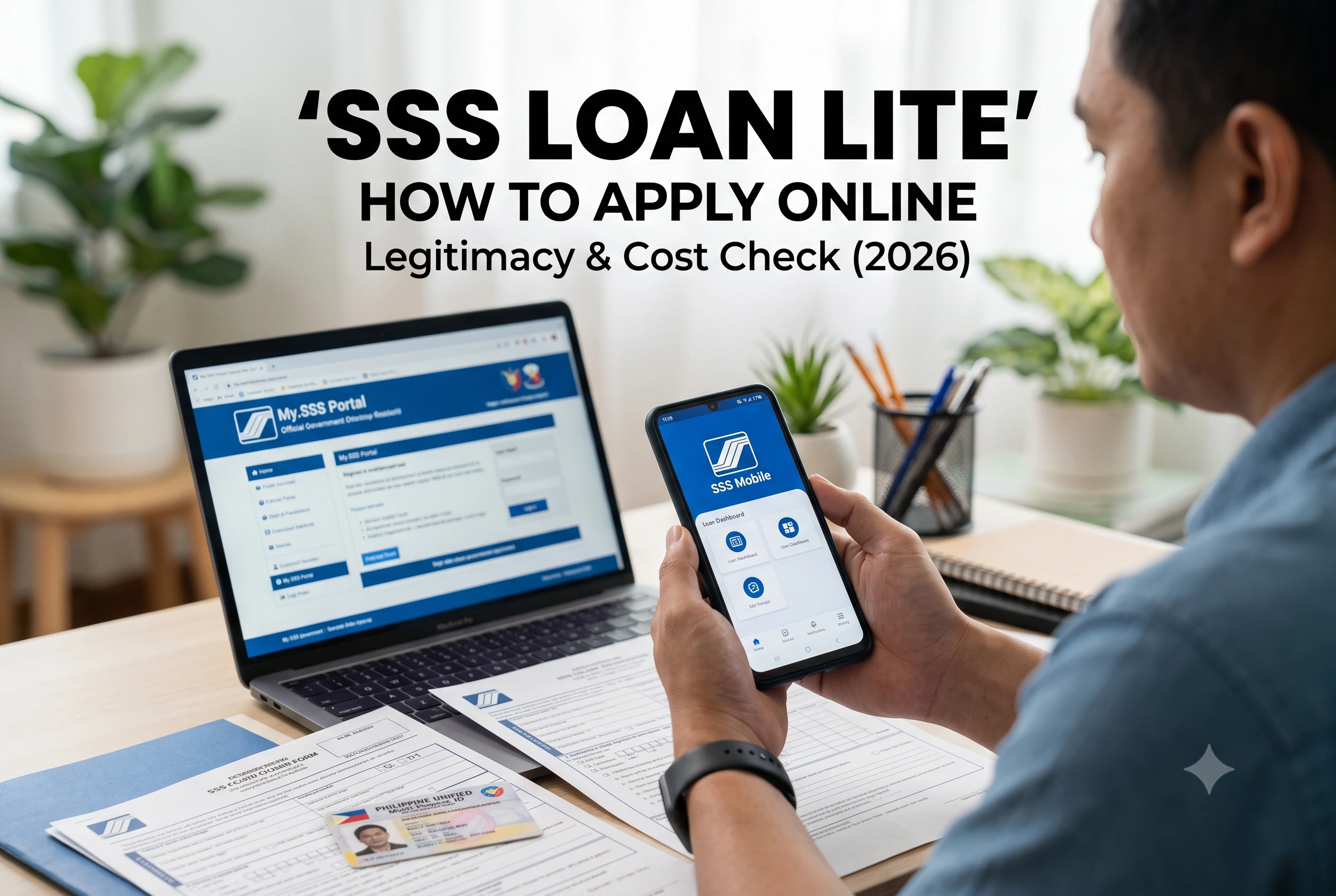
To apply for an official SSS Salary Loan in 2026, log in to the My.SSS web portal or SSS Mobile App, enroll a PESONet bank account or e-wallet in the Disbursement Account Enrollment Module (DAEM), select E-Services > Apply for Salary Loan, and await employer certification if employed.
Whether you are applying for a standard 1-month or 2-month SSS Salary Loan (or any official short-term micro-loan variant rolled out inside the portal), the application is 100% digital. However, first-time online applicants often hit technical roadblocks before they even reach the loan screen.
1.Verify Contribution Eligibility and Account Status:Minimum 36 monthly contributions required for a 1-month loan.
Log in to your My.SSS account via member.sss.gov.ph or the SSS Mobile App. For a 1-month salary loan, you must have at least 36 posted monthly contributions, six (6) of which must be within the last 12 months prior to the month of filing. For a 2-month loan, you need 72 posted contributions. Ensure you are under 65 years of age at the time of application and have not been granted final benefits (such as total disability or retirement).
2.Enroll a Payout Channel in DAEM:Mandatory prerequisite – takes 1 to 5 business days for approval.
Before the system allows you to submit a loan request, you must have an active, approved payout channel in the Disbursement Account Enrollment Module (DAEM). Go to Services > Disbursement Account Enrollment. You can enroll a PESONet-participating bank account, an accredited e-wallet (such as GCash or Maya), or an SSS-issued UnionBank Quick Card. You will need to upload a clear photo of your valid government ID, proof of account (such as a bank statement, passbook with name and account number, or verified e-wallet profile screenshot), and a selfie holding both documents.
3.Submit the Online Loan Application:Found under E-Services.
Apply for Salary Loan”>
Once your DAEM status shows as Approved, navigate to E-Services > Apply for Salary Loan. The portal will automatically calculate your maximum loanable amount based on the average of your last 12 Monthly Salary Credits (MSCs). Select your preferred loan amount and your enrolled disbursement account, read the disclosure statement and terms of service, and submit the request.
4.Complete Employer Certification (For Employed Members):Your application will expire if your employer does not certify it on time.
If you are an Individually Paying Member (Self-Employed, Voluntary, or OFW), your loan application goes straight to SSS for processing. If you are currently employed, the system sends a notification to your employer’s My.SSS account. Your HR or payroll officer must log in and certify your loan application online. Inform your HR department immediately after applying; if the employer fails to certify the request within the system’s validity window, the application is automatically canceled.
How does the application flow differ on a private “Loan Lite” app?
If you are instead using a private OLP, there is no contribution check or employer portal certification. The public application flow for private Philippine cash apps typically requires:
- Mobile number registration via OTP;
- eKYC identity verification, which involves photographing one primary government ID (UMID, SSS ID, PhilSys National ID, Driver’s License, or Passport) and completing a live facial recognition scan (blinking or turning your head);
- Personal and employment profile completion, including your company’s name, monthly income, payday dates, and two to three emergency contact references;
- Disbursement binding to an active GCash, Maya, or InstaPay bank account.
How much does the loan really cost? (Official SSS vs. Private “Loan Lite” Apps)
An official SSS Salary Loan charges 10% per annum (or 8% per annum under updated micro-loan rules) on a diminishing principal balance plus a 1% upfront service fee. By contrast, private “Loan Lite” apps can legally charge up to 15% per month in effective costs under BSP Circular No. 1133.
Borrowers often look only at the monthly installment or the headline percentage without checking whether the rate is annual or monthly, and whether fees are deducted before the cash reaches their bank account.
1. Official SSS Salary Loan Cost Structure
Under current SSS guidelines, the financial terms are transparent and strictly regulated:
- Interest Rate: 10% per annum computed on a diminishing principal balance over 24 months (or 8% per annum for members qualifying under recent rate-reduction adjustments).
- Service Fee: 1% of the loan amount, deducted upfront from the proceeds.
- Pro-rated Interest Deduction: Interest from the date the loan is granted until the end of the month prior to the first amortization month is computed and deducted upfront from the loan proceeds, meaning your first actual monthly payment starts on the 2nd month following the loan date.
Sample Cost Calculation: ₱20,000 Official SSS 1-Month Salary Loan (at standard 10% p.a. over 24 months)
Suppose you are approved for a ₱20,000 SSS Salary Loan in the middle of the month:
- Approved Principal: ₱20,000.00
- Less 1% Service Fee: -₱200.00
- Less Pro-rated Initial Interest (approx. 45 days before 1st amortization month begins): -₱246.58 (varies by exact approval day)
- Estimated Net Cash Received: ~₱19,553.42
- Monthly Amortization (Months 2 to 25): ~₱922.90 per month for 24 months.
- Total Repayment Over 2 Years: ~₱22,149.60
- Total Borrowing Cost (Interest + Service Fee over 24 months): ~₱2,596.18 (an effective cost of roughly 13.28% over two full years relative to net cash received).
2. Private “Loan Lite” OLP Cost Structure (BSP Circular No. 1133 Benchmark)
If you accidentally apply with a private lending app thinking it is affiliated with SSS, the math changes dramatically. Under Bangko Sentral ng Pilipinas (BSP) Circular No. 1133 (implemented alongside SEC Memorandum Circular No. 3, Series of 2022), unsecured, general-purpose loans up to ₱10,000 with tenors up to 4 months are subject to these maximum caps:
- Nominal Interest Rate Ceiling: 6% per month (~0.2% per day).
- Effective Interest Rate (EIR) Ceiling: 15% per month (~0.5% per day), which includes nominal interest plus all mandatory processing, service, and platform fees.
However, many private apps deduct a 10% to 15% “service/processing fee” upfront from the principal, or fall outside the Circular 1133 cap by offering loans slightly above ₱10,000 or bundling optional “credit life insurance” or “VIP fast-track channel fees.”
Sample Cost Calculation: ₱5,000 Private “Loan Lite” App Offer (30-Day Term at Maximum Legal Cap)
Suppose a private app approves you for ₱5,000 for 30 days, charging a 9% upfront processing fee and 6% monthly interest:
- Approved Principal: ₱5,000.00
- Less 9% Upfront Processing Fee: -₱450.00
- Net Cash Actually Received: ₱4,550.00
- Plus 6% Nominal Interest (30 days): +₱300.00
- Total Repayment Due in 30 Days: ₱5,300.00
- Total Peso Cost for 1 Month: ₱750.00 (₱450 deducted + ₱300 added)
- Cost Relative to Net Cash Received: 16.48% for a single month (₱750 ÷ ₱4,550).
Side-by-Side Cost Comparison
| Cost Factor | Official SSS Salary Loan | Typical Private “Loan Lite” App |
| Governing Rate Rule | SSS Commission / RA 11199 | BSP Circular No. 1133 (if ≤₱10,000 and ≤4 mos) |
| Headline Interest Rate | 8% to 10% per YEAR (diminishing) | Up to 6% nominal / 15% effective per MONTH |
| Upfront Service Fee | 1% of loan principal | Commonly 5% to 15% of principal |
| Repayment Tenor | 12 to 24 months | Typically 7, 14, 30, or 90 days |
| Installment Frequency | Monthly (starting 2nd month after grant) | Lump-sum, every 7 days, or bi-weekly (every 15 days) |
How long do approval and disbursement really take?
Official SSS online loans typically take 3 to 7 business days from employer certification to PESONet or e-wallet disbursement, provided your DAEM account is already approved. Private lending apps advertise 5-to-30-minute approvals, though manual underwriting and banking cut-offs can delay payout by 24 to 48 hours.
Marketing banners often promise “instant cash,” but operational bottlenecks affect both government and private systems in the Philippines.
What slows down an official SSS Loan payout?
- DAEM Verification Backlog: If you do not have an approved bank account or e-wallet in the Disbursement Account Enrollment Module before applying, you must wait 1 to 5 business days for SSS staff to manually review your uploaded ID, account proof, and selfie.
- DAEM Rejection Triggers: The most common reason for DAEM rejection is uploading a screenshot of an ATM debit card that only shows the 16-digit card number instead of the actual bank account number, or uploading a blurry selfie where the text on the ID cannot be read.
- Employer Certification Delay: Your application sits in a pending queue until your company’s authorized signatory logs into their employer My.SSS portal and approves it.
- PESONet Settlement Windows: Unlike InstaPay, PESONet processes transfers in batch cycles on banking days. If SSS releases your batch after the afternoon cut-off on a Friday or before a Philippine public holiday, the funds will not reflect in your bank account or GCash/Maya wallet until the next banking day.
What slows down a private lending app payout?
- eKYC and Liveness Failures: Dim lighting, glare on laminated IDs, or name discrepancies between your ID and your GCash/Maya profile trigger manual compliance queues.
- First-Time Underwriting Verification: Even when an app claims automated AI scoring, first-time borrowers frequently receive verification calls to their personal number or listed emergency contacts before funds are released.
- e-Wallet Incoming Limits: If your GCash or Maya account is on a basic verification tier or has reached its monthly incoming wallet limit (e.g., ₱100,000 for basic/standard tiers), the disbursement will bounce back to the lender while your loan contract remains active and accruing interest.
How does repayment work, and what happens if you pay late?
Official SSS loans are repaid via monthly salary deduction or through Payment Reference Numbers (PRN) on GCash, Maya, and accredited banks, with a 0.5% to 1% monthly penalty for late payments. Private apps use digital reference codes (Dragonpay/7-Eleven) and cap total penalties at 100% of principal for covered loans.
Paying an Official SSS Loan
If you are employed, your employer deducts your monthly loan amortization directly from your payroll and remits it to SSS alongside your regular contributions. If you are self-employed, voluntary, an OFW, or have separated from your employer, you must generate a Loan Payment Reference Number (PRN) inside the My.SSS portal or SSS Mobile App and pay via accredited channels (GCash, Maya, UnionBank, Bayad Center, or commercial banks).
- Late Payment Penalty: Under standard SSS rules, late amortizations incur a 1% monthly penalty until fully paid (though recent SSS circulars have lowered penalty charges to 0.5% per month or offered condonation programs for delinquent borrowers – check your My.SSS Loan Info tab for the exact penalty rate applied to your current account).
- Benefit Offset Risk: Unlike private loans, an unpaid SSS loan never disappears. If a loan remains in default when you file for SSS Retirement, Total Disability, or Death/Funeral benefits, the SSS is legally mandated under RA 11199 to deduct the entire unpaid principal, accumulated interest, and decades of compounded penalties directly from your final benefit claim.
Paying a Private “Loan Lite” App
Private OLPs generally require you to generate a dynamic Lifetime ID or Dragonpay / SkyPay reference code inside the app to pay via GCash (Bills > Loans), Maya, 7-Eleven CLiQQ kiosks, or over-the-counter partners.
- Payment Posting Risk: Always pay purely through the official in-app biller code. Never transfer money to a personal GCash number or private bank account sent to you by a collection agent via SMS, Viber, or Facebook Messenger. That is a documented scam tactic where the agent pockets the money and leaves your app balance unpaid.
- Late Penalty Ceilings: For small-value loans covered by BSP Circular No. 1133, late payment penalties are capped at 5% per month on the overdue amount. Furthermore, Circular 1133 enforces a total cost cap: the combined total of all interest, upfront fees, and late penalties cannot exceed 100% of the original amount borrowed.
- Credit Bureau Reporting: Both the SSS and SEC-licensed private lenders submit borrower payment data to the Credit Information Corporation (CIC) under Republic Act No. 9510. A default reported to the CIC is shared with accredited credit bureaus (such as TransUnion Philippines and CIBI), which can block you from getting future credit cards, auto loans, or digital bank credit lines.
What borrower protections apply to privacy and debt collection?
Under the Philippine Constitution (Art. III, Sec. 20), no person can be imprisoned for ordinary non-payment of debt. Additionally, SEC Memorandum Circular No. 18 (s. 2019) and NPC Circular No. 20-01 strictly prohibit lending apps from harvesting phonebook contacts, shaming borrowers on social media, or making violent threats.
One of the main reasons borrowers search for reviews of “Loan Lite” apps is anxiety over aggressive collection behavior or intrusive smartphone permissions. Knowing the exact legal boundaries in the Philippines protects you from intimidation.
1. Device Permissions and Contact Harvesting (NPC Circular No. 20-01)
Under the Data Privacy Act of 2012 (RA 10173) and National Privacy Commission (NPC) Circular No. 20-01, mobile lending applications are legally barred from requiring unnecessary access to your phonebook contacts, photo gallery, SMS messages, or social media accounts as a condition for loan approval. Even if you list two character references on an application form, the lender is only permitted to verify your identity or location – they cannot coerce, harass, or demand payment from your references unless those individuals formally signed as legal co-makers or guarantors.
2. Unfair Debt Collection Practices (SEC MC No. 18, Series of 2019)
Whether a private lender is SEC-licensed or operating illegally, SEC Memorandum Circular No. 18, Series of 2019 explicitly bans the following collection acts:
- Using threat of violence, profanity, or obscene language;
- Contacting the borrower before 6:00 AM or after 10:00 PM (unless the debt is more than 15 days past due or the borrower gave explicit consent);
- Disclosing or publishing the borrower’s name and alleged debt on Facebook, workplace group chats, or to third parties not legally liable for the loan;
- Using false representations, such as pretending to be a court sheriff, police officer, barangay official, or lawyer, or sending fake subpoenas and warrants of arrest via text message or email.
3. Civil Debt vs. Criminal Liability
Under Article III, Section 20 of the 1987 Philippine Constitution, “No person shall be imprisoned for debt.” If you lose your job or suffer an emergency and cannot pay an online loan or an SSS salary loan on time, your liability is purely civil. Police will not arrest you for an unpaid cash app balance. Criminal liability (such as Estafa under Article 315 of the Revised Penal Code or violations of Batas Pambansa Blg. 22) generally arises only if a borrower issues a bouncing physical check or commits active, provable identity fraud (such as applying with a forged government ID).Note: For employers, failing to remit SSS loan amortizations that were already deducted from an employee’s salary is a criminal offense with prison penalties under RA 11199.
Where to file an official complaint
If a private lending app violates these rules, preserve unedited screenshots of the loan disclosure, payment receipts, SMS/chat threats, and caller ID numbers, then report them to:
- Securities and Exchange Commission (SEC) – Enforcement and Investor Protection Department (EIPD): via the i-Message Mo portal at
imessagemo.sec.gov.phfor unlicensed lending, hidden charges, or unfair collection harassment. - National Privacy Commission (NPC): via
privacy.gov.phfor contact-list harvesting or public shaming. - PNP Anti-Cybercrime Group (PNP-ACG) / NBI Cybercrime Division: for online extortion, grave threats, or identity theft.
What are borrowers saying, and what are the pros and cons?
Recent borrower discussions in 2025 and 2026 praise the low annual cost of official SSS salary loans but frequently report frustration with DAEM bank verification rejections and slow employer certifications. Meanwhile, complaints about third-party “Lite” loan apps center on upfront fee deductions and aggressive 7-day collection calls.
Because we do not aggregate unverified star ratings as statistical proof, it is helpful to separate recurring user feedback into two distinct buckets based on public forum discussions (such as Reddit r/phinvest and r/DigitalbanksPh) and app store feedback trends:
- Feedback on the Official SSS Mobile App & My.SSS Portal: Borrowers consistently highlight the 8% to 10% per annum interest rate as one of the safest, lowest-cost emergency credit options in the country. However, recurring friction points include OTP delivery delays, strict DAEM rejections when uploading digital bank statements (like GoTyme, SeaBank/Maribank, or Maya Bank) if the account holder’s name and account number do not appear on the exact same screen, and delays caused by unresponsive company HR personnel who fail to certify the loan in the employer portal.
- Feedback on Private “Loan Lite” Apps: Borrowers who download third-party “Lite” cash apps occasionally note fast e-wallet disbursement for small emergencies, but frequently complain about receiving only 65% to 85% of the approved principal due to upfront service fees, misleading “up to 180 days” tenor advertisements that turn into 7-day or 14-day due dates after contract signing, and collection reminders starting 2 to 3 days before the actual due date.
Advantages and Disadvantages
Official SSS Salary / Micro-Loan (via My.SSS)
- Advantage – Lowest statutory cost: Regulated annual interest rates (8% – 10% p.a.) and a minimal 1% service fee protect your net proceeds.
- Advantage – Predictable monthly schedule: 12-to-24-month repayment terms with no payment required in the first calendar month after grant.
- Advantage – Zero harassment risk: No phonebook scraping or abusive third-party collection texts.
- Drawback – Strict contribution hurdle: Requires at least 36 posted monthly contributions, excluding informal workers or new hires without a 3-year track record.
- Drawback – Multi-day processing: Requires prior DAEM approval, employer certification (if employed), and PESONet batch clearing.
Private Third-Party “Loan Lite” Apps
- Advantage – Accessible without 36 SSS contributions: Evaluates applicants using a single government ID and mobile eKYC.
- Drawback – High monthly cost and upfront deductions: Service fees and monthly interest rapidly erode net cash received.
- Drawback – Severe regulatory and privacy risk if unlicensed: Unverified “Lite” apps mimicking government names often ignore SEC and NPC consumer protection rules.
Who should apply, and what should you verify before accepting a loan?
Before submitting your ID or clicking “Confirm Loan,” walk through this four-point decision checklist to protect your finances and personal data:
- Verify the exact legal counterparty: Are you logged into
sss.gov.ph/ the official SSS Mobile App, or are you inside a third-party app? If it is a private app, check the Disclosure Statement for the corporate name and cross-check it against the SEC List of Recorded Online Lending Platforms. If no SEC Certificate of Authority is listed, close the app and delete it immediately. - Calculate your net cash vs. your actual need: If you need exactly ₱10,000 for a medical bill or tuition payment, check the Net Proceeds line before accepting. An official SSS loan deducts roughly 1% plus pro-rated first-month interest; a private app may deduct 10% to 20% upfront, leaving you short of the cash you need while billing you for the full principal.
- Match the due date to your verified income: If you qualify for an official SSS Salary Loan, your monthly amortization (~₱923 per month on a ₱20,000 loan) is manageable for most salaried budgets. If you are considering a private app that demands full repayment in 7 to 14 days, ask yourself honestly: Can I pay this back in full on my next payday without taking out another loan to cover my groceries and rent? If the answer is no, do not accept the offer.
- Check your alternative low-cost channels first: If you are an active employee with 36 contributions, always exhaust your official SSS Salary Loan or Pag-IBIG Multi-Purpose Loan (MPL) before touching any private cash app. Even waiting 3 to 5 banking days for PESONet disbursement is far safer than paying 15% per month to a private digital lender.
Frequently Asked Questions (FAQ)
Can I cancel an official SSS Salary Loan after submitting the application online?
If you are an employed member and your employer has not yet certified your loan request inside their My.SSS employer portal, you can ask your HR or payroll officer to reject/deny the certification request, or simply let the application expire without certification. However, once an employer certifies the loan – or immediately upon submission for self-employed, voluntary, and OFW members – the application enters automated SSS processing and cannot be canceled online.
Can I pay off my SSS Salary Loan early without pre-termination penalties?
Yes. The Social Security System does not charge early settlement or pre-termination fees. You can pay the remaining principal balance in full or make partial excess payments at any time by generating a Loan Payment Reference Number (PRN) inside your My.SSS account and adjusting the payment amount to match your total outstanding balance. Paying early stops future diminishing-balance interest from accruing.
Why did the SSS reject my GCash or bank account in the Disbursement Account Enrollment Module (DAEM)?
DAEM enrollments are most frequently rejected for three reasons:
- Uploading an ATM card photo showing only the 16-digit card number instead of the actual savings account number;
- Name formatting mismatches between your SSS member record and your bank/e-wallet profile (such as missing suffixes like Jr. or mismatched married surnames);
- Blurry or cropped selfie photos where the reviewer cannot clearly read the text on your government ID and proof of account held next to your face.
When can I renew my official SSS Salary Loan?
You can apply for an SSS Salary Loan renewal only after you have paid at least 50% of the original principal amount and at least 50% of the loan term has elapsed (for example, after 12 months of on-time payments on a 24-month loan). Any remaining unpaid balance on your existing loan will be deducted directly from the gross proceeds of your renewed loan.
References
- Social Security System (SSS)Organization: Republic of the Philippines – Social Security System
Resource: Republic Act No. 11199 (Social Security Act of 2018) and Official SSS Salary Loan Guidelines
- Bangko Sentral ng Pilipinas (BSP)Organization: Bangko Sentral ng Pilipinas
Resource: Circular No. 1133, Series of 2021 – Ceilings on Interest Rates and Other Fees Charged by Lending Companies, Financing Companies, and their Online Lending Platforms
- Securities and Exchange Commission (SEC) PhilippinesOrganization: Securities and Exchange Commission
Resource: SEC Memorandum Circular No. 18, Series of 2019 (Prohibition on Unfair Debt Collection Practices) and SEC Memorandum Circular No. 19, Series of 2019 (Disclosure Requirements on Advertisements of Financing and Lending Companies)
- National Privacy Commission (NPC)Organization: National Privacy Commission Philippines
Resource: NPC Circular No. 20-01 – Guidelines on the Processing of Personal Data for Loan-Related Transactions
- Official Gazette of the PhilippinesOrganization: Republic of the Philippines
Resource: Republic Act No. 9474 (Lending Company Regulation Act of 2007) and Republic Act No. 3765 (Truth in Lending Act)