Last Updated on 23/10/2026 by Nicole Alba
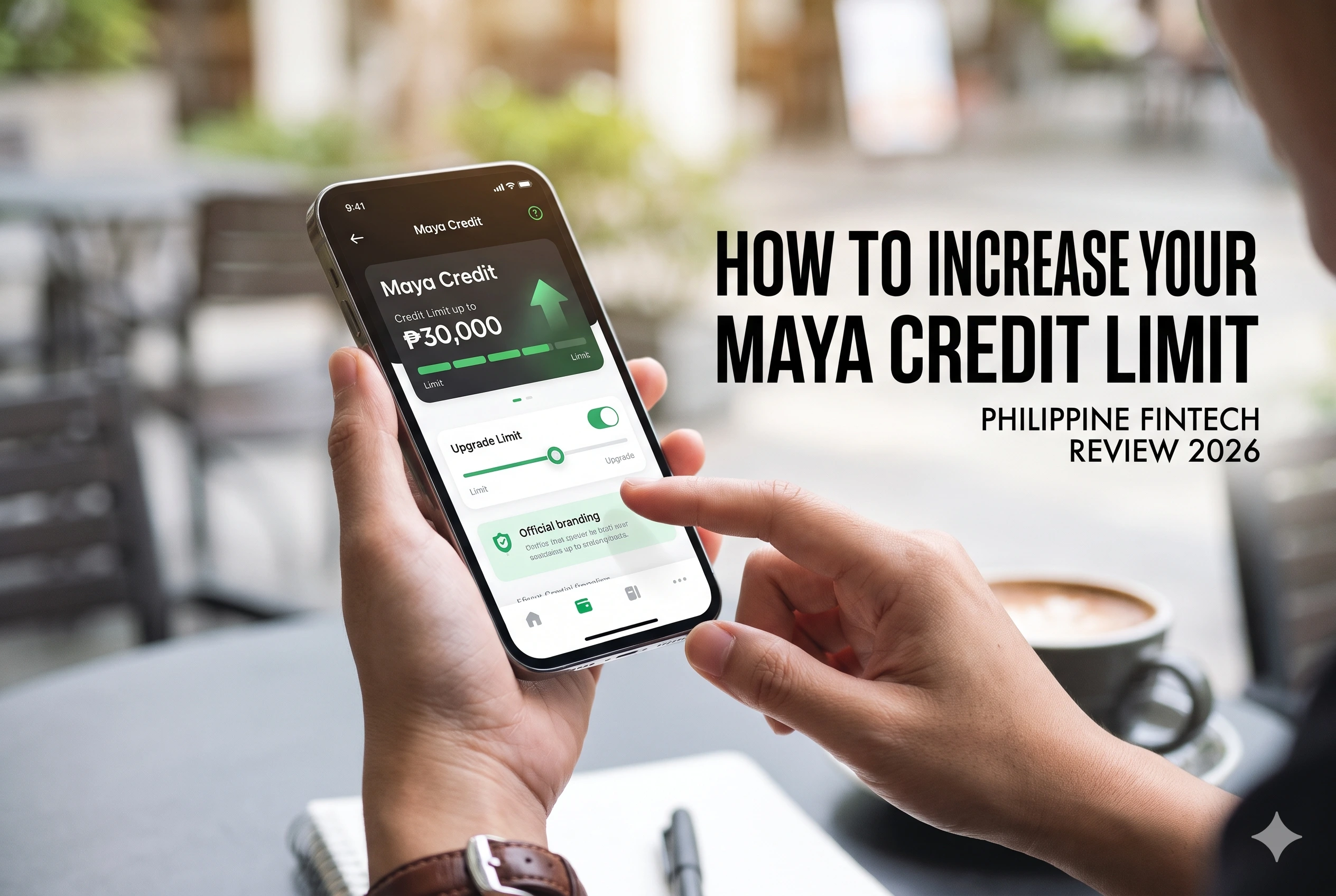
For many Filipino borrowers, opening a Maya Credit account begins with a sense of restriction. After completing the initial account upgrade and providing identification, users often find themselves assigned a starting credit limit of just ₱500 to ₱2,000. Because the platform prominently advertises a maximum ceiling of up to ₱30,000, borrowers frequently search for ways to manually request a credit limit increase. However, unlocking higher purchasing power within the app requires understanding how digital banks evaluate borrower risk behind the scenes.
This review investigates how Maya Bank determines its credit limits, what behaviors actually trigger an algorithm-driven increase, and the financial risks borrowers must consider before utilizing a higher credit line.
Maya Credit is a legitimate virtual credit line provided by the BSP-licensed Maya Bank, Inc., offering limits up to ₱30,000. Unlike traditional credit cards, borrowers cannot manually request a limit increase. Instead, the platform automatically adjusts limits based on an algorithmic evaluation of user behavior, such as consistent bill payments, Maya Savings deposits, and timely loan repayments. While securing a higher limit provides valuable financial flexibility during emergencies, borrowers must account for monthly interest rates of up to 3.95% and per-transaction service fees. Because it is a short-term credit line rather than a long-term installment loan, maximizing a high limit without a clear repayment plan can quickly lead to expensive late fees and negative credit reporting.
| Borrower question | Current finding | Why it matters |
| Legal Operator | Maya Bank, Inc. (BSP-licensed digital bank) | Ensures regulatory oversight, standardized terms, and official CIC credit reporting. |
| Advertised Limit | Up to ₱30,000 | Most first-time users receive starting limits under ₱2,000; the ceiling is reserved for established users. |
| Limit Increase Method | Automated algorithm | Borrowers cannot request an increase via customer support; upgrades rely purely on app usage and payment behavior. |
| Interest Rate | Up to 3.95% per month | Accrues based on the billing cycle. Rates vary per user based on internal credit scoring. |
| Service Fees | Applied per wallet transfer | Increases the effective cost of borrowing beyond the nominal interest rate. |
| Credit Reporting | CIC integrated | Late payments will negatively affect your national credit record, impacting future bank loan applications. |
Is Maya Credit legitimate and properly authorized in the Philippines?
Yes. Maya Credit is a legitimate financial product operated by Maya Bank, Inc., a digital bank fully licensed and supervised by the Bangko Sentral ng Pilipinas (BSP). This establishes a clear legal operator that is subject to Philippine banking regulations and consumer protection laws.
When analyzing online lending applications, it is critical to distinguish between the consumer-facing app and the legal lending entity. The Maya application itself serves as a digital ecosystem. Its e-wallet functions (formerly PayMaya) are operated by PayMaya Philippines, Inc., which holds an Electronic Money Issuer (EMI) license. However, the lending products – including Maya Credit and Maya Personal Loan – are issued by Maya Bank, Inc., a distinct entity holding a digital banking license from the BSP.
This distinction means that Maya Credit is not an unregulated fast-cash app. It operates under standard banking guidelines regarding truth in lending, debt collection practices, and data privacy.
How does the Maya Credit limit increase actually work?
Maya does not offer a manual application or customer service request for credit limit increases. The platform relies entirely on an automated algorithm that reviews your financial behavior, usage frequency, and repayment history within the Maya ecosystem to adjust limits periodically.
Many traditional credit card issuers allow cardholders to call customer service or submit updated income documents to request a limit increase. Maya Credit does not operate this way. The platform utilizes proprietary alternative credit scoring models to assess risk.
The role of the Maya ecosystem
According to the platform’s public guidelines, the algorithm evaluates how deeply integrated a user is into the Maya ecosystem. Activities that generate positive data points for the algorithm generally include:
- Using the Maya wallet to pay utility bills.
- Cashing in regularly through linked bank accounts or partner outlets.
- Paying via Maya QR at retail merchants.
- Maintaining a growing balance in Maya Savings.
- Purchasing mobile load or data packages through the app.
Borrowers who use Maya merely as a pass-through account – cashing in and immediately transferring the exact same amount to another bank – build less internal credibility than those who hold funds and transact natively within the app.
Repayment consistency
The most critical factor in retaining or increasing a credit limit is repayment history. Paying the Maya Credit balance in full on or before the due date signals reliability to the algorithm. Conversely, paying only a fraction of the balance or paying after the billing deadline will severely damage internal scoring, often resulting in an immediate limit reduction or account suspension.
What limits are advertised versus what users actually receive?
While Maya advertises a maximum credit limit of up to ₱30,000, new borrowers typically receive starting limits between ₱500 and ₱2,000. Reaching the maximum ceiling usually requires months of consistent, high-volume transactions and spotless repayment records.
A common point of friction among new users is the disparity between marketing materials and underwriting reality. The “up to ₱30,000” claim represents the ceiling of the specific product tier, not the standard approval amount.
Maya Bank does not publicly disclose its exact internal scoring formulas. However, the initial limit is largely determined by the user’s transaction history prior to activating Maya Credit. An individual who has used the Maya e-wallet extensively for two years before activating the credit line is likely to receive a higher initial limit than someone who downloaded the app yesterday and immediately applied for credit.
What does using an increased Maya Credit limit really cost?
A higher limit means higher potential costs. Maya Credit charges a monthly interest rate of up to 3.95% and often applies a service fee per transaction. Borrowers repaying a fully maxed ₱10,000 limit will pay hundreds of pesos in combined fees and interest.
Borrowers actively trying to increase their credit limit must recognize that using that higher limit comes with substantial financing costs. The exact interest rate is personalized; some highly rated users receive rates lower than the maximum 3.95% per month, but many remain at the upper threshold.
When evaluating the cost, borrowers must calculate both interest and transaction fees. When a user transfers funds from their Maya Credit line to their Maya Wallet for cash withdrawal or general spending, the platform applies a service fee. This fee is added to the principal and interest on the next billing statement.
If a borrower transfers ₱5,000 to their wallet and their specific account carries a 5% service fee and a 3.95% interest rate, the actual cost of that borrowing involves both the immediate deduction of the fee and the interest applied to the total outstanding balance. Therefore, utilizing a newly increased ₱30,000 limit for non-essential purchases will result in significant monthly carrying costs.
What happens if you pay a larger credit limit late?
Failing to repay Maya Credit on time triggers daily late penalty fees on the overdue principal. Because Maya Bank is a regulated entity, delinquent accounts are reported to the Credit Information Corporation (CIC), which will damage your ability to secure future bank loans.
The consequences of default scale with the size of the limit. A borrower who defaults on a ₱1,000 limit faces absolute penalties that are mathematically small, even if the percentage is high. A borrower who defaults on a maxed-out ₱30,000 limit faces rapidly compounding daily late fees.
According to Maya Bank’s published terms, late payments incur a penalty fee calculated daily based on the overdue principal. More importantly, as a BSP-regulated digital bank, Maya is mandated to submit borrower credit data to the CIC. A late payment on a Maya Credit line carries the same weight on a national credit report as a late payment on a traditional bank loan or credit card. It will be visible to other banks, auto lenders, and mortgage providers.
What are borrowers saying about Maya limit adjustments?
Recent borrower discussions indicate that Maya’s limit adjustments can be unpredictable. While many users report gradual increases after heavy app usage, others report sudden limit decreases or account freezing if their transaction volume drops or if they miss a single payment.
An analysis of recent feedback on community forums and app store reviews reveals clear patterns in how Filipino borrowers experience Maya Credit’s algorithmic underwriting.
Positive patterns frequently highlight the convenience of having a standby emergency fund. Users who use Maya as their primary daily financial application often report their limits increasing in increments of ₱1,000 to ₱3,000 every few months.
Negative patterns heavily focus on the opacity of the algorithm. Several users report that after paying off a large balance, their limit was unexpectedly reduced rather than increased. Others note that failing to use the app for a few months resulted in their credit line being suspended. This anecdotal evidence underscores that an assigned credit limit is not permanent; Maya Bank reserves the right to reduce or revoke the credit line at any time based on ongoing risk assessments.
Pros and Cons of relying on Maya Credit
Based on the product disclosures and regulatory structure, borrowers should weigh the following attributes:
Potential Advantages:
- Regulated by the BSP, ensuring standardized consumer protections and transparent fee disclosures.
- Funds are disbursed instantly to the Maya Wallet, providing immediate liquidity during emergencies.
- Integrates seamlessly with the Credit Information Corporation, allowing responsible users to build a formal national credit history.
- Does not require traditional income documents or employment certificates to establish an initial line.
Potential Disadvantages:
- Interest rates of up to 3.95% per month are expensive when annualized, particularly for large limits.
- Service fees on wallet transfers reduce the net efficiency of the loan.
- Algorithmic underwriting means limits can be reduced without warning, making it unreliable as a guaranteed emergency net.
- Borrowers cannot appeal or manually request a limit review if they experience a sudden financial need.
What should you check before maximizing your Maya Credit limit?
Before utilizing a newly increased limit, verify your exact assigned interest rate, the per-transaction service fee, and your exact billing date. Confirm that your expected income aligns with the single-payment schedule, as this is a short-term credit line, not an installment loan.
When a limit increases from ₱2,000 to ₱15,000, the borrower’s risk profile changes dramatically. Maya Credit typically requires the outstanding balance to be paid in full by the due date. It does not automatically convert large balances into multi-month installment plans.
If a borrower uses ₱15,000 from their credit line, they must ensure they have at least ₱15,000 (plus applicable interest and fees) available in cash before the next billing cycle ends. Using a high limit without the immediate liquidity to repay it will force the account into delinquency.
Frequently Asked Questions
Can I request a Maya Credit limit increase through customer service? No. Maya Bank’s customer support agents do not have the authority to manually increase your credit limit. The process is entirely system-driven based on your transaction history.
Does paying my loan early guarantee a limit increase? No. While paying on time is required to maintain good standing, early repayment is only one factor in the algorithm. Transaction volume, savings behavior, and frequency of app usage also play critical roles.
Why did my Maya Credit limit suddenly decrease? Limits can decrease if the algorithm detects higher risk. Common triggers include late payments on previous bills, a significant drop in overall Maya app usage, withdrawing all funds from Maya Savings, or changes in internal credit-scoring policies.
Does Maya require income documents for a limit upgrade? For the standard Maya Credit product, limit upgrades are based on app behavior rather than submitted payslips or tax returns. However, Maya does offer a separate “Maya Personal Loan” product for larger amounts, which may involve different underwriting criteria.
Conclusion
Increasing a Maya Credit limit in 2026 requires patience, financial discipline, and a willingness to adopt the Maya ecosystem for daily transactions. Because the system is automated, borrowers must prove their reliability through consistent bill payments, savings deposits, and timely debt settlement rather than by submitting documents or calling support.
However, borrowers should ask themselves whether reaching the ₱30,000 ceiling is actually in their best financial interest. While having an available credit line provides security, the combination of up to 3.95% monthly interest and transfer service fees makes Maya Credit an expensive tool for large, sustained borrowing. It is best utilized as a strict emergency fund that is repaid in full at the end of the billing cycle. Borrowers requiring larger amounts with longer repayment horizons should explore formal installment loans rather than maximizing short-term virtual credit lines.
References
- Bangko Sentral ng Pilipinas Organization: Bangko Sentral ng Pilipinas Resource: Directory of Digital Banks. URL: https://www.bsp.gov.ph/SitePages/FinancialStability/DirBanksFIList.aspx
- Maya Bank, Inc. Organization: Maya Resource: Maya Credit Terms and Conditions. URL: https://www.maya.ph/credit/terms-and-conditions
- Credit Information Corporation Organization: Credit Information Corporation Philippines Resource: List of Accessing Entities. URL: https://www.creditinfo.gov.ph/list-accessing-entities