Last Updated on 09/09/2026 by Nicole Alba
If you reached this page after receiving a “pre-approved,” “approved,” or “ready to disburse” message from LoanOnline PH, you probably want a much simpler answer than the marketing gives you: Who is actually lending the money, what will it cost, and who is responsible if something goes wrong?
Those are the right questions.
LoanOnline.ph is not a direct lender. Its own current terms describe the service as an intermediary that receives and compares credit offers from banks and lenders. This distinction matters because approval, interest, disbursement, repayment and debt collection may come from a third-party provider rather than LoanOnline itself.
If you already owe money and are frightened by collection messages, remember one important legal point: ordinary contractual debt does not automatically send a borrower to jail. Article III, Section 20 of the Philippine Constitution states that no person shall be imprisoned for debt. That does not erase the debt or prevent a creditor from pursuing lawful civil remedies, and separate criminal conduct is a different matter.
| Question | What I verified | Borrower risk |
|---|---|---|
| Is LoanOnline.ph the lender? | No. It says it is an intermediary/comparison platform. | Approval, fees and collections may come from another company. |
| Who operates it? | Website terms name SIA JEFF, Latvia; current mobile listings name FinMerkado Inc. | Operator disclosure is not perfectly aligned across channels. |
| Is approval guaranteed? | No. Partner lenders make the lending decision. | Marketing messages should not be treated as final approval. |
| Are complaints visible? | Yes, but the public sample is limited. Common themes involve follow-up emails, redirects and rejection after promotional offers. | Complaint evidence should be read cautiously rather than treated as statistical proof. |
| Does LoanOnline charge a comparison fee? | The website says the comparison service is free. | The matched lender can still charge interest and permitted fees. |
| Are rates easy to compare? | Not always. Several current pages publish different ranges and examples. | Check the lender’s disclosure statement, not only LoanOnline marketing. |
| Is personal data shared? | Website terms allow data transfer to lenders and partners for matching and financial offers. | Do not provide more information than needed before knowing who receives it. |
| Is there a safer app-install route? | Yes. Official Google Play and Apple App Store listings now exist. | Avoid sideloading an APK when an official store version is available. |
| Should you use it? | Only as a comparison starting point, not as proof that a loan is safe or approved. | Independently verify the actual creditor with the SEC or BSP. |
Is LoanOnline PH a real lender or only a loan comparison service?
LoanOnline PH does not lend its own money. It describes itself as an intermediary connecting users with third-party lenders and financial service providers. The loan agreement, if you accept one, is supposed to be between you and the provider making the offer.
That distinction changes how I assess the service.
A direct lending app normally controls underwriting, approves the loan, establishes the contract, sends the proceeds and collects repayment. A marketplace sits earlier in the funnel. It acquires a potential borrower, gathers or evaluates information, matches that person to one or several providers, and may earn a referral or commercial fee from its partners.
LoanOnline’s current website describes exactly that type of model. Its terms say personal information may be transferred to lenders and third parties involved in verification, evaluation and connecting the user to other suitable financial offers. The terms also say users may be contacted by lenders or partners in the LoanOnline partner network.
That means a borrower should never ask only:
“Is LoanOnline legit?”
The more useful question is:
“Which company is giving me this specific loan, and is that company authorized to lend?”
What did I find when I checked the LoanOnline PH application flow myself?
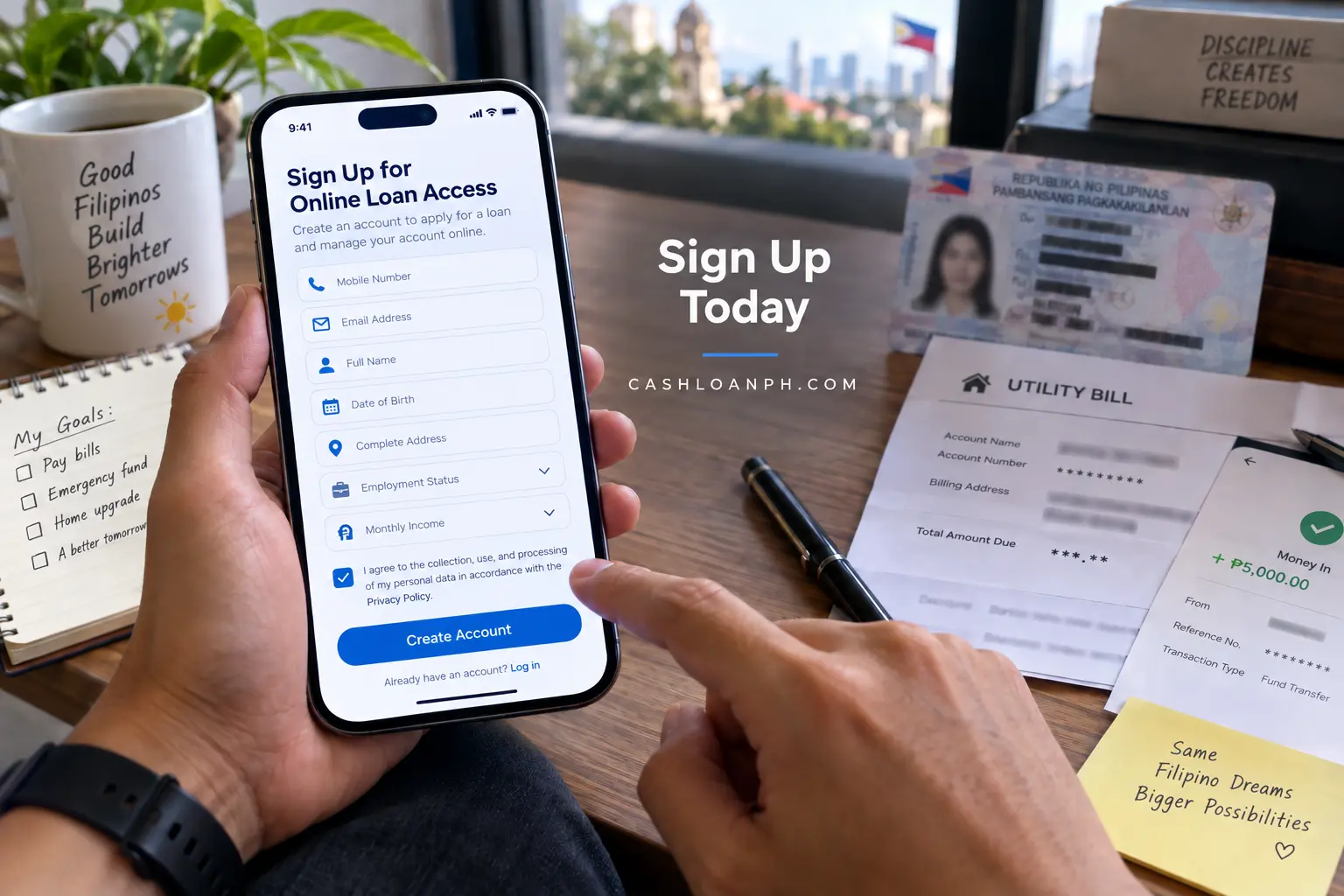
The public web flow currently starts with a simple identity check asking for a Philippine mobile number and email address, followed by acceptance of the Terms and Privacy Policy. I stopped before entering personal information or submitting an application.
That limitation is intentional. Claiming that “our team borrowed successfully” without actually taking a regulated financial product would weaken this review.
What does the current LoanOnline.ph registration screen actually ask for?
The first visible registration screen asks for a mobile number, email address and consent to the Terms and Privacy Policy before the user can continue. It does not display a final lender, final APR, final repayment amount or binding approval on that first screen.
This is an important friction point for borrowers under pressure.
Someone trying to find ₱5,000 for groceries or medicine may see a large loan button and assume they are beginning one particular loan application. Operationally, they may instead be entering a lead-matching funnel.
That is not automatically improper. Financial marketplaces use referral models throughout the industry. The problem begins when a distressed borrower cannot easily tell where the marketplace ends and where the creditor begins.
What changed in the LoanOnline mobile apps during 2026?
The current mobile-store descriptions position LoanOnline more clearly as an independent comparison tool, and the August 2026 iOS version notes say the product was rebuilt so users can compare offers before continuing to a lender’s official channel.
This is one of the biggest changes I found.
The Apple listing says users can browse loan information without giving account or personal details, then move to a lender’s own channel if they want to apply. The Google Play listing, updated September 5, 2026, similarly describes LoanOnline as an informational comparison tool rather than an entity that provides cash or guarantees approval.
Yet parts of the website still use older language such as “apply once” and receiving multiple offers through one application. The website privacy policy also describes fairly broad collection and transfer of financial, employment and personal information.
For borrowers, this means the experience may depend on whether you are using the current app or the older web funnel.
That difference should be communicated more clearly.
What are borrowers actually complaining about with LoanOnline PH?
The complaints I found are mainly about promotional messaging, rejection after apparent offers, redirects and repeated follow-up communication—not verified evidence that LoanOnline.ph itself is conducting abusive debt collection. Public complaint data is still too small to calculate a meaningful complaint rate.
Why do some users say they were “approved” but later rejected?
At least one App Store reviewer complained that LoanOnline kept presenting loan offers or messaging suggesting money was ready, only for the application to be rejected later. That pattern is consistent with a marketplace where a marketing or eligibility signal is not the same as final lender underwriting.
This is a common source of anger in digital lending.
A borrower interprets:
- “You may qualify”
- “Pre-approved”
- “Loan offer available”
- “Amount ready”
- “Eligible up to ₱X”
as:
“I have been approved.”
But those statements may mean only that a profile passed a preliminary matching rule. The lender can still reject the application after identity verification, fraud screening, employment checks, device-risk analysis, credit bureau data or internal affordability scoring.
For gig workers, freelancers and irregular-income borrowers, the friction can be worse. A monthly income number entered into a form does not necessarily prove recurring cash flow. A lender may inspect transaction history, employment tenure, repayment history or other lawful risk indicators before issuing a final decision.
LoanOnline should therefore avoid promotional wording that can be reasonably confused with final credit approval.
Why do some users complain about repeated emails or too many redirects?
A 2026 Reddit user described abandoning the LoanOnline.ph process after encountering repeated advertising or redirects, then receiving several emails referring to pre-approved or approved amounts. This is anecdotal evidence from one user, not a regulator finding, but it aligns with the site’s terms permitting marketing communications and partner contact.
This is where the platform’s business model matters.
Loan comparison services make money when a user reaches a financial provider. That creates an economic incentive to keep presenting alternative providers when one option fails.
From the borrower’s side, however, repeated matching can feel like:
Apply → redirect → decline → new offer → another form → another message → another lender.
That is tiring when the person needs cash immediately.
My practical rule is simple: after one or two unsuccessful applications, stop. Do not submit the same ID, income details and mobile number to six unfamiliar lenders in one evening simply because every decline generates another “recommended” offer.
Have I found evidence that LoanOnline PH itself harasses borrowers?
I did not find authoritative evidence showing that LoanOnline.ph itself is a debt collector engaging in contact-list harassment or public shaming. That distinction matters because LoanOnline says it is not the creditor.
The Philippine online lending sector has a documented history of harassment and misuse of personal information, but regulators have repeatedly warned against attributing misconduct loosely without identifying the responsible company.
The NPC’s 2026 joint advisory with the DICT and SEC reiterates that unnecessary permissions and unauthorized or disproportionate processing of borrowers’ contact lists are prohibited. Earlier NPC enforcement actions also documented cases where other online lenders used contacts or personal data for harassment and public shaming.
If harassment begins after using LoanOnline, capture the name of the actual lender or collection agency appearing in the loan agreement, SMS, email, payment instructions or demand notice.
That name is more important than the comparison site through which you first found the loan.
Is LoanOnline PH SEC registered and licensed to lend money?
Do not look for a LoanOnline.ph lending license as though it were the creditor, because the platform says it does not lend. Instead, verify the specific financing company, lending company or bank behind each offer.
This distinction is frequently missed in online reviews.
FinMerkado’s own Philippine website states that FinMerkado Inc. is SEC registered and publishes a corporate registration number. Yet corporate registration is not the same thing as a Certificate of Authority to operate as a lending or financing company. FinMerkado also describes itself as a comparison platform rather than a lender.
There is another trap: historical SEC lists contain an online lending platform called “LoanOnline” associated with Sunprime Finance Inc. That does not, by itself, prove that the old SEC-listed LoanOnline brand is the same entity as the present loanonline.ph service operated or developed under the disclosures discussed in this review. Brand names can collide.
Never verify a lender from the app name alone.
How should you verify the lender behind a LoanOnline offer?
Match the legal company name in the loan agreement against current SEC records before accepting a non-bank loan. If the provider is a BSP-supervised bank or financial institution, verify it through the appropriate BSP channels.
Use this sequence:
- Write down the exact legal creditor name.
- Identify its SEC registration details if it is a lending or financing company.
- Confirm that it has the appropriate Certificate of Authority.
- For an online lending operation, verify the platform or digital channel against applicable SEC records.
- Compare the company named in the contract with the company receiving repayment.
- Do not send an “unlocking,” “processing,” “insurance” or “verification” fee merely to release a promised loan.
The SEC itself advises borrowers to verify the lending/financing company and online lending platform, read the agreement carefully and beware of advance-fee scams.
Which regulator should receive a LoanOnline-related complaint?
The correct complaint channel depends on what went wrong and which entity caused the problem. SEC issues generally involve SEC-regulated lending and financing companies; BSP channels apply to BSP-supervised institutions; NPC handles personal-data rights; DTI may handle appropriate consumer and online-commercial concerns.
For example:
- Harassment by an SEC-regulated lender: document the collector and raise the issue with the lender and SEC.
- Unauthorized use of contacts or personal information: consider an NPC complaint.
- Bank-related financial consumer issue: use the bank’s internal complaint process and applicable BSP consumer channels.
- Misleading general online commercial representations: DTI maintains consumer complaint and online dispute-resolution systems, subject to agency jurisdiction.
Do not send your full ID, OTP, PIN or online banking password to someone merely claiming to be a “regulator” helping with a complaint.
Are LoanOnline PH interest rates and loan costs transparent enough?
Not consistently. LoanOnline publishes cost disclosures, but its current pages show materially different loan ranges and product examples, so borrowers should treat website numbers as indicative rather than contractual.
For example, different current pages refer to:
- a limit around ₱25,000 on the main page;
- borrowing up to ₱30,000 on another loan page;
- a separate Philippine landing page showing much larger ranges and longer terms;
- a footer disclosure advertising partner APRs from 0% up to 427% and repayment periods of 91–180 days.
Those figures may represent different lender categories, but the site does not make the segmentation easy enough for a borrower rushing through an emergency application.
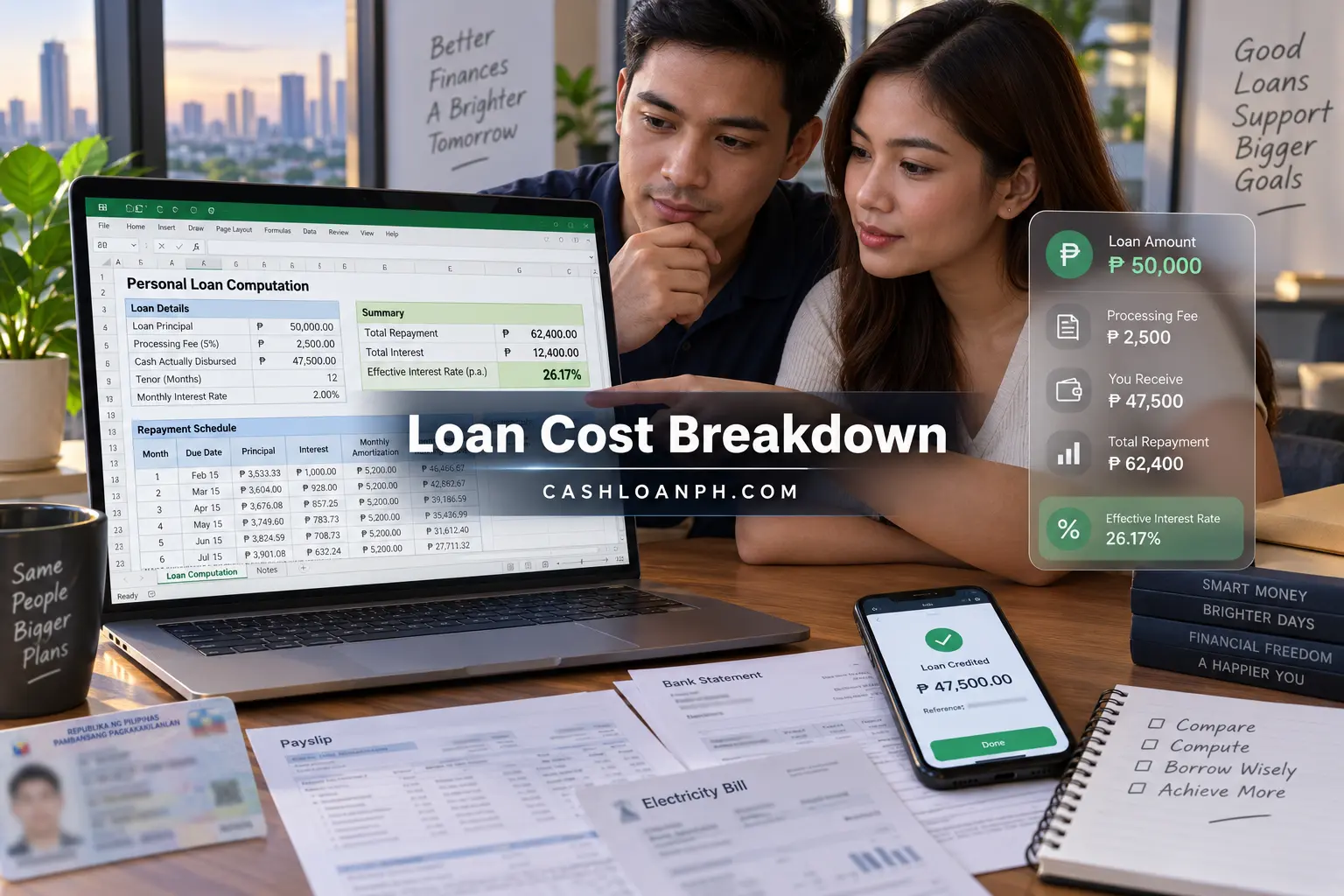
There is also a worked example in the current footer that deserves scrutiny. It refers to a ₱20,000 loan, a six-month period, a ₱5,000 monthly payment, a separate “total cost” figure of ₱2,383 per month and a 143% APR. Those numbers are not intuitively reconcilable from the disclosure as written.
A good financial disclosure should let an ordinary borrower answer three questions instantly:
How much cash reaches my account? How much do I pay in total? On what dates do I pay it?
If you cannot answer those three questions, do not press Accept.
Does the 2026 Philippine interest-rate cap apply to every LoanOnline offer?
No. The current small-loan ceilings apply only to specified categories of loans, not every personal loan advertised through a comparison platform.
This is where many online reviews make a serious analytical mistake.
For covered unsecured, general-purpose loans of ₱10,000 or less with a tenor of up to four months, SEC Memorandum Circular No. 14, Series of 2025 applies to covered loans entered into, restructured or renewed from April 1, 2026. Reported ceilings include:
- nominal interest: 6% per month;
- effective interest rate: 12% per month;
- late-payment penalty: 5% per month on the outstanding scheduled amount due;
- total cost cap: interest, fees, charges and penalties cannot exceed 100% of the amount borrowed.
The earlier framework used a 15% monthly EIR ceiling for the same general small-loan category. The 2026 recalibration lowered that EIR limit to 12% for covered transactions.
A ₱20,000 six-month product is not automatically judged under the same small-loan ceiling because it exceeds both the ₱10,000 amount threshold and four-month tenor.
This is why saying “427% APR is illegal” merely from LoanOnline’s footer would be reckless. You first need the actual creditor, principal, tenor, fees, EIR and contract date.
Is installing the LoanOnline APK from the website a good idea in 2026?
I would prefer the official Google Play or Apple App Store version over sideloading an APK. LoanOnline’s website still instructs Android users to enable installation from unknown sources, while an official Google Play listing now exists.
Enabling “unknown sources” is not proof that an APK is malicious. Many legitimate companies distribute Android apps outside Google Play.
It does, however, bypass some of the protection and update mechanisms users normally receive through the official store.
Since the current Google Play listing was updated on September 5, 2026, I see little borrower benefit in taking the extra sideloading risk unless LoanOnline provides a specific technical reason and a verifiable package source.
Should the difference between SIA JEFF and FinMerkado Inc concern borrowers?
It deserves clarification before you share sensitive financial data, although the mismatch alone does not prove misconduct. The web terms identify SIA JEFF in Latvia, while current iOS and Android listings identify FinMerkado Inc.
There may be a perfectly ordinary corporate explanation—such as a change in operating entity, local subsidiary, developer arrangement or platform migration.
What I do not like is making borrowers piece that explanation together themselves.
The privacy policy still describes the SIA JEFF Group and says some personal information may be shared with banks, lenders and other financial service providers. Apple identifies the current app developer as FinMerkado Inc., and Google Play shows the developer as FinMerkado Inc. with a Philippine address.
For a financial product, the privacy notice, terms, app-store developer identity and customer-support identity should tell one coherent story.
That is an area where LoanOnline could improve trust.
How should you protect yourself before using LoanOnline PH?
Treat LoanOnline as the start of your comparison process, not the end of your due diligence. Never let urgent cash needs turn a marketing match into an automatic borrowing decision.
Before accepting any offer:
- Save a screenshot showing the principal, cash actually released, fees, EIR, payment dates and total repayment.
- Confirm the legal lender name before uploading more IDs or financial documents.
- Read the lender’s privacy notice rather than assuming LoanOnline’s policy governs the lender.
- Never provide OTPs, PINs, passwords or full e-wallet credentials.
- Reject unnecessary access to contacts, photos or social-media accounts.
- Avoid advance-payment demands supposedly required to “unlock” your approved loan.
- Compare the peso amount you will repay, not only a daily or monthly percentage.
- If the app displays one figure but the contract contains another, stop before confirming disbursement.
The NPC, SEC and DICT reiterated in March 2026 that unnecessary permissions and excessive processing of personal information—including disproportionate contact-list access—are prohibited in loan-related transactions.
What should you do if LoanOnline keeps emailing or messaging you?
Use the platform’s support and data-rights channels first, keep evidence of your request, and escalate to the relevant regulator if unlawful processing continues.
LoanOnline’s support page currently includes options covering account/data deletion, stopping messages and suspicious or spam communications. Its privacy policy also describes rights relating to access, correction, withdrawal or blocking of personal information subject to legal limitations.
Take screenshots before unsubscribing or deleting anything.
Save:
- the sender address;
- timestamp;
- exact wording of “approved” or “pre-approved” claims;
- lender name;
- links in the message;
- screenshots of consent settings;
- your written request to stop marketing.
Those details are far more useful in a complaint than saying, “They keep spamming me.”
What should you do if you received money without clearly accepting a loan?
Do not spend the money while you are disputing the transaction, and identify the company that actually sent it. A marketplace referral and a lender disbursement are different events.
Some borrowers online describe cases involving third-party lenders they reached through comparison sites where the final amount or disbursement surprised them. Such anecdotes must be attributed to the lender involved rather than automatically blamed on the marketplace.
If this happens, save:
- the contract;
- application timeline;
- confirmation screens;
- amount supposedly approved;
- amount actually received;
- fees deducted;
- GCash or bank transaction reference;
- emails and SMS;
- lender’s corporate name.
Ask the lender in writing how to reverse or settle a disputed disbursement without accepting unagreed charges.
Do not transfer funds to a random personal GCash account because someone on Telegram or Messenger claims to be an “account officer.”
Is LoanOnline PH safe enough to use in 2026?
My assessment is “use with caution,” not “automatic scam” and not “fully verified safe lender.” LoanOnline has real, active comparison services and current app-store listings, but borrowers still need to resolve lender identity, data-sharing and final-cost questions before committing.
What I like is the newer app positioning: comparing first and continuing to the lender separately can give borrowers more control.
What lowers my confidence is the inconsistency between the current app model and older website funnel, the SIA JEFF versus FinMerkado disclosures, conflicting product ranges, and borrower complaints about promotional offers that did not translate into approval.
Most importantly, LoanOnline is not where your due diligence should stop.
The creditor’s legal identity, SEC/BSP status, contract and final EIR matter more than the comparison site’s logo.
Should you use LoanOnline PH if you urgently need money?
Use it only if comparing options will help you make a cheaper, safer decision—not because a message creates pressure to borrow immediately. A decline is frustrating, but repeatedly applying to unfamiliar providers can expose more personal data while making your debt problem harder.
If your current repayment commitments already consume the money needed for rent, food, transport, medicine or utilities, another high-cost short-term loan may solve this week’s shortage by creating next month’s emergency.
For someone already caught in a tapal cycle—borrowing from one lender to repay another—the better financial move may be to stop new applications, list every balance and due date, contact legitimate creditors about restructuring where available, and prioritize essential expenses.
LoanOnline may be useful as a comparison tool.
It should never replace your own affordability check.
References
- LoanOnline.ph Terms and Conditions
Organization: LoanOnline.ph / SIA JEFF
Resource: Terms and Conditions
URL: LoanOnline.ph Terms and Conditions - LoanOnline.ph Privacy Policy
Organization: LoanOnline.ph / SIA JEFF
Resource: Privacy Policy
URL: LoanOnline.ph Privacy Policy - Securities and Exchange Commission Philippines
Organization: Securities and Exchange Commission
Resource: Lending and Financing Company Advisories and 2026 OLP Regulatory Updates
URL: SEC Lending and Financing Company Advisories - Securities and Exchange Commission Philippines
Organization: Securities and Exchange Commission
Resource: SEC Memorandum Circular No. 20, Series of 2026 — Online Lending Platform Framework
URL: SEC Philippines - Bangko Sentral ng Pilipinas
Organization: Bangko Sentral ng Pilipinas
Resource: Circular No. 1133 — Ceilings on Interest Rates and Other Fees
URL: BSP Circular No. 1133 - National Privacy Commission
Organization: NPC, DICT and SEC
Resource: 2026 Public Advisory on Online Lending Platforms
URL: 2026 Joint Advisory on Online Lending Platforms - Department of Trade and Industry
Organization: DTI Philippines
Resource: Consumer Complaints Assistance and Resolution System
URL: DTI Consumer CARe System - Google Play
Organization: Google / FinMerkado Inc.
Resource: LoanOnline: Compare Peso Loans
URL: LoanOnline on Google Play - Apple App Store Philippines
Organization: Apple / FinMerkado Inc.
Resource: LoanOnline: Peso Loan Online
URL: LoanOnline on the Philippine App Store - The LawPhil Project
Organization: Arellano Law Foundation
Resource: 1987 Constitution of the Republic of the Philippines, Article III, Section 20
URL: 1987 Philippine Constitution
Editorial disclosure: This review was researched using public website flows, current official platform disclosures, regulator materials, app-store information and clearly identified borrower reports. No live loan was accepted and no personal identity information was submitted merely to manufacture a “first-hand borrowing” claim. Borrower anecdotes are treated as reports rather than proven regulatory findings.

![Cash-Express Loan PH Review: Loan Info, Terms, Legitimacy, and Application Process [New Update]](https://cashloanph.com/wp-content/uploads/2023/10/cash-express-loan-philippines-review-cashloanph-438x246.jpg "Cash-Express Loan PH Review: Loan Info, Terms, Legitimacy, and Application Process [New Update]")