Last Updated on 17/10/2026 by Nicole Alba
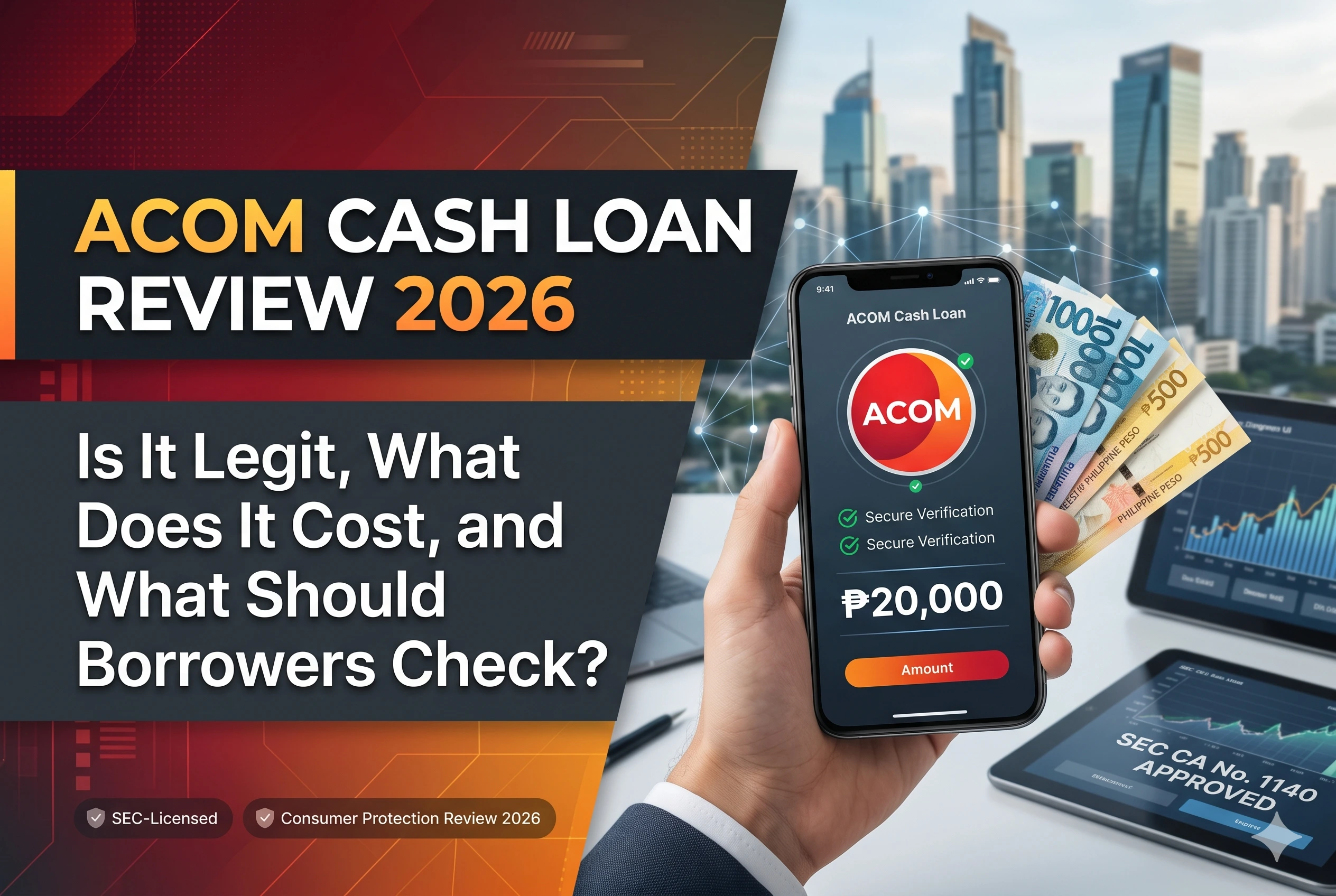
Finding a transparent cash loan in the Philippines often means navigating between illegal online lending apps and traditional banks with lengthy approval requirements. Many borrowers look toward multinational financing companies as a middle ground. ACOM, backed by one of Japan’s largest consumer finance groups, positions itself as a premium non-bank lender offering unsecured personal loans. However, the difference between an advertised maximum credit limit and the cash a first-time applicant actually receives requires careful review. This analysis examines the legal status, verified costs, underwriting friction, and collection practices associated with the ACOM cash loan in 2026.
Summary:
ACOM Consumer Finance Corporation operates legally in the Philippines as an SEC-authorized financing company. While the lender advertises unsecured cash loans up to ₱500,000, actual approvals for first-time borrowers are typically much lower, often restricted to ₱10,000 to ₱30,000 depending on verified income. The monthly interest rate ranges between 3.315% and 4.56%, placing it below predatory app rates but significantly higher than traditional bank loans. Borrowers must undergo traditional employment and income verification, meaning the application process is not instant. The product is most suitable for formally employed individuals who need a medium-term installment loan and understand the strict penalties for late repayment.
| Borrower question | Current finding | Why it matters |
| Legal operator | ACOM Consumer Finance Corporation | Confirms the borrower is dealing with a registered entity, not a fly-by-night operation. |
| Regulatory status | SEC-licensed Financing Company (CA No. 1140) | Ensures the lender is subject to the Truth in Lending Act and formal regulatory oversight. |
| Loan range | Up to ₱500,000 advertised | First-time approvals are strictly tied to verified income capacity, rarely hitting maximum limits. |
| Monthly interest | 3.315% to 4.56% | Lower than unregulated 7-day apps, but still expensive when annualized (APR exceeds 40%). |
| Approval speed | 1 to 2 business days | Manual underwriting and employer verification prevent “instant” automated approvals. |
| Disbursement | Bank transfer or e-wallet | Funds may be delayed by standard banking clearing cut-offs (PESONet/InstaPay). |
| Credit reporting | Submits data to the CIC | Late payments will negatively impact your formal Philippine credit score. |
Is ACOM a legitimate and authorized lender in the Philippines?
Yes. ACOM Consumer Finance Corporation is a legally registered entity holding an active Certificate of Authority to operate as a Financing Company from the Securities and Exchange Commission (SEC). This confirms the company operates under Philippine financial regulations, though it does not guarantee low-cost credit.
Who legally operates the ACOM app?
The consumer-facing brand is operated directly by ACOM Consumer Finance Corporation. Unlike some platforms that act merely as lead generators or brokers for third-party rural banks, ACOM funds the loans directly using its corporate capital. It is a subsidiary of ACOM Co., Ltd., a major consumer finance company based in Japan.
Regulatory status and consumer protection
Holding SEC Certificate of Authority No. 1140 means ACOM is subject to the Truth in Lending Act (Republic Act No. 3765) and the Financial Products and Services Consumer Protection Act (Republic Act No. 11765). The company is legally required to provide a clear disclosure statement detailing the exact peso amount of interest, processing fees, and net proceeds before a borrower signs the electronic contract.
How does the ACOM cash loan actually work?
The product functions as an unsecured, multi-purpose revolving personal loan. Approved borrowers receive a credit limit, can borrow up to that limit, and repay via scheduled installments. Every application requires formal income documentation and manual underwriting review.
Who can apply?
According to current public disclosures, the baseline eligibility criteria require applicants to be Filipino citizens aged 21 to 65. Unlike purely digital micro-lenders that rely solely on alternative data (like smartphone metadata), ACOM requires applicants to have stable, verifiable employment. The minimum documented monthly income requirement is typically set at ₱10,000 for regular employees.
What documents are required?
The application process requires friction that instant-approval apps avoid. Borrowers must typically provide:
- Two valid government-issued IDs.
- Proof of employment (Certificate of Employment or company ID).
- Proof of income (latest payslips or BIR Form 2316).Self-employed individuals face stricter documentary requirements, including DTI or SEC registration, recent bank statements, and audited financial statements.
How much can you realistically borrow from ACOM?
While ACOM heavily markets a maximum loan limit of up to ₱500,000, new borrowers rarely qualify for this amount. First-time approvals are strictly calculated against documented monthly income, typically resulting in initial offers between ₱10,000 and ₱30,000.
Advertised limits versus underwriting reality
The ₱500,000 ceiling applies almost exclusively to high-income earners with established, spotless repayment histories with the company. For standard applicants, ACOM limits the monthly amortization to a manageable percentage of their net disposable income. If an applicant earns ₱20,000 monthly, the approved principal will be constrained to ensure the monthly payment does not cause financial distress.
Revolving credit facility
Once approved, the account operates somewhat like a virtual credit card. If a borrower is approved for ₱30,000 but only withdraws ₱15,000, the remaining ₱15,000 is held as available credit. As the principal is repaid, the credit line replenishes.
What does an ACOM loan really cost?
The disclosed monthly interest rate ranges from 3.315% to 4.56%, calculated on a diminishing balance. Borrowers must also account for an upfront processing fee deducted from the approved principal, meaning the net cash received will be lower than the borrowed amount.
Interest and processing fees
A monthly rate of 4.56% translates to an Annual Percentage Rate (APR) exceeding 50%. While this is expensive compared to a traditional bank personal loan (which may range from 1.2% to 1.5% per month), it sits well below the maximum ceilings permitted by the BSP for small-value online loans. A processing fee – usually ranging from ₱500 to ₱1,000 depending on the principal – is deducted before disbursement.
Sample cost breakdown
Consider a hypothetical approved principal of ₱20,000 payable over 6 months at a 4.56% monthly rate:
- Approved Principal: ₱20,000
- Processing Fee Deduction: ₱1,000 (estimated)
- Net Cash Received: ₱19,000
- Estimated Monthly Payment: ₱3,800 to ₱4,000 (depending on exact diminishing calculation)
- Total Repayment: ~₱23,500
- Cost of Borrowing: ₱4,500 (Interest + Fees)
Borrowers must evaluate the cost based on the ₱19,000 actually received, not the ₱20,000 on paper.
How fast is ACOM’s approval and disbursement process?
Because ACOM conducts manual underwriting and employment verification, approval rarely happens on the same day. Most applicants wait 1 to 2 business days for a decision, with disbursement taking an additional 24 hours depending on banking channels.
What causes application delays?
The most common friction points reported by applicants involve employment verification. ACOM’s underwriting team routinely calls the employer’s HR department or the applicant’s office landline to confirm job status. If the HR department is unresponsive, or if the applicant provides a mobile number for the company that cannot be independently verified, the application stalls.
Disbursement channels and timing
Once the electronic contract is signed, funds are typically routed via InstaPay or PESONet to the borrower’s designated bank account or registered e-wallet (such as GCash or Maya). If the contract is signed on a Friday afternoon, banking cut-offs mean the funds might not reflect until the following Monday.
What happens if you pay late?
Late payments trigger immediate financial penalties, including a flat late fee and daily penalty interest on the overdue amount. Because ACOM is a regulated financing company, persistent default will be reported to the Credit Information Corporation (CIC).
Penalties and collection communication
According to standard financing company practices, missing a due date incurs a penalty charge – often ₱500 per late installment – plus a percentage of the unpaid principal. ACOM maintains an in-house collections department. Borrowers report that collection agents will call the applicant’s provided contact numbers promptly when a payment is missed.
Credit reporting consequences
ACOM complies with Republic Act No. 9510, the Credit Information System Act. The company submits regular borrower data – both positive and negative – to the CIC. Defaulting on an ACOM loan will damage a borrower’s formal credit report, potentially disqualifying them from future bank loans, credit cards, or housing loans (Pag-IBIG/bank mortgages). Debt nonpayment in the Philippines is a civil matter, meaning no one can be imprisoned purely for inability to pay, but the reputational damage is permanent until settled.
How does ACOM handle borrower data and privacy?
ACOM collects extensive personal, financial, and device data in accordance with the Data Privacy Act of 2012. The app requires permissions to access the camera for identity verification, but it is not authorized to scrape independent phone contact lists for harassment.
App permissions and data security
When applying through the ACOM mobile app, users must grant permissions for location data (to verify they are within the Philippines) and the camera (for selfie verification and document scanning). Unlike illegal lending apps that demand access to the user’s entire contact book to shame them during collections, ACOM’s privacy policy and SEC licensing forbid unauthorized third-party disclosure. The lender will only contact the specific character references or HR numbers explicitly provided by the applicant during underwriting.
What are Filipino borrowers saying about ACOM in 2026?
Recent borrower feedback highlights appreciation for the transparent fee structure and high limits for repeat borrowers. However, recurring complaints focus on slow customer service response times and strict underwriting procedures that reject many applicants.
Positive recurring themes
Borrowers consistently note that once a credit limit is established and the first loan is paid off, subsequent drawdowns from the revolving credit line are processed rapidly. The absence of hidden weekly fees – a common grievance with unregistered online lending apps – is frequently praised by users who prefer structured monthly amortizations.
Common points of friction
A notable pattern of frustration centers on the employer verification process. Many applicants working for smaller businesses or remote international companies face rejection because ACOM cannot verify their employment through a traditional landline. Additionally, users report that reaching live customer support regarding account lockouts or payment posting delays can take several attempts.
Should you apply for an ACOM loan?
The ACOM loan is conditionally suitable for formally employed individuals who need ₱10,000 to ₱50,000 for a medium-term expense and can absorb the 4%+ monthly interest rate without sacrificing essential living costs.
Who may find this product relevant
- Salaried employees with complete documentation (payslips, company ID).
- Borrowers who need structured monthly payments rather than a 15-day bullet repayment.
- Individuals seeking to build a positive record with the Credit Information Corporation (CIC).
- Those who have been rejected by traditional banks but want to avoid unregulated loan sharks.
Who should be especially cautious
- Freelancers or informal gig workers who lack BIR Form 2316 or formal HR departments (high risk of rejection).
- Borrowers intending to use the funds to pay off existing debt from other online lending apps.
- Applicants who need emergency cash within 2 hours, as the manual verification process cannot guarantee immediate release.
Frequently Asked Questions
Can I pay off my ACOM loan earlier than the scheduled term?
Yes. ACOM allows early settlement of the outstanding principal. However, borrowers should check the terms to see if the lender recalculates the interest down to the exact day of payment or requires a pre-termination fee to close the contract early.
Why was my approved limit much lower than I requested?
Financing companies use debt-to-income (DTI) ratios. If your documented income suggests that the monthly amortization of your requested amount would consume too much of your salary, the underwriter will counter-offer with a lower principal to reduce the risk of default.
Does ACOM contact my employer during the application?
Yes. Employer verification is a standard part of ACOM’s manual underwriting process. They typically call the company landline or HR department to verify that you are currently employed and that your stated salary bracket is accurate.
How do I confirm my monthly payment has been posted?
Payments made through authorized third-party channels (like GCash, Maya, or 7-Eleven via Dragonpay) typically take 24 to 48 hours to reflect in the ACOM system. Borrowers should always keep their payment reference numbers or transaction receipts until the app updates their outstanding balance.
What should you check before accepting an ACOM loan?
Making an informed decision requires looking past the advertised maximum credit limit and focusing on the actual contract presented upon approval. Before tapping “Accept” on the digital agreement, verify these specific details:
First, calculate the exact cash you will receive. Subtract the processing fee from the approved principal. Ensure that this net amount is sufficient to cover your financial emergency; otherwise, you risk taking on an expensive loan without actually solving your cash deficit.
Second, check the exact payment due dates. Unlike some lenders that align billing cycles with your payday, the contractual due dates may fall on days when your cash flow is restricted. Missing a payment by a single day triggers expensive penalties that quickly inflate the total cost of the debt.
Finally, assess your repayment capacity without relying on future, uncertain income. The monthly interest rate is manageable only if paid on time. If paying the monthly installment requires you to borrow from another lending app, the loan is mathematically unaffordable and should be declined.
References
- Securities and Exchange Commission (SEC) PhilippinesOrganization: Securities and Exchange Commission
Resource: List of Registered Financing Companies
URL: https://www.sec.gov.ph/lending-companies-and-financing-companies-2/list-of-financing-companies/
- ACOM Consumer Finance CorporationOrganization: ACOM Co., Ltd.
Resource: Official Philippine Product Terms and Disclosures
- Credit Information Corporation (CIC)Organization: Credit Information Corporation
Resource: Accessing Entity Registry