Last Updated on 12/10/2026 by Nicole Alba
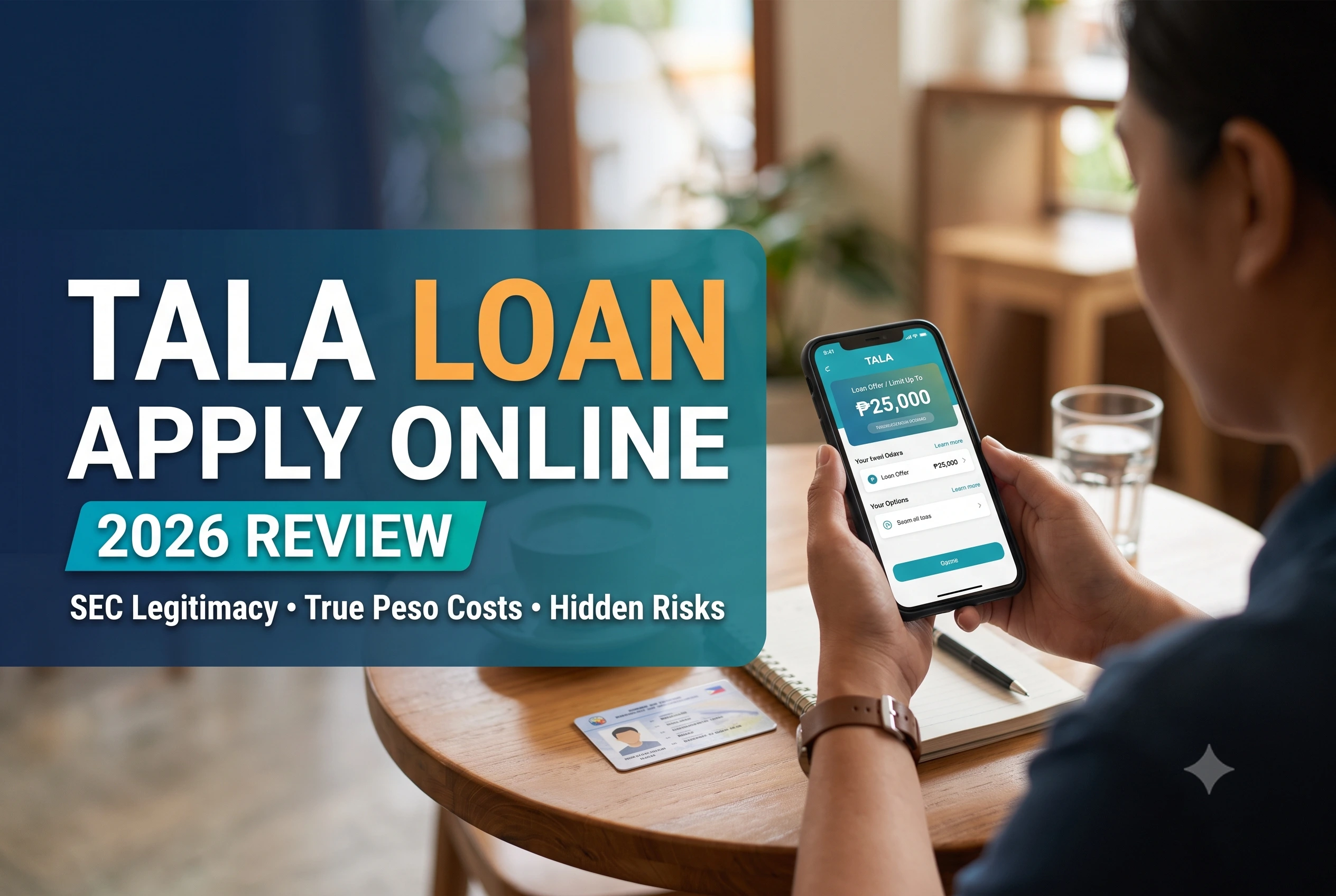
Applying for short-term credit on a smartphone often happens under time pressure, when a household bill, medical expense, or cash-flow gap cannot wait for traditional bank underwriting. That urgency is exactly why borrowers searching for how to apply for a Tala loan online in 2026 need more than a walkthrough of app screens. You need to know which legal entity actually holds your debt, how daily interest and service fees translate into actual pesos out of pocket, and whether your net payout will cover your financial need after transfer charges are deducted.
This review examines Tala’s Philippine lending structure, pricing mechanics, application friction, repayment rules, and statutory borrower protections. Because live application offers vary by individual credit profile and we did not conduct a live borrowing test for this review, our analysis relies on publicly documented corporate registrations, statutory lending caps enforced by Philippine regulators, and standard contract mechanics disclosed for the product. Where specific contract terms depend on your in-app offer sheet, we point out exactly what you must inspect before tapping accept.
| Borrower question | Current finding | Why it matters |
| Who is the legal operator? | Tala Financing Philippines Inc. (SEC Reg. No. CS201710582, CA No. 1132) | Confirms you are dealing with an identifiable, regulated financing company rather than an unregistered operator. |
| Is it supervised by the BSP? | Also registered with the Bangko Sentral ng Pilipinas as an Operator of Payment System (OPS) | OPS registration covers payment/wallet routing, while the SEC regulates its financing and lending conduct. |
| How much can you borrow? | Advertised from ₱1,000 up to ₱25,000 | First-time borrowers rarely qualify for the ₱25,000 ceiling; initial limits are strictly tiered by underwriting. |
| How is pricing structured? | Daily interest rate (tracked to your chosen repayment date) plus a one-time service fee | Choosing a longer repayment window directly increases the total peso cost of the loan. |
| How do Philippine rate caps apply? | Covered by SEC Memorandum Circular No. 3, Series of 2022 (for unsecured loans ≤ ₱10,000 and tenors ≤ 4 months) | Caps nominal interest at 6% per month (~0.2% daily) and effective rates at 15% per month (~0.5% daily) for qualifying small loans. |
| What happens if you pay late? | A one-time late fee (commonly disclosed at 5% of outstanding balance) plus potential collection calls and credit reporting | Even without compounding daily late penalties, a missed payment raises your total cost and freezes future credit access. |
| What should you check before accepting? | The pre-contract Disclosure Statement showing net proceeds vs. total amount due | Ensures third-party cash-out fees do not leave you short of the exact cash amount you need. |
Is Tala legitimate and properly authorized in the Philippines?
Yes. Tala operates legally in the Philippines through Tala Financing Philippines Inc., which holds SEC Registration No. CS201710582 and Certificate of Authority No. 1132 as a financing company. While this confirms legal authorization to lend, it does not guarantee low borrowing costs or automatic approval.
When evaluating any digital lending app in the Philippines, separating corporate marketing from regulatory licensing is the first line of defense for consumers. Many predatory apps claim to be “SEC-approved” simply because they registered a business name, without holding the specific secondary license required to issue loans.
Who legally operates the Tala app?
According to public corporate disclosures and regulatory listings, the consumer-facing Tala mobile application in the Philippines is operated by Tala Financing Philippines Inc. Under the Financing Company Act of 1998 (Republic Act No. 8556), a corporation must obtain both primary corporate registration and a secondary Certificate of Authority (CA) from the Securities and Exchange Commission (SEC) before offering credit to the public.
Tala Financing Philippines Inc. lists SEC Registration No. CS201710582 and Certificate of Authority No. 1132. In addition to its SEC licensing, the company has disclosed registration with the Bangko Sentral ng Pilipinas (BSP) as an Operator of Payment System (OPS). Borrowers should understand the legal distinction between these two regulators:
- The SEC oversees Tala’s conduct as a financing company, including its interest rate caps on qualifying small loans, truth-in-lending disclosures, and fair debt collection rules.
- The BSP oversees its payment system operations where in-app wallet, bill pay, or fund routing features are involved, rather than guaranteeing or subsidizing the underlying credit product.
Is the app itself the lender, or does it route you to third parties?
Unlike lead-generation websites or loan marketplaces that harvest your personal data and distribute it to multiple third-party lenders, Tala’s public disclosures indicate that Tala Financing Philippines Inc. acts as the direct financing entity for loans issued through its official Philippine Android and iOS applications. However, before signing any electronic promissory note in 2026, you should still inspect the header of the in-app Disclosure Statement to confirm that Tala Financing Philippines Inc. (and not an unfamiliar third-party entity) is listed as the creditor on your specific contract.
How does the Tala online loan application work in 2026?
Borrowers apply exclusively through the official Tala mobile app by registering a mobile number, completing an identity and income questionnaire, uploading a valid government ID, and submitting a live selfie. Underwriting is automated, and the lender does not publicly disclose its exact proprietary credit-scoring model.
If you are searching for a desktop web portal to submit a Tala loan application, be cautious: Tala’s loan origination is built around its mobile application, and third-party websites claiming to process Tala applications via web forms are often phishing pages or unauthorized aggregators.
Who can apply and what documents are required?
Based on standard eligibility disclosures for the platform, applicants in the Philippines must:
- Be a Filipino citizen residing in the Philippines and at least 18 years of age.
- Possess an active mobile number and a compatible smartphone capable of running the current version of the Tala app and capturing clear camera images.
- Present a valid, government-issued primary identification card. Commonly accepted IDs include the PhilSys National ID, Passport, Driver’s License, UMID, SSS ID, Postal ID, PRC ID, or Voter’s ID.
Unlike traditional bank personal loans, the application flow does not typically require physical collateral, a co-maker, or formal BIR tax returns upfront. Instead, the app relies on digital identity verification and behavioral/financial questionnaires inside the mobile interface.
How underwriting differs across borrower profiles
Because Tala does not publish its proprietary underwriting weights, no reviewer can guarantee why one applicant is approved and another is declined. However, analyzing digital credit scoring practices in the Philippines shows how the process creates different experiences depending on your profile:
- First-time borrowers with thin credit files: If you have no existing record with the Credit Information Corporation (CIC) or private credit bureaus, automated systems weigh identity verification accuracy, consistency between your stated income and occupation, and device integrity heavily. Even a minor mismatch between the spelling of your name on your government ID and your account registration can trigger an immediate automated rejection.
- Freelancers, gig workers, and self-employed applicants: Because the app does not mandate traditional corporate payslips at entry, informal earners and gig workers can apply on equal footing with salaried employees. However, irregular cash flow means you must choose your repayment date carefully so it aligns with confirmed client payouts.
- Repeat borrowers: Tala’s credit model relies heavily on internal repayment behavior. Paying on or before your chosen due date is the primary driver for unlocking higher credit limits on subsequent loans, whereas a single late payment can freeze or reduce your available credit line.
How much can you actually borrow from Tala?
While Tala advertises credit limits ranging from ₱1,000 up to ₱25,000 with flexible repayment dates between 15 and 61 days, first-time applicants almost never qualify for the ₱25,000 ceiling. Initial loan offers commonly start between ₱1,000 and ₱4,000 depending on automated risk scoring.
A common point of frustration among new applicants is the gap between headline marketing numbers and the actual figure displayed on the first approval screen.
Why first-time limits are much lower than advertised maximums
In Philippine digital lending, “up to ₱25,000” describes the ceiling of a graduated credit ladder, not an entry-level entitlement. Unsecured microloans carry high default risk on first disbursement because the lender has zero historical payment data on the applicant. Consequently, the system assigns conservative starting principals – often ₱1,000 to ₱3,000 – to test repayment discipline. Reaching the upper tiers requires multiple completed loan cycles paid on time over several months.
How the flexible repayment window works
Rather than locking every borrower into a rigid 7-day or 14-day payday cycle, Tala allows approved users to select their preferred single-payment due date within a permitted window – typically advertised as 15 to 61 days from disbursement. While choosing your own date helps align repayment with a known payday (such as the 15th or 30th of the month), it is not a free grace period: because interest is calculated daily, selecting a 45-day term costs substantially more in pesos than selecting a 20-day term.
What does a Tala loan really cost in pesos?
A Tala loan’s total cost consists of a daily interest rate (commonly disclosed starting around 0.43% per day), a one-time service fee based on the loan term, and an external cash-out fee (typically ₱15 to ₱58 depending on the channel). For loans up to ₱10,000, effective costs are subject to SEC rate caps.
Looking only at a daily percentage like “0.43% per day” makes a loan appear deceptively cheap. To make an informed financial decision, you must evaluate the Effective Interest Rate (EIR) – which combines nominal interest and mandatory processing/service fees – and translate those percentages into exact peso outflows.
Philippine regulatory rate caps: What SEC MC No. 3, Series of 2022 covers
Borrowers should know that Philippine law restricts how much financing and lending companies can charge on small, short-term consumer loans. Under SEC Memorandum Circular No. 3, Series of 2022 ( implementing BSP Monetary Board Resolution No. 1642.A), specific ceilings apply to unsecured, general-purpose loans that do not exceed ₱10,000 and have a loan tenor of up to four (4) months:
- Nominal Interest Rate Ceiling: Cannot exceed 6% per month (approximately 0.2% per day).
- Effective Interest Rate (EIR) Ceiling: Cannot exceed 15% per month (approximately 0.5% per day). The EIR includes nominal interest plus all mandatory administrative, processing, and service fees, excluding late payment penalties.
- Total Cost Cap: Total interest and fees (including late penalties) cannot exceed 100% of the total amount borrowed.
Important scope qualification: If you qualify for a loan principal above ₱10,000 (for example, a ₱15,000 or ₱25,000 repeat loan), those higher-tier loans fall outside the ₱10,000 threshold of SEC MC No. 3. Regardless of the loan size, under the Truth in Lending Act (Republic Act No. 3765), the lender is legally required to show you the exact peso breakdown of all charges before you consummate the loan.
Sample peso cost breakdown: Principal vs. Net Proceeds vs. Total Repayment
Because Tala’s pricing combines a daily rate with a one-time service fee and cash-out deductions, the easiest way to see the real impact on your wallet is through an illustrative mathematical model.
Note: The figures below are an editorial calculation demonstrating how daily pricing and cash-out fees interact under the regulatory framework. Your actual offered rate and service fee split will be itemized on your in-app Disclosure Statement.
$$\text{Total Finance Charge} = \text{Principal} \times (\text{Daily Effective Rate} \times \text{Days})$$
$$\text{Net Cash Received} = \text{Approved Principal} – \text{Cash-Out Transfer Fee}$$
| Cost Component | Illustrative 21-Day Loan (₱2,000) | Illustrative 30-Day Loan (₱3,000) | Illustrative 61-Day Loan (₱5,000) |
| Approved Principal | ₱2,000.00 | ₱3,000.00 | ₱5,000.00 |
| Assumed Effective Daily Cost (combined daily interest + service fee at 0.45%/day for illustration) | 0.45% per day (9.45% over 21 days) | 0.45% per day (13.50% over 30 days) | 0.45% per day (27.45% over 61 days) |
| Total Interest & Service Fee (Peso Cost) | ₱189.00 | ₱405.00 | ₱1,372.50 |
| Estimated Cash-Out Fee (e.g., ₱25 via e-wallet / ₱50 via remittance padala) | ₱25.00 (deducted on transfer) | ₱25.00 (deducted on transfer) | ₱50.00 (deducted on transfer) |
| Actual Net Cash Received in Hand | ₱1,975.00 | ₱2,975.00 | ₱4,950.00 |
| Total Repayment Due on Maturity | ₱2,189.00 | ₱3,405.00 | ₱6,372.50 |
| True Cost Above Net Cash Received | ₱214.00 (10.84% of net cash) | ₱430.00 (14.45% of net cash) | ₱1,422.50 (28.74% of net cash) |
Look closely at the bottom two rows of the table. If you need exactly ₱2,000 to pay an urgent hospital bill or utility disconnection notice and a ₱25 cash-out fee is deducted from the disbursement, you will receive ₱1,975 – leaving you ₱25 short of your emergency while still owing repayment on the full ₱2,000 principal plus finance charges. Furthermore, stretching a ₱5,000 loan out to the full 61-day window at an effective daily rate near 0.45% adds over ₱1,370 in borrowing costs.
How fast is Tala approval and cash disbursement in practice?
While automated credit decisions can appear within minutes for straightforward applications, actual cash receipt depends on identity verification quality and the settlement rails of your chosen payout channel. E-wallet transfers (GCash, Maya) typically clear faster than traditional bank transfers or over-the-counter remittance pickups.
Marketing copy across the fintech sector frequently highlights “instant” approval and cash-out. In practice, moving from application submission to spendable pesos involves two separate stages: internal underwriting review and external payment rail settlement.
Operational friction that slows down approval
Even when an app uses automated scoring, several common friction points can push an application into manual review or trigger an outright rejection:
- Blurry or glare-heavy ID photos: Automated Optical Character Recognition (OCR) software rejects ID images if holographic overlays obscure your birth date or ID number, or if the card edges are cropped out of the frame.
- Name mismatches across accounts: If your government ID lists your married name or middle initial differently from how your GCash, Maya, or bank account is registered, disbursement validation can fail to prevent third-party fraud.
- OTP delivery delays: Network congestion on local cellular carriers can delay One-Time Passwords beyond their expiration window, locking users out of verification steps temporarily.
E-wallet vs. bank vs. cash pickup settlement speeds
Once a loan is approved and you accept the contract, the speed of fund arrival depends on the payout channel you select:
- E-Wallets (such as GCash, Maya, or ShopeePay) and Tala’s in-app wallet: Generally the fastest option, often reflecting within minutes during normal operating hours, though maintenance windows on the receiving e-wallet can still stall posting.
- Bank Transfers (via InstaPay or PESONet rails): InstaPay transfers typically settle near-instantly if both institutions are online, whereas transactions routed through batch-settlement rails like PESONet are subject to banking cut-off times and do not process on weekends or Philippine public holidays.
- Over-the-Counter Cash Pickup (e.g., Cebuana Lhuillier or Palawan Express via partner rails): Requires waiting for a valid reference control number via SMS and physically visiting a branch during business hours with a matching valid ID.
How does repayment work, and what happens if you pay late?
Borrowers can repay through the Tala app via linked e-wallets (GCash, Maya), online banking, or over-the-counter partners like 7-Eleven (Cliqq) and Cebuana Lhuillier. Missing your due date triggers a one-time late payment fee – commonly disclosed at 5% of the outstanding amount due – and freezes future borrowing.
Understanding how your payment is credited is just as important as knowing how cash is disbursed. A payment initiated at 11:50 PM on your due date through a third-party biller that takes 24 hours to settle can still trigger an automated delinquency flag if the system only recognizes settled funds.
Repayment channels and posting precautions
To avoid accidental late fees caused by payment-posting delays:
- Use direct in-app or real-time channels when close to the deadline: Paying directly through the app’s integrated GCash, Maya, or InstaPay billing workflow generally posts faster than over-the-counter cash partners.
- Verify your reference or contract number: Over-the-counter kiosks (such as 7-Eleven Cliqq machines) require an active, exact payment reference code generated inside the Tala app. Paying against an expired reference code or an old loan account number can leave your funds in suspense while your current loan marks overdue.
- Keep every digital screenshot and paper thermal receipt: Until the Tala app explicitly updates your loan status to Paid / Closed, retain the confirmation SMS and receipt showing the exact timestamp and transaction reference number.
Late payment penalties and collection consequences
Unlike predatory apps that compound punitive daily rollover fees endlessly, Tala’s public terms describe a one-time late fee of 5% of the outstanding balance if you miss your scheduled repayment date (subject to the specific terms of your contract and the SEC’s 100% total cost ceiling). However, the absence of daily compounding late fees does not make delinquency consequence-free:
- Immediate loss of credit standing inside the app: Late repayment typically reduces your next available credit limit or suspends your ability to borrow again.
- Collection communications: Expect persistent automated reminders via SMS, email, push notifications, and phone calls from internal or third-party collection personnel.
- Statutory credit bureau reporting: Under the Credit Information System Act (Republic Act No. 9510), SEC-registered financing companies are submitting entities required to report borrower credit data – both positive and negative – to the Credit Information Corporation (CIC). An unresolved default reported to the CIC and accessed by private credit bureaus (such as TransUnion Philippines or CIBI) can hurt your ability to qualify for future bank credit cards, auto loans, or housing loans.
How does Tala handle your personal data and borrower rights?
Under SEC Memorandum Circular No. 18 (Series of 2019), National Privacy Commission guidelines, and RA 11765, Philippine lenders are strictly prohibited from harvesting your phone’s contact list to shame you or harass third parties. Ordinary inability to pay a civil loan cannot result in arrest or imprisonment.
Privacy and debt-collection anxiety are major concerns for Filipino borrowers researching online lending apps, largely due to widespread abuses by illegal operators over the past several years.
App permissions and NPC data privacy boundaries
The National Privacy Commission (NPC) – notably through NPC Circular No. 20-01 on the processing of personal data for loan-related transactions – forbids online lending apps from demanding unnecessary mobile permissions such as blanket access to your phonebook contacts, photo gallery, or social media accounts for debt collection or “character verification” purposes.
Legitimate app functionality only requires camera access (for taking your ID photo and live verification selfie), location/device metadata (for fraud prevention and regional verification), and basic identity details. When installing or updating the Tala app in 2026, review the Android or iOS permission prompts carefully: you should never grant an app permission to read your personal address book or SMS messages outside of single-use OTP verification.
Your legal rights against unfair debt collection (SEC MC No. 18 & RA 11765)
Even when a borrower is genuinely overdue, Philippine law sets strict legal boundaries on how a financing company or its third-party collection agencies may communicate with you. Under SEC Memorandum Circular No. 18, Series of 2019 (Prohibition on Unfair Debt Collection Practices) and the Financial Products and Services Consumer Protection Act (Republic Act No. 11765), lenders and collectors are legally prohibited from:
- Using threat of violence, profane language, or obscene insults;
- Contacting people in your contact list, your employer, or your relatives who did not co-sign or guarantee the loan to inform them of your debt;
- Publishing or threatening to publish your name and photo on social media as a “delinquent borrower”;
- Making false representations that non-payment will result in immediate police arrest, barangay blotter warrants, or court-ordered property seizure without a formal civil lawsuit and judgment;
- Calling at unreasonable hours (generally prohibited between 10:00 PM and 6:00 AM, unless the borrower explicitly gave prior consent).
Civil Debt vs. Criminal Liability: Article III, Section 20 of the 1987 Philippine Constitution states clearly: “No person shall be imprisoned for debt.” If you lose your job or suffer an emergency and cannot pay an online cash loan on time, that is a civil breach of contract – not a crime. Criminal liability only arises if a borrower commits an independent criminal offense, such as issuing a bouncing check under Batas Pambansa Blg. 22 (which does not apply to standard digital app loans) or committing active identity fraud and estafa under the Revised Penal Code (such as applying with a forged government ID).
If any SEC-regulated financing company violates collection or privacy laws, borrowers can file formal complaints with:
- Securities and Exchange Commission (SEC) – Corporate Governance and Finance Department (CGFD) via the SEC i-Message portal.
- National Privacy Commission (NPC) – Complaints and Investigation Division for unauthorized data processing or contact harassment.
- Bangko Sentral ng Pilipinas (BSP) – Consumer Protection and Market Conduct Office (where payment system/OPS issues are involved).
What recurring patterns appear in recent borrower feedback?
Recent borrower reviews on Google Play and the Apple App Store commonly praise Tala’s predictable single-payment structure and professional communication compared to unlicensed apps, while recurring complaints focus on sudden credit limit reductions after early repayment, strict ID verification rejections, and occasional payment-posting delays.
To evaluate real-world user experience without relying on isolated dramatic anecdotes, it is helpful to separate technical app complaints from structural lending feedback reported by Filipino users on public app storefronts:
- Positive borrower themes: Many repeat borrowers note that Tala clearly displays the total repayment amount before loan acceptance and allows users to pick their exact due date within the permitted window. Reviewers also frequently contrast Tala’s automated reminder system positively against the aggressive harassment tactics associated with unregistered lending apps.
- Frustration over sudden limit drops or rejections after paying on time: A frequent complaint among repeat users is paying off a loan on or before the due date, only to find their next loan application declined or their credit limit reduced without a detailed explanation. Because automated underwriting continuously recalibrates risk based on macroeconomic rules, device signals, and internal scoring, paying on time does not legally obligate the lender to renew your credit line.
- Early repayment dynamics: Some borrowers report that paying a loan off significantly earlier than the selected maturity date does not automatically trigger an immediate limit increase – and in some cases, paying full contracted charges early means your effective daily cost for the days you actually held the cash becomes much higher.
- Customer support and payment posting friction: When third-party payment channels (such as over-the-counter centers or bank transfers during system maintenance) delay posting past the due date, borrowers report frustration having to submit manual ticket screenshots through in-app support while automated overdue notices continue to trigger.
What are the main advantages and disadvantages of Tala?
Evaluating Tala objectively requires weighing its regulatory transparency and flexible maturity scheduling against its daily cost structure and strict automated underwriting.
Verified Advantages
- Verifiable SEC and BSP regulatory footprint: Operated by an identifiable legal entity (Tala Financing Philippines Inc., SEC Reg. No. CS201710582, CA No. 1132) with clear statutory disclosures.
- Customizable maturity date (15 to 61 days): Unlike rigid 7-day payday traps, borrowers can align their single repayment date with a specific end-of-month or mid-month salary date.
- No collateral or formal payslip barrier: Accessible to informal-sector workers, freelancers, and thin-file applicants who hold a valid primary government ID.
- Capped, non-compounding late fee structure: Discloses a one-time late penalty (commonly 5% of the outstanding balance) rather than endless daily penalty rollovers, alongside statutory protection under the SEC’s 100% total cost ceiling for small loans.
Verified Drawbacks
- High effective cost compared to traditional credit: Daily interest combined with a one-time service fee and cash-out deduction makes borrowing expensive – approaching the SEC’s 15% monthly effective rate ceiling on qualifying small loans.
- Conservative starting limits for new applicants: First-time borrowers cannot rely on getting anywhere near the ₱25,000 advertised ceiling for a large emergency.
- Single lump-sum repayment pressure: Most short-term offers require paying back the entire principal plus all finance charges in one lump sum on the chosen due date, rather than spreading payments over small multi-month installments.
- Opaque automated re-underwriting: Even borrowers with a clean repayment record can experience unexpected credit freezes or limit reductions between loan cycles.
Who may find Tala relevant, and who should avoid borrowing here?
No high-cost short-term digital credit product is suitable for every financial situation. Before downloading the app, compare your cash-flow reality against these two profiles:
Tala may be a workable short-term option if you:
- Face a concrete, one-time cash timing gap (for example, a utility bill or medical prescription due five days before a confirmed salary payout);
- Need a modest starting amount (₱1,000 to ₱3,000) and have accounted for the ₱15 – ₱58 cash-out transfer fee so the net payout actually covers your expense;
- Have a verified, guaranteed income source arriving on or before your selected maturity date that can absorb the full lump-sum principal plus finance charges without leaving you short for food or rent.
You should pause and avoid taking a Tala loan if you:
- Are borrowing money to pay off another online lending app – rolling over short-term digital debt at ~12% to 15% effective monthly cost quickly creates an unmanageable debt spiral;
- Need a large emergency sum immediately as a first-time applicant, where a ₱1,500 initial approval will not solve your underlying problem;
- Have unstable or unpredictable income and are hoping to “figure out repayment later” by selecting the maximum 61-day window, which maximizes your peso finance charges.
Pre-acceptance checklist: 5 things to verify before tapping “Accept Loan”
If you complete the application and receive a loan offer inside the Tala app, pause for two minutes and run through this checklist before signing the electronic contract:
- Check the exact Net Proceeds after cash-out fees: Subtract the third-party disbursement fee for your chosen bank, e-wallet, or remittance center from the approved principal. Will the exact peso amount landing in your hands solve your problem?
- Calculate the Total Peso Cost – not just the daily percentage: Subtract your net cash received from the Total Amount Due shown on the Truth in Lending Disclosure Statement. Ask yourself honestly whether having the cash today is worth paying that exact peso premium in 20, 30, or 60 days.
- Audit your selected due date against banking and payroll realities: Do not set your repayment date on the exact morning your salary is scheduled to arrive. Add a 2-to-3-day buffer to account for payroll delays, weekend holidays, or payment-posting lag.
- Confirm early repayment terms on your specific contract: Check the Disclosure Statement to see whether paying the loan off 10 days early reduces your daily interest charge or whether the full contracted finance charge remains fixed once disbursed.
- Test your exit without re-borrowing: Look at your next month’s budget after subtracting the full lump-sum Tala repayment. If paying Tala back on payday will force you to immediately take out another loan the next day just to buy groceries, the loan is unaffordable – decline the offer and explore lower-cost alternatives such as an employer salary advance, SSS/Pag-IBIG calamity or salary loans, or negotiating a payment extension directly with your biller.
Frequently Asked Questions (FAQ)
Can I cancel a Tala loan application after submitting it?
Before you accept the final loan offer and trigger disbursement, you can simply exit the offer screen or decline the terms without incurring any fee. However, once you confirm the loan agreement and the funds are queued or disbursed to your chosen bank, e-wallet, or cash pickup channel, the contract is active and cannot be canceled – you must repay the principal and applicable charges according to your Disclosure Statement.
Does paying a Tala loan early reduce the interest I owe?
Whether early repayment lowers your finance charges depends on how your specific contract structures the daily rate versus the fixed one-time service fee. While Tala encourages on-time or early repayment to build account standing, borrowers should inspect their pre-contract Disclosure Statement to confirm whether the total finance charge is locked in at selection of the maturity date or prorated by the actual days elapsed.
Why did my Tala credit limit drop even though I paid on time?
Tala’s credit limits are re-evaluated automatically after every loan cycle. A limit reduction or temporary denial after an on-time payment is usually triggered by automated risk recalibrations – such as paying very close to the cut-off time, rapid back-to-back borrowing patterns, device/account changes, or broader tightening of the company’s lending criteria.
How can I request deletion of my personal data if I stop using Tala?
Under the Data Privacy Act of 2012 (Republic Act No. 10173), once you have zero outstanding loan balance and no pending transactions, you have the right to request account closure and erasure of your personal data from active marketing systems, subject to statutory record-retention periods required by Philippine financial and tax regulations (such as AMLA and BIR rules). You can submit data privacy requests directly to Tala’s designated Data Protection Officer listed in its official Privacy Policy.
References
- Securities and Exchange Commission (SEC) PhilippinesOrganization: Republic of the Philippines – Securities and Exchange Commission
Resource: SEC Memorandum Circular No. 3, Series of 2022 – Ceilings on Interest Rates and Other Fees Charged by Lending Companies, Financing Companies, and Their Online Lending Platforms
- Securities and Exchange Commission (SEC) PhilippinesOrganization: Republic of the Philippines – Securities and Exchange Commission
Resource: SEC Memorandum Circular No. 18, Series of 2019 – Prohibition on Unfair Debt Collection Practices of Financing Companies and Lending Companies
- Bangko Sentral ng Pilipinas (BSP)Organization: Bangko Sentral ng Pilipinas
Resource: Circular No. 1133, Series of 2021 – Ceiling on Interest Rates and Other Fees Charged by Lending Companies, Financing Companies, and their Online Lending Platforms
- National Privacy Commission (NPC)Organization: Republic of the Philippines – National Privacy Commission
Resource: NPC Circular No. 20-01 – Guidelines on the Processing of Personal Data for Loan-Related Transactions
- Official Gazette of the PhilippinesOrganization: Republic of the Philippines
Resource: Republic Act No. 11765 – Financial Products and Services Consumer Protection Act
- Official Gazette of the PhilippinesOrganization: Republic of the Philippines
Resource: Republic Act No. 3765 – Truth in Lending Act
- Credit Information Corporation (CIC)Organization: Republic of the Philippines – Credit Information Corporation
Resource: Republic Act No. 9510 – Credit Information System Act (CISA) and Submitting Entity Guidelines
- Tala Philippines Official WebsiteOrganization: Tala Financing Philippines Inc.
Resource: Official Product Disclosures, FAQs, and Regulatory Registration Information (SEC Reg. No. CS201710582, CA No. 1132)
URL: https://tala.ph/



![OKPeso Loan App PH Review: SEC Registered, Legit, and More [New Update]](https://cashloanph.com/wp-content/uploads/2023/10/okpeso-loan-philippines-review-cashloanph-438x246.jpg "OKPeso Loan App PH Review: SEC Registered, Legit, and More [New Update]")