Last Updated on 22/10/2026 by Nicole Alba
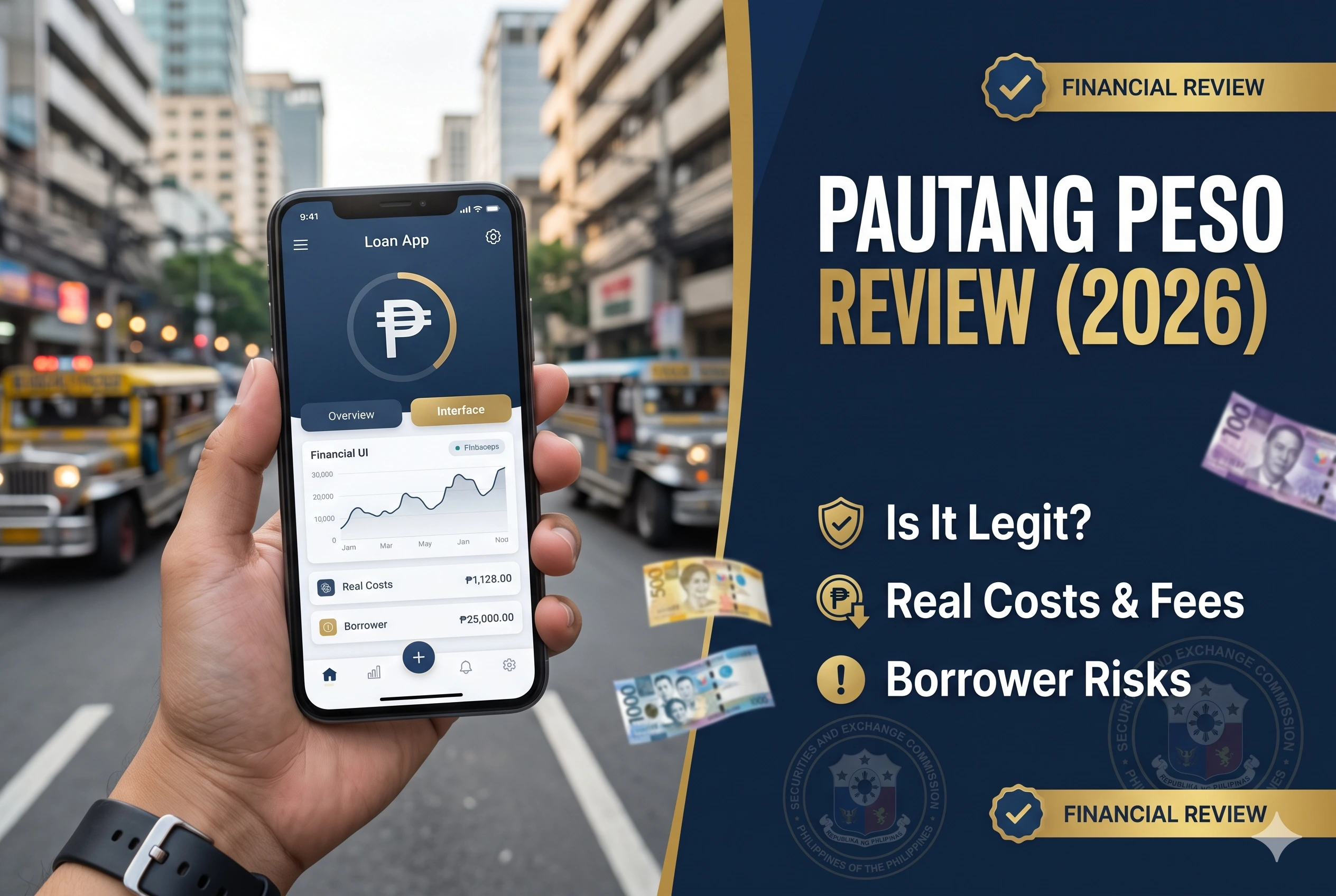
Filipino borrowers turning to digital lending apps often face a frustrating disconnect between the loan amount advertised and the actual cash deposited into their accounts. When medical emergencies, utility cut-offs, or tuition deadlines strike, apps like Pautang Peso offer immediate liquidity. However, the convenience of fast approval frequently masks steep upfront deductions and aggressive repayment schedules that can easily trap applicants in a cycle of debt.
This review investigates the mechanics of Pautang Peso, separating marketing claims from the actual financial obligations placed on the borrower. By examining typical fee structures, legal operator requirements, and collection practices, we aim to provide a clear picture of what this credit line actually costs and what risks accompany the speed of disbursement.
Summary: Pautang Peso is an online lending application operating in the Philippines that provides fast, short-term unsecured cash loans. While it successfully delivers rapid disbursements to e-wallets and bank accounts, the product is characterized by high upfront service fee deductions and very short initial repayment windows – often as brief as 7 to 14 days. Borrowers typically receive significantly less cash than their approved principal. Because app ownership and regulatory statuses shift frequently in the Philippine fintech sector, applicants must verify the current active legal operator behind Pautang Peso against the Securities and Exchange Commission (SEC) registry before applying. This product is strictly for severe emergencies where repayment of the gross amount is guaranteed within days.
| Borrower question | Current finding | Why it matters |
| Legal Operator | Must be verified via the SEC’s registered online lending platform list. | Ensures you are dealing with a licensed entity bound by fair collection rules. |
| Advertised Limits | Up to ₱20,000 (varies by marketing material). | First-time applicants are generally restricted to much lower limits, typically ₱2,000 to ₱3,000. |
| Net Proceeds | High upfront processing and service fees are standard. | You will receive substantially less cash than the principal balance you are required to repay. |
| Repayment Term | Frequently ranges from 7 to 14 days for new users. | Extremely short terms drastically increase the risk of default and late penalties. |
| Data Privacy | Requires extensive device permissions during application. | Your data is processed for underwriting and can be a friction point if privacy policies are updated. |
Is Pautang Peso legitimate and authorized in the Philippines?
While Pautang Peso operates as a recognizable online lending platform, its strict legal legitimacy depends entirely on the active corporate registration of its operator. Borrowers must check the latest SEC roster of licensed financing or lending companies to confirm the exact entity holding its current Certificate of Authority.
In the Philippine digital credit market, the consumer-facing brand name of an app is rarely the legal name of the corporation providing the funds. A lending platform must be operated by a corporation that holds not only a primary SEC registration but also a secondary license – a Certificate of Authority (CA) to Operate as a Lending or Financing Company.
Furthermore, the SEC requires licensed operators to officially register the names of their online lending platforms (OLPs). If an app is not listed under an active CA, operating it constitutes a regulatory violation. Because the operational structures behind loan apps frequently change due to acquisitions, rebranding, or regulatory suspensions, borrowers should never assume an app is authorized simply because it is available on the Google Play Store or Apple App Store. Always match the developer or operator name listed in the app to the official SEC database of authorized OLPs before submitting sensitive ID documents.
How much money do you actually receive from Pautang Peso?
You will likely receive significantly less than your approved principal. Like many short-term Philippine loan apps, Pautang Peso historically deducts processing and service fees directly from the approved amount before depositing the net proceeds into your account.
A major friction point for digital borrowers is the difference between the approved credit limit and the actual disbursement. While a platform may approve a ₱3,000 loan, the borrower does not receive ₱3,000.
Instead, the lender applies upfront deductions. These may be categorized as processing fees, service charges, or technical fees. If an app applies a 30% upfront deduction on a ₱3,000 loan, ₱900 is subtracted immediately. The borrower receives only ₱2,100 in their GCash, Maya, or bank account, but remains legally obligated to repay the full ₱3,000 on the due date. This structure technically complies with the concept of principal lending, but it often catches inexperienced borrowers off guard when they need a specific exact amount to cover an emergency bill.
What does a Pautang Peso loan really cost?
The true cost of borrowing is driven primarily by upfront service fees rather than the nominal interest rate. If you borrow ₱3,000, receive only ₱2,100, and must repay ₱3,000 in just 7 days, the effective cost of that capital is extremely high.
Evaluating the cost of short-term fintech loans requires ignoring the advertised monthly interest rates and focusing entirely on the total peso cost. Philippine regulations, including BSP circulars regarding interest rate ceilings for small, short-term, unsecured loans, place limits on nominal interest rates and late penalties (typically capping nominal interest at around 1.5% to 2% per month and total costs to a specific threshold of the principal).
However, borrowers must carefully review the mandatory Disclosure Statement before clicking accept. The Disclosure Statement will outline:
- The requested principal.
- The exact upfront deductions.
- The net cash out.
- The total amount due.
When you calculate the fee (e.g., ₱900) against the cash actually received (₱2,100) over a short 7-day period, the annualized effective interest rate (EIR) reaches triple digits. This is not traditional financing; it is an expensive cash advance designed to bridge a gap of a few days.
How fast are approvals and disbursements?
Pautang Peso automates its underwriting, meaning approvals can often occur within minutes to a few hours. However, actual settlement into a borrower’s account can be delayed by banking cut-off times, name mismatches, or system maintenance.
The primary value proposition of digital micro-lending is speed. The application requires a valid government-issued ID (such as a UMID, Passport, or PhilID) and a live selfie to utilize facial recognition and anti-fraud checks.
Friction occurs when applicants use IDs with poor lighting or when the name on the registered e-wallet or bank account does not perfectly match the name on the submitted ID. Any discrepancy forces the application into manual review, which nullifies the promise of instant approval. Additionally, while the app may approve the loan immediately on a weekend, interbank transfer systems (like InstaPay or PESONet) occasionally experience downtime, delaying the actual receipt of funds.
What happens if you pay Pautang Peso late?
Late payments trigger daily penalty fees that rapidly inflate the debt. Furthermore, Philippine online lenders frequently use aggressive outbound calling, SMS campaigns, and messaging apps to collect, which can cause significant stress.
Failing to repay an online loan on the exact due date carries immediate financial and psychological consequences. Financially, the lender will apply a late payment penalty, which is often charged daily. This means a ₱3,000 debt can escalate quickly, although SEC rules dictate that total penalties and fees cannot infinitely compound beyond legal ceilings relative to the principal.
Operationally, late payments trigger the collections department. Borrowers frequently report receiving numerous calls and text messages. It is crucial to understand Philippine borrower protections under SEC Memorandum Circular No. 18 (Series of 2019), which strictly prohibits unfair debt collection practices. Licensed lenders are forbidden from:
- Using threats of physical harm or violence.
- Using unreasonably abusive or profane language.
- Contacting persons in the borrower’s contact list who were not explicitly named as co-makers or guarantors.
- Threatening unfounded criminal prosecution for a purely civil debt (under Philippine law, non-payment of debt is a civil liability, though fraud is a criminal matter).
How does the app handle your personal data?
The application requires extensive device permissions, often including access to location, camera, and device identifiers. Borrowers should review the privacy policy to ensure their data is not used improperly during debt collection.
To assess creditworthiness without collateral or traditional credit scores, lending apps harvest alternative data. During installation, the app will request various permissions.
The National Privacy Commission (NPC) has issued strict guidelines regarding data scraping. Lending apps are no longer permitted to scrape a borrower’s entire phonebook or photo gallery for use as leverage during collections. However, basic data points required for Know Your Customer (KYC) compliance – such as device IDs, location, and the images voluntarily uploaded during application – are stored on the operator’s servers. Borrowers must carefully read the privacy policy to understand how long this data is retained if an account is closed or a loan application is rejected.
What are borrowers saying about Pautang Peso in 2026?
Recent borrower feedback across forums and app stores consistently highlights the speed of disbursement as a major advantage, while recurring complaints focus on unexpectedly short initial loan terms, high service deductions, and persistent collection messages.
Analyzing independent borrower reports reveals a clear pattern. The positive reviews generally center on accessibility: borrowers who cannot access bank loans or credit cards appreciate the lack of paperwork and the speed of funding.
The negative reviews almost universally focus on the terms of the loan rather than technical bugs. A common theme is the “bait and switch” perception regarding loan tenors. While marketing materials may advertise repayment terms of 90 to 120 days, first-time borrowers frequently report being locked into 7-day or 14-day terms. When borrowers inevitably struggle to repay within a week, they face the aggressive collection tactics mentioned earlier.
What should you check before accepting the loan?
Before tapping accept, read the final Disclosure Statement carefully. Verify the exact peso amount you will receive, the exact peso amount you must repay, the precise due date, and the daily penalty rate for late payments.
Do not rely on the initial slider on the app’s home screen. The only numbers that matter legally are those presented in the final Disclosure Statement generated right before you confirm the loan.
Ask yourself three questions:
- Is the net cash out enough to solve my immediate problem?
- Do I have guaranteed income arriving before the exact due date to cover the full gross amount?
- Am I borrowing this just to pay off another loan app?
If the answer to the third question is yes, accepting the loan will likely accelerate a debt spiral. If the cost is too high or the tenor too short, it is better to abandon the application than to default on an expensive short-term obligation.
References
- Securities and Exchange Commission Philippines Organization: Securities and Exchange Commission (SEC) Resource: List of Registered Online Lending Platforms. URL: https://www.sec.gov.ph/lending-companies-and-financing-companies-2/list-of-registered-online-lending-platforms/
- Securities and Exchange Commission Philippines Organization: Securities and Exchange Commission (SEC) Resource: Memorandum Circular No. 18, Series of 2019 (Prohibition on Unfair Debt Collection Practices). URL: https://www.sec.gov.ph/mc-2019/mc-no-18-s-2019/
- National Privacy Commission Organization: National Privacy Commission (NPC) Resource: Issuances on Data Privacy for Online Lending Applications. URL: https://www.privacy.gov.ph/