
Last Updated on 08/10/2026 by Nicole Alba
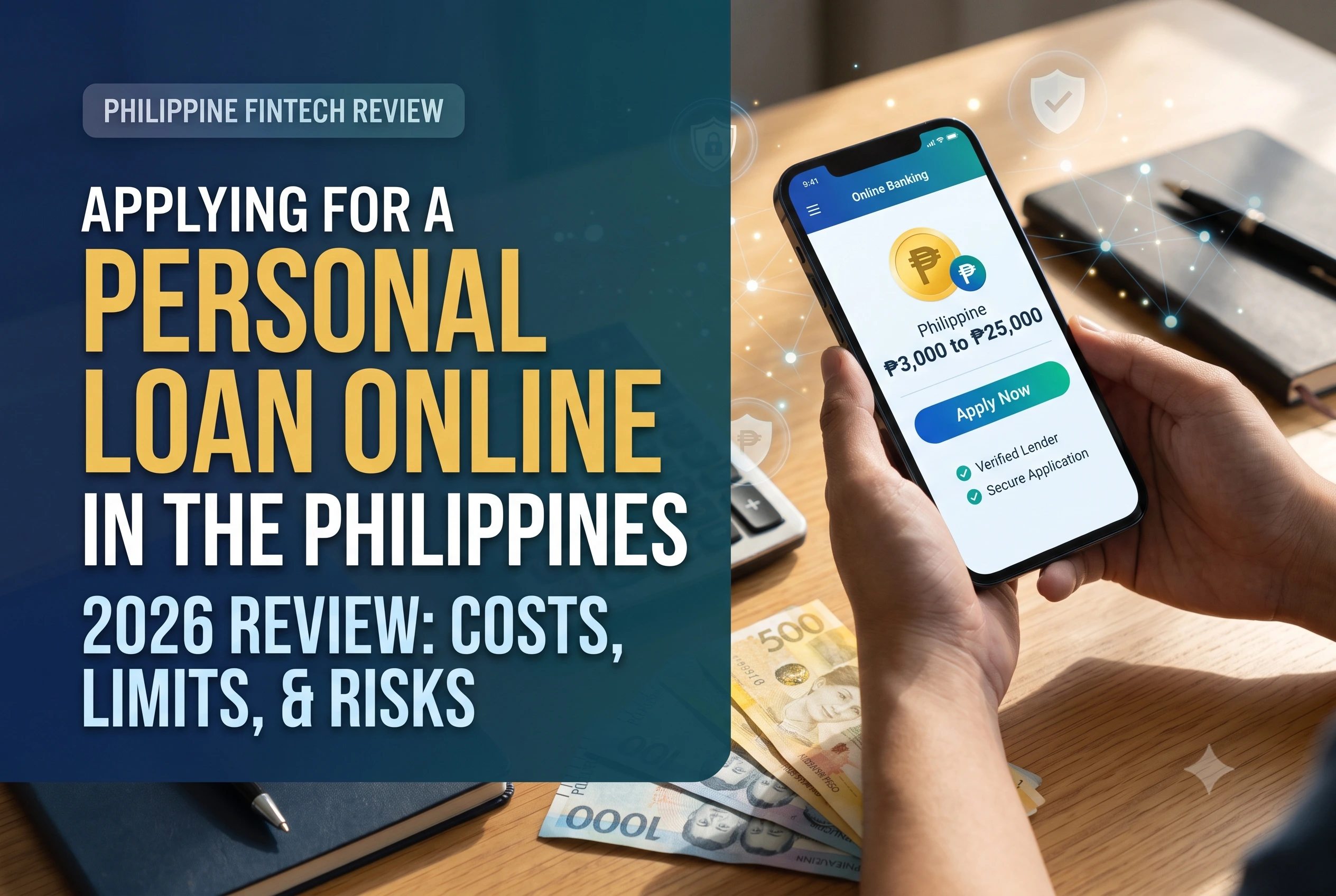
Searching for emergency cash often leads Filipino borrowers to hundreds of digital lending platforms promising instant approval and zero interest. However, applying for a personal loan online requires navigating a market where marketing claims frequently obscure the true cost of borrowing. While legitimate fintech platforms offer genuine financial access to underbanked consumers, the application process demands strict attention to regulatory registration, data privacy permissions, and upfront fee deductions.
This review investigates the 2026 landscape of Philippine online personal loans. We analyze how to verify a lender’s legal identity, calculate the actual peso cost behind advertised rates, understand practical approval friction, and identify the protections available to borrowers under current financial regulations.
Summary:
Applying for a personal loan online in the Philippines carries specific financial and privacy risks. While authorized platforms provide accessible, uncollateralized credit, borrowers must verify that the operator holds a valid Certificate of Authority (CA) from the Securities and Exchange Commission (SEC). Advertised interest rates rarely reflect the true cost of borrowing, as processing and service fees are often deducted upfront, significantly reducing the net proceeds received. Furthermore, first-time limits are strictly capped, rarely matching the heavily promoted maximums. Before submitting an application, borrowers must calculate their total out-of-pocket repayment and review the app’s data permissions to ensure compliance with National Privacy Commission (NPC) guidelines against unauthorized contact scraping.
| Borrower question | Current finding | Why it matters |
| Legal operator | Must possess an SEC Certificate of Authority (CA). | SEC corporate registration alone does not grant the legal right to lend money. |
| Loan range | First-time approvals usually range from ₱1,000 to ₱3,000. | Advertised limits of ₱25,000+ are generally reserved for repeat borrowers with established payment histories. |
| Net proceeds | Processing and service fees are often deducted before disbursement. | You will likely receive less cash than your approved loan principal, but you must repay the full principal. |
| Approval speed | Advertised as “instant,” but practical friction exists. | Manual ID verification, selfie mismatches, and banking cut-offs frequently delay actual cash receipt to 24-48 hours. |
| Data privacy | Apps cannot legally harvest your phone’s contact list. | NPC rules prohibit lenders from accessing your contacts to use as leverage during debt collection. |
| Credit reporting | Legitimate lenders report to the Credit Information Corporation (CIC). | Late payments will damage your formal credit score, affecting future bank or car loan applications. |
How do you verify if a Philippine online loan app is legitimate?
A legitimate online lending app must be operated by a company with a valid Securities and Exchange Commission (SEC) registration and a specific Certificate of Authority (CA) to operate as a lending or financing company. Without a CA, the platform is operating illegally, regardless of its availability on official app stores.
Identifying the legal operator
The consumer-facing brand name of an application (e.g., “CashNow” or “FastLoan”) is rarely the legal name of the corporation. When applying for a personal loan online, always check the bottom of the lender’s website or the app store description for the corporate entity name. Once identified, this name must be cross-referenced with the SEC’s published list of registered lending and financing companies.
Differentiating between technology platforms and lenders
Some online applications function merely as credit marketplaces or technology providers. In these cases, the app collects your data and brokers the application to a third-party lending company that actually funds the loan. The terms and conditions should explicitly state which exact financial institution is issuing the credit, as that specific entity is the one bound by Philippine lending regulations.
How much can you actually borrow when applying online?
While digital lending apps routinely advertise maximum limits of ₱25,000 to ₱50,000, public disclosures and typical underwriting models indicate that first-time borrowers are usually approved for ₱1,000 to ₱3,000. Limits typically scale only after multiple on-time repayment cycles.
The reality of advertised limits
Online personal loans are predominantly uncollateralized, high-risk microloans. Lenders mitigate their exposure to new users by strictly capping initial credit lines. The heavily promoted maximum amounts act as marketing anchors rather than realistic expectations for a new applicant.
Discrepancy between approved principal and net proceeds
A critical concept in Philippine online lending is the difference between the approved principal and the net proceeds (the actual money deposited into your bank account or e-wallet). Many financing companies deduct processing fees, platform fees, and credit assessment charges upfront. If you are approved for a ₱3,000 loan with a 15% upfront processing fee, you will only receive ₱2,550, yet your repayment obligation remains based on the full ₱3,000 principal.
What does an online personal loan really cost?
The true cost of an online loan extends far beyond the nominal interest rate. Upfront processing fees and mandatory service charges can consume 10% to 30% of your approved principal, making the effective cost of borrowing substantially higher than the advertised monthly rate.
Calculating the actual peso cost
Evaluating affordability requires looking past percentage rates and focusing on the actual peso flow. Consider a hypothetical short-term loan structured under typical market conditions:
- Requested Principal: ₱5,000
- Upfront Deductions (Processing/Service): ₱750
- Net Proceeds Received: ₱4,250
- Repayment Amount: ₱5,250 (Principal + Interest)
- Total Cost of Borrowing: ₱1,000 (Repayment minus Net Proceeds)
In this scenario, paying ₱1,000 for the use of ₱4,250 over 30 days represents an extremely high effective cost, even if the nominal interest rate appears manageable on paper.
Regulatory caps on interest and fees
To protect consumers, the Bangko Sentral ng Pilipinas (BSP) maintains specific ceilings on short-term, small-value loans (up to ₱10,000 with tenors of up to four months) offered by lending and financing companies. Current guidelines cap nominal interest at 5% per month, late penalties at 5% per month, and total costs (including interest and fees) at 100% of the total amount borrowed. Borrowers should actively verify whether their loan offer exceeds these mandatory regulatory limits.
How fast are online loan approvals and disbursements?
Many registered platforms utilize automated underwriting for near-instant approval, but disbursement can realistically take 24 to 48 hours. Delays are frequently caused by manual ID verification, e-wallet transaction limits, or interbank settlement cut-offs.
What causes application friction?
While marketing materials emphasize seamless processing, evidence from typical application flows highlights several common points of friction:
- Image Rejection: Automated optical character recognition (OCR) systems frequently reject blurry government IDs or glare-heavy selfies, triggering a slower manual review queue.
- Name Mismatches: If the name on the registered ID does not match the receiving bank account or GCash/Maya account precisely (including middle initials), the disbursement will fail.
- Income Verification: While some apps rely solely on alternative data (like device metadata), others still request proof of billing, payslips, or employer details, which slows down the underwriting process.
Settlement delays
Even if a loan is approved at 10:00 PM on a Friday, the funds might not clear the PESONet or InstaPay system until the next banking day. Borrowers relying on the money for an immediate weekend emergency must factor in banking network realities.
What happens if you pay a digital loan late?
Late payments trigger daily penalty fees that compound rapidly. Legitimate lenders will report defaults to the Credit Information Corporation (CIC), which damages your formal credit score, but they are legally prohibited from harassing your phone contacts or threatening imprisonment.
Financial consequences and credit reporting
Defaulting on an online loan carries severe financial penalties. Late fees accrue quickly, though they are subject to BSP caps. More importantly, SEC-authorized lenders are mandated to submit borrower data to the CIC. A defaulted online microloan will appear on your credit report, potentially causing rejections when you apply for a credit card, auto loan, or housing loan with a traditional bank years later.
Protections against unfair debt collection
The SEC has strict rules against unfair debt collection practices (Memorandum Circular No. 18). Lenders and their third-party collection agencies cannot legally:
- Use threats, physical harm, or obscene language.
- Contact individuals in your phonebook who were not explicitly named as guarantors.
- Publicly shame you on social media.
- Falsely represent themselves as government authorities or police officers.
Civil debt vs. Criminal conduct
Under Article III, Section 20 of the 1987 Philippine Constitution, no person shall be imprisoned for debt. Inability to repay an online loan is a civil matter. However, this protection does not cover independently criminal acts, such as applying for a loan using a forged identity, fake documents, or stolen credentials, which constitutes fraud (Estafa).
How do online lending apps handle your personal data?
During the application, lenders require a government ID, a selfie, and basic financial data. However, under National Privacy Commission (NPC) rules, lending applications are strictly prohibited from demanding access to your entire contact list or private photo galleries.
Legitimate vs. predatory permissions
A secure, legitimate loan app will request permission to access your camera (for the selfie and ID scan) and perhaps location data (to verify you are in the Philippines).
Predatory apps often demand permissions to read your SMS messages, access your phonebook, or view your local storage. Historically, illegal operators have weaponized this data to message a borrower’s contacts when a payment is delayed. If an app refuses to proceed unless you grant access to your contact list, it is likely violating NPC Circular No. 20-01, and you should abandon the application immediately.
What are the main advantages and disadvantages?
Potential Advantages
- Accessibility: Applicants without formal credit histories or traditional bank accounts can often secure funding.
- Convenience: The entire process, from application to disbursement, is handled remotely without physical branch visits.
- No Collateral: These are unsecured loans, requiring no property or assets to guarantee the debt.
Potential Disadvantages
- High Effective Cost: The combination of nominal interest and upfront processing fees creates a very expensive form of debt.
- Low Initial Limits: First-time borrowers rarely receive enough to cover major emergencies.
- Aggressive Collections: While illegal, third-party collection agencies associated with some platforms frequently employ stressful and bordering-on-abusive follow-up tactics.
Who should apply for an online personal loan, and who should avoid it?
Online personal loans serve a specific, narrow financial purpose. They are conditionally suitable for individuals facing a verified, immediate emergency (such as a medical prescription or urgent utility shut-off) who know exactly where the repayment money will come from within the next 15 to 30 days.
Borrowers should aggressively avoid these products if they are experiencing chronic cash shortages. Using a 30-day online loan to pay off a different debt, or to cover everyday lifestyle expenses, predictably leads to a debt trap. If repaying the loan will consume your entire next paycheck, forcing you to immediately borrow again, this financial product is highly unsuitable.
What should you check before accepting a loan offer?
Before clicking “Accept” and signing the electronic promissory note, execute a strict final review:
- Check the net proceeds: Look at the exact peso amount that will be sent to your account, not just the approved limit.
- Check the total repayment: Identify the exact peso amount you must pay back. Subtract the net proceeds from this number. That difference is your true cost of borrowing.
- Check the due date: Ensure the repayment date falls one or two days after your confirmed salary date.
- Check the SEC list: Verify the legal operator’s CA number on the SEC website.
FAQ
Can I apply for an online loan using only my PhilID (National ID)?
Yes. Legitimate financial institutions are legally mandated by the Philippine Statistics Authority (PSA) and the BSP to accept the PhilID as sufficient, standalone proof of identity for financial transactions.
Can an online lender automatically deduct money from my payroll account?
A lender can only deduct funds automatically if you explicitly signed an Auto-Debit Agreement (ADA) and provided the specific account details for that purpose. They cannot arbitrarily access bank accounts that were not authorized in the loan agreement.
How can I file a complaint about harassment from a loan app collection agent?
Borrowers experiencing harassment, threats, or unauthorized disclosure of their debt to third parties should immediately file a formal complaint with the SEC Financing and Lending Companies Division and submit a data privacy violation report to the National Privacy Commission (NPC).
Why was the money sent to my GCash lower than my approved loan amount?
Most online lending platforms deduct a processing fee, service charge, or risk assessment fee directly from the principal before disbursement. This practice must be clearly disclosed in the loan agreement before you accept the terms.
Conclusion
Applying for a personal loan online in the Philippines offers a fast, accessible route to emergency cash, but it transfers the burden of due diligence entirely onto the borrower. The speed of digital lending makes it dangerously easy to accept terms without calculating the actual financial impact.
Your decision should not be based on whether an app is easy to use, but on cold mathematics. Calculate the exact net proceeds you will receive, determine the total peso cost you will repay, and verify that the payment schedule aligns perfectly with your documented income. Above all, never trade your data privacy or peace of mind to an unregistered operator merely for a quick approval. If the upfront fees are exorbitant or the app demands access to your personal contacts, the safest financial decision is to close the application.
References
- Securities and Exchange Commission PhilippinesOrganization: Securities and Exchange Commission (SEC)
Resource: List of Registered Financing and Lending Companies
URL: https://www.sec.gov.ph/lending-companies-and-financing-companies-2/list-of-registered-entities/
- Bangko Sentral ng PilipinasOrganization: Bangko Sentral ng Pilipinas (BSP)
Resource: Circular No. 1133 – Ceilings on Interest Rates and Other Fees Charged by Lending Companies, Financing Companies, and Their Online Lending Platforms
URL: https://www.bsp.gov.ph/Regulations/Issuances/2021/c1133.pdf
- National Privacy CommissionOrganization: National Privacy Commission (NPC)
Resource: NPC Circular No. 20-01 – Guidelines on the Processing of Personal Data for Loan-Related Transactions
- Official Gazette of the PhilippinesOrganization: Government of the Philippines
Resource: 1987 Constitution of the Republic of the Philippines, Article III, Section 20


![Pesoredee Loan PH Review: Is it Legit? Repayment Options, App APK, and Contact Information [New Update]](https://cashloanph.com/wp-content/uploads/2023/10/pesoredee-loan-philippines-review-cashloanph-438x246.jpg "Pesoredee Loan PH Review: Is it Legit? Repayment Options, App APK, and Contact Information [New Update]")
![Soscredit Loan PH Review: Loans, Terms, Legitimacy, and Application Process [New Update]](https://cashloanph.com/wp-content/uploads/2023/10/soscredit-loan-philippines-review-cashloanph-438x246.jpg "Soscredit Loan PH Review: Loans, Terms, Legitimacy, and Application Process [New Update]")