Last Updated on 12/10/2026 by Nicole Alba
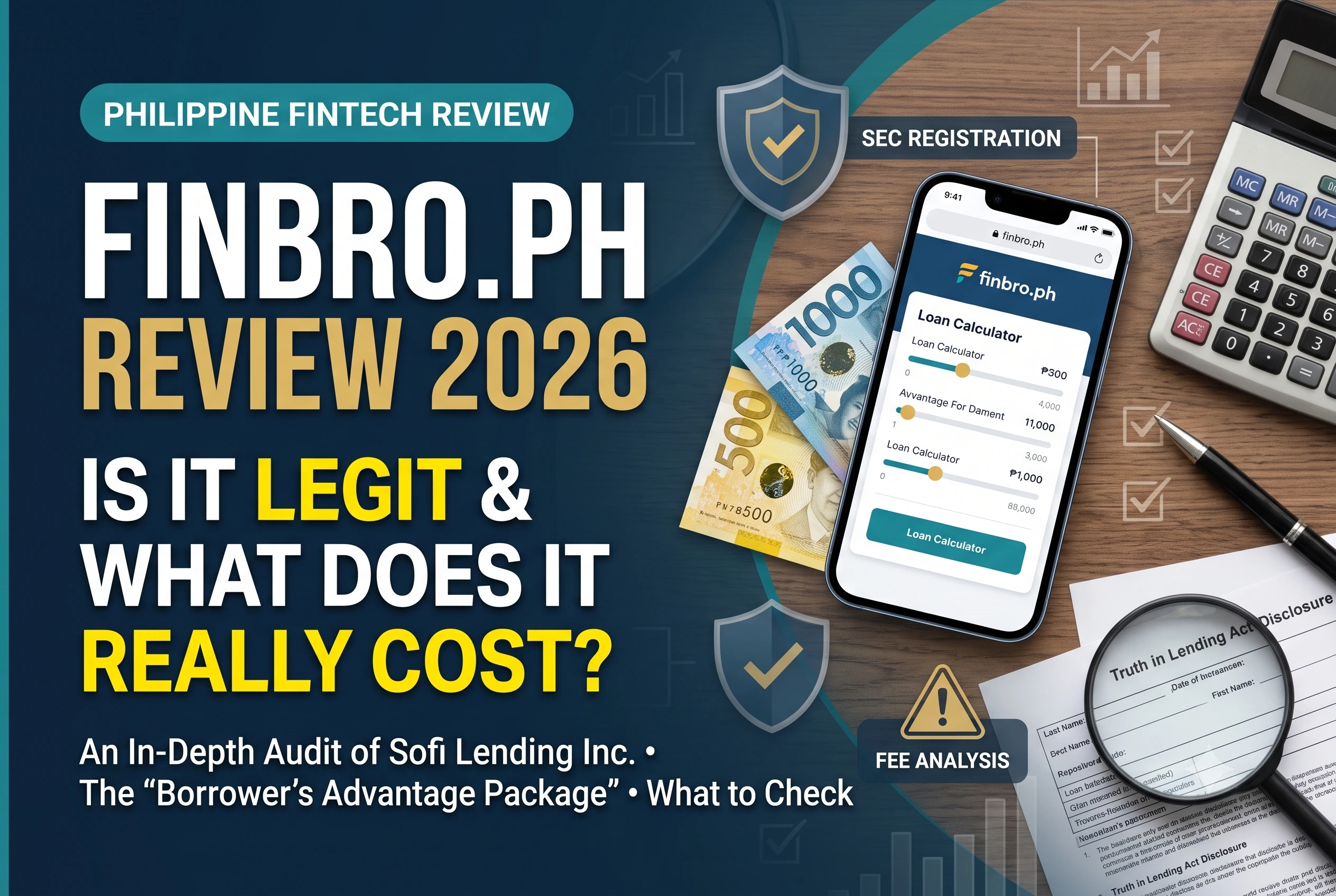
Looking at the interactive slider on Finbro.ph can make short-term borrowing look deceptively expensive – or unusually flexible – depending on which small print you read first. Many Filipino borrowers searching for a Finbro review are trying to reconcile two conflicting experiences: the platform is operated by a verified, SEC-licensed lending company, yet its sample calculators often show total repayment amounts that far exceed standard Philippine interest-rate ceilings.
The confusion usually comes down to how Finbro structures its charges, specifically the optional – yet heavily promoted – “Borrower’s Advantage Package” alongside statutory interest rates. This review examines the corporate identity behind Finbro.ph, breaks down how its fee structure interacts with Bangko Sentral ng Pilipinas (BSP) and Securities and Exchange Commission (SEC) caps, analyzes the difference between full repayment and “minimum payment” extensions, and outlines the exact contract terms you should inspect before signing electronically. Because live live-borrowing tests were not conducted for this review, our findings rely on Finbro’s published disclosures, Philippine regulatory circulars, and recurring patterns in public borrower reports.
| Borrower Question | Current Finding | Why It Matters |
| Who is the legal operator? | Sofi Lending Inc. (SEC Reg. No. CS201908275; Certificate of Authority No. 2990). | Confirms you are dealing with an identifiable, SEC-licensed lending corporation rather than an unregistered entity. |
| Is it an app or a website? | Primarily a web-based lending platform (finbro.ph), though mobile wrappers/apps have appeared periodically. |
Web-based applications do not pull automated mobile contact lists the way invasive APK files do, though you still submit personal references manually. |
| How much can you borrow? | Advertised from ₱1,000 to ₱50,000, subject to underwriting. | First-time borrowers rarely receive the ₱50,000 ceiling; initial approvals are typically restricted to lower tiers to test repayment behavior. |
| Why is the total repayment so high? | Standard nominal interest is paired with an optional “Borrower’s Advantage Package” or service add-ons. | If you accept the optional package, the total peso cost rises sharply above the base interest rate. |
| How does the “Minimum Payment” work? | Allows borrowers to pay a smaller fee to extend or defer the principal due date. | Paying only the minimum fee frequently does not reduce your principal balance, which can trap borrowers in a costly rollover cycle. |
| What happens if you pay late? | Late payment penalties apply, and accounts may be referred to collection teams and reported to the Credit Information Corporation (CIC). | Unpaid balances increase rapidly and can impair your ability to borrow from banks or other licensed lenders in the future. |
Is Finbro.ph legit and SEC-registered in the Philippines?
Yes. Finbro.ph is the registered online lending platform of Sofi Lending Inc., a licensed lending company registered with the Philippine Securities and Exchange Commission under SEC Registration No. CS201908275 and Certificate of Authority (CA) No. 2990. Being legally authorized confirms corporate accountability, not that its loans are inexpensive.
Who legally operates Finbro.ph?
In the Philippine fintech market, a consumer brand name is rarely the legal entity that holds the lending license. Finbro.ph is owned and operated by Sofi Lending Inc. Under the Lending Company Regulation Act of 2007 (Republic Act No. 9474), a corporation cannot legally grant loans to the public using its own capital purely on the basis of a general SEC Certificate of Incorporation; it must also obtain a secondary license known as a Certificate of Authority (CA) to Operate as a Lending or Financing Company.
Sofi Lending Inc. holds both required credentials:
- Corporate Registration: SEC Registration No. CS201908275
- Lending License: Certificate of Authority No. 2990
This distinction separates Finbro from illegal, unregistered “fly-by-night” apps that operate without regulatory oversight. Because Sofi Lending Inc. holds a valid CA, it falls under the direct supervision of the SEC Financing and Lending Companies Division (FinLend) and must comply with Philippine disclosure, interest-cap, and fair debt-collection regulations.
Is Finbro.ph a direct lender or a loan broker?
According to its public disclosures and website terms, Sofi Lending Inc. acts as the direct lender for loans originated through Finbro.ph rather than merely forwarding your data to third-party lead aggregators. Unlike many competing brands that rely exclusively on downloadable Android apps, Finbro has historically operated primarily through its browser-based web portal (finbro.ph), where borrowers log into a personal profile to manage applications, view contracts, and check repayment reference numbers.
How much can you actually borrow from Finbro.ph?
Finbro.ph advertises loan amounts ranging from ₱1,000 to ₱50,000 with stated repayment terms of up to 12 months. However, first-time applicants are typically restricted to lower initial credit limits, and higher amounts are generally reserved for repeat borrowers with established on-time repayment records.
Advertised limits versus first-time borrower reality
Marketing banners on Finbro.ph highlight a maximum credit limit of ₱50,000. In practice, unsecured digital lenders in the Philippines manage default risk through “graduated” or tiered underwriting. When you apply for the first time, the platform has limited data on your willingness to repay short-term digital obligations. Consequently, recent borrower reports indicate that initial approvals commonly fall in the ₱1,000 to ₱10,000 range, even for applicants with steady monthly salaries. Reaching the upper tiers usually requires completing multiple loan cycles without late payments.
Loan term structure vs. actual payment cycles
While Finbro’s public documentation references loan terms ranging from 30 days up to 360 days (12 months), short-term cash loans in this category are frequently structured around a single 30-day maturity window or recurring 15-day/30-day installment cycles. Borrowers should check their specific loan agreement before signing to verify whether they are entering a true multi-month amortizing installment loan (where every payment reduces the principal) or a 30-day short-term facility that offers periodic maturity extensions.
What does a Finbro.ph loan really cost?
A Finbro.ph loan carries two distinct cost layers: a statutory base interest rate (typically aligned with the 6% monthly nominal interest cap under SEC MC No. 3, Series of 2022) and an optional “Borrower’s Advantage Package.” Including the optional package drastically increases the total repayment amount.
How the Philippine interest rate cap applies to Finbro
Under BSP Circular No. 1133 and implemented by the SEC through Memorandum Circular No. 3, Series of 2022, small-value, short-term unsecured consumer loans offered by lending and financing companies (specifically loans not exceeding ₱10,000 with tenors of up to four months) are subject to strict rate ceilings:
- Nominal Interest Rate Ceiling: 6% per month (roughly 0.2% per day).
- Effective Interest Rate (EIR) Ceiling: 15% per month, which includes nominal interest plus mandatory processing, service, and administrative fees, excluding late payment penalties.
- Total Cost Cap: Total interest, fees, and penalties cannot exceed 100% of the total amount borrowed.
Note that if a loan exceeds ₱10,000 or has a tenor longer than four months, it falls outside the mandatory numeric ceiling of SEC MC No. 3, though it remains subject to the Truth in Lending Act (RA 3765) and general civil law protections against unconscionable charges.
The “Borrower’s Advantage Package” explained
If you use the loan calculator on Finbro.ph’s homepage, you will notice that the displayed total repayment is much higher than 6% to 15% per month. This happens because Finbro bundles an optional service called the “Borrower’s Advantage Package” (or similar value-added service packages) into its default calculator settings.
According to Finbro’s published platform mechanics, this package grants features such as:
- The option to extend or defer your repayment date by making a “Minimum Payment” rather than paying the full principal on the due date;
- Split-payment flexibility;
- Priority application handling or penalty waivers under specific conditions.
Because the fee for this package is substantial, accepting it makes the loan very expensive in peso terms.
Sample cost comparison: Base Loan vs. With Advantage Package
To illustrate how optional add-ons alter the real cost of borrowing, consider a hypothetical ₱10,000 loan over 30 days. (Note: Exact package pricing varies by borrower risk profile and current platform terms; the figures below demonstrate the structural difference between a capped base loan and a bundled package offer).
| Cost Component | Scenario A: Base Loan Only (Under SEC MC No. 3 Ceiling) | Scenario B: Loan + Optional Advantage Package (Illustrative) |
| Approved Principal | ₱10,000 | ₱10,000 |
| Upfront Deductions | ₱0 (Assuming fees are added to repayment rather than deducted) | ₱0 |
| Net Cash Received | ₱10,000 | ₱10,000 |
| Nominal Interest (30 days) | ₱600 (6% per month) | ₱600 (6% per month) |
| Mandatory Processing / Service Fee | Up to ₱900 (keeping total EIR at 15% cap) | Included or replaced by package fee |
| Optional “Borrower’s Advantage Package” | Declined / Opted Out (₱0) | ₱3,000 to ₱4,000+ (Depending on tier) |
| Total Repayment After 30 Days | ₱10,600 – ₱11,500 | ₱13,600 – ₱14,600+ |
| Total Peso Cost of Borrowing | ₱600 – ₱1,500 | ₱3,600 – ₱4,600+ |
The critical takeaway for borrowers: During the application process, you must check whether you can uncheck or opt out of the Borrower’s Advantage Package. Several recent borrower discussions on Reddit and local finance forums report that opting out of the package lowers the repayment amount to the statutory interest rate, though some applicants claim that opting out reduced their likelihood of instant approval or slowed down processing. We could not independently verify whether Finbro’s underwriting algorithm penalizes applications that decline the optional package.
The “Minimum Payment” rollover trap
Finbro displays two figures on your billing statement: Total Amount to Pay and Minimum Amount to Pay.
Borrowers accustomed to credit cards often assume the “Minimum Amount” pays down a portion of their loan balance. In short-term online lending, however, the “Minimum Amount” frequently functions as a prolongation or extension fee tied to the Borrower’s Advantage Package. If you pay only the Minimum Amount on your due date, your maturity date is pushed back (usually by 14 or 30 days), but your original principal remains unpaid. Repeating this minimum payment two or three times can result in paying more in extension fees than the original cash you borrowed, while still owing 100% of the principal.
Who can apply, and how does the application process work?
Filipino citizens aged 20 to 70 who are currently employed or self-employed with a verifiable income source can apply on Finbro.ph using one valid government ID and a selfie. Unlike app-only lenders, the registration takes place directly through the website.
Eligibility and documentary requirements
Based on Finbro.ph’s published requirements, applicants must meet the following baseline criteria:
- Citizenship and Residency: Filipino citizen residing in the Philippines.
- Age Bracket: 20 to 70 years old.
- Income Source: Employed, self-employed, or receiving verifiable remittance/business income.
- Identification: At least one primary government-issued ID (such as UMID, SSS ID, Driver’s License, Passport, PhilSys National ID, PRC ID, Voter’s ID, or Postal ID).
- Contact Details: An active Philippine mobile number and email address.
Operational friction during underwriting
While the registration form is designed to take only a few minutes, applicants frequently encounter verification checkpoints that determine whether an application is approved or rejected:
- Live Selfie & ID Matching: You must capture a live photo holding your ID or performing a liveness check. Glare on plastic ID cards, blurry text, or discrepancies between your registered profile name and the name printed on your ID will trigger automated rejection.
- Employment and Contact Verification: Although the process is automated for many users, Finbro reserves the right to conduct verification calls. If you list an employer number or character reference that is unreachable – or if your declared monthly income does not align with your job title – underwriting may decline the loan.
- Salaried vs. Freelance Applicants: Salaried employees with consistent payroll records and standard government IDs typically face less friction than gig workers or informal business owners whose income fluctuates. The lender does not publicly disclose its internal credit-scoring model.
How fast is disbursement, and where do delays happen?
Once a loan contract is signed through OTP verification, Finbro advertises rapid disbursement to Philippine bank accounts and e-wallets such as GCash and Maya. However, actual receipt of funds depends on interbank clearing channels like InstaPay and PESONet, which can cause delays during weekends or maintenance windows.
Supported payout channels
Finbro disburses approved proceeds through three primary channels:
- E-Wallets: GCash and Maya (generally the fastest method via real-time transfer rails).
- Local Bank Accounts: Major commercial and digital banks including BDO, BPI, Metrobank, UnionBank, Landbank, and Security Bank.
- Cash Pickup Partners: Selected over-the-counter remittance centers where supported in the borrower portal.
Why “instant approval” does not always mean instant cash
Even after you receive an SMS confirming loan approval and enter your One-Time Password (OTP) to execute the contract, three common operational hurdles can delay the money:
- Account Name Mismatch: The bank account or GCash/Maya wallet must be registered under the exact legal name of the borrower. Attempting to disburse funds to a spouse’s or relative’s account will cause the transfer to fail.
- InstaPay vs. PESONet Routing: Transfers routed via InstaPay arrive within minutes, provided the receiving bank or e-wallet is not experiencing system downtime. If a transfer is routed through PESONet, or if it fails over during a bank maintenance window, funds are processed in batch cycles on banking days – meaning a Friday evening approval might not reflect until Monday morning.
- E-Wallet Incoming Limits: If your GCash or Maya account is not fully verified, or if you have already reached your monthly incoming transaction limit (e.g., ₱100,000 for standard verified wallets), the disbursement will bounce back to the lender, leaving your loan technically active while the funds are stuck in reconciliation.
How does Finbro.ph repayment work?
Borrowers repay Finbro.ph using a unique Lifetime ID or reference number via GCash, Maya, online banking (Dragonpay), 7-Eleven Cliqq kiosks, or over-the-counter payment centers like Bayad Center and Cebuana Lhuillier. Payments are only credited once they settle with the lender’s payment gateway.
Step-by-step repayment mechanics and reference numbers
Finbro primarily uses payment aggregators (such as Dragonpay or direct biller integrations under Finbro / Sofi Lending) to process incoming payments.
- Log into your
finbro.phaccount dashboard before paying to check the exact amount due and retrieve your Lifetime ID or current Reference Number. - In GCash or Maya, navigate to Bills and search for Finbro or Dragonpay (follow the exact biller name specified in your repayment instruction email/SMS, as choosing the wrong biller delays posting).
- Enter the exact reference number and pay at least a few hours before the cut-off on your due date.
Protecting yourself against payment-posting delays
One of the most frequent sources of borrower distress across Philippine lending platforms occurs when a borrower pays on time via a third-party channel, but the payment takes 24 hours to reflect on the lender’s dashboard – triggering automated late-payment calls. To protect yourself:
- Always pay at least 24 hours before your due date if using over-the-counter centers or bank transfers.
- Take a clear screenshot of the confirmation screen showing the date, time, reference number, and transaction ID, and keep physical paper receipts from 7-Eleven or pawnshops until your Finbro dashboard explicitly shows the loan status as Closed / Paid.
What happens if you pay Finbro.ph late?
Missing your due date without paying at least the minimum extension fee triggers late payment penalties, forfeits any package discounts, and exposes your account to collection reminders and negative reporting to the Credit Information Corporation (CIC).
Late penalties and loss of promotional terms
Under SEC MC No. 3, Series of 2022, lending companies are subject to a maximum penalty cap of 5% per month on the outstanding scheduled amount due for covered small-value loans, alongside the overarching rule that total fees and penalties cannot exceed 100% of the principal borrowed. However, if you previously benefited from a promotional discount or conditional fee structure, defaulting on your due date typically voids the discount and causes the full contractual charges to fall due immediately.
Debt collection rules and your legal rights in the Philippines
If your account becomes delinquent, Finbro’s internal recovery team or accredited third-party collection agencies will contact you via SMS, email, and phone calls. While lenders have every legal right to demand payment of a valid debt, Philippine law strictly regulates how they collect:
- SEC Memorandum Circular No. 18, Series of 2019 (Prohibition on Unfair Debt Collection Practices): Prohibits lending companies from using threats of violence, profane or obscene language, false representations (such as pretending to be lawyers, police officers, or court sheriffs), and contacting borrowers at unreasonable hours (generally before 6:00 AM or after 10:00 PM).
- Public Shaming is Illegal: Contacting people in your contact list who are not co-makers or guarantors to disclose your debt, or posting your face and ID on social media, violates both SEC MC No. 18 and the Data Privacy Act of 2012.
- Can you go to jail for an unpaid Finbro loan? Under Article III, Section 20 of the 1987 Philippine Constitution, “No person shall be imprisoned for debt.” Ordinary inability to repay an online cash loan is a civil liability, not a criminal offense. Police do not arrest borrowers for unpaid online loans. The exception is when a borrower commits an independent criminal act – such as issuing a bouncing check (violating BP 22) or submitting fake government IDs and fraudulent identities to obtain the money (Estafa under the Revised Penal Code). Even though you cannot be imprisoned for ordinary non-payment, the lender can still pursue civil collection remedies and report your default.
Credit bureau reporting (CIC)
Under Republic Act No. 9510 (Credit Information System Act), SEC-licensed lending companies like Sofi Lending Inc. are required to submit borrower credit data – both positive and negative – to the Credit Information Corporation (CIC). Leaving a Finbro loan unpaid can damage your official credit history, which traditional banks, credit card issuers, and other digital lenders check through accredited bureaus like TransUnion Philippines and CIBI.
How does Finbro.ph handle your personal data and privacy?
Because Finbro.ph operates primarily through a web browser rather than requiring a mandatory invasive mobile APK, it cannot automatically scrape your entire phone contact list unless you install an app and grant those permissions. However, it collects extensive personal, financial, and device metadata under its privacy policy.
Web browser permissions vs. mobile app permissions
A major advantage of applying through finbro.ph on a mobile or desktop web browser (such as Chrome or Safari) is sandboxing: a standard website can request camera access (to take your selfie and ID photo) and geolocation, but a browser cannot silently read your SMS inbox, call logs, or phonebook contacts.
During registration, Finbro requires you to manually type in emergency contacts or character references. Under NPC Circular No. 20-01 issued by the National Privacy Commission, lenders are prohibited from harvesting contact lists for debt collection and may only use borrower data in ways that are proportional and necessary for credit underwriting and servicing.
What are borrowers saying about Finbro.ph?
Public borrower feedback across Reddit (r/ola_harassment, r/phinvest), Facebook groups, and consumer review platforms shows a sharp divide: users praise the fast web-based approval for emergency cash, while widespread complaints focus on the high cost of the Borrower’s Advantage Package and persistent collection calls.
Positive borrower experiences
- Fast Web-Based Disbursement: Several recent reviewers report that once their ID and selfie passed verification, repeat loans were disbursed to GCash within 10 to 20 minutes without needing to download an app.
- Accessible Underwriting: Borrowers who were declined by traditional bank personal loans often note that Finbro approved smaller starter amounts with only one valid government ID.
Recurring borrower complaints
- Sticker Shock from the Advantage Package: The most frequent complaint involves borrowers who applied for ₱5,000 or ₱10,000 without realizing that the “Borrower’s Advantage Package” was included, leaving them shocked when the dashboard showed a 30-day repayment total 35% to 45% higher than the principal.
- Confusion Over Minimum Payments: Numerous borrowers report paying the “Minimum Payment” for several consecutive months, only to realize later that their original principal balance had not decreased at all.
- Intense Collection Call Volume: Borrowers whose accounts went past due report receiving high-frequency automated and live phone calls starting the morning of or the day after the due date, though reports generally describe Finbro’s collection scripts as less abusive than illegal, unregistered OLA (“online lending app”) operators.
What are the main advantages and disadvantages of Finbro.ph?
| Potential Advantages | Potential Drawbacks |
| Verified SEC License: Operated by Sofi Lending Inc. (SEC Reg. No. CS201908275, CA No. 2990), providing a clear regulatory trail. | Extremely High Bundled Cost: Unless you opt out of the Borrower’s Advantage Package, the total peso cost is very expensive for a 30-day loan. |
Browser-Based Application: Can be accessed via finbro.ph without granting invasive mobile app permissions to your phonebook. |
Rollover Risk on Minimum Payments: Paying the “Minimum Amount” extends the due date without reducing the principal owed. |
| Multiple Payout & Repayment Channels: Supports GCash, Maya, major Philippine banks, and over-the-counter Dragonpay partners. | Short Effective Maturity: Despite advertising up to 12 months, many offers require full settlement or costly extension within 30 days. |
| Minimal Documentary Barrier: Requires only one primary government ID and a live selfie to apply. | Strict Late-Payment Follow-Up: High frequency of collection calls and reminders immediately upon delinquency. |
Who may find Finbro.ph relevant, and who should be especially cautious?
When Finbro.ph may be worth considering
Finbro.ph may serve a practical purpose if you face an urgent, short-term cash gap (such as a medical prescription or utility disconnection prior to payday), you verify how to decline or opt out of optional service packages before signing, and you have a guaranteed incoming lump sum (such as a confirmed 15th/30th payroll credit) that will pay off 100% of the principal and interest on the first due date.
Who should avoid this loan product
You should hold off on accepting a Finbro offer if:
- You need multi-month debt consolidation: Using a 30-day high-cost cash loan to pay off another online lending app (“tapal system”) almost always accelerates over-indebtedness.
- Your income is irregular or uncertain: If there is any chance you will only be able to afford the “Minimum Payment” on the due date, the extension fees will rapidly erode your finances.
- Your contract includes the Advantage Package and you cannot remove it: Paying 35% to 45% in combined interest and package fees for 30 days of liquidity is financially unsustainable for virtually any household budget.
Frequently Asked Questions (FAQ)
Can I cancel my Finbro.ph loan after it is approved?
Before you enter the OTP to sign the electronic loan agreement, you can abandon or decline the offer without penalty. Once you enter the OTP and the funds are disbursed to your bank or e-wallet, the contract is binding. If you wish to return the money immediately, you must contact Finbro customer support or check your borrower portal to verify whether early cancellation waives the optional package fee or requires paying accrued charges.
Does Finbro.ph allow early repayment to save on fees?
You can pay off your loan before the scheduled maturity date at any time through your borrower dashboard. However, whether early repayment reduces your total bill depends on your contract structure: while daily interest may be prorated in some cases, flat upfront service fees or bundled “Borrower’s Advantage Package” charges are often billed in full once the contract takes effect unless the lender specifically grants a recalculation.
How can I contact Finbro.ph customer service or file a regulatory complaint?
For account inquiries, payment posting issues, or package opt-out requests, you should first contact Finbro’s official support channels listed on finbro.ph (via their customer service hotline or official support email). If you experience unfair debt collection practices (violations of SEC MC No. 18) or disclosure violations that the lender refuses to resolve, you can file a formal complaint with the SEC Financing and Lending Companies Division (FinLend) via the SEC i-Message portal (imessage.sec.gov.ph) or with the National Privacy Commission (NPC) for data privacy breaches.
Can I delete my Finbro.ph account and personal data after paying off my loan?
Once your loan is fully settled and you have obtained a Certificate of Full Payment or dashboard confirmation of zero balance, you can submit a formal request to Finbro’s Data Protection Officer (DPO) to close your profile and stop marketing communications. Note that under BSP, SEC, and Anti-Money Laundering (AMLA) record-retention rules, licensed financial institutions are legally required to retain transaction and KYC records for a statutory retention period (typically five years) even after your active user account is closed.
Final Borrower Decision Checklist: What to Verify Before You Accept
Before you type in the final OTP to accept a loan from Finbro.ph, pause and run through these five checks on your screen:
- Inspect the Disclosure Statement: Under the Truth in Lending Act (RA 3765), Sofi Lending Inc. must show you a clear itemized breakdown before loan consummation. Look for the exact Net Proceeds (cash you will receive) versus the Total Amount to Pay.
- Audit the “Borrower’s Advantage Package”: Check whether the optional Advantage Package is checked by default. Compare the peso cost with and without the package, and do not sign if the bundled fee exceeds what you can comfortably absorb from your next paycheck.
- Ignore the “Minimum Payment” Figure in Your Budget: Plan your finances strictly around the Total Amount to Pay. Treat the Minimum Payment option as an emergency rollover mechanism that adds cost without reducing your debt.
- Match Your Disbursement Account Name: Confirm that your receiving GCash, Maya, or bank account is fully verified under your exact legal name and has enough remaining monthly wallet limit to accept the transfer.
- Confirm Your Repayment Source: Only proceed if you know the exact date and paycheck that will retire the full balance on time – without needing to borrow from another app to cover it.
References
- Securities and Exchange Commission (SEC) PhilippinesOrganization: Republic of the Philippines – Securities and Exchange Commission
Resource: List of Recorded Online Lending Platforms (OLPs) and Licensed Lending Companies (Sofi Lending Inc. – SEC Reg. No. CS201908275, CA No. 2990)
- Securities and Exchange Commission (SEC) PhilippinesOrganization: Republic of the Philippines – Securities and Exchange Commission
Resource: SEC Memorandum Circular No. 3, Series of 2022 – Ceilings on Interest Rates and Other Fees Charged by Lending Companies, Financing Companies, and Their Online Lending Platforms
- Bangko Sentral ng Pilipinas (BSP)Organization: Bangko Sentral ng Pilipinas
Resource: BSP Circular No. 1133, Series of 2021 – Ceiling on Interest Rates and Other Fees Charged by Lending Companies, Financing Companies, and their Online Lending Platforms
URL: https://www.bsp.gov.ph/Regulations/Issuances/2021/1133.pdf
- Securities and Exchange Commission (SEC) PhilippinesOrganization: Republic of the Philippines – Securities and Exchange Commission
Resource: SEC Memorandum Circular No. 18, Series of 2019 – Prohibition on Unfair Debt Collection Practices of Financing Companies and Lending Companies
- Finbro.ph (Sofi Lending Inc.)Organization: Sofi Lending Inc.
Resource: Official Website, Loan Calculator, and Corporate Disclosures
- Official Gazette of the Philippines / LawphilOrganization: Republic of the Philippines
Resource: Republic Act No. 9474 – Lending Company Regulation Act of 2007
URL: https://lawphil.net/statutes/repacts/ra2007/ra_9474_2007.html
- Credit Information Corporation (CIC)Organization: Republic of the Philippines – Credit Information Corporation
Resource: Republic Act No. 9510 – Credit Information System Act (CISA) and Submitting Entities Mandate