Last Updated on 22/10/2026 by Nicole Alba
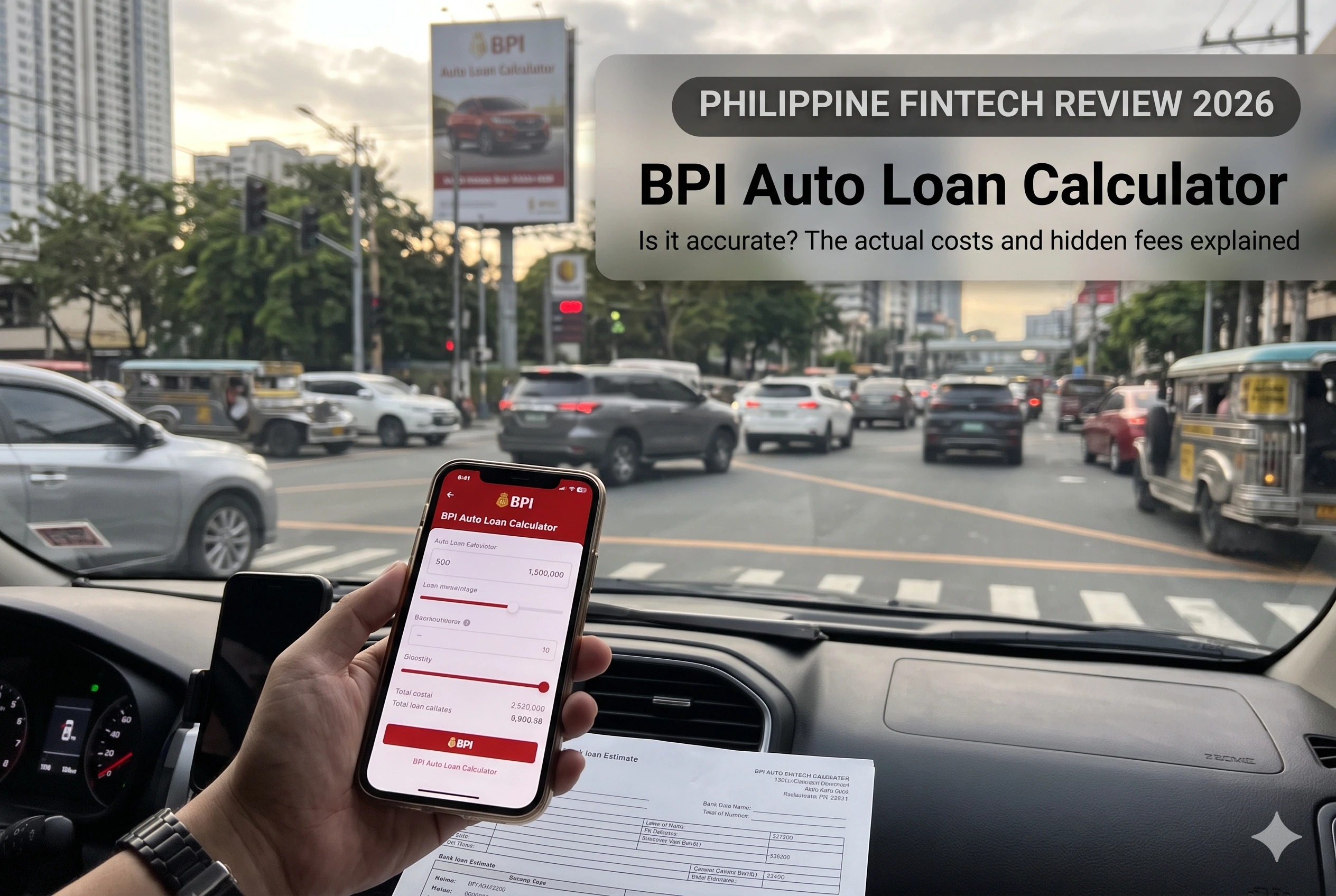
Buying a vehicle in the Philippines involves more than just matching a dealer’s sticker price to your monthly salary. Many prospective buyers rely on the Bank of the Philippine Islands (BPI) Auto Loan calculator to estimate their monthly amortization. However, taking basic calculator outputs at face value can lead to severe financial miscalculations if you fail to account for upfront processing costs, mandatory insurance, and legal fees.
This review examines how the BPI Auto Loan calculator functions in 2026, what it accurately predicts, and what financial realities borrowers must independently verify before signing a promissory note.
Summary:
The BPI Auto Loan calculator is a legitimate estimation tool provided by one of the Philippines’ largest universal banks, which is strictly regulated by the Bangko Sentral ng Pilipinas (BSP). While the tool accurately computes basic monthly amortization based on your principal and standard add-on rates, it typically excludes heavy out-of-pocket expenses like comprehensive car insurance, chattel mortgage fees, and documentary stamp taxes. Borrowers should prepare an additional 3% to 5% of the vehicle’s price for these upfront costs unless they secure a specific “All-In” dealer promo. You must request a formal bank computation to confirm your exact financial obligation.
| Borrower question | Current finding | Why it matters |
| Who is the lender? | Bank of the Philippine Islands (BPI), a BSP-supervised universal bank. | Provides regulatory protection and formal complaint channels through the BSP. |
| Is the calculator exact? | No. It provides an estimate based on current indicative rates. | Final rates depend on actual bank approval, vehicle type, and current market conditions. |
| What is missing from the calculation? | Chattel mortgage, comprehensive insurance, and standard processing fees. | You will need thousands of pesos in actual cash beyond the standard 20% downpayment. |
| What are the standard terms? | 12 to 60 months, with a minimum 20% downpayment for brand-new private vehicles. | Longer terms lower the monthly payment but significantly increase the total interest paid. |
| Are early payments allowed? | Yes, but standard bank policies apply. | Paying off the loan early may incur pre-termination fees that offset expected interest savings. |
Is the BPI Auto Loan calculator accurate for 2026?
Yes, the BPI Auto Loan calculator accurately applies the bank’s standard add-on interest rates to your requested principal. However, it functions strictly as an estimator. It does not guarantee approval, nor does it typically reflect mandatory supplementary costs like insurance or chattel mortgage fees.
When you input a vehicle price, downpayment percentage, and loan term into the BPI online calculator, the system uses the bank’s prevailing indicative rates to generate a monthly amortization figure. Our review of published banking practices in the Philippines confirms that these indicative rates represent the baseline cost of borrowing.
However, the final rate applied to your contract may vary based on the specific dealership tie-ups, promotional periods (such as the BPI Auto Madness events), and your individual credit evaluation. The calculator is a starting point, not a legally binding contract.
What fees are missing from standard auto loan calculators?
Standard calculators isolate the principal and interest. They routinely exclude the Chattel Mortgage fee, Documentary Stamp Tax (DST), and Comprehensive Motor Car Insurance. Borrowers must pay these in cash before the vehicle is released.
The most significant risk of relying purely on a loan calculator is “sticker shock” upon approval. If a borrower calculates a 20% downpayment on a ₱1,000,000 vehicle, they might expect to pay exactly ₱200,000 upfront. In reality, the net cash required is much higher.
Based on standard Philippine automotive financing structures, borrowers must also prepare for:
- Chattel Mortgage Fee: The legal cost of registering the vehicle as collateral with the Registry of Deeds and the Land Transportation Office (LTO). This generally ranges from 2% to 3% of the amount financed.
- Comprehensive Insurance: BPI requires the vehicle to be fully insured for the duration of the loan. A one-year policy for a standard sedan or SUV typically costs between ₱18,000 and ₱35,000, payable before release.
- Documentary Stamp Tax (DST): A mandatory government tax levied on loan agreements and promissory notes.
Unless you are approved for a specific “Free Chattel” or “Free One-Year Insurance” promo, you must add these figures to your cash preparation.
How does BPI Auto Loan calculate interest?
Like most automotive financing in the Philippines, BPI uses an “add-on rate” rather than a declining balance method. The bank computes the total interest for the entire term upfront and divides the total equally across your monthly payments.
Understanding the add-on rate is critical for borrowers comparing costs. If the calculator applies a hypothetical 25% add-on rate over 60 months, that percentage is applied to the original loan amount, not the remaining balance.
For example, if you finance ₱800,000 at a 25% total add-on rate for five years:
- Total Interest = ₱200,000
- Total Amount Payable = ₱1,000,000
- Monthly Amortization = ₱16,666.67
This structure means your monthly payment remains fixed, which helps with budgeting. However, it also means that you are paying interest on the full principal for the entire five years, making the effective interest rate (EIR) notably higher than the nominal add-on rate.
BPI Bank Financing vs. In-House Dealer Financing
BPI bank financing is generally much cheaper than in-house financing offered directly by car dealerships. While dealers may advertise lower downpayments, they typically apply significantly higher add-on interest rates to compensate for the higher risk.
Borrowers often use the BPI calculator to compare bank rates against dealer quotes. Dealerships frequently push buyers toward in-house financing because the dealer earns a commission on the loan.
If you compare the monthly amortization of a BPI Auto Loan against an in-house financing quote for the same term and downpayment, the bank financing will almost always result in a lower monthly payment and a lower total borrowing cost. The trade-off is that BPI’s underwriting and approval process is stricter than that of a dealership, requiring thorough income verification and a solid credit history.
What happens if you pay late?
BPI imposes a late payment penalty on overdue amortizations. According to standard bank disclosures, this is typically around 5% per month or a fraction thereof, applied to the delayed amount, alongside potential collection actions.
Missing an auto loan payment carries heavy consequences. Because the vehicle serves as collateral (via the Chattel Mortgage), sustained delinquency gives the bank the legal right to repossess the car.
Furthermore, as a highly regulated financial institution, BPI submits borrower credit data to the Credit Information Corporation (CIC). A default or consistent late payments will severely damage your Philippine credit score, affecting your ability to secure future housing loans, credit cards, or personal credit.
What are borrowers saying about the BPI Auto Loan process?
Recent anecdotal borrower reports highlight highly competitive interest rates, especially during promo periods, but note that the approval process requires extensive documentation. Some borrowers report delays if their income sources are difficult to verify.
Based on consumer discussions in Philippine financial forums and automotive groups, the prevailing sentiment is that BPI offers some of the most reasonable rates in the market.
Recurring positive themes include:
- Transparency in the final contract disclosure.
- The convenience of auto-debit arrangements (ADA) for repayment.
- Frequent promotional tie-ups with major car brands (Toyota, Mitsubishi, Ford).
Recurring points of friction include:
- Strict underwriting that often limits approval for freelancers or gig workers without formal income tax returns (ITR).
- The requirement to open or maintain a BPI deposit account specifically for the ADA.
What should you check before accepting the final loan?
Never rely solely on the website calculator. Before signing the promissory note, demand a formal Disclosure Statement from BPI. Verify the exact monthly amortization, the effective interest rate, and the itemized list of upfront deductions.
The Truth in Lending Act (Republic Act No. 3765) requires all Philippine lenders to provide a clear Disclosure Statement before a loan is consummated.
When your BPI Auto Loan is approved, compare the formal disclosure against your initial calculator estimates. Specifically, check:
- The Net Proceeds: Is the bank deducting the chattel mortgage and DST from the loan proceeds, or do you need to pay them in cash to the dealer?
- The Lock-in Period: Are there penalties for paying off the loan before the 60-month term ends?
- Insurance Renewal: Are you required to renew your comprehensive insurance exclusively through BPI’s partner providers, or can you source your own policy in the second year?
References
- Bank of the Philippine Islands Organization: BPI Resource: Auto Loan Calculator and Product Terms URL: https://www.bpi.com.ph/personal/loans/auto-loan
- Bangko Sentral ng Pilipinas Organization: BSP Resource: Financial Consumer Protection Department URL: https://www.bsp.gov.ph
- Official Gazette of the Philippines Organization: Republic of the Philippines Resource: Republic Act No. 3765 (Truth in Lending Act) URL: https://www.officialgazette.gov.ph/1963/06/22/republic-act-no-3765/