Last Updated on 23/09/2026 by Nicole Alba
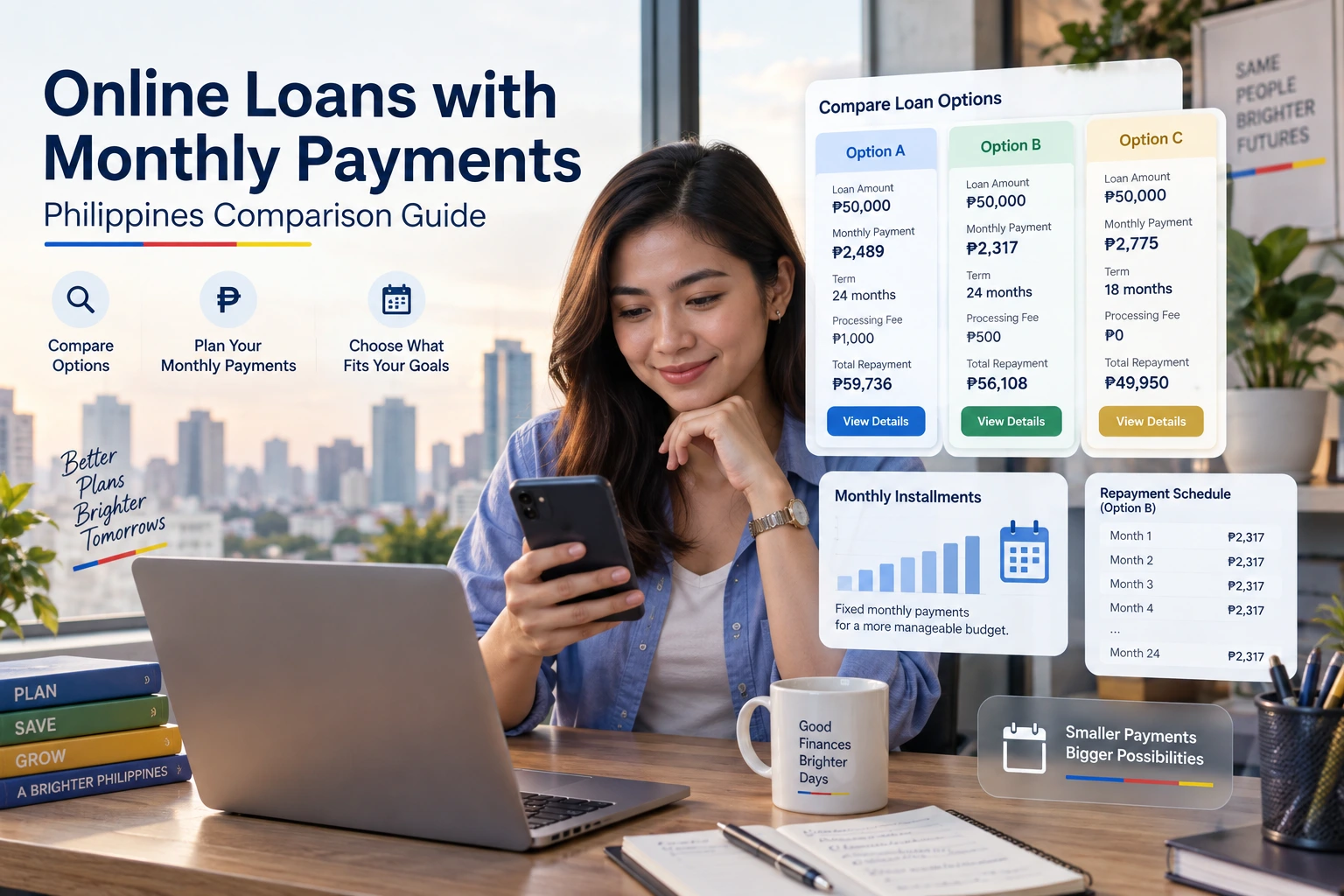
A monthly payment can make an online loan look easier to manage than a short-term loan due in seven, 14, or 30 days. But “monthly installment” does not automatically mean inexpensive. A lower-looking monthly rate can sit beside processing fees, documentary stamp tax, disbursement charges, late-payment penalties, or an approved principal that is larger than the cash actually credited to your account.
For this September 2026 review, we compared six online loan products available to Philippine borrowers: Maya Personal Loan, CIMB Personal Loan, UnionBank Personal Loan, GLoan, Tonik Credit Builder, and BillEase. The comparison focuses on legal lender identity, repayment term, published rates and fees, actual cash proceeds where those can be established, repayment friction, and borrower protections.
Filipino borrowers looking for online loans with monthly payments have choices ranging from small app-based credit to bank personal loans reaching seven figures. Maya, CIMB, UnionBank, and Tonik operate through BSP-supervised banks, while GLoan and BillEase involve SEC-authorized financing companies. Published terms vary sharply: some loans advertise sub-1% monthly add-on rates, while others disclose rates above 4% monthly plus fees. The most important comparison is therefore not the headline rate but cash actually received, total repayment, due dates, late charges, and the legal lender named in the Disclosure Statement.
| Borrower question | Current finding | Why it matters |
|---|---|---|
| Which products offer monthly installments? | All six products reviewed provide monthly repayment structures, although eligible terms depend on the approved offer. | Monthly repayment may align better with salary cycles than very short-term OLP loans. |
| Which have the longest published terms? | CIMB and UnionBank publish terms of up to 60 months. | A longer term can reduce the monthly installment but may increase the total peso cost. |
| Which have the largest published limits? | UnionBank advertises personal loans up to ₱2 million, while CIMB publishes up to ₱1 million, subject to approval. | Maximum advertised limits are not guaranteed first-loan amounts. |
| Can approved principal differ from cash received? | Yes. GLoan publishes a 3% – 5% processing fee deducted from proceeds, and Tonik documentation lists upfront processing and DST charges. | Borrowers should budget using net proceeds rather than the approved principal alone. |
| Does the Philippine 6% monthly interest ceiling apply to every online loan? | No. BSP Circular No. 1133 applies to a defined class of unsecured general-purpose loans of ₱10,000 or less with terms of four months or less from covered lending/financing companies and OLPs. | Bank personal loans and larger or longer loans should not automatically be judged against that specific cap. |
| What should be checked immediately before accepting? | The in-app Disclosure Statement or loan agreement should confirm the lender, net proceeds, EIR, total repayment, due dates, fees, and late-payment rules. | Public product pages can change and, in several cases reviewed here, do not perfectly agree with one another. |
Which online loans with monthly payments are worth comparing in 2026?
The six products below cover different borrowing needs rather than forming a cheapest-to-most-expensive ranking. The important differences are loan size, tenor, legal lender, deductions, effective borrowing cost, and whether the borrower already needs an account or pre-qualified offer.
| Product | Legal/operator position | Published amount and term | Important pricing or fee checkpoint |
|---|---|---|---|
| Maya Personal Loan | Offered by Maya Bank, a BSP-supervised digital bank. | Current Maya pages show terms of 6 – 24 months, but published amount limits differ between official pages. | One official page advertises rates as low as 0.77% monthly add-on, while another states 0.83% in parts of its disclosure. Verify the actual offer. |
| CIMB Personal Loan | CIMB Bank Philippines appears in current BSP banking records. | ₱30,000 – ₱1,000,000, with 12 – 60 months published. | Published PDS lists rates from 0.83% monthly add-on, plus DST and possible disbursement or early-settlement fees. |
| UnionBank Personal Loan | UnionBank is a BSP-supervised bank appearing in current BSP records. | Up to ₱2 million and up to five years. | Official examples use a 26.9% average annual contractual rate and disclose separate fees and possible initial interest. |
| GLoan | The GLoan agreement identifies Fuse Financing Inc.; the official GCash listing states SEC Registration No. CS201617622 and Certificate of Authority No. 1317. | GCash pages currently show 1 – 24 months, but published maximums differ between ₱125,000 and ₱150,000. | Published monthly interest is 1.59% – 6.99%, with a 3% – 5% processing fee deducted from proceeds. |
| Tonik Credit Builder | Tonik Digital Bank is included in BSP digital-bank records. | Up to ₱50,000, generally 6, 9, or 12 months on the current product page. | Tonik’s official pages currently show slightly different advertised rate floors and disclose a ₱500 processing fee plus DST in its FAQ. |
| BillEase | Operated by First Digital Finance Corporation, which states SEC Registration No. CS201516347 and financing-company Certificate of Authority No. 1101. | Official app disclosures show ₱500 – ₱50,000 and installment terms of 2 – 24 months. | Published interest is 0% – 3.49% monthly, with possible service charges of 0% – 10%, depending on the offer. |
How did we verify these online loans?
This review uses regulator records, lenders’ official pages, product disclosures, app-store information, privacy documentation, and independently calculated peso examples where the published inputs are sufficient. It does not claim a hands-on borrowing test or an approval outcome that was not documented.
That distinction matters for loan reviews. Approval limits, interest rates and fees can be personalized, and an app’s marketing page may not show the same offer presented to a particular borrower. Where official pages conflict, this article identifies the discrepancy instead of choosing whichever figure looks more attractive.
Borrower-review anecdotes were also not used as a substitute for contractual evidence. App-store ratings can cover payments, wallets, shopping functions and technical issues as well as lending, making them a poor basis for estimating how a specific loan will perform for a new borrower.
Is Maya Personal Loan a clear monthly-installment option?
Maya Personal Loan provides monthly installments through a BSP-supervised digital bank, but Maya’s current public pages do not fully agree on the available loan range or lowest advertised rate. Borrowers should therefore treat the Disclosure Statement shown for their individual offer as the controlling cost document.
Maya’s current borrowing page advertises personal loans from ₱15,000 to ₱250,000, with repayment choices of 6, 9, 12, 18 or 24 months. It also advertises a monthly add-on rate as low as 0.77% for a 24-month loan and a monthly EIR figure starting at 1.40%.
A separate official Maya Personal Loan page currently says the loan amount can range from ₱10,000 to ₱400,000 and includes other rate wording. That is a material public-disclosure inconsistency, not something a borrower should attempt to reconcile by assumption.
Maya provides a useful official peso example: a ₱25,000 six-month loan at 0.83% monthly add-on, with the cited promotional fees at zero, has an installment of about ₱4,374.17 and stated total repayment of ₱26,239.19.
The same page currently lists a late charge of 0.17% of unpaid principal per day. Maya’s contractual documentation also states that collection activity may involve authorized collection agencies and that delinquency may be reported to a credit bureau under applicable terms.
For a borrower, the main checkpoint is simple: do not assume the ₱250,000 or ₱400,000 headline, or the lowest displayed rate, is the offer you will receive. Read the amount, EIR, fees and total obligation shown immediately before acceptance.
How does CIMB Personal Loan compare for longer repayment terms?
CIMB is one of the broader-term options in this comparison, publishing loans from ₱30,000 to ₱1 million and terms from 12 to 60 months. Its rate can look low on an add-on basis, but the PDS also lists taxes, disbursement charges, prepayment costs and late fees.
CIMB’s published Product Disclosure Sheet states monthly add-on rates starting around 0.83%, corresponding in its disclosure example to an annual contractual rate of 18%, subject to risk assessment. The actual approved pricing depends on the borrower and offer.
The fee structure deserves as much attention as the interest rate. The PDS lists Documentary Stamp Tax of ₱1.50 per ₱200, a zero disbursement fee when using a CIMB account, and a fee of 1% of principal or ₱500, whichever is higher, for certain disbursements to other banks. It also lists an early settlement fee of 3% of unbilled principal or ₱300, whichever is higher.
For late payment, CIMB’s published terms state 5% of the unpaid installment or ₱300, whichever is higher, subject to the contractual conditions.
CIMB says application review may take up to two banking days after the necessary requirements are supplied. Disbursement timing also depends on where the borrower sends the proceeds: transfers to a CIMB account can be immediate, while other-bank settlement may depend on InstaPay or PESONet processing.
The practical implication is that a five-year term should not be evaluated by monthly installment alone. Compare the total amount payable over the full term and check whether you might want to settle early, because an early-settlement fee can change that decision.
What stands out about UnionBank Personal Loan?
UnionBank publishes the highest headline limit among the six products reviewed – up to ₱2 million – and terms of up to five years. Its own repayment examples also show why borrowers should compare total peso repayment rather than focusing only on the size of the monthly installment.
The official UnionBank page presents an example based on an average 26.9% Annual Contractual Rate. For ₱100,000 over 12 months, the displayed monthly payment is ₱9,596.86. Twelve installments therefore total approximately ₱115,162.32.
That figure should not automatically be interpreted as the borrower’s final all-in cash outflow. UnionBank’s page separately discloses a ₱1,750 disbursement fee, Documentary Stamp Tax and an initial-interest charge that may appear on the first statement. Its example for a ₱200,000, 36-month loan also cites an EIR of 31.98% under the stated assumptions.
The page lists a pretermination or closure handling charge of 4% of unbilled principal, while the late-payment charge is stated as ₱500 or 6% of the overdue amount, whichever is higher. Further default charges may apply under the contract after prolonged delinquency.
UnionBank also advertises fast approval and disbursement under qualifying circumstances, but “as fast as” is not a guaranteed processing time. Document completeness, underwriting and account validation can still affect when a borrower receives funds.
Does GLoan really give you the full amount you borrow?
Not necessarily. GLoan currently discloses a processing fee of 3% – 5% that is deducted from the approved loan proceeds. That makes the difference between approved principal and cash actually received especially important when comparing GLoan with products that do not deduct an upfront fee.
For example, on a ₱10,000 approved GLoan, a 3% processing fee would leave about ₱9,700, while a 5% fee would leave about ₱9,500, before considering any other contract-specific item. The borrower should therefore ask, “How much lands in my wallet?” rather than only, “How much was approved?”
GCash currently publishes monthly GLoan interest of approximately 1.59% – 6.99% and monthly repayment periods of up to 24 months. However, its own help pages do not currently agree on the maximum loan amount: one page states up to ₱125,000, while another states up to ₱150,000.
Legal identity also requires care. The GLoan terms identify Fuse Financing Inc. as the contracting financing company, while GCash states that qualifying accounts may in some circumstances be transferred to partner financial institutions without changing the contracted loan terms. Borrowers should therefore check the lender named on the actual Disclosure Statement rather than assuming “GCash” itself is always the creditor.
Current published late charges include 1% of the loan amount for each missed due date plus 0.15% of outstanding balance multiplied by the number of days past due, under the disclosed rules.
Payment timing is another operational risk. GCash states that payments made through the GLoan dashboard can post in real time, while some bills-payment or partner channels may take up to three business days. A borrower who waits until the due date and uses a slower channel could therefore create unnecessary payment-posting uncertainty.
Is Tonik Credit Builder still the same as Tonik Quick Loan?
Tonik describes Credit Builder as the updated version of Quick Loan. The product currently offers up to ₱50,000 with monthly terms commonly shown as 6, 9 or 12 months, but its public materials contain differing rate figures and fee/disbursement descriptions that should be checked against the final in-app offer.
Tonik’s current loans page advertises Credit Builder with a monthly add-on rate “as low as” around 4.20% in one section, while other official Tonik material gives slightly different starting figures. The same product page also contains a different rate figure elsewhere. This makes the personalized Disclosure Statement more important than the marketing headline.
Tonik’s FAQ lists a ₱500 processing fee and Documentary Stamp Tax of ₱1.50 per ₱200, described as one-time deductions associated with disbursement. The fixed processing fee has a particularly large proportional effect on small loans: ₱500 alone equals 10% of a ₱5,000 principal, before interest or DST.
The same FAQ lists a ₱500 late-payment fee where applicable. Tonik also states that borrowers should keep sufficient money in their Tonik account for automatic repayment; PESONet top-ups may not post until the next banking day.
One useful contract feature disclosed by Tonik is that early full settlement is available without a pretermination penalty on the current Credit Builder page.
What should borrowers know about BillEase cash loans?
BillEase combines monthly installment lending with relatively small loan sizes. Its current app disclosures show ₱500 – ₱50,000, terms of 2 – 24 months, monthly interest of 0% – 3.49%, and possible service charges of 0% – 10%. The exact offer can therefore vary substantially between borrowers.
BillEase is operated by First Digital Finance Corporation (FDFC), which states that it holds SEC financing-company Certificate of Authority No. 1101. Its website also references BSP registration as an Operator of Payment System. Those are different regulatory concepts: the SEC financing authority relates to lending/financing activity, while BSP OPS registration should not be described as BSP approval of every BillEase loan product.
An official Google Play example is especially useful for understanding the cost. It describes a ₱12,000 cash plan for three months with installments of ₱4,539, producing total repayment of ₱13,617.
There is also a small but meaningful arithmetic inconsistency in that published example. The listing states a ₱120 monthly service charge, which over three installments equals ₱360, while another line describes the total service charge as ₱420. The stated ₱13,617 repayment reconciles with ₱12,000 principal + ₱1,257 interest + ₱360, not ₱420. This does not establish that a borrower’s contract is wrong; it is a reason to rely on the actual Disclosure Statement rather than an app-store summary.
BillEase’s privacy policy also deserves attention. It describes collection of identity, device, financial and certain contact-related information for purposes that include KYC and fraud prevention. At the same time, BillEase’s public safety statement says it does not contact a borrower’s family, employer or phonebook contacts for debt collection. Data collection and the use of contacts for collection are separate questions, so borrowers should review both permissions and the stated purpose for each permission.
What do these monthly online loans really cost in pesos?
Advertised interest alone cannot answer this question. The useful figures are approved principal, cash actually received, installment amount, number of installments, upfront deductions, total repayment and any cost triggered by late or early payment.
| Example | What the published information shows | What a borrower should notice |
|---|---|---|
| Maya: ₱25,000 / 6 months | Official example: about ₱4,374.17 monthly, ₱26,239.19 total repayment, using the stated 0.83% add-on rate and cited zero-fee promotion. | A low-looking monthly add-on rate still produces a peso cost above principal. Promotions can change. |
| UnionBank: ₱100,000 / 12 months | Official calculator example: ₱9,596.86 × 12 = ₱115,162.32 in scheduled installments. Separate fees and initial-interest treatment are disclosed by UnionBank. | Do not assume the installment sum is the only cash outflow. |
| GLoan: ₱10,000 approved | A 3% – 5% processing deduction means estimated cash proceeds of about ₱9,500 – ₱9,700. | Approved principal and usable cash can be materially different. |
| Tonik: ₱5,000 principal | The published ₱500 processing fee alone equals 10% of principal, before DST and interest. | Fixed fees have a larger percentage impact on small loans. |
| BillEase: ₱12,000 / 3 months | Official example gives ₱4,539 × 3 = ₱13,617 total repayment, but the listing contains an inconsistent service-fee subtotal. | Recalculate the peso amounts shown in the Disclosure Statement before accepting. |
This is why comparing “0.83% versus 2.49% versus 4.20%” without the rest of the contract can be misleading. Add-on rates, contractual rates and effective interest rates are not interchangeable, and upfront deductions can increase the cost relative to the cash the borrower actually receives.
What happens if you pay these loans late?
Every product reviewed can impose financial or credit consequences for delinquency, although the formulas differ. A borrower who expects repayment difficulty should contact the lender before the due date rather than assume a grace period exists.
| Product | Published late-payment information reviewed |
|---|---|
| Maya | Current product page lists 0.17% of unpaid principal per day. |
| CIMB | PDS lists 5% of unpaid installment or ₱300, whichever is higher. |
| UnionBank | Official page lists ₱500 or 6% of the overdue amount, whichever is higher, with further default provisions under stated circumstances. |
| GLoan | Published formula includes 1% of loan amount per missed due date plus 0.15% of outstanding balance per day past due under the stated terms. |
| Tonik Credit Builder | Official FAQ lists a ₱500 late-payment fee, where applicable. |
| BillEase | Current public information confirms that penalties may apply, but the precise cash-loan late charge should be checked in the borrower’s loan agreement rather than inferred from another BillEase product. |
Payment posting also matters. A borrower can initiate a transfer on time yet still face a problem if the selected channel takes one or more banking days to credit the loan. GLoan and Tonik both publish timing information showing why borrowers using slower transfer channels should fund repayment before the last moment.
What Philippine borrower protections apply to online loans?
Philippine borrowers have protections covering disclosure, privacy, data access and debt-collection conduct, but the exact regulatory rule depends on the lender and product. A rule written for small OLP loans should not be presented as a universal cap for every bank personal loan.
Interest and fee ceilings have a limited scope
BSP Circular No. 1133 sets price ceilings for a specific category of unsecured, general-purpose loans extended by covered lending companies, financing companies and their online lending platforms: loans of ₱10,000 or less with terms not exceeding four months. For that defined category, the circular sets a nominal interest ceiling of 6% per month and an effective interest ceiling of 15% per month, excluding permitted late-payment charges.
That rule should not be turned into the statement “all Philippine online loans are capped at 6% monthly.” Longer bank personal loans and products outside the circular’s defined scope require separate analysis.
Contact-list access is not a free pass for debt collection
A March 2026 joint advisory from the DICT, National Privacy Commission and SEC reiterates restrictions on unnecessary or disproportionate processing of personal data by online lending platforms. It specifically addresses excessive contact-list access and the use of persons in a borrower’s contact list for collection when those people are not named guarantors.
NPC rules also require app permissions to be suitable, necessary and not excessive for the declared purpose. Camera or photo access may be legitimate for specific identity-verification functions, but that does not justify unrestricted access to unrelated personal information.
Credit data can have consequences beyond the next due date
The Credit Information Corporation operates the Philippines’ central credit-information repository under the Credit Information System Act. Covered financial institutions submit credit information, and consumers have mechanisms to access their credit report and dispute erroneous information.
A late loan should therefore not be viewed only through the size of the immediate penalty. Where a lender reports credit performance, delinquency can affect a borrower’s recorded credit history. The exact reporting practice for a particular account should be checked with the lender rather than assumed.
The SEC also advises borrowers to verify the lender or financing company, read the loan agreement and Disclosure Statement, understand rates and fees, keep payment receipts, and avoid unnecessary permissions to contacts or social-media information.
Which type of borrower might compare each product?
The useful question is not “Which app is universally best?” but “Which repayment structure matches the amount, time horizon and cash flow I can realistically support?” The same product can be workable for one borrower and unnecessarily expensive for another.
| Borrowing situation | Products that may be relevant to compare | Main caution |
|---|---|---|
| Need a larger amount and potentially several years to repay | CIMB, UnionBank | Longer tenor lowers the installment but may increase total peso interest; both disclose early-settlement charges. |
| Already use a digital bank and want an integrated application | Maya, Tonik | Published offers are personalized, and current public pages contain some inconsistent figures. |
| Already have an eligible GCash account and receive a GLoan offer | GLoan | Processing fees reduce net proceeds, and not every verified GCash user receives an offer. |
| Need a smaller installment loan | BillEase, GLoan, Tonik | Fixed or percentage fees can represent a large share of a small principal. |
| Expect to repay earlier than scheduled | Tonik may be worth examining because its current page states no pretermination penalty | CIMB and UnionBank publish early-settlement or closure charges, so compare the contract before choosing a long tenor. |
| Need the full approved principal available as cash | Examine disbursement deductions carefully | GLoan expressly publishes a 3% – 5% deduction; other products may have taxes or fees depending on the offer. |
None of those situations guarantees approval. Banks and financing companies use underwriting criteria that can include age, income, employment, account history, verification results and credit information. Their full internal scoring models are not generally public.
What should you verify before accepting an online loan?
The safest comparison is made from the final Disclosure Statement, not an advertisement. Before tapping “Accept,” the borrower should be able to identify the legal creditor and reproduce the basic peso economics of the offer without guessing.
| Check | What should be visible before acceptance |
|---|---|
| Legal lender | Full company or bank name, not only the consumer-facing app brand |
| Approved principal | The contractual amount on which repayment is calculated |
| Net proceeds | Exact peso amount that will reach the bank account or e-wallet after deductions |
| Effective cost | Interest rate/EIR, processing charges, DST, service charges and other mandatory fees |
| Total repayment | Total pesos due if every scheduled installment is paid on time |
| Payment schedule | Exact number of installments, due dates and payment channels |
| Late-payment exposure | Penalty formula, default interest if applicable, and collection consequences |
| Early repayment | Whether paying ahead saves interest and whether a pretermination fee applies |
| Payment posting | Whether payment is considered received immediately or after bank/partner processing |
| Privacy permissions | What device or personal data is requested and the stated purpose |
| Complaint route | Lender support channel plus the appropriate SEC, BSP or privacy escalation route |
A particularly useful final check is to calculate total repayment minus cash actually received. That peso difference is often more intuitive than a marketing rate. If a ₱10,000 approval leaves only ₱9,500 in usable cash but the repayment schedule is based on the contracted principal and charges, the cost should be evaluated against the ₱9,500 the borrower can actually spend.
Final borrower decision framework
Online loans with monthly payments can reduce the pressure of a single near-term due date, but they replace that pressure with a longer contractual commitment. The most important number is therefore not the maximum limit, “as low as” interest rate or advertised approval speed. It is the amount your budget must produce on every due date until the balance reaches zero.
For Maya, verify the personalized offer because current official pages show different amount and rate headlines. For CIMB, pay attention to the long tenor, DST, external disbursement costs and early-settlement fee. For UnionBank, include the initial interest and disclosed charges rather than relying on the monthly calculator alone. For GLoan, distinguish approved principal from net proceeds after the processing deduction. For Tonik, consider how the fixed ₱500 processing fee affects a small loan. For BillEase, check the contractual figures directly because even its current published sample contains a small arithmetic inconsistency.
Before accepting any of them, the borrower should be able to answer five questions in pesos: How much will I receive? How much will I repay in total? How much is due each month? What will late payment cost? Can I repay every installment without borrowing again? If one of those answers is still unclear, the loan offer has not yet been explained well enough to accept.
References
- Bangko Sentral ng Pilipinas
Organization: Bangko Sentral ng Pilipinas
Resource: Circular No. 1133 – Ceiling/s on Interest Rates and Other Fees Charged by Lending Companies, Financing Companies, and their Online Lending Platforms
URL: BSP Circular No. 1133 - DICT, National Privacy Commission and Securities and Exchange Commission
Organization: Philippine Government
Resource: Joint Advisory on Online Lending Platforms, March 2026
URL: Joint Advisory on Online Lending Platforms - National Privacy Commission
Organization: National Privacy Commission
Resource: NPC Circular No. 2022-02 and loan-related data-processing rules
URL: NPC loan-related data rules - Credit Information Corporation
Organization: Credit Information Corporation
Resource: CIC Privacy Notice / Credit Information System information
URL: CIC Privacy Notice - Securities and Exchange Commission Philippines
Organization: SEC Philippines
Resource: Borrower advisory on online lending and financing companies
URL: SEC borrower advisory - Bangko Sentral ng Pilipinas
Organization: BSP
Resource: Digital Bank records covering Maya Bank and Tonik Digital Bank
URL: BSP digital bank records - Bangko Sentral ng Pilipinas
Organization: BSP
Resource: Universal and Commercial Bank records covering UnionBank and CIMB Bank Philippines
URL: BSP bank records - Maya Bank
Organization: Maya Bank, Inc.
Resource: Maya Personal Loan
URL: Maya Personal Loan - Maya
Organization: Maya Bank, Inc.
Resource: Personal Loan rates, sample computation and charges
URL: Maya borrowing information - CIMB Bank Philippines
Organization: CIMB Bank Philippines, Inc.
Resource: CIMB Personal Loan Product Disclosure Sheet
URL: CIMB Personal Loan PDS - CIMB Bank Philippines
Organization: CIMB Bank Philippines, Inc.
Resource: Personal Loan amounts and repayment terms
URL: CIMB Personal Loan information - UnionBank of the Philippines
Organization: UnionBank
Resource: Personal Loan – rates, fees, repayment examples and eligibility
URL: UnionBank Personal Loan - GCash / Fuse Financing
Organization: Fuse Financing Inc. / GCash
Resource: GLoan Terms and Conditions
URL: GLoan Terms and Conditions - GCash
Organization: G-Xchange, Inc. / Fuse Financing Inc.
Resource: GLoan interest, processing fees and late charges
URL: GLoan fees and charges - GCash
Organization: G-Xchange, Inc.
Resource: GLoan lending-partner information
URL: GLoan lender information - Google Play – GCash
Organization: GCash / Fuse Financing Inc.
Resource: Official GCash app lending disclosure
URL: GCash official app listing - Tonik Digital Bank
Organization: Tonik Digital Bank, Inc.
Resource: Credit Builder loan information
URL: Tonik Credit Builder - Tonik Digital Bank
Organization: Tonik Digital Bank, Inc.
Resource: Quick Loan / Credit Builder FAQ, fees and eligibility
URL: Tonik Credit Builder FAQ - First Digital Finance Corporation
Organization: First Digital Finance Corporation / BillEase
Resource: Company and regulatory information
URL: BillEase official website - Google Play – BillEase
Organization: First Digital Finance Corporation
Resource: BillEase official app listing – loan amounts, terms, rates and repayment example
URL: BillEase official app listing - BillEase
Organization: First Digital Finance Corporation
Resource: Privacy Policy
URL: BillEase Privacy Policy