Last Updated on 28/10/2026 by Nicole Alba
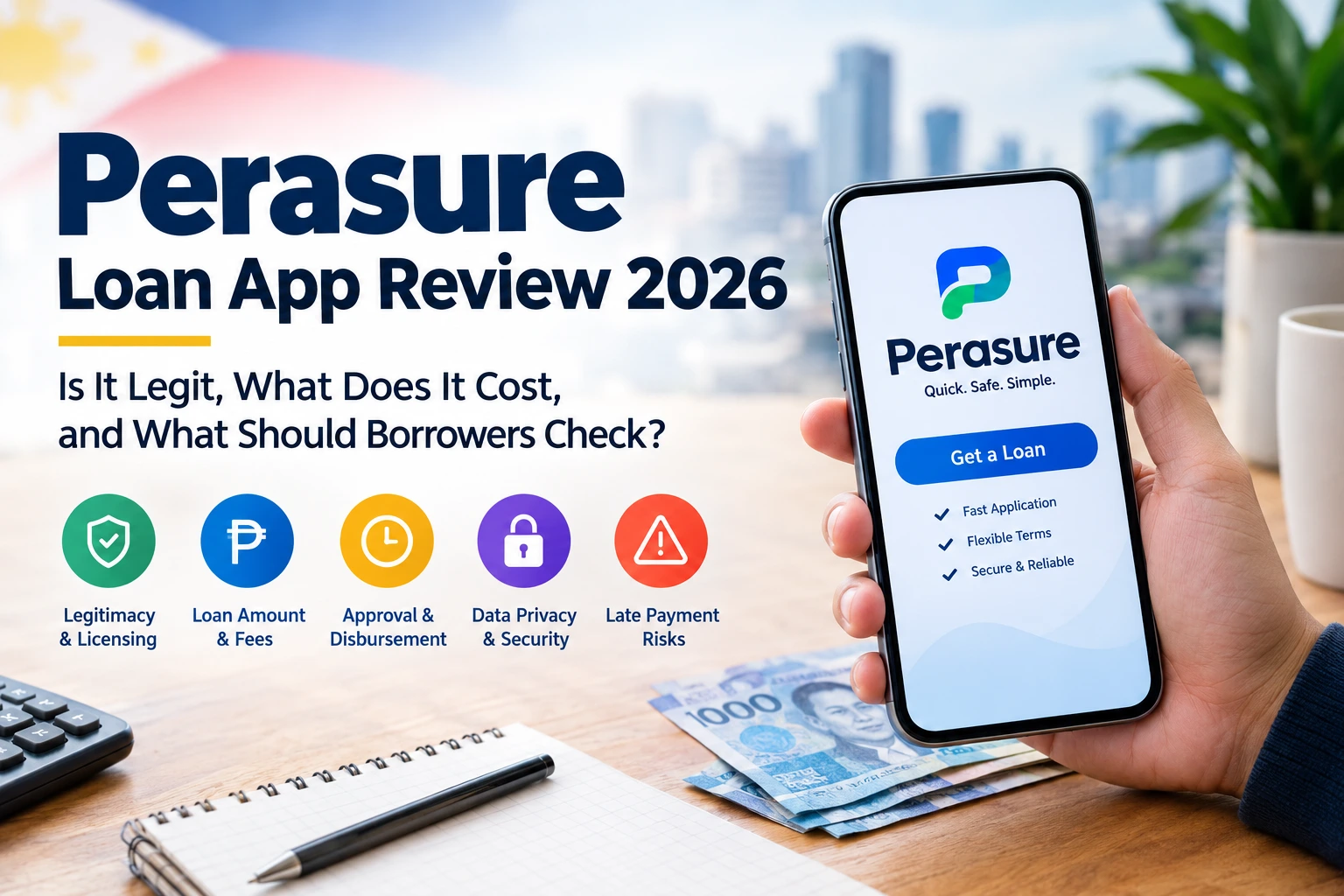
PeraSure is an online lending app operated by SULIT LENDING CORPORATION, which appears under the PeraSure brand in the Philippine Securities and Exchange Commission’s (SEC) list of recorded online lending platforms dated October 12, 2026. The company publishes SEC Registration No. 2020100002616-03 and Certificate of Authority No. 3333 on its official website.
The harder question is price. PeraSure advertises loans of up to ₱50,000 and daily rates below 0.3%, but those figures do not establish what a particular borrower will receive, repay, or pay in fees. Borrowers should rely on their own written disclosure statement and loan agreement, not a headline rate.
This review examines PeraSure’s published product information, SEC platform records, Philippine consumer-protection rules, available reporting, and the limits of publicly accessible borrower evidence. It is a document-based review, not a first-hand loan test. Available research did not establish a sufficiently complete, independently verified set of current loan terms to calculate every possible PeraSure offer or confirm a representative pattern of borrower complaints.
Summary
PeraSure is operated by SULIT LENDING CORPORATION, a lending company whose PeraSure platform appears on the SEC’s October 12, 2026 recorded-platform list. Its official website advertises credit of up to ₱50,000, repayment periods of 91–180 days, and a daily rate below 0.3%. The maximum credit limit is not a guaranteed approval, and the advertised rate is not a complete cost quotation. Public information does not independently establish the exact amount every borrower receives or repays. Before accepting an offer, check the legal lender, net disbursement, all fees, total repayment, payment schedule, late charges, and applicable annual percentage rate (APR) in the written disclosure.
| Borrower question | Current finding | Why it matters |
|---|---|---|
| Is PeraSure identifiable? | Yes. The published operator is SULIT LENDING CORPORATION. | The legal company, not just the app name, should appear in the contract. |
| Is the platform recorded by the SEC? | Yes, in the SEC list dated October 12, 2026. | Platform recording is not a guarantee of fair pricing or an endorsement of every loan offer. |
| How much can a borrower get? | Advertised maximum: ₱50,000, subject to credit evaluation. | The actual approved amount may be lower. |
| What does it cost? | The website advertises a daily rate below 0.3%; the final written offer determines the actual cost. | A daily rate alone does not show the total peso cost. |
| How fast is disbursement? | The company says funds typically arrive the same business day; some banks may take up to 24 hours. | This is a published claim, not a guaranteed processing time. |
| Is borrower privacy protected? | The company says it does not upload contact lists or call phonebook contacts. | These are company statements; app permissions and actual data practices still require scrutiny. |
Is PeraSure a legitimate loan app in the Philippines?
PeraSure has a verifiable legal operator and an SEC-recorded online lending platform. The operator is SULIT LENDING CORPORATION, with SEC Registration No. 2020100002616-03 and published Certificate of Authority No. 3333. These are meaningful legitimacy indicators, but they do not certify that every fee, collection practice, or individual loan contract complies with Philippine law.
The legal identity check produces the following findings.
| Identity check | Finding |
|---|---|
| Consumer-facing brand | PeraSure |
| Legal operator | SULIT LENDING CORPORATION |
| SEC registration number | 2020100002616-03 |
| Certificate of Authority | No. 3333, as published on the company’s website |
| SEC online lending platform record | PeraSure appears in the SEC list dated October 12, 2026 |
| Separate third-party lender | No separate lender is identified in the reviewed public disclosures |
| BSP-supervised bank or digital bank | No evidence reviewed establishes PeraSure as a bank or digital bank |
The distinction between corporate registration and lending authority matters. A company can be registered as a corporation without being authorized to conduct lending activities. An online lending platform’s SEC record is another distinct regulatory check. PeraSure’s published Certificate of Authority number strengthens its identity disclosure, but borrowers should verify the current company record if they need confirmation of its regulatory standing on a later date.
PeraSure also operates under the same legal company name associated with GoraLoan in the SEC list. That shared operator is relevant when identifying the party responsible for a loan, complaint, or collection dispute.
Legitimacy verdict: PeraSure is identifiable and appears in the SEC’s recorded-platform list. The available evidence does not justify calling it risk-free, declaring all its terms compliant, or treating SEC recording as a government recommendation.
What loan amounts and repayment terms does PeraSure advertise?
PeraSure’s official website advertises a maximum credit limit of ₱50,000, daily pricing below 0.3%, and repayment terms of 91–180 days. Applicants must undergo identity verification, and the company says eligibility depends on credit evaluation.
| Product feature | Published information | What borrowers should establish |
|---|---|---|
| Maximum credit | Up to ₱50,000 | The actual approved limit and first-offer amount |
| Repayment period | 91–180 days on the official website | The exact contractual maturity and instalment dates |
| Interest pricing | Daily rate below 0.3% | The exact daily rate, calculation basis, and APR |
| Fees | Website claims transparent pricing and no hidden charges | Every service fee, deduction, tax, and other charge in the disclosure |
| Identity requirements | Government-issued ID and work-related details | Exact documents and information requested by the current application |
| Disbursement | Bank account or e-wallet | Supported destination, amount received, and processing conditions |
The maximum is a ceiling, not a promise. A borrower who sees “up to ₱50,000” should not budget around that amount until the app displays an actual approved offer.
There is also a difference between an approved credit limit and a disbursed loan. A limit indicates how much credit may be available; it does not establish that the full amount will be released in cash, that all of it can be withdrawn at once, or that the borrower will qualify for the same limit again.
Who is PeraSure designed for?
PeraSure describes its target customers as Filipino working professionals aged 18–60 with stable monthly income who reside in the Philippines and have a valid government-issued ID. It also advertises an application process that does not require payslips, printed bank statements, or HR letters.
That paperless approach may reduce documentation for applicants whose earnings come from freelance work, gig platforms, commissions, or small businesses. It does not mean that income stability is irrelevant or that approval is automatic.
The company does not publicly explain enough about its proprietary credit assessment to establish how it weighs salaried employment against irregular income. Claims about particular approval odds for employees, freelancers, or self-employed applicants would be speculation.
Before submitting information, applicants should confirm whether the current in-app requirements match the website’s description.
What does a PeraSure loan really cost?
The official website advertises a daily rate below 0.3%, but the exact peso cost depends on the rate offered, how interest is calculated, applicable fees, and the repayment schedule. Research did not establish a complete, independently verified 2026 pricing schedule that can be applied to every PeraSure borrower.
This is the most important limitation in the public information reviewed. A headline daily rate cannot, by itself, tell a borrower how much money will arrive or how much must be repaid.
How to calculate the actual borrowing cost
Use the figures in the personal disclosure statement rather than estimating from the advertised maximum.
| Calculation | Formula |
|---|---|
| Net proceeds | Gross loan amount − upfront deductions |
| Total borrowing cost | Total contractual repayments − net proceeds |
| Total repayment | Sum of all scheduled payments |
| Cost as a percentage of cash received | Total borrowing cost ÷ net proceeds × 100 |
| Effective monthly burden | Total amount due in each month compared with available income |
Consider an illustrative offer with a gross principal of ₱10,000, upfront deductions of ₱500, and scheduled repayments totalling ₱12,000. These figures are hypothetical, not a PeraSure quotation.
| Item | Amount |
|---|---|
| Gross loan | ₱10,000 |
| Upfront deductions | −₱500 |
| Cash actually received | ₱9,500 |
| Total scheduled repayment | ₱12,000 |
| Total cost above cash received | ₱2,500 |
| Cost as a share of cash received | 26.32% |
In this example, the borrower owes ₱12,000 despite receiving only ₱9,500. The ₱2,500 difference is the actual peso cost relative to the cash received. The 26.32% figure is a simple cost ratio over the full loan, not an APR.
The calculation also shows why borrowers must distinguish the amount financed from the amount deposited into a bank account or e-wallet.
Does a daily rate below 0.3% mean a cheap loan?
No. The rate needs a calculation basis.
PeraSure’s website says its daily interest is calculated against the remaining principal, so interest falls as principal is repaid. A September 29, 2026 industry report separately described a 0.10% daily interest rate and a 0.25% combined daily rate including applicable service fees. These are published descriptions, not a substitute for the terms of a specific offer.
A daily rate can be misleading when readers assume that it is an annual percentage rate or that every fee uses the same declining balance. Borrowers should ask:
- Is interest calculated on the outstanding balance or the original principal?
- Are service fees calculated separately from interest?
- Does the quoted rate include all compulsory charges?
- Is the APR disclosed, and what assumptions does it use?
- Does early repayment reduce future interest or fees?
- Are any deductions taken before disbursement?
Without these details, multiplying a daily rate by the number of days may produce the wrong repayment estimate.
What Philippine interest-rate rules apply?
The SEC’s Memorandum Circular No. 14, Series of 2025 recalibrated interest-rate and fee ceilings for covered lending and financing companies. A contemporaneous report on PeraSure’s launch describes a 12% monthly cap on combined interest and fees for qualifying small loans, effective April 1, 2026.
That ceiling must not be applied indiscriminately to every loan. Its scope depends on the covered lender and the loan’s qualifying characteristics, including the applicable principal and term. The precise regulatory calculation also matters; a simple daily-rate comparison is not enough to establish compliance.
Borrowers should check the text of SEC Memorandum Circular No. 14, Series of 2025 and request a written explanation if the quoted charges appear inconsistent with the applicable ceiling. An SEC listing does not exempt a lender from pricing rules.
How fast does PeraSure approve and release funds?
PeraSure advertises application decisions in under three minutes and says approved funds typically arrive in the same business day. Its FAQ allows for some bank transfers to take up to 24 hours. These are company-published expectations, not guaranteed service levels.
Three separate stages matter:
- Identity verification: The applicant signs up and completes an in-app identity check.
- Credit decision: The platform assesses the profile and presents an offer, if approved.
- Disbursement: Funds are sent to the nominated bank account or e-wallet.
A fast credit decision does not prove that the money has been released. Nor does an advertised maximum approval time establish how long verification, a rejected destination account, or a transfer delay might take.
The reviewed public documentation does not provide independently verified processing-time statistics or a breakdown of rejection rates. Borrowers should not commit to a payment deadline, purchase, or emergency expense on the assumption that an application will be approved within minutes.
What happens if you miss a PeraSure payment?
PeraSure’s website warns that late repayment may affect a borrower’s credit score. The reviewed public material does not establish a complete current schedule of late fees, default interest, collection costs, or the exact consequences of a missed instalment.
Before accepting an offer, find the contractual provisions covering:
- The due date and grace period, if any.
- Late-payment charges and the balance on which they are calculated.
- Whether interest continues to accrue after default.
- The consequences of partial payments.
- Early settlement and any prepayment charge.
- Credit reporting and the handling of disputed balances.
Do not assume that a missed instalment automatically triggers every possible penalty. The contract and applicable rules determine which charges may be imposed.
Can PeraSure contact your family or phone contacts?
PeraSure says it does not upload contact lists and does not call borrowers’ families, employers, or other phonebook contacts. Its website says repayment reminders go directly to borrowers through SMS and in-app messages. These are the lender’s stated policies; this review did not independently test the app’s permissions or collection operations.
Philippine rules provide protections regardless of a lender’s marketing promises. The National Privacy Commission’s guidance on online lending applications prohibits harvesting contact lists for harassment or debt collection. A joint government advisory also reiterates that lenders may not contact people in a borrower’s contact list for collection purposes unless they are the borrower’s guarantors.
A character reference is not automatically a guarantor. A lender should not treat the simple act of supplying someone’s name as blanket permission to pursue that person for another individual’s debt.
If an app requests access to contacts, photos, location, or other personal information, ask why the permission is needed. Deny permissions that are unnecessary for the stated service, and do not grant broad access merely because the application requests it.
What do borrower reviews and complaints reveal?
The available evidence is insufficient to establish a reliable pattern of PeraSure borrower complaints as of October 2026. Search results include the official company website, launch coverage, and third-party loan information pages, but the material reviewed does not provide a sufficiently verified sample of recent borrower reviews to quantify complaint frequency or determine whether particular problems are recurring.
That limitation matters because PeraSure is a relatively recent entrant to the market. Reports published in September and October 2026 describe its launch and product positioning, but launch coverage is not independent evidence of repayment experiences.
A borrower reviewing app-store feedback should distinguish between four types of evidence:
| Complaint category | What to check |
|---|---|
| Application problems | Identity verification failures, login errors, or unexplained rejection |
| Pricing disputes | Differences between the advertised rate, disclosure statement, and actual repayment demand |
| Disbursement problems | Approval notifications without matching deposits or unclear transfer status |
| Collection and privacy | Alleged threats, contact-list misuse, public shaming, or contact with unrelated third parties |
A single review cannot prove that a practice is widespread. Equally, a high app rating cannot prove that a lender’s pricing or collection conduct complies with the law.
The official PeraSure website links to Google Play, but this review did not independently establish a reliable current count of verified installs, ratings, or recent one-star reviews. No complaint count or customer-satisfaction statistic is presented here as fact.
Is PeraSure safe to use from a privacy perspective?
PeraSure’s published privacy claims are a positive starting point, but the full privacy policy determines what data is collected, why it is processed, who receives it, and how long it is retained. The company advertises in-app identity verification and profile-based credit decisions.
Before applying, read the PeraSure privacy policy and check the policy linked from the current app listing. Look specifically for:
- Identity documents and personal details collected during verification.
- Employment and income information used for credit assessment.
- Data shared with service providers, credit-information systems, or collection agents.
- Data retention after rejection, repayment, or account closure.
- Procedures for accessing, correcting, or requesting deletion of personal data.
- Permissions required by the app and the purpose of each permission.
The Data Privacy Act of 2012 and applicable National Privacy Commission rules govern personal-data processing. Republic Act No. 11765, the Financial Products and Services Consumer Protection Act, also recognizes financial consumers’ rights to privacy, disclosure, fair treatment, and complaint handling.
A claim of bank-grade encryption does not, by itself, establish compliance with privacy law. Encryption is a security measure; lawful collection, appropriate use, restricted sharing, and retention are separate obligations.
PeraSure pros and cons
The following assessment is based on the company’s published product characteristics and the limits of the available evidence.
| Pros | Cons and limitations |
|---|---|
| The legal operator and SEC platform record are identifiable. | SEC recording does not guarantee fair pricing or satisfactory customer service. |
| The advertised maximum is up to ₱50,000. | Individual approval and the actual limit remain uncertain until an offer is issued. |
| The website says interest is calculated on remaining principal. | The complete pricing and repayment schedule must be checked for each offer. |
| The advertised application process does not require printed payslips or bank statements. | Applicants still undergo verification and credit assessment. |
| The company publishes a policy against contacting phonebook contacts. | Actual data handling and collection conduct were not independently tested. |
| The website provides a stated support email and telephone number. | Public evidence reviewed does not establish complaint-resolution performance. |
The main advantage is identifiable ownership combined with a paperless application process. The main limitation is that borrowers cannot judge affordability from the headline credit limit or daily rate alone.
Who should consider PeraSure, and who should be cautious?
PeraSure may be worth evaluating for an eligible applicant who needs a defined amount, can compare the written offer with alternatives, and has enough predictable income to meet the instalment schedule.
It deserves greater caution when:
- The money is needed for recurring living expenses rather than a one-off shortfall.
- Repayment depends on uncertain freelance income or future borrowing.
- The lender’s net disbursement or total repayment is unclear.
- The instalments compete with rent, food, utilities, school expenses, or existing debt payments.
- The borrower expects to roll one loan into another to meet the first loan’s due date.
A lender’s willingness to approve a loan does not establish that the borrower can afford it. The relevant test is whether the instalments fit the household budget without forcing missed payments elsewhere.
What should you verify before accepting an offer?
Use this checklist against the actual offer shown in the app.
Pre-loan verification checklist
- The gross principal and net cash disbursement are both stated.
- The daily rate, APR, compulsory fees, and applicable taxes are disclosed.
- The total repayment and every instalment amount and due date are listed.
- Late-payment charges and early-settlement terms are clear.
- The destination bank account or e-wallet is correct.
- The privacy policy and requested app permissions are acceptable.
- The repayment fits the budget without requiring another loan.
If the disclosure does not explain a charge, request clarification in writing before accepting. Keep a copy of the offer, contract, payment schedule, receipts, and relevant communications.
Frequently asked questions
Is PeraSure SEC-approved?
PeraSure appears on the SEC’s recorded online lending platform list under SULIT LENDING CORPORATION. The more precise description is that the platform is recorded by the SEC, not that the government guarantees or endorses every product or contract.
Can I borrow ₱50,000 on my first application?
The company advertises a maximum of ₱50,000, subject to credit evaluation. The available documentation does not guarantee that a first-time applicant will receive that amount.
Does PeraSure require payslips?
Its website says applicants do not need payslips, printed bank statements, or HR letters. It still describes identity verification and collection of work-related details. Confirm the requirements in the current application.
Can a lender threaten or shame me for late payment?
Philippine rules prohibit unfair collection practices, and privacy rules restrict the use of contact lists for debt collection. A legitimate debt does not authorize threats, public shaming, or unlawful disclosure of personal information. Preserve evidence of suspected violations and report them to the appropriate regulator.
Where can I contact PeraSure?
The official website publishes [email protected] and (+632) 8271-2800. Verify these details against the current official website before sharing account information. The company warns that its official channels will not request payments, OTPs, or account details through social media or direct messages.
Should you use PeraSure in 2026?
PeraSure passes an important initial identity check: its operator is named, the company publishes a Certificate of Authority number, and its platform appears on the SEC’s October 2026 recorded-platform list. Its paperless application process and stated policy against contacting phonebook contacts may appeal to eligible borrowers. Those features do not settle the more important question of affordability.
Make the decision using four facts: the legal lender, the net amount received, the total amount repayable, and the cost of missing a payment. If any of these remain unclear, do not accept the offer until the lender explains them in writing.
Choose the loan only if the cash you receive covers the actual need and the scheduled repayments fit your budget without relying on another loan. If the cost cannot be calculated from the disclosure statement, the offer is not ready for an informed decision.
References
- Securities and Exchange Commission Philippines. List of Recorded Online Lending Platforms, dated October 12, 2026.
- PeraSure. Official product website, eligibility, pricing claims, privacy statements, and contact information.
- Securities and Exchange Commission Philippines. SEC Memorandum Circular No. 14, Series of 2025: Recalibrated Ceilings on Interest Rates and Other Fees Charged by Financing Companies and Lending Companies.
- FintechNewsPH. PeraSure Enters Philippine Digital Lending Market With Paperless Loans of Up To ₱50,000. September 29, 2026.
- National Privacy Commission, Department of Information and Communications Technology, and SEC. Public Advisory on Online Lending Platforms.
- National Privacy Commission. Online lenders barred from harvesting borrowers’ phone and social-media contact lists.
- Republic Act No. 11765. Financial Products and Services Consumer Protection Act.
- National Privacy Commission. NPC Circular No. 20-01: Guidelines for the Processing of Personal Data for Loan-Related Transactions.