Last Updated on 08/10/2026 by Nicole Alba
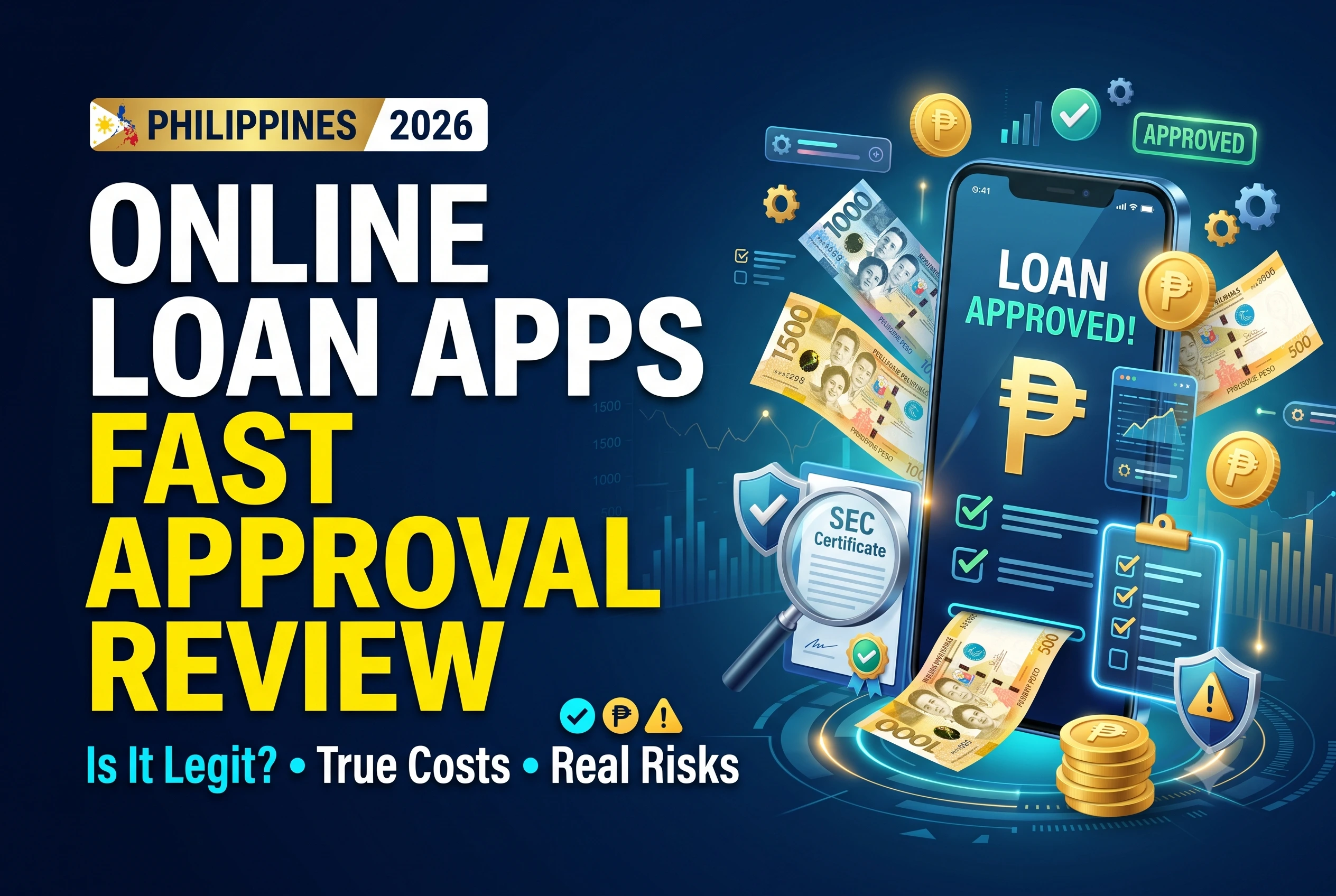
When an emergency requires immediate cash, Filipino borrowers frequently turn to mobile applications promising instant processing and zero collateral. The marketing language across these platforms is identical: guaranteed funds, minimal documentation, and immediate disbursement. However, the gap between an advertised loan limit and the actual net cash received is often substantial. This review investigates the fast-approval online lending sector in the Philippines for 2026, analyzing current regulatory compliance, true borrowing costs, realistic disbursement friction, and the actual risks borrowers assume when accepting these digital terms.
Summary:
While many fast-approval online loan apps in the Philippines offer genuine access to emergency cash, the sector remains heavily divided between highly regulated operators and unauthorized platforms. Legitimate applications must hold a Securities and Exchange Commission (SEC) Certificate of Authority to operate a lending or financing company. Borrowers should expect maximum monthly effective interest rates of 15% on unsecured, short-term loans, as mandated by the Bangko Sentral ng Pilipinas (BSP). Despite “instant” marketing claims, first-time applicants often face lower initial credit limits, high upfront processing deductions, and disbursement delays subject to banking cut-offs. Always verify a platform’s SEC registration before submitting government identification or accepting a digital contract.
| Borrower question | Current finding | Why it matters |
| Legal Operator | Must hold an SEC Certificate of Authority (CA). | A standard corporate SEC registration does not grant legal permission to lend money. |
| Advertised Rate vs. Cost | Maximum 15% Effective Interest Rate (EIR) per month. | Upfront processing deductions mean you receive less cash than the principal you must repay. |
| Approval Speed | Minutes for repeat users; hours/days for new users. | Manual ID verification and document checks frequently delay the “instant” promise for first-timers. |
| Disbursement | Subject to InstaPay/PESONet clearing times. | Approvals late in the day or on weekends may not reflect in your e-wallet until the next banking day. |
| Late Penalties | Capped at 5% per month on outstanding principal. | Lenders cannot legally impose daily compounding penalty fees that double the loan amount in a week. |
| Data Privacy | Contact list harvesting is strictly prohibited. | The National Privacy Commission outlaws using a borrower’s phonebook for collection harassment. |
Are fast approval loan apps legitimate in the Philippines?
Yes, provided they are registered. Legitimate fast approval apps must be operated by a corporate entity holding a valid Certificate of Authority (CA) from the SEC to operate as a Lending Company or Financing Company, specifically registered as an authorized Online Lending Platform (OLP).
Who legally operates the platform?
A common point of confusion for borrowers is the difference between a consumer-facing app name and the legal entity funding the loan. An app named “FastCash Express” might be legally operated by a completely different corporate name, such as “XYZ Lending Corporation.”
To verify legitimacy, the app must display its legal corporate name, its SEC Registration Number, and most importantly, its Certificate of Authority (CA) Number on its website and official app store listing. The SEC maintains a public, regularly updated list of authorized Online Lending Platforms. If an app is not on that list, it is operating illegally, regardless of how professional its interface appears.
How much does a fast approval online loan really cost?
Short-term, unsecured online loans are subject to strict Bangko Sentral ng Pilipinas caps: a maximum nominal interest rate of 6% per month and an Effective Interest Rate (EIR) of 15% per month. Total combined fees and interest cannot exceed the borrowed principal.
What deductions and fees are applied?
Financial cost analysis reveals that fast-approval apps rarely disburse the full approved amount. Most authorized lenders comply with BSP Circular No. 1133 by keeping nominal interest at or below 6% per month. However, they maximize the allowed 15% EIR by charging high upfront processing, service, and technical fees.
For example, if you are approved for a ₱5,000 loan for 30 days, the lender might charge the maximum 15% in total borrowing costs (₱750). Instead of adding this to your repayment, many platforms deduct the ₱750 upfront. You receive ₱4,250 in your e-wallet, but you are legally obligated to repay the full ₱5,000. Evaluating the cost relative to the exact net proceeds received is the only accurate way to measure affordability.
How fast is the actual approval and disbursement process?
While automated underwriting can approve returning borrowers in minutes, first-time applicants frequently face manual ID verification delays. Actual cash disbursement depends entirely on the payment gateway; InstaPay transfers are immediate, but PESONet transactions routinely take a full banking day to clear.
What operational friction slows approval?
Marketing materials highlight automated, AI-driven approvals, but public platform documentation indicates several real-world bottlenecks. Common friction points include:
- ID Rejection: Glare or poor lighting on a PhilID or UMID often triggers a manual review process, pausing the application for 24 to 48 hours.
- Name Mismatches: If the name on your government ID does not perfectly match the registered name on your receiving GCash or Maya account, the disbursement will fail.
- First-Time Limits: Apps frequently advertise “up to ₱25,000” limits. Current public disclosures show that first-time borrowers are typically approved for only ₱1,000 to ₱3,000 to establish repayment history before higher tiers are unlocked.
What happens if you pay an online loan app late?
Late fees are capped by the BSP at 5% per month on the outstanding principal. However, missing payments triggers collection efforts. Regulated lenders must strictly follow SEC rules against unfair debt collection, meaning they cannot legally threaten you or use public shaming.
What collection consequences actually apply?
Borrowers often fear imprisonment for unpaid online loans. The 1987 Philippine Constitution strictly prohibits imprisonment for non-payment of a purely civil debt.
However, delinquency carries severe financial consequences. Under SEC Memorandum Circular No. 18, Series of 2019, debt collectors are prohibited from using obscenity, false representation, or contacting people in your phonebook to shame you. Authorized lenders will instead report your default to the Credit Information Corporation (CIC), which will damage your credit score and prevent you from accessing standard bank loans, credit cards, or auto financing in the future.
How do these apps handle your personal data?
Lending apps legally collect basic identity and financial data to assess creditworthiness. However, the National Privacy Commission explicitly prohibits applications from harvesting your phone’s entire contact list, reading private text messages, or accessing your photo gallery to use for debt collection.
What permissions should you verify?
Before installing any lending application, borrowers must review the requested device permissions. Legitimate underwriting requires access to your camera (for selfie verification) and location (to verify you are in the Philippines). If an app requests permission to read your contacts or access your local file storage without a clear technical necessity, this strongly indicates a predatory platform attempting to gather leverage for future collection harassment.
What are borrowers consistently reporting in 2026?
Recent borrower feedback across major platforms frequently highlights frustration with hidden upfront deductions, much lower-than-advertised initial credit limits, and aggressive automated payment reminders that begin arriving several days before the actual due date.
Our review of recent borrower reports on public app stores and financial forums indicates a recurring pattern. While most users confirm that registered apps disburse funds reliably, the heaviest criticism centers on the repayment timeline. Many apps offer 7-day or 14-day terms for new users. Borrowers frequently report that automated SMS and in-app collection reminders begin bombarding them up to three days before the loan is actually due, creating unnecessary anxiety.
What are the main advantages and disadvantages of fast approval apps?
Pros:
- Requires no collateral or formal banking history.
- Disbursement to common e-wallets (GCash, Maya) is clearly supported.
- Legitimate, SEC-registered platforms now operate within strict BSP interest rate ceilings.
Cons:
- Effective borrowing costs remain substantially higher than traditional bank personal loans.
- Upfront processing fees significantly reduce the actual cash received.
- Initial credit limits are usually too small to cover major emergencies.
- Short repayment windows (often 15 to 30 days) heighten the risk of debt cycling.
Who may find these apps relevant, and who should be cautious?
A fast-approval online loan is conditionally suitable for a borrower who has a confirmed, exact source of incoming funds (such as an impending salary deposit) and needs a small amount of gap funding to resolve a highly specific, time-sensitive emergency.
A borrower should be especially cautious-and likely avoid these products-if they are already struggling to cover basic monthly expenses. Because the repayment terms are short and the effective interest rates are high, using a fast-approval loan to pay off another existing debt frequently leads to a severe, compounding debt trap.
Frequently Asked Questions
Do online lenders report to the Credit Information Corporation (CIC)?
Yes. Legitimate, authorized lending and financing companies are mandated by law to submit basic credit data to the CIC. Timely payments will build your credit profile, while defaults will be visible to traditional banks and other financial institutions.
Can uninstalling the app cancel my loan obligation?
No. Deleting the application from your device does not erase your digital contract or your outstanding balance. Your data remains on the lender’s servers, and collection efforts-as well as interest accumulation-will continue.
Can a lender file a police blotter against me for unpaid debt?
While unpaid debt is a civil matter and not a criminal offense, lenders can file civil claims for collection. Threats of police action or imprisonment for standard non-payment are considered unfair debt collection practices under SEC guidelines.
Conclusion
Determining whether to use a fast-approval online loan requires looking past the marketing guarantees. While the Philippine regulatory environment has tightened-capping rates and restricting predatory collection practices-these loans remain expensive financial instruments.
Before accepting any digital loan contract, manually calculate your affordability. Check the exact net proceeds you will receive after processing fees are deducted, note the precise due date, and ensure your expected income aligns with that schedule. Most importantly, never submit government identification to an app without first verifying its exact corporate name against the SEC’s official list of authorized Online Lending Platforms. If the math does not support your ability to repay in full and on time, an online loan will only amplify the financial emergency.
References
- Securities and Exchange Commission PhilippinesOrganization: Securities and Exchange Commission
Resource: List of Registered Online Lending Platforms
- Bangko Sentral ng PilipinasOrganization: Bangko Sentral ng Pilipinas
Resource: Circular No. 1133 Series of 2021 (Ceilings on Interest Rates and Other Fees)
URL: https://www.bsp.gov.ph/Regulations/Issuances/2021/1133.pdf
- Securities and Exchange Commission PhilippinesOrganization: Securities and Exchange Commission
Resource: Memorandum Circular No. 18, Series of 2019 (Prohibition on Unfair Debt Collection Practices)
- National Privacy CommissionOrganization: National Privacy Commission
Resource: NPC Circular No. 20-01 (Guidelines on the Processing of Personal Data for Loan-Related Transactions)
URL: https://www.privacy.gov.ph/wp-content/uploads/2020/10/NPC-Circular-No.-20-01.pdf