Last Updated on 25/05/2026 by Nicole Alba
Getting an “SSS emergency loan rejected” notice can feel frustrating, especially after completing the online application, uploading details correctly, and waiting for employer certification or bank validation. In many cases, the rejection is not permanent approval denial. It is usually triggered by operational validation checks inside the Social Security System’s filing workflow, contribution database, employer certification queue, or bank verification layer.
Many rejected applications come from mismatched personal records, inactive disbursement accounts, delayed employer action, contribution posting gaps, duplicate filing attempts, or unresolved benefit claims. The good news is that most of these issues can still be corrected and refiled successfully once the exact trigger is identified.
An “sss emergency loan rejected” result usually happens because the system detects validation failures involving contribution eligibility, employer certification, bank account verification, duplicate records, DAEM enrollment issues, or active benefit claims. Returned applications are often recoverable if the borrower corrects the flagged issue before reapplying. Common fixes include updating bank details, resolving contribution posting delays, coordinating with employers, correcting membership records, and waiting for system refresh cycles after failed submissions. Applicants should avoid repeated filing attempts without identifying the root cause because repeated validation failures can trigger additional review checks in the SSS online filing system.
Why SSS Emergency Loan Applications Get Rejected 🚫
Many borrowers assume rejection means they are not qualified. In reality, the SSS online filing system runs multiple automated checks before approval routing even begins.
A member may technically qualify under the published eligibility rules but still fail operational validation.
The rejection process usually happens during:
- Member identity verification
- Contribution history validation
- Employer certification routing
- Bank or e-wallet disbursement checking
- DAEM enrollment matching
- Duplicate application detection
- Benefit overlap review
Unlike manual lending systems, SSS emergency loan processing relies heavily on automated backend validation. Even minor inconsistencies can stop the workflow immediately.
Some applications are formally “rejected,” while others are marked:
- Returned to member
- Pending correction
- Failed validation
- Pending employer certification
- Invalid disbursement account
- Duplicate filing detected
These statuses matter because each one requires a different corrective action.
The Most Common Reasons Your SSS Emergency Loan Was Rejected
Contribution Posting Problems
One of the most frequent rejection triggers involves contribution posting discrepancies.
The system checks whether required monthly contributions were properly posted inside the contribution database before filing. Problems usually happen when:
- Recent payments are still unposted
- Employer remittances were delayed
- Voluntary payments were mismatched
- PRN references failed
- Payment channels experienced syncing delays
This is common among:
- Freelancers
- Self-employed workers
- Overseas Filipino Workers
- Gig-economy earners using irregular contribution schedules
A borrower may believe payments were completed successfully, but backend reconciliation may still be pending.
This is especially true after:
- GCash payments
- Maya transactions
- Bayad Center processing
- Bank collection delays
- Weekend or holiday posting periods
Before refiling, verify contribution visibility inside the My.SSS portal.
Members searching for qualification details should also review related eligibility rules under sss emergency loan requirements to confirm contribution thresholds and filing conditions align with current SSS policy expectations.
Employer Certification Delays
Employees often get stuck in “Pending Employer Certification” status.
This does not automatically mean rejection. It usually means the employer-side portal has not yet approved or processed the request.
Operationally, employers receive filing notifications through their SSS employer account dashboard. Delays happen when:
- HR personnel miss notification emails
- Authorized signatories are unavailable
- Employer SSS credentials expired
- Company records are under compliance review
- Payroll teams batch-process certifications manually
Some employers only process certifications once or twice weekly.
Borrowers frequently make the mistake of immediately reapplying, which can create duplicate application flags instead of speeding up approval.
Invalid Bank Account or Disbursement Details
The bank validation system is another major rejection source.
SSS cross-checks disbursement accounts against:
- Account ownership records
- PESONet-compatible banks
- Name matching logic
- Account status verification
- DAEM enrollment data
Applications are commonly returned because:
- The bank account is inactive
- The account name does not exactly match SSS records
- Initials differ
- Married names are inconsistent
- The account type cannot receive PESONet credits
- Digital bank onboarding verification is incomplete
This happens frequently with online-only banking accounts where e-KYC remains partially verified.
Borrowers using digital banks should confirm:
- Full account verification is completed
- Government ID verification succeeded
- Mobile number OTP validation is active
- The account supports inward PESONet transactions
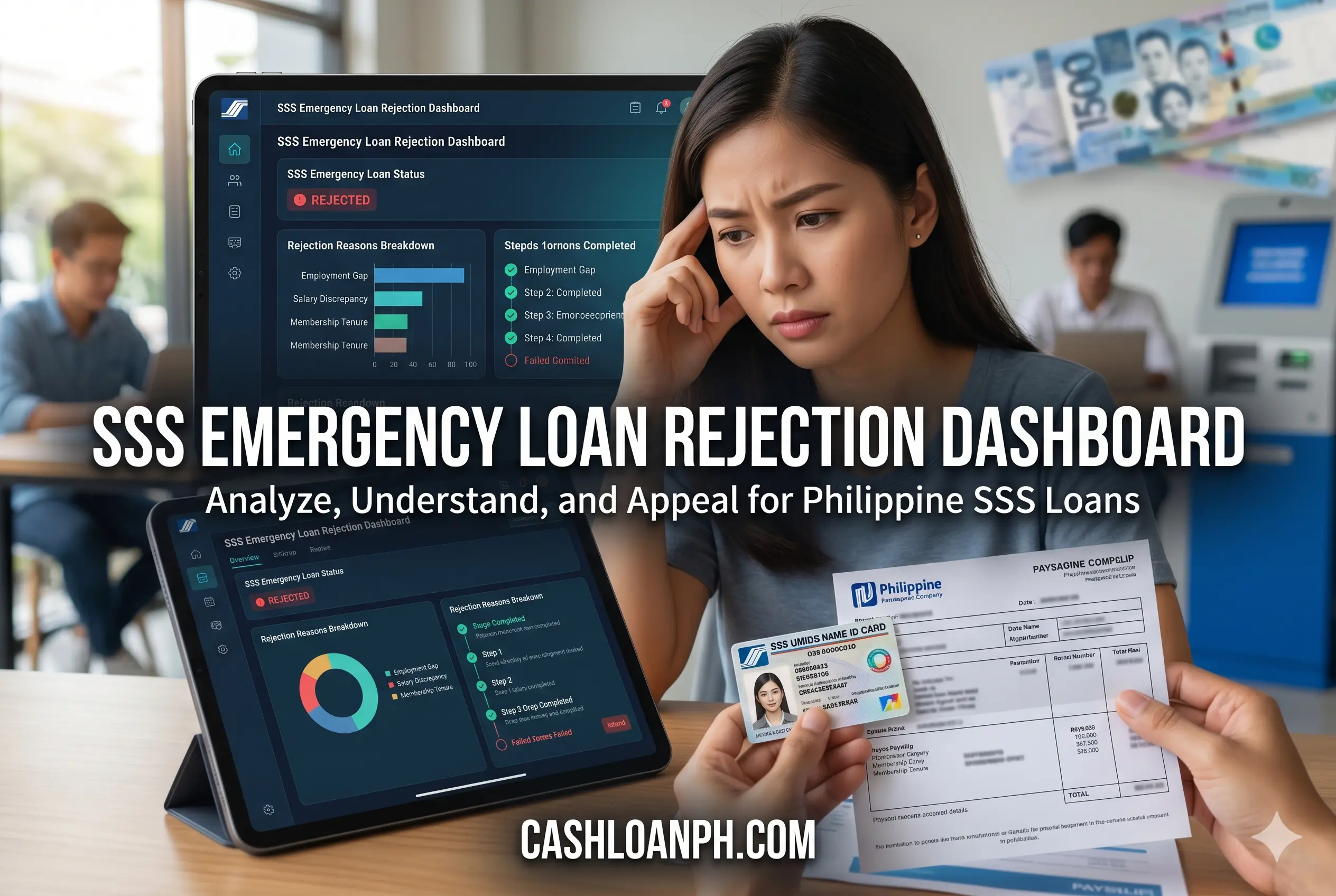
SSS Emergency Loan Rejection Dashboard Example
(SSS emergency loan rejected status showing employer certification and bank validation errors)
What “Returned Application” Actually Means
Returned Is Different From Permanent Rejection
A returned application usually means the system detected a correctable issue.
Examples include:
- Missing bank validation
- Incorrect membership details
- Employer routing failures
- Incomplete DAEM activation
- Temporary contribution mismatch
Permanent rejection is less common and usually tied to policy-level disqualification.
Returned applications are operational failures, not necessarily eligibility failures.
Common Returned Status Messages and Their Meaning
| Status Message | Operational Meaning | Typical Fix |
|---|---|---|
| Pending Employer Certification | Employer has not approved filing | Coordinate with HR |
| Invalid Disbursement Account | Bank verification failed | Update DAEM details |
| Duplicate Application | Multiple submissions detected | Wait for prior application resolution |
| Member Not Qualified | Contribution or policy mismatch | Review contribution history |
| Existing Final Benefit Claim | Benefit overlap restriction | Resolve active claim |
| Account Validation Failed | Identity mismatch detected | Update membership records |
How DAEM Problems Cause Rejection
The Disbursement Account Enrollment Module (DAEM) has become one of the largest operational bottlenecks in emergency loan processing.
SSS now depends heavily on validated digital disbursement channels.
Common DAEM Failure Triggers
Borrowers often fail DAEM validation because:
- Uploaded IDs are blurry
- Selfie verification mismatches occur
- Account names differ slightly
- Mobile camera metadata fails validation
- Screenshots are uploaded instead of official bank documents
The fraud-prevention layer inside DAEM also checks for suspicious behaviors like:
- Multiple accounts linked to one device
- Repeated failed uploads
- OCR inconsistencies
- Invalid account numbers
- Unsupported banks
These checks became stricter after increased digital fraud activity across Philippine fintech platforms.
Why Digital Wallet Users Face More Verification Delays
Users relying on e-wallets sometimes encounter additional review cycles.
This is because:
- Wallet limits may affect disbursement
- Some accounts remain partially verified
- Identity documents may not fully match SSS records
- Facial verification confidence scores can fail
Operationally, SSS systems now behave more similarly to fintech onboarding platforms that use AI-assisted fraud detection and device fingerprinting.
Duplicate Application Detection Is More Aggressive Than Before
Repeated filing attempts can worsen the problem.
Many applicants panic after rejection and submit another application immediately.
This can trigger:
- Duplicate filing flags
- Manual review escalation
- Temporary filing locks
- Identity verification rechecks
Modern digital lending systems increasingly use anti-fraud logic similar to fintech KYC systems.
If the system detects:
- Multiple retries within short periods
- Device inconsistencies
- Browser session conflicts
- Different bank accounts submitted rapidly
the application may enter secondary review status.
Instead of refiling immediately, diagnose the root rejection reason first.
Borrowers With Existing Benefit Claims Often Get Blocked
Final Benefit Claims Can Override Loan Eligibility
A common overlooked issue involves active final claims.
Members with:
- Retirement claims
- Permanent disability claims
- Death benefit processing
- Final settlement workflows
may automatically fail emergency loan validation.
The system prioritizes final benefit settlement over loan disbursement.
This frequently surprises older members who still have active employment records but already initiated retirement-related processing.
Why Contribution Activity Alone Does Not Guarantee Approval
Some borrowers continue contributing voluntarily and assume that means eligibility remains active.
However, the backend system evaluates multiple account states simultaneously, including:
- Benefit lifecycle status
- Membership classification
- Prior loan settlement
- Employment tagging
- Contribution recency
- Final claim processing
This layered validation logic explains why borrowers with seemingly complete records still encounter rejection.
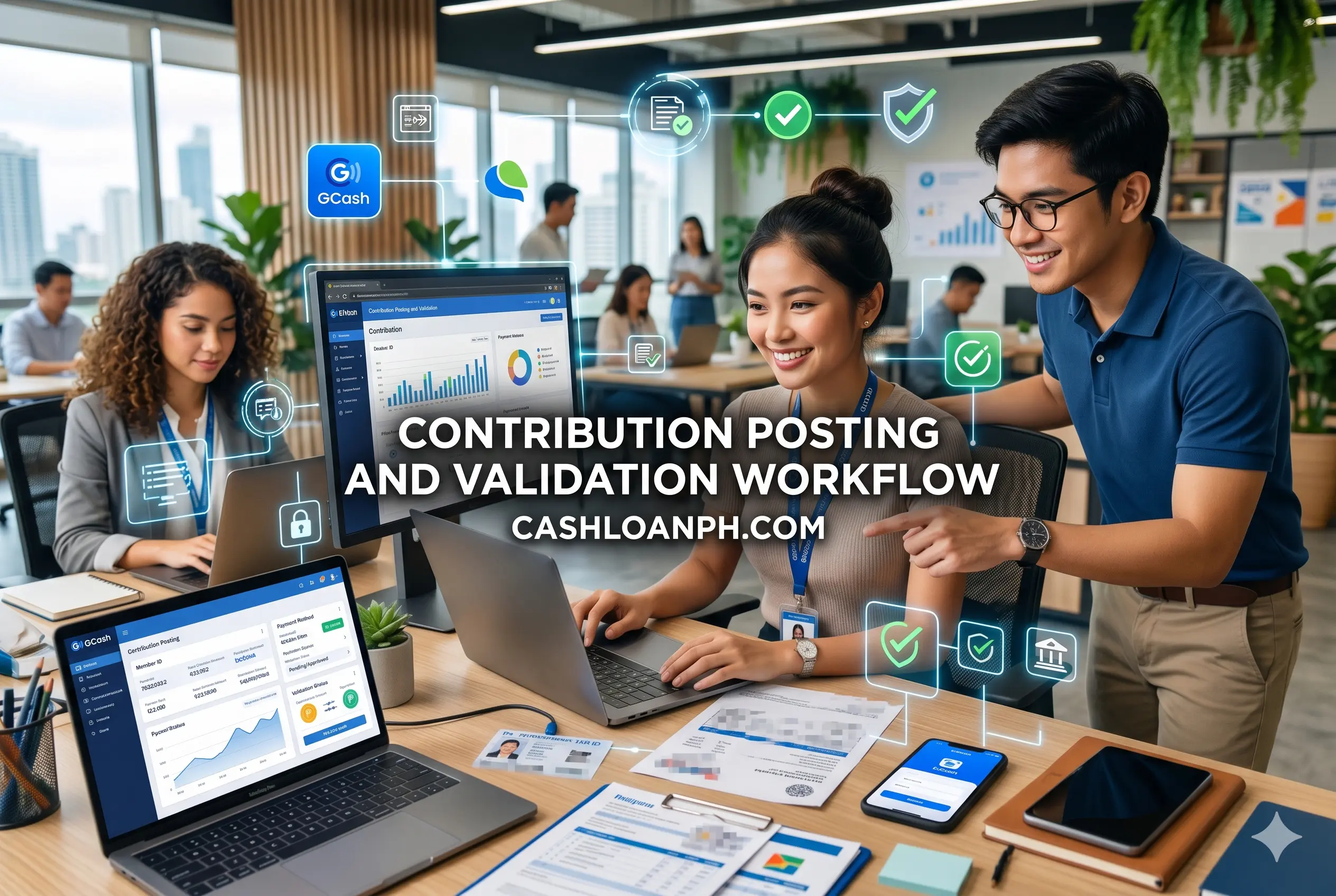
Contribution Posting and Validation Workflow
(SSS contribution posting database and emergency loan validation process)
How Long Should You Wait Before Reapplying?
Immediate Refiling Usually Backfires
If your application failed because of:
- Bank validation
- Employer certification
- Contribution posting
- DAEM verification
wait until the issue is fully resolved before retrying.
Operationally, backend systems may need:
- 24–72 hours for bank validation refresh
- Several business days for contribution posting
- Employer-side certification completion
- DAEM account synchronization updates
Submitting too early often results in repeated automated rejection.
Recommended Waiting Periods by Issue Type
| Problem Type | Suggested Waiting Time |
|---|---|
| Contribution posting delay | 3–7 business days |
| Bank account correction | 24–72 hours |
| Employer certification | Depends on HR processing |
| DAEM update | 1–3 business days |
| Duplicate application lock | Until previous status resolves |
Practical Fixes Before Reapplying ✔️
Verify Your My.SSS Records Carefully
Do not rely solely on memory or screenshots from previous filings.
Check:
- Name spelling
- Birthdate
- Membership category
- Contribution history
- Employer tagging
- Mobile number
- Registered email
Minor mismatches can trigger automated rejection.
Review Uploaded Verification Documents
Many borrowers upload:
- Cropped IDs
- Screenshots
- Blurry bank documents
- Low-light selfies
Digital verification systems increasingly use OCR and AI-assisted identity checking.
Clearer uploads improve success rates significantly.
Applicants preparing additional proof requirements should also organize required documents for verification before resubmission to reduce further validation delays.
Coordinate With Your Employer Proactively
Do not assume HR automatically sees the filing request.
Contact:
- Payroll
- HR
- Authorized SSS signatories
Confirm:
- Certification queue status
- Employer portal access
- Submission timelines
Large companies often process SSS certifications in batches rather than real time.
Real Operational Behaviors Borrowers Rarely Notice
Weekend and Holiday Processing Delays
Borrowers often file during weekends expecting instant movement.
However:
- Contribution posting slows
- Bank reconciliation pauses
- Employer approvals stall
- Backend syncing queues lengthen
This creates the illusion of rejection even when the issue is temporary.
Mobile Browser Problems Can Affect Submission Integrity
Some rejected applications originate from incomplete session processing.
This is increasingly observed among users filing through:
- Outdated Android browsers
- Weak mobile connections
- Aggressive battery-saving settings
- Interrupted OTP sessions
Partial submission states can create corrupted application sessions inside the filing workflow.
Using updated browsers and stable internet connections reduces risk.
Gig-Economy and Freelance Members Face Different Validation Patterns
Freelancers and platform workers often experience additional scrutiny because income and contribution timing are less predictable.
Borrowers using:
- Ride-hailing income
- Creator economy earnings
- Freelance remittances
- Mixed voluntary contributions
may encounter inconsistent posting patterns that trigger automated qualification checks.
This does not automatically mean denial. It simply means the system may require clearer contribution consistency.
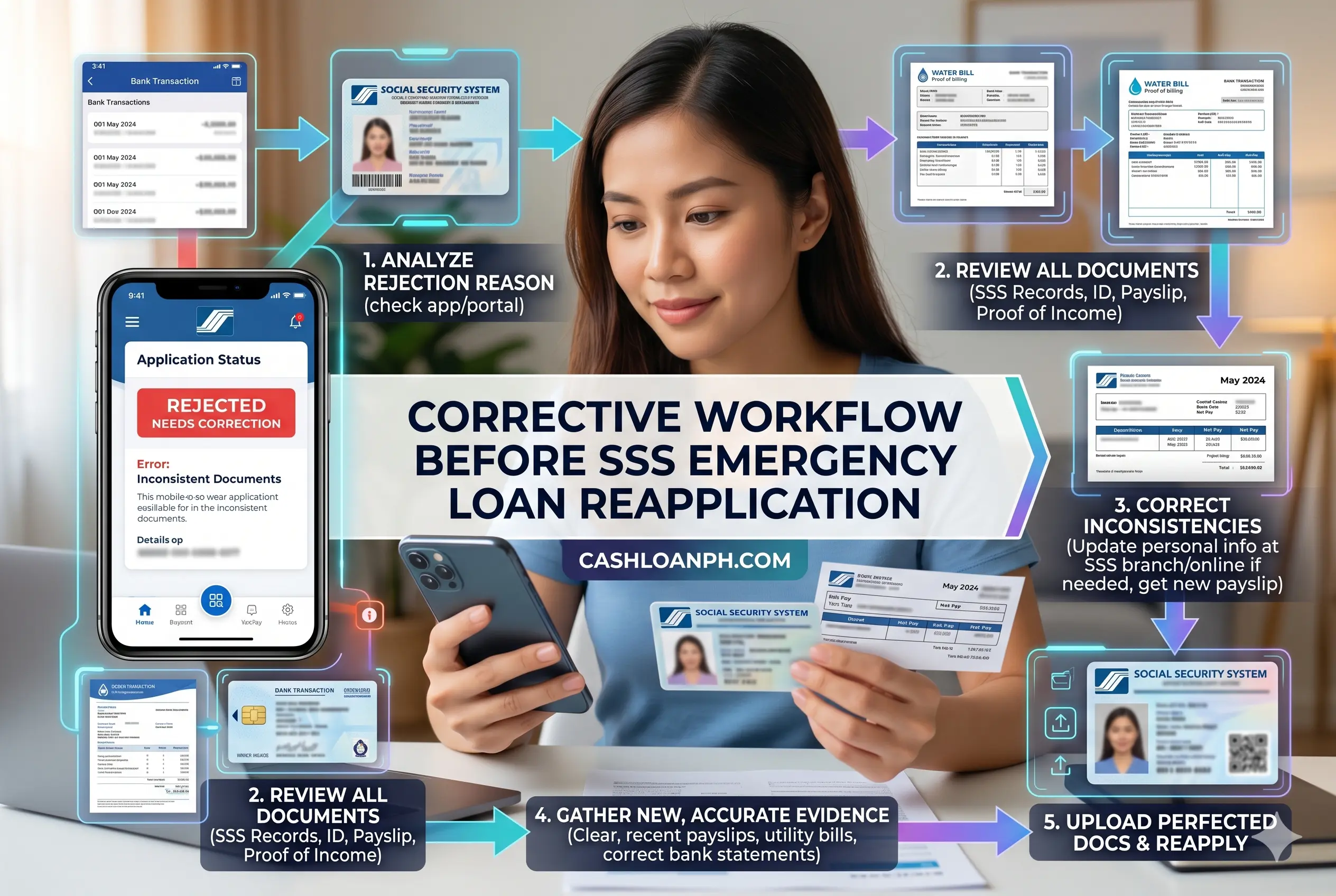
(Borrower corrective checklist before refiling rejected SSS emergency loan application)
Can You Appeal an SSS Emergency Loan Rejection?
Most Cases Require Correction, Not Formal Appeal
In practice, operational rejection cases are usually resolved through correction and resubmission.
Formal appeals are uncommon unless:
- Employer disputes exist
- Contribution records are incorrect
- Membership classification errors persist
- System-generated disqualification appears inaccurate
Most successful borrowers simply fix the validation trigger and reapply.
When Branch Assistance Becomes Necessary
Online correction is not always enough.
Branch-level support may help if:
- Contributions are missing despite payment proof
- Member records contain historical errors
- Duplicate accounts exist
- Name discrepancies involve civil status changes
Bring:
- Government IDs
- Payment receipts
- Employer certification proof
- Supporting account documents
Members checking possible recovery timelines may also want to review the expected approval processing timeline after corrected submissions are refiled.
Quick Recovery Checklist After Rejection 📋
Before submitting another application:
- Confirm contribution posting visibility
- Verify DAEM enrollment status
- Check bank account matching
- Coordinate with employer certification teams
- Review uploaded IDs and selfies
- Ensure no active final benefit claims exist
- Avoid duplicate submissions
- Wait for backend synchronization periods
- Update outdated membership records
- Retry only after confirmed correction
This approach dramatically reduces repeated rejection cycles.
Frequently Asked Questions
Why was my SSS emergency loan rejected even if I qualified before?
Previous approvals do not guarantee automatic approval today. The system continuously rechecks contribution activity, bank validation, DAEM status, employer certification, and account integrity each time you file.
Can I reapply after rejection?
Yes. Most rejected or returned applications can be refiled after the underlying issue is corrected. Avoid immediate duplicate submissions without diagnosing the actual trigger.
What does pending employer certification mean?
It means your employer has not yet approved or processed the filing request through the employer-side SSS portal. This is common in companies using scheduled HR processing workflows.
How long should I wait before retrying?
It depends on the issue. Contribution posting delays may require several business days, while bank validation corrections may update within 24–72 hours.
Will changing my bank account improve approval chances?
Only if the previous account failed validation. The replacement account must match your SSS records exactly and support valid disbursement processing.
Does DAEM rejection mean permanent denial?
No. DAEM failures are often caused by upload quality, identity mismatch, unsupported account types, or incomplete verification. Most cases are correctable.
Conclusion
An “sss emergency loan rejected” result is often a system validation problem rather than a permanent denial. Most returned applications stem from contribution posting delays, employer certification bottlenecks, DAEM verification mismatches, duplicate filing attempts, or bank validation failures. Borrowers who slow down, identify the exact trigger, and correct the issue methodically usually have better outcomes than those repeatedly resubmitting applications immediately.
Careful preparation matters. Verify your records, coordinate with employers early, upload clear documents, and allow backend systems enough time to refresh. Responsible borrowing also means avoiding panic-driven actions that create additional verification flags. With the right corrective steps, many rejected applications can still move toward successful processing.