Last Updated on 09/09/2026 by Nicole Alba
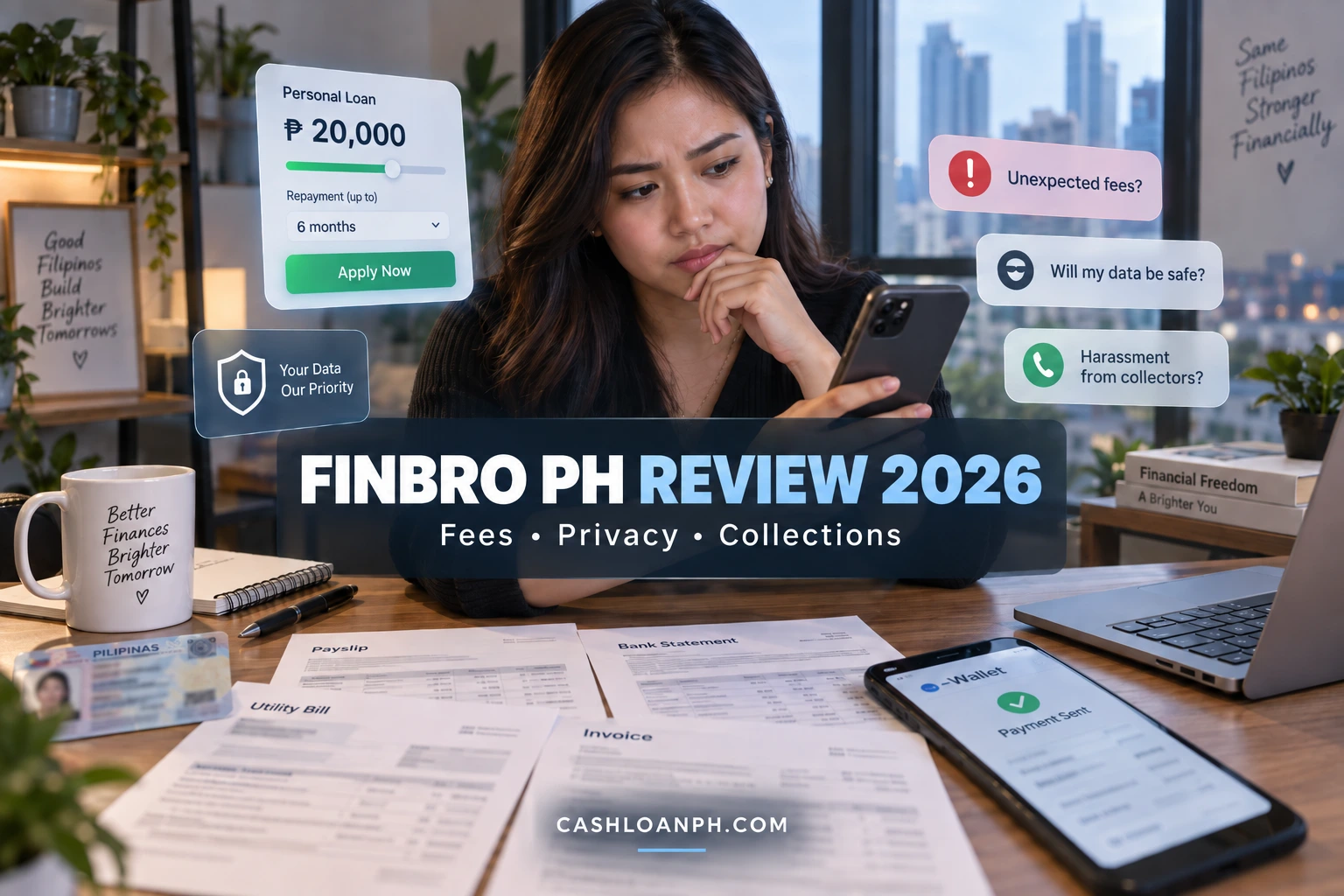
If you searched for Finbro PH complaints after seeing a repayment amount you did not expect, receiving collection messages, or wondering what happens to the information you submitted during an application, the anxiety is understandable.
The important point is to separate three very different questions: Is FINBRO a real lending platform? Are its loans necessarily cheap because the company is registered? And do complaints posted online prove that FINBRO violated Philippine law?
Those questions do not have the same answer.
FINBRO currently presents itself as an online lending platform operated by Sofi Financing Inc., with SEC Registration No. CS201908275 and Certificate of Authority No. 1324. Its current iOS listing advertises loans from ₱1,000 to ₱50,000, terms of up to 12 months, and an APR range of 0% to 36% depending on credit assessment. FINBRO’s own FAQ says the actual interest rate and processing fees are shown during the application before the borrower confirms the agreement.
Registration, however, does not mean every offer will be suitable for every borrower. The real decision should come down to the Disclosure Statement, net cash actually received, repayment schedule, extension cost, data permissions, and your ability to repay without borrowing again.
Key Takeaways
| Question borrowers usually ask | What the evidence shows |
|---|---|
| Is FINBRO PH legitimate? | FINBRO’s current official materials identify Sofi Financing Inc., SEC Registration No. CS201908275 and CA No. 1324. |
| How much can you borrow? | Current app materials advertise ₱1,000–₱50,000. |
| How long can repayment run? | Up to 12 months is advertised, subject to the actual offer. |
| What rate is advertised? | Current iOS listing states 0%–36% APR depending on credit assessment; individual terms vary. |
| Are there FINBRO complaints? | Yes. Recent public complaints concern privacy, extension/minimum-payment expectations, loan amounts and collections. They must be treated as allegations rather than regulatory findings. |
| What is the biggest borrower risk? | Accepting a loan based on the headline amount without comparing net proceeds, total repayment, fees and extension costs. |
| Can collectors shame borrowers or blast their contacts? | Philippine SEC and NPC rules restrict abusive collection and the use of contact-list information for debt collection. |
| Can you be jailed simply because you cannot repay? | No. The Philippine Constitution prohibits imprisonment solely for debt. Fraud or another separate criminal act is a different matter. |
| My 2026 risk rating | Moderate — potentially usable for a short, planned liquidity gap, but unsuitable for debt cycling or borrowers who cannot repay without taking another loan. |
Is Finbro PH legitimate and SEC-registered in 2026?
FINBRO currently identifies its operator as Sofi Financing Inc., with SEC Registration No. CS201908275 and Certificate of Authority No. 1324. That makes it materially different from an anonymous or unregistered loan app, but SEC registration alone does not make a loan inexpensive or appropriate.
There is an important Philippine regulatory detail many review sites get wrong.
FINBRO is not a bank. A financing company is primarily supervised under the Philippine Securities and Exchange Commission framework, while BSP supervision primarily applies to banks and other BSP-supervised financial institutions.
The BSP itself advises borrowers to verify lending and financing companies through the SEC rather than assuming every legitimate financial provider must appear as a BSP-supervised bank.
That distinction matters when assessing whether finbro ph is legitimate.
Why do older FINBRO records show Sofi Lending Inc. and CA No. 2990?
Older SEC lists identify FINBRO under Sofi Lending Inc., registration number CS201908275 and CA No. 2990, while current FINBRO and Apple materials use Sofi Financing Inc. and CA No. 1324. The registration number remains the same, but borrowers should use the current legal documents presented with their loan.
I would not automatically interpret this historical difference as evidence of wrongdoing.
Corporate names, classifications and regulatory authorizations can change. What I would not do is invent an explanation for that change without the underlying SEC corporate filings.
For a borrower, the safer check is simple: compare the corporate name and SEC details appearing in your current Loan Agreement and Disclosure Statement with the current FINBRO website and SEC records.
If those do not match, stop before releasing money or signing anything.
Does SEC registration mean FINBRO has no borrower complaints?
No. Registration answers whether a company has regulatory authority to operate; it does not guarantee low costs, instant approvals, perfect customer service, or the absence of consumer disputes.
This is an important distinction.
A registered financing company can still receive complaints. A complaint can also be unfounded. Regulatory analysis should therefore distinguish:
complaint → investigation → regulator finding → sanction
Those are four different stages.
I did not find evidence in the current SEC material reviewed for this article establishing that every recent allegation posted about FINBRO has been proven.
That is why this review does not label individual accusations as facts.
What are borrowers actually complaining about with Finbro PH in 2026?
The most useful complaints are not generic comments such as “high interest.” The stronger signals involve specific issues: what a minimum payment does, differences between expected and payable amounts, privacy concerns, and collection behavior.
At the time of this review, FINBRO’s Philippine iOS listing showed a 3.0/5 rating from 25 ratings. That sample is far too small to treat the score as a statistically reliable measure of the entire FINBRO borrower base.
Some recent reviews describe fast applications and clear repayment disclosures. Another recent review alleges misuse of personal information after a rejected application. FINBRO responded by asking the reviewer to contact customer care.
That allegation is meaningful enough to investigate, but an App Store review by itself is not proof that the alleged conduct occurred.
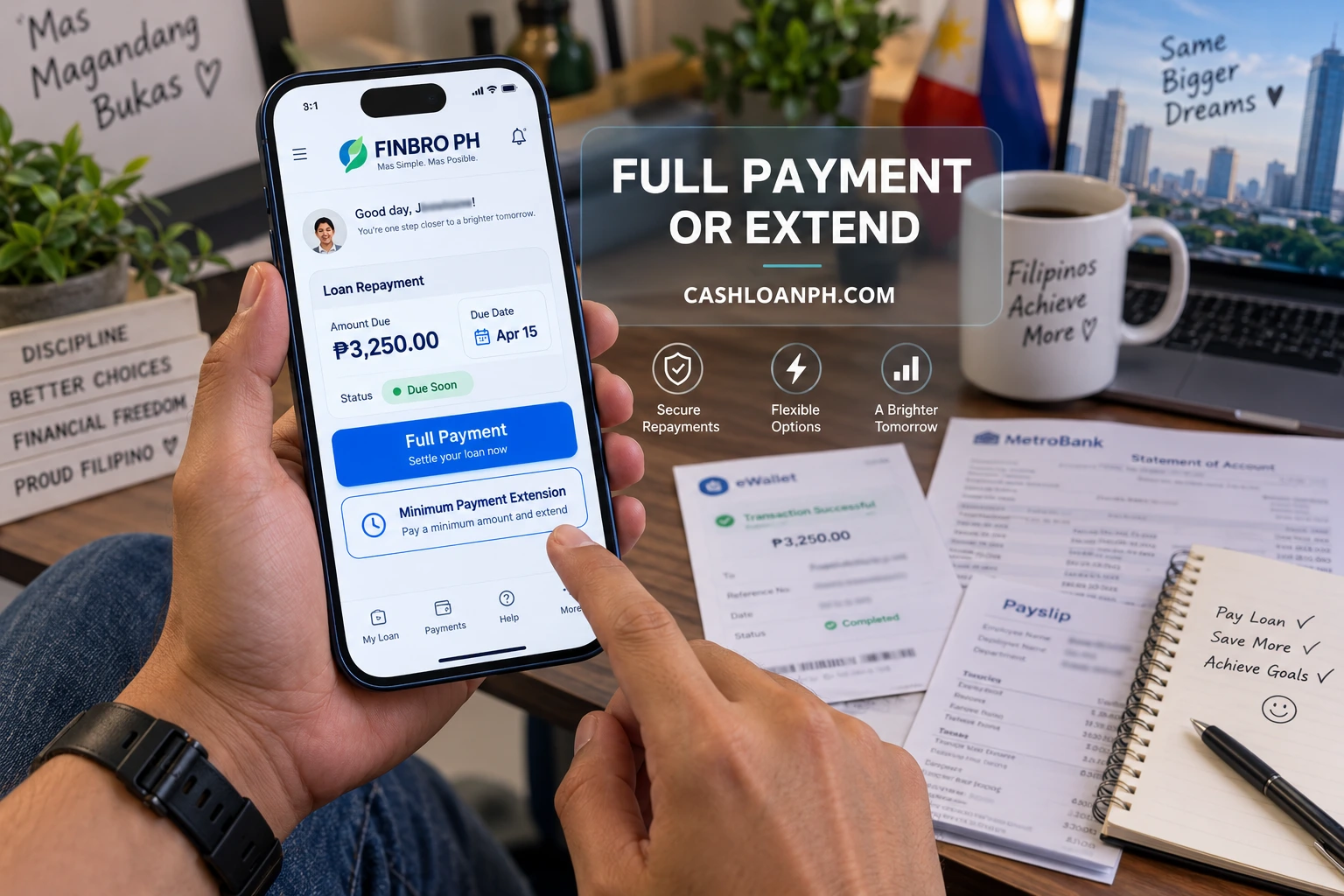
Why does FINBRO’s minimum-payment option cause confusion?
FINBRO states that a minimum payment can extend the next payment date by 7, 14 or 30 days. Borrowers should not assume that an extension payment reduces principal unless their individual agreement explicitly says that it does.
This is one of the most useful findings in my review.
FINBRO’s repayment page distinguishes between:
- full loan repayment; and
- a minimum payment that extends the next payment date.
A borrower complaint posted in March 2026 said the borrower believed a roughly ₱948 minimum payment would reduce a loan balance, then later concluded from the contract that the payment was for extension rather than principal reduction. That is one borrower’s account, not a regulatory determination.
The practical lesson matters more than arguing over terminology.
Before making an extension payment, ask:
“After I pay this amount, what will my remaining principal and total balance be?”
If the answer is essentially unchanged, you are paying for time rather than materially extinguishing the debt.
That can become expensive when repeated.
What should borrowers make of FINBRO privacy complaints?
Treat privacy complaints seriously but distinguish allegations from verified violations. FINBRO’s current app-store disclosures confirm that the service processes personal, location and financial information, making permission control and privacy notices especially important.
Google Play currently says the FINBRO app may collect location and personal information and may share certain location and personal data with third parties. It also states that information is encrypted in transit and that users can request deletion.
Apple’s disclosures list information potentially linked to the user including financial information, location, contact information and identifiers. Apple explicitly notes that these disclosures are supplied by the developer and are not independently verified by Apple.
FINBRO’s own Privacy Policy goes into greater detail. It states that information processed can include identification data, employment information, bank details and transaction information, and provides a Data Protection Officer contact channel.
None of this automatically means misuse.
It does mean you should treat a loan application as a serious financial-data transaction—not the same as installing a shopping or entertainment app.
Are recent claims of FINBRO harassment or overcharging proven?
Public complaint records exist, but a complaint filed through a government portal is not itself a judgment against FINBRO. Look for an SEC or NPC order before describing an allegation as a proven violation.
A particularly recent example appeared on the Philippine FOI portal in August 2026. A requester alleged problems involving a FINBRO reloan, the amount owed and collection activity involving an external collection agency.
That record proves that someone submitted a complaint.
It does not prove that the lender violated the law.
This evidence standard matters because financial review sites often turn “a borrower complained” into “the lender did this.” Those statements are not equivalent.
My approach is more conservative: document the complaint pattern, compare it with the contract and applicable rules, then look for a regulator’s finding.
How much does Finbro PH really cost in 2026?
FINBRO’s current iOS listing advertises an APR range of 0%–36%, but FINBRO says the actual rates and processing fees depend on the individual application and are disclosed before confirmation. Your Disclosure Statement—not the marketing headline—is the number that matters.
The Apple listing gives a representative example using a daily rate of 0.0986%, while making clear that actual terms vary with credit assessment.
Do not interpret the lowest advertised rate as the rate you personally will receive.
Credit pricing can change according to risk assessment, customer history, amount, tenor and other underwriting inputs.
FINBRO’s public registration page itself tells applicants that the requested loan amount is provisional and that the final amount depends on creditworthiness assessment.
What interest-rate limits apply to FINBRO loans after April 1, 2026?
For covered unsecured general-purpose loans of ₱10,000 or less with a term of up to four months, SEC MC No. 14, Series of 2025 now limits nominal interest to 6% monthly and EIR to 12% monthly. The new ceilings apply from April 1, 2026.
For loans meeting all of those conditions, the current ceilings are:
| Cost component | Current ceiling for covered loans |
|---|---|
| Nominal interest rate | 6% per month |
| Effective interest rate | 12% per month |
| Late/non-payment penalty | 5% per month on the outstanding scheduled amount due |
| Total interest, fees, charges and penalties over the life of the loan | 100% of principal borrowed |
The EIR ceiling was previously 15% per month under the earlier framework. The recalibrated rule reduced it to 12% for covered transactions beginning April 1, 2026.
A common SEO article mistake is to say that the 12% monthly EIR ceiling applies to every online loan.
It does not.
The specific ceiling applies when the qualifying conditions—including loan size and tenor—are met.
A ₱30,000 loan with a 12-month term is not automatically governed by that particular small-loan ceiling simply because it came from an online platform.
What should you inspect before pressing “accept loan”?
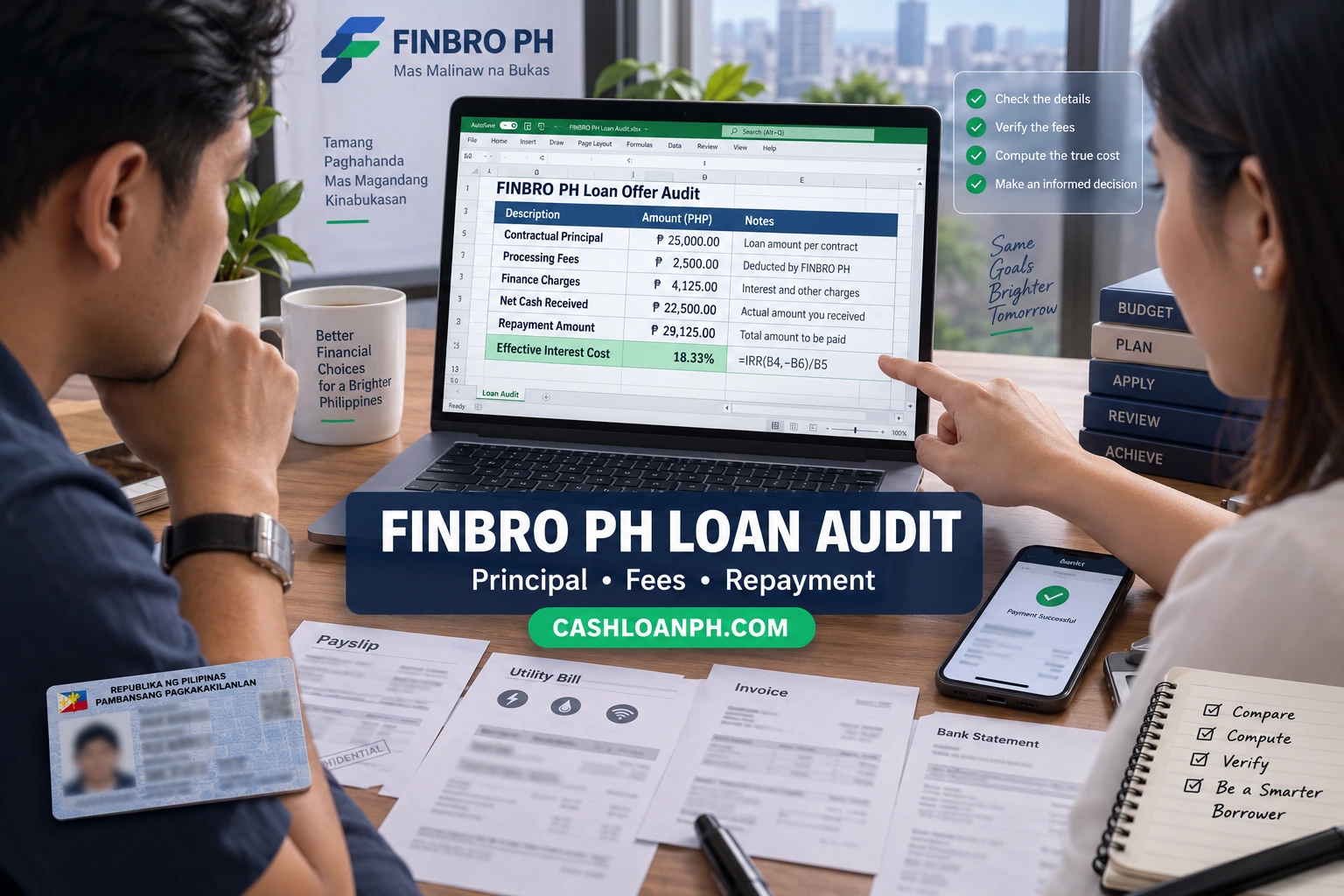
Check the amount you will actually receive, contractual principal, all deducted fees, EIR, total repayment, exact due dates, late charges and what any extension payment accomplishes. Save a copy before disbursement.
I would make the decision from seven numbers:
- Requested amount
- Approved principal
- Cash actually credited to your account
- Upfront deductions
- Total finance charge
- Total repayment
- Exact repayment dates
This prevents one of the most common digital-lending mistakes: comparing the repayment amount only with the headline “loan amount.”
Suppose an offer displays a contractual loan of ₱10,000 but significantly less than ₱10,000 reaches your account because fees are deducted before disbursement.
Your economic borrowing cost is being borne against the cash you actually received, not merely the number printed at the top of the screen.
That distinction is why Philippine Truth in Lending rules focus heavily on transparent finance-cost disclosure.
How does the FINBRO application and approval process work?
FINBRO currently says applicants must be Filipino, generally 20–70 years old, have employment or regular income, an active mobile number and at least one accepted valid ID. Approval remains subject to credit assessment.
Accepted IDs listed in FINBRO’s FAQ include:
- SSS ID;
- UMID;
- driver’s license;
- passport;
- National ID; and
- Postal ID.
The platform says applicants receive the decision through SMS and that approved funds may be transferred to a bank account belonging to the borrower.
FINBRO markets an application process that can be completed quickly and says approved funds can be transferred the same day. That should be treated as a service target, not a guaranteed funding SLA for every borrower.
What application friction should borrowers realistically expect?
Identity mismatches, weak document images, inconsistent personal information, unstable income signals or credit-risk checks can slow or stop a digital loan application. FINBRO does not publicly disclose every underwriting rule or guarantee approval.
This is where I will not manufacture “hands-on testing.”
I reviewed FINBRO’s live public-facing application information, current official app listings, repayment documentation, privacy materials and borrower complaint records. I did not borrow money under a fabricated identity merely so I could claim I had personally received a loan.
That would neither be ethical nor prove what another applicant will experience.
From the actual public flow, we can verify that FINBRO conducts a creditworthiness assessment and may approve a different amount from the amount requested.
What we cannot responsibly claim from public documentation is the exact weight its underwriting system assigns to salary, employer, device attributes or alternative credit data.
How might FINBRO assess freelancers and gig-economy borrowers?
FINBRO publicly requires employment or a regular source of income but does not publish a separate underwriting formula for freelancers, riders, online sellers or other gig workers.
From a lender-risk perspective, this distinction matters.
A salaried employee may present relatively predictable monthly cash flow. A food-delivery rider, online seller or freelance designer may earn the same annual income but show greater weekly volatility.
That does not automatically make the gig worker a bad borrower.
It can make income stability harder for a credit model to measure.
If your income is nontraditional, avoid exaggerating employment status just to fit an application field. Accurate information is safer than getting approved through a profile you cannot later substantiate.
How does FINBRO repayment work, and why should you be careful with extensions?
FINBRO supports repayment through e-wallets, payment centers and bank transfer. It also offers full repayment and minimum-payment extensions, but borrowers should calculate whether an extension meaningfully reduces debt or simply purchases more time.
FINBRO says full repayment can be made on or before the next payment date without extra cost associated with early settlement.
Its repayment page also provides a minimum-payment option that can extend the next payment date by 7, 14 or 30 days.
This feature can help a borrower experiencing a temporary cash-flow mismatch.
It can also become a warning sign if used repeatedly.
If you pay extension charges several times while principal remains largely untouched, you can enter what Filipino borrowers often call the tapal system: taking new credit or repeatedly paying rollover costs simply to prevent an existing obligation from becoming overdue.
At that point, the problem is no longer access to credit.
It is negative cash flow.
My rule is simple: if repayment requires another online loan, stop evaluating lenders based on approval speed and start evaluating how to exit the debt cycle.
What can FINBRO collectors legally do if your payment is late?
A legitimate unpaid debt can be collected, but Philippine rules restrict threats, public shaming, deceptive collection tactics and improper disclosure of borrower information to third parties.
SEC Memorandum Circular No. 18 prohibits unfair collection practices by financing and lending companies and their service providers.
Examples include threats of violence, threats of actions that legally cannot be taken, obscene or abusive language, deceptive representations and improper public disclosure of debt information.
Importantly, outsourcing a delinquent account does not give a lender’s collection agency unlimited freedom.
Under the SEC framework, third-party collectors acting for financing or lending companies are still part of the regulated collection chain.
Can you be jailed simply because you cannot repay a FINBRO loan?
No. Article III, Section 20 of the Philippine Constitution states that no person shall be imprisoned for debt. Ordinary inability to repay a civil loan is therefore not, by itself, grounds for imprisonment.
That does not cancel the debt.
A lender may still pursue lawful collection remedies, report information where legally permitted, negotiate settlement, assign an account to a collection agency, or pursue an appropriate civil action.
The constitutional protection should also not be misread as immunity for separate criminal conduct.
For example, a genuine allegation of fraud or falsification would be legally different from simply having insufficient money to repay a legitimate debt.
Can FINBRO contact your relatives, employer or everyone in your phone?
A lender cannot freely use your contact list to pressure or shame you. NPC rules sharply restrict contact-list processing, and persons in your contacts are not automatically liable for your loan.
NPC Circular No. 2022-02 strengthened protections involving character references and guarantors.
A character reference is not automatically a guarantor.
A guarantor must separately consent to assume that responsibility.
The NPC also states that lenders cannot use a borrower’s contacts indiscriminately for debt collection and harassment.
This is particularly relevant when borrowers receive messages claiming:
“Your whole contact list will be informed.”
That is not a collection right created simply because money is owed.
What should you do if you believe FINBRO has overcharged, harassed or mishandled your information?
Document everything first, raise a written complaint with FINBRO, and escalate unresolved collection or privacy issues to the appropriate Philippine regulator with screenshots, contracts and payment records.
Do not rely solely on phone conversations.
Save:
- Loan Agreement;
- Disclosure Statement;
- screenshot of the approved amount;
- screenshot of net amount received;
- repayment dashboard;
- receipts;
- bank or e-wallet transaction records;
- SMS and email messages;
- collection-agent names and numbers;
- call dates and times; and
- screenshots showing any disclosure of your debt to third parties.
FINBRO currently publishes separate customer-service and collections channels on its website, while its privacy policy provides a DPO contact for data-related concerns.
If the issue remains unresolved, the SEC Financing and Lending Companies Department handles unfair lending and collection complaints, while the National Privacy Commission is the more relevant regulator for unlawful processing or disclosure of personal information.
A March 18, 2026 joint DICT-NPC-SEC advisory specifically tells consumers to report unfair debt collection practices to the SEC and provides separate government channels for threats, fraud and cyber-related harassment.
Do not delete the evidence after blocking a collector.
Evidence is more useful than an angry reply.
Who should realistically consider FINBRO PH?
FINBRO makes the most sense for someone facing a short, clearly defined cash shortage who has verified the full repayment amount and already knows which incoming funds will repay it. It is a poor fit for recurring monthly deficits.
A reasonable use case might be:
You need a limited amount for an urgent bill. Your salary arrives before the scheduled repayment date. After checking the Disclosure Statement, repayment fits your budget without delaying rent, food, medicine, utilities or existing debt payments.
A risky use case looks very different:
You already have several online loans. You need FINBRO to repay another lender. Your next salary cannot cover both household expenses and the new loan. You are already relying on extensions.
In that situation, another approval does not solve the financial problem.
It postpones it while creating another creditor.
Who should avoid applying for FINBRO PH right now?
Avoid another online loan if repayment depends on another loan, if the Disclosure Statement is unclear, if the net amount received is materially below what you expected, or if essential living expenses would be sacrificed to meet the due date.
I would also stop the application if:
- you are being asked to pay money before loan proceeds are released;
- someone claiming to represent FINBRO asks you to transfer funds to a personal bank account;
- the company name on the contract does not match the verified operator;
- you are pressured to accept without reading the disclosure;
- permissions appear unrelated to legitimate loan processing;
- repayment dates do not match what was represented to you; or
- you cannot explain in one sentence where the repayment money will come from.
The SEC specifically warns borrowers against advance-fee loan scams and advises consumers to verify online lenders before transacting.
What is my Finbro PH verdict for 2026?
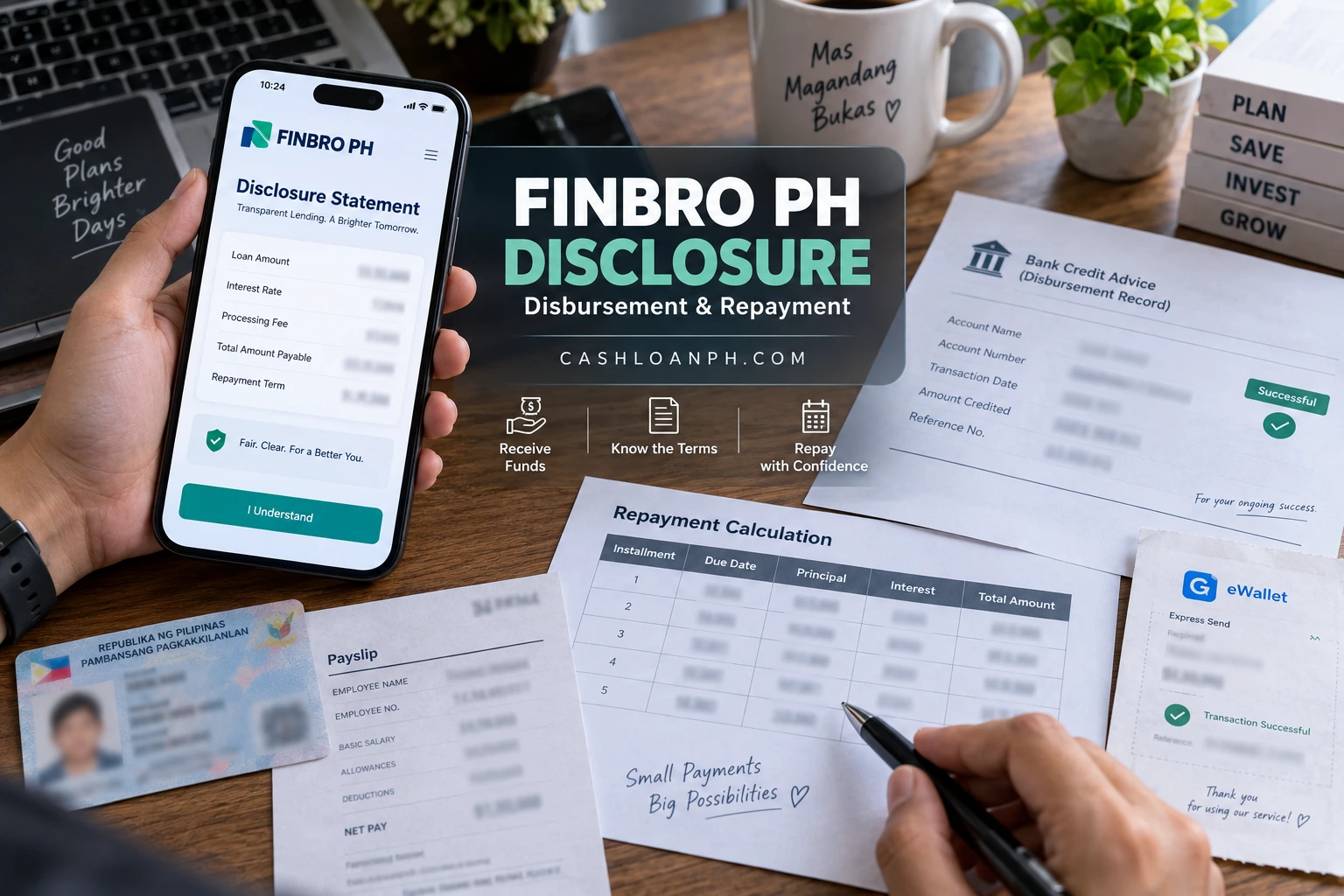
FINBRO appears to be a regulated operating lender rather than an anonymous illegal loan app, but I would rate it as a product that requires careful offer-by-offer review rather than something borrowers should accept based on brand legitimacy alone.
The strongest positive points are straightforward:
FINBRO publishes its operator information, provides formal customer and collection channels, discloses repayment methods, offers early repayment, and presents loan documents before confirmation. Current app materials also clearly identify Sofi Financing Inc. and its claimed SEC credentials.
The areas deserving closer scrutiny are just as important:
Borrower reports show confusion around extension payments, there are recent privacy allegations, and at least one recent government-portal complaint alleges problems involving amounts and collection. Those reports should not be exaggerated into findings of wrongdoing, but borrowers should not ignore them either.
My borrower-protection score would therefore be:
- Legitimacy: 4/5
- Disclosure transparency: 3.5/5
- Application convenience: 4/5
- Cost predictability: 3/5 — depends heavily on the individual offer
- Privacy sensitivity: 3/5 — significant personal and financial data are involved
- Suitable for debt consolidation through repeated OLAs: 1/5
- Suitable for a controlled emergency with a clear repayment source: 3.5/5
The decision should never be “FINBRO approved me, so I can afford it.”
Approval measures the lender’s willingness to take the risk.
Affordability measures whether you should.
What other questions do borrowers ask about FINBRO PH?
Can you repay FINBRO early without waiting for the due date?
Yes. FINBRO states that full repayment can be made on or before the next payment date. Check your account for the exact settlement amount before transferring funds.
Always keep the payment confirmation and request proof that the account is fully settled.
Does a rejected FINBRO application mean you should immediately try five other loan apps?
No. Multiple rapid applications can be a sign that the underlying problem is cash-flow stress rather than access to one particular lender.
A rejection may also protect you from taking on a repayment obligation that the lender’s model considers too risky.
Do not falsify income or employment information to bypass the decision.
Should you pay someone who promises to “unlock” a FINBRO approval?
No legitimate loan approval should require sending an advance payment to an agent, Telegram account, personal GCash number or unofficial bank account.
The SEC warns borrowers about advance-fee scams impersonating lending and financing companies.
Use only official FINBRO channels.
Should you uninstall the FINBRO app after paying the loan?
Paying the account does not automatically answer every data-retention question. You can review FINBRO’s privacy policy and exercise applicable data-subject rights, including asking about retention or deletion where legally available.
FINBRO’s privacy policy states that personal information is retained according to the purposes for which it is processed and applicable legal requirements.
NPC rules also require lenders to adopt reasonable retention policies rather than retaining borrower data indefinitely without a defined purpose.
What is the safest question to ask before taking any FINBRO loan?
Ask: “If I accept this today, can I repay the full contractual obligation from income I already reasonably expect—without borrowing again?”
If the answer is no, the interest rate is almost secondary.
The loan is probably not affordable.
References
- Securities and Exchange Commission — Online Lending Platform Records
Organization: Securities and Exchange Commission Philippines
Resource: List of Financing and Lending Companies and Online Lending Platforms
URL: SEC list of financing and lending companies and online lending platforms - Securities and Exchange Commission — Financing and Lending Companies
Organization: Securities and Exchange Commission Philippines
Resource: Advisories, Regulations and Current 2026 Notices
URL: SEC Financing and Lending Companies advisories - National Privacy Commission
Organization: National Privacy Commission
Resource: NPC Circular No. 2022-02 — Loan-Related Transactions
URL: NPC Circular No. 2022-02 - DICT, NPC and SEC
Organization: Philippine Government
Resource: 2026 Public Advisory on Online Lending Platforms
URL: 2026 Public Advisory on Online Lending Platforms - Bangko Sentral ng Pilipinas
Organization: BSP
Resource: Protect Yourself From Fraud and Scam
URL: BSP consumer protection guidance for online lenders - Republic of the Philippines
Organization: LawPhil Project
Resource: 1987 Philippine Constitution — Article III, Section 20
URL: 1987 Philippine Constitution - Republic of the Philippines
Organization: LawPhil Project
Resource: Republic Act No. 11765 — Financial Products and Services Consumer Protection Act
URL: Republic Act No. 11765 - FINBRO
Organization: Sofi Financing Inc.
Resource: FINBRO Frequently Asked Questions
URL: FINBRO official FAQ - FINBRO
Organization: Sofi Financing Inc.
Resource: Loan Repayment Information
URL: FINBRO official repayment page - FINBRO
Organization: Sofi Financing Inc.
Resource: Privacy Policy
URL: FINBRO Privacy Policy - Apple App Store Philippines
Organization: Apple / Sofi Financing Inc.
Resource: FINBRO.ph App Listing
URL: FINBRO.ph on the Philippine App Store - Google Play
Organization: Google / Sofi Financing Inc.
Resource: FINBRO.ph Application and Data Safety Disclosure
URL: FINBRO.ph on Google Play

![Cashspace Loan PH Review: Loan Details, Legitimacy, and Application Process [New Update]](https://cashloanph.com/wp-content/uploads/2023/10/cashspace-loan-philippines-review-cashloanph-438x246.jpg "Cashspace Loan PH Review: Loan Details, Legitimacy, and Application Process [New Update]")