Last Updated on 09/09/2026 by Nicole Alba
When you borrow because the electricity bill is due, a child needs medicine, or payday is still several days away, the difference between receiving ₱3,000 and owing far more than expected is not a small technical detail. It can wreck an already tight household budget.
That is why the most useful Kviku PH review complaints 2026 is not simply a “legit or scam?” verdict.
Kviku Lending Co. Inc. has identifiable Philippine regulatory credentials, and SEC records have listed the company under registration number CS201918702 and Certificate of Authority 3169. Its online platform, kviku.ph, also appeared in the SEC’s recorded OLP list in earlier official records. That establishes something important: you are not dealing with an anonymous lender.
But registration does not answer the questions borrowers care about most: How much cash actually reaches you? How much must you repay? Are optional services being added? What happens if you are late? And are the terms shown before confirmation clear enough to make an informed decision?
Those questions deserve much closer scrutiny.
| Question | What borrowers should know |
|---|---|
| Is Kviku PH a real registered lender? | Yes, Kviku Lending Co. Inc. appears in SEC lending-company records under CS201918702 and CA 3169. |
| Does that make every Kviku loan inexpensive or automatically compliant? | No. Registration and the fairness or legality of a particular charge are separate issues. |
| What concerns appear repeatedly in borrower reports? | High total repayment, amount received being lower than expected, ancillary-service charges, payment-channel charges and collection pressure. |
| Are all complaints proven violations? | No. Reddit posts and government-request submissions are allegations unless a regulator or court makes a finding. |
| What is the biggest issue found in this review? | Kviku’s own public channels currently describe materially different loan limits, tenors and rates. |
| Can an unpaid borrower be jailed simply for owing money? | No. The Philippine Constitution prohibits imprisonment for debt, although fraud or another separate criminal act is a different legal issue. |
| Who regulates Kviku as a lending company? | Primarily the SEC; BSP rules matter for applicable interest-rate ceilings, while the NPC regulates personal-data processing. |
| Should you borrow? | Only if the exact disclosure statement shows a total repayment you can comfortably fund without borrowing again. |
Is Kviku PH legitimate and SEC-registered in 2026?
Kviku Lending Co. Inc. has verifiable Philippine corporate and lending credentials: SEC Registration No. CS201918702 and Certificate of Authority No. 3169. SEC records also associated kviku.ph with the company as an online lending platform.
This distinction matters because online borrowers often use “legit” to mean three very different things:
- Does the lender legally exist?
- Is it authorized to conduct lending?
- Is the particular loan being offered fairly priced and correctly disclosed?
For Kviku, the evidence supports the first two much more strongly than a blanket answer to the third.
Kviku’s current website also identifies Kviku Lending Co. Inc., its Makati address, SEC registration number, CA 3169 and NPC registration information.
A Certificate of Authority is therefore useful evidence. It is not a consumer-protection warranty for every individual contract.
That is one of the most important distinctions a distressed borrower can make.
What did I actually verify during this Kviku PH review?
I reviewed Kviku’s publicly accessible 2026 application flow, FAQ, repayment instructions, privacy disclosures and Google Play listing rather than pretending to have taken a funded loan under a fake borrower identity. This lets us examine real screens and disclosures without manufacturing “first-hand” borrowing experience.
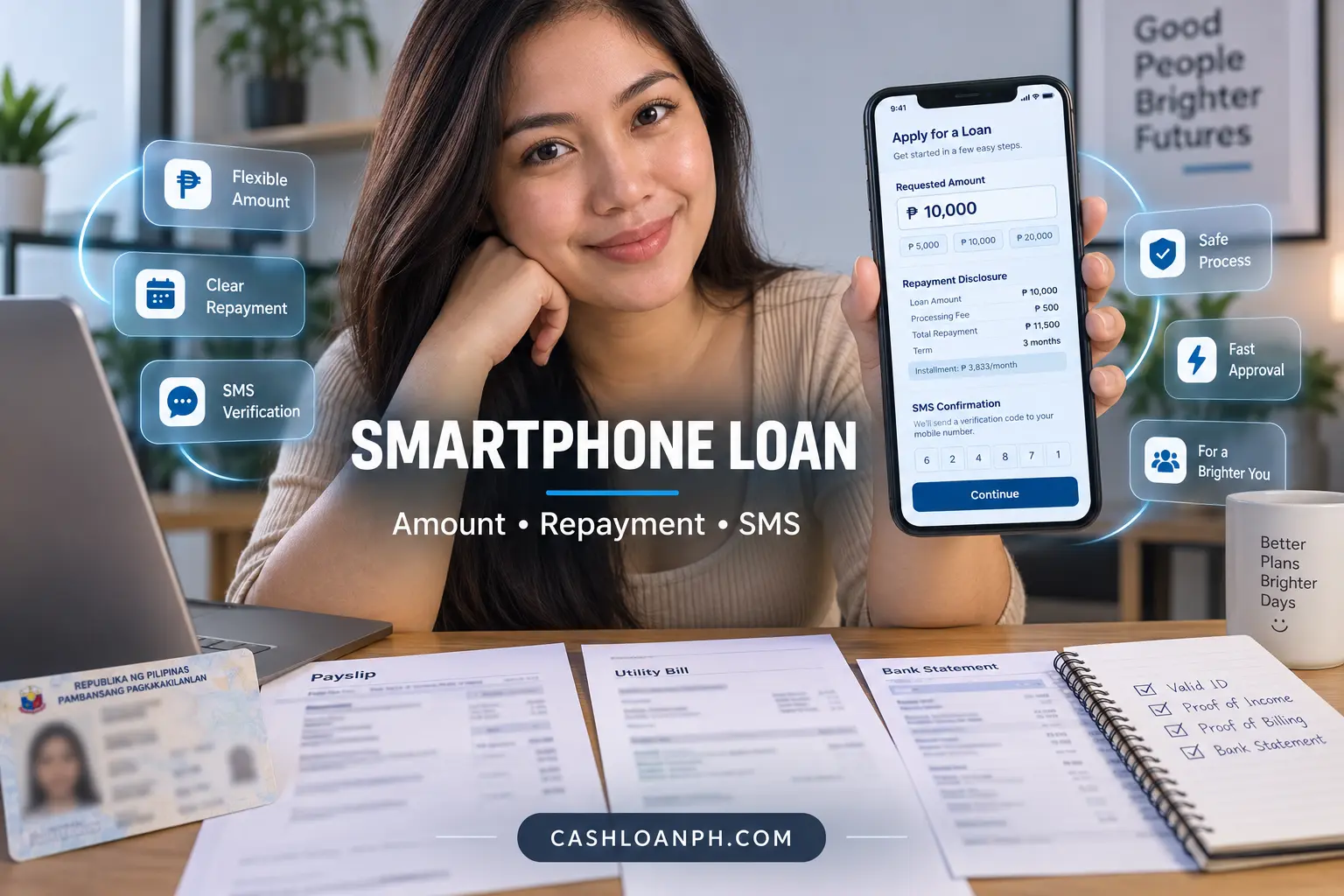
On the public application page, the visible flow moves through personal information, SMS confirmation and money transfer. The form asks for identity details, government-ID information, email and phone number and requires agreement to terms and privacy provisions before continuing.
I also traced Kviku’s published repayment routes. Its current instructions include GCash/Dragon Loans, Maya, Coins.ph, over-the-counter channels and a UnionBank transfer option. Kviku specifically warns borrowers that using an incorrect reference number can prevent proper validation of the payment.
That operational detail is more important than it looks.
When a borrower is already receiving collection reminders, a payment made to the right biller but attached to the wrong Lifetime ID can become a dispute over whether the account was actually paid. Always retain the payment receipt, screenshot the reference number and save the before-and-after account balance.
What Kviku PH complaints are borrowers reporting in 2026?
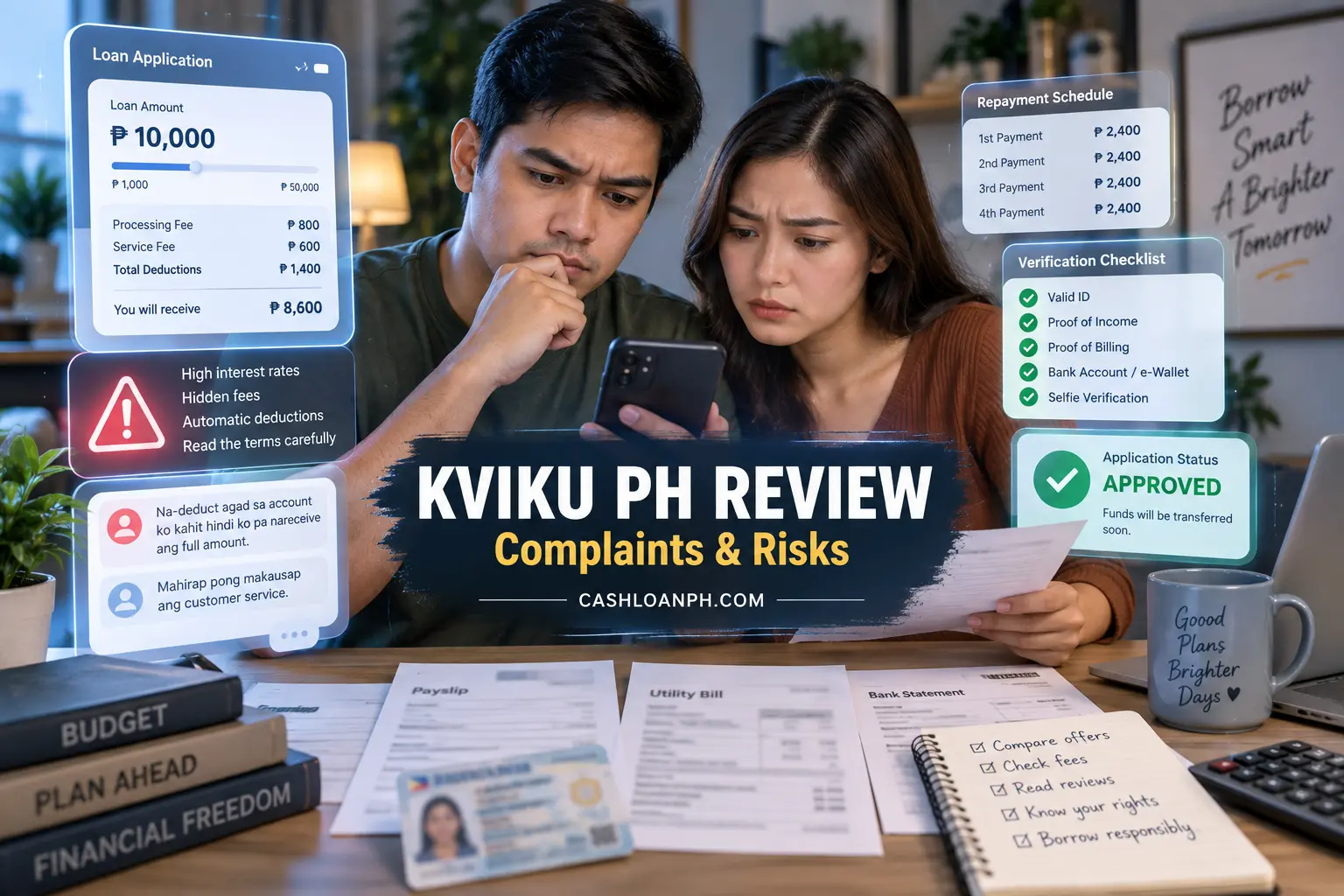
The clearest complaint pattern involves borrowers saying the economic result differed from what they thought they had agreed to: less usable cash than expected, higher financed amounts, ancillary services, repayment fees or rapidly increasing balances. These remain borrower allegations unless formally upheld by a regulator.
Several 2026 Reddit discussions describe this pattern.
One borrower reported receiving ₱1,000 while seeing a higher principal associated with what the poster described as a telemedicine add-on. The same poster said the disputed service was later removed after escalating the issue and supplying screenshots and contract documents.
Another post alleged that an initially expected ₱1,000 facility later showed a higher principal after disbursement because of a mental-support-related service.
Other borrowers described balances that they believed had grown far beyond the cash received, including accounts eventually being endorsed to third-party collection providers.
A September 3, 2026 Freedom of Information portal request submitted to the Anti-Money Laundering Council also alleged that a borrower applied for ₱2,000, received ₱1,500 and was asked to repay ₱2,784. That request was still marked pending when reviewed, so it must not be presented as a finding that Kviku violated the law.
This distinction protects readers from two bad conclusions.
“Someone complained” does not prove wrongdoing.
But repeated, independently described friction around net proceeds versus contractual principal and total repayment is enough reason for prospective borrowers to slow down and document the offer carefully.
Why are Kviku’s own 2026 loan disclosures worth examining closely?
Kviku’s current public channels do not describe its product in exactly the same way. The website FAQ, homepage and Google Play listing show different maximum amounts, tenors and published rate ranges, so borrowers should treat the final disclosure statement—not marketing copy—as controlling.
This was the strongest information-quality concern I found.
What does Kviku’s Philippine website currently say?
Kviku’s FAQ describes installment loans of ₱1,000–₱25,000, with a published daily rate of 0.16%, first-time terms up to 60 days and repeat-borrower terms potentially extending to 180 days.
The homepage meanwhile advertises loans up to ₱25,000, with selectable periods displayed up to 135 days, and states that the product ultimately approved may differ from the applicant’s initial request.
That last sentence deserves attention. What you request is not necessarily what underwriting approves.
What does Kviku’s Google Play listing currently say?
The Android listing updated August 5, 2026 advertises up to ₱50,000, terms of 61–180 days, daily interest from 0% to 2%, and a maximum stated annual rate of 730%.
That is materially different from the FAQ’s ₱25,000 maximum and 0.16% daily installment-loan description.
The Google Play page also gives an example in which a ₱5,000 loan over 135 days has a stated total repayment of approximately ₱14,906. The listing does not provide a full amortization table explaining each day’s declining balance and payment allocation, so a borrower should not attempt to infer their own repayment from the headline daily rate alone.
This does not automatically mean a borrower will be charged the maximum rate.
It means the contract-level disclosure matters enormously.
How should you calculate the real cost of a Kviku loan?
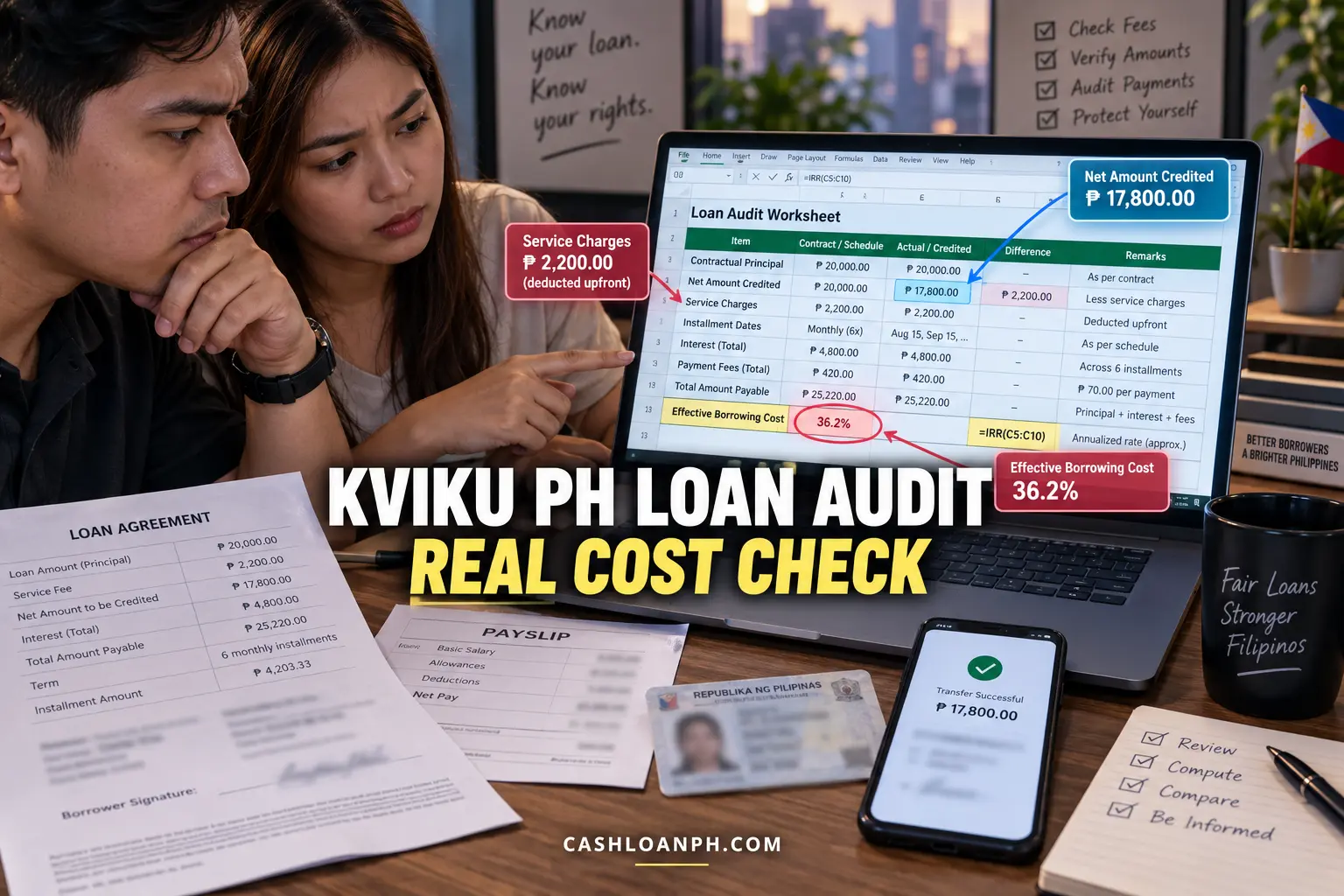
Ignore the emotional appeal of “cash now” and calculate three numbers first: cash actually received, total contractual repayment and peso cost of credit. If the first number and contractual principal differ, identify exactly where every peso went before confirming.
Suppose a screen says:
- Contractual principal: ₱5,000
- Cash credited: ₱4,200
- Total scheduled repayments: ₱7,000
A rushed borrower may think, “I borrowed ₱5,000 and pay ₱2,000 extra.”
From the household-budget perspective, however, only ₱4,200 became spendable cash.
The difference between gross financed amount and net proceeds must therefore be understood. If ₱800 funded a disclosed optional product or fee, ask whether it was truly optional, whether you expressly accepted it and how cancelling it affects the loan.
Do not rely only on percentages.
Write the transaction in pesos:
Total cash leaving your pocket − cash that entered your account = practical peso borrowing cost.
Then inspect the formal disclosure statement for the regulatory EIR treatment.
Do BSP and SEC interest-rate caps apply to every Kviku loan?
No. The long-standing BSP/SEC ceilings apply only when all coverage conditions are met, including an unsecured general-purpose loan of no more than ₱10,000 and a tenor of no more than four months. Larger or longer loans require a different regulatory analysis.
For covered loans, BSP Circular No. 1133 established:
- nominal interest ceiling: 6% per month
- effective interest ceiling including specified fees: 15% per month
- late/non-payment penalty ceiling: 5% per month on the scheduled amount due
- total cost cap: 100% of the amount borrowed
The word covered is where many online explanations go wrong.
A ₱25,000 six-month loan cannot simply be tested against the small-value-loan cap as though it were a ₱5,000 60-day facility.
Conversely, a Kviku loan of ₱5,000 for 60 or 90 days may potentially fall within the covered category if the remaining legal conditions are satisfied.
There is also useful evidence that the rule has not simply faded into history. A July 2026 SEC enforcement case involving another lender reportedly applied the 15% monthly EIR standard under SEC MC No. 3.
The SEC had proposed recalibrating lending ceilings in late 2025, but its official 2026 advisories still identify that item as a request for comments, not the final rule I would substitute for BSP Circular 1133/SEC MC No. 3 when analyzing covered loans.
What changed for Philippine online lenders in 2026?
SEC Memorandum Circular No. 20, Series of 2026 introduced a stronger prudential, disclosure and market-conduct framework for online lending and lifted the nearly five-year moratorium on new OLPs from August 1, 2026.
This matters for a Kviku review because the regulatory question is becoming broader than “Does the company have a CA?”
The SEC is placing greater emphasis on how the digital lending operation itself functions: borrower onboarding, credit assessment, disclosure, execution of contracts, disbursement, servicing, repayment and collections.
For borrowers, the practical principle is simple:
Digital speed does not reduce disclosure obligations.
A three-minute automated decision is still a financial contract.
What should you check before entering the Kviku SMS confirmation code?
Treat the SMS or OTP confirmation as the point of no casual return: screenshot and read the final offer before entering it. Kviku itself states that the loan contract is confirmed using a code sent by SMS.
Before confirmation, record one screen containing:
- Requested amount.
- Approved principal.
- Net proceeds.
- Every deduction.
- Interest rate.
- Effective interest rate, where disclosed.
- Number and amount of installments.
- Total amount payable.
- First due date.
- Late-payment terms.
- Optional insurance, health, support or membership service.
- Early-settlement amount or method.
The part distressed borrowers most often skip is the optional-product line.
If you see a medical, mental-health, subscription, assistance or other service that you did not intend to purchase, do not assume it is simply another name for interest.
Ask in writing:
“Is this service optional? What is its exact price? Did I expressly consent? Can I decline it without losing the loan offer?”
Save the answer.
What should you do if the cash received is lower than the principal displayed?
Do not immediately spend the money and hope the difference will make sense later. Compare the bank or e-wallet credit against the disclosure statement and request a written itemization of every deduction.
Your evidence packet should contain:
- screenshot of the offer before confirmation;
- signed/electronic contract;
- disclosure statement;
- screenshot of the amount credited;
- e-wallet or bank transaction record;
- invoice or description of any add-on;
- customer-support conversation.
Do not frame the first email as “you are scammers.”
Ask a numerical question:
“The contract shows ₱X principal, while my account received ₱Y. Please identify the contractual basis and amount of each deduction totaling ₱Z.”
That wording forces the dispute back to accounting.
What should you do when Kviku’s repayment amount appears wrong?
Dispute the amount in writing before the evidence becomes difficult to reconstruct. Ask for a complete statement of account showing principal, interest, fees, penalties, payments received and the allocation of each payment.
Kviku currently publishes several repayment channels and acknowledges that bank transfers can take time to post. It advises borrowers to provide proof of payment to prevent repayment delays.
For every payment:
Receipt → screenshot → email confirmation → updated balance.
That four-step habit can save weeks of argument.
Never send cash to a collector’s personal bank or e-wallet account merely because a threatening message says the offer expires today. Verify settlement instructions through Kviku’s official contact channel.
If a third-party collector offers a discount, request the settlement figure in writing and ask whether payment will result in full and final settlement.
Can Kviku or a collector legally shame you or contact everyone in your phone?
No lender receives unlimited collection rights merely because a debt is overdue. Philippine SEC and NPC rules restrict harassment, disclosure of debt information and contact with unrelated persons.
The March 2026 joint OLP advisory from the NPC, DICT and SEC expressly reiterated that contacting people in a borrower’s phone contacts who are not designated guarantors is prohibited for debt collection.
NPC rules also prohibit harvesting phone or social-media contacts for collection or harassment and require personal-data processing to remain proportionate to a legitimate purpose.
This is especially relevant because Kviku’s online privacy policy is broad. It refers to categories such as device information, location, contact information where permission is granted, third parties and other digital activity.
The policy even contains references to features such as stored-value exchanges, ATM transactions, IBAN information and overseas-use examples that do not closely resemble the straightforward Philippine cash-loan product described in Kviku’s local FAQ.
That does not establish a privacy violation.
It does make the policy harder for an ordinary Filipino borrower to interpret, which is exactly why just-in-time, purpose-specific privacy notices matter. NPC’s amended rules require accessible explanations of how requested information will be processed and prohibit unnecessary permissions.
Can you go to jail simply because you cannot pay Kviku?
No. Article III, Section 20 of the 1987 Philippine Constitution provides that no person shall be imprisoned for debt or non-payment of a poll tax.
That does not erase a valid debt.
A lender may use lawful civil remedies and legitimate collection procedures. A genuine court document also should never be ignored.
The constitutional protection should therefore be understood precisely:
Ordinary inability to pay a civil debt is not itself a reason for imprisonment.
A separate allegation involving fraud, falsification or another criminal offense is a different legal matter and should be discussed with a qualified Philippine lawyer.
Do not let a generic text saying “legal action,” “case filing” or “endorsement to legal” push you into sending money to an unverified account.
What should you do if collection messages become threatening?
Preserve the evidence rather than arguing by phone. Timestamped screenshots, caller numbers, recordings where lawfully obtained, emails, contracts and proof that you disputed the account are much more useful than a long emotional exchange.
SEC MC No. 18 prohibits forms of unfair debt collection such as threats of unlawful action, abusive language, deceptive collection methods and improper disclosures. The lender also remains accountable for collection agents acting on its behalf.
A 2026 SEC case involving another financing company is a useful reminder that these rules are actively enforced: the regulator imposed a fine after collection activity involved people who were not guarantors or co-makers.
For a Kviku dispute, escalate in this order:
Kviku written complaint → request for final account reconciliation → SEC complaint for lending/collection issues → NPC complaint where personal-data misuse is involved.
The SEC’s current iMessage system includes a route for complaints concerning financing and lending companies.
Do not mass-email unrelated agencies merely because a social-media template tells you to. Send the right evidence to the regulator with jurisdiction over the actual issue.
Is Kviku PH a good emergency-loan choice in 2026?
For a borrower who has other reasonably priced options, I would compare those first. Kviku’s automated access is convenient, but its published maximum pricing and inconsistent public product descriptions make contract-level cost checking especially important.
The positives are real.
Kviku offers a fully online process, relatively light documentation, multiple repayment channels, and eligibility that may accommodate self-employed or informally employed borrowers. Its Google Play listing says a government ID, phone and bank account may be enough for the basic application.
The weaknesses matter more when cash flow is fragile.
A borrower whose next two paychecks are already committed to rent, food, tuition and utilities should not take an expensive short-term facility merely because approval is easier than at a bank.
The question is not:
“Can Kviku approve me?”
It is:
“Can I finish this loan without needing another loan?”
If the answer is no, approval solves today’s cash shortage by creating another one.
Which borrowers should be especially cautious about Kviku?
Kviku is a poor fit for anyone who cannot state, before signing, exactly how much cash will arrive and where every scheduled repayment will come from.
Be particularly cautious when:
- you are borrowing to repay another OLA;
- you need the loan for regular monthly groceries rather than a one-off shortfall;
- repayment consumes most of your next salary;
- you have several existing app loans;
- you do not understand an ancillary service shown in the contract;
- the approved amount changed from what you requested;
- you are relying on future overtime, commissions or gig income that is not guaranteed.
Lenders using automated underwriting may be willing to lend to workers without conventional payroll records. That flexibility can help freelancers and gig workers.
It also transfers more repayment-risk judgment to you.
How can you reduce your risk if you still decide to use Kviku?
Borrow only after converting every contract term into pesos and calendar dates. The safest borrower is not the person with the highest approved limit; it is the person who knows the exit date before accepting the money.
Use one simple rule.
If total installments are ₱1,500 every two weeks, remove ₱1,500 from your hypothetical budget today.
Can you still pay rent, commute, eat and cover medicine?
If not, the repayment is not affordable merely because the app approved it.
Also check your permissions after the application. NPC guidance says application permissions must be suitable, necessary and proportionate, and unnecessary access should not continue simply because it was granted during onboarding.
And never delete your contract after repayment.
Kviku says contracts may be retained in its database for years, while your own copy can disappear when you change phones, SIM cards or email accounts.
What is my final Kviku PH borrower-protection verdict for 2026?
Kviku PH is associated with a verifiable SEC-registered lending company, but I would rate its 2026 product disclosures as requiring unusually careful borrower verification before acceptance. The current differences among its website, FAQ and Android listing are too important to ignore when evaluating cost.
The fair conclusion is neither “Kviku is fake” nor “SEC registered means you are safe.”
It is this:
Verify the exact offer in front of you.
The company’s public pages currently provide conflicting descriptions of maximum loan amount, loan period and daily pricing. At the same time, 2026 borrower reports repeatedly raise concerns about high repayment totals, deductions and ancillary charges. Those allegations should not be converted into factual findings without regulatory evidence, but prospective borrowers have every reason to treat them as prompts for closer due diligence.
If you already have a Kviku loan and are frightened by the balance, start with the records.
Find the disclosure statement. Find the contract. Total your payments. Confirm the amount you actually received. Separate interest from fees, ancillary products and penalties. Request a reconciliation in writing.
And remember: having a debt does not remove your right to dignity, accurate accounting, fair treatment and lawful use of your personal information.
What else do borrowers commonly need to know before dealing with Kviku?
Small operational details—cancellation timing, early payment, documentation and posting delays—can materially change the borrower experience even when the original loan terms remain unchanged.
Can you cancel a Kviku application before receiving the money?
Kviku’s FAQ says cancellation is possible before the contract is confirmed. Once confirmed, it says funds are sent and the borrower would instead need to consider early repayment.
This makes the SMS confirmation stage especially important.
Can you repay a Kviku loan early?
Kviku says full or partial early repayment is possible, but you should obtain the exact settlement amount before transferring funds. Its FAQ refers borrowers to their profile or customer service for the amount required.
Do not assume that paying early automatically produces the savings you calculated yourself.
Does Kviku require a payslip or Certificate of Employment?
Not necessarily. Kviku says one valid government ID is its basic requirement, while a payslip, COE, ITR, company ID or DTI documentation may support an application.
This accessibility is useful for informal-income workers, but approval should never be interpreted as proof that the debt is affordable.
What should you do when a Kviku payment has not appeared in your account?
Keep the receipt and notify Kviku promptly with proof of payment and the correct loan or Lifetime ID. Kviku warns that bank transfers may take several days and that incorrect reference details can delay validation.
Continue documenting the balance until the payment is posted.
Does SEC registration guarantee that an optional service charge is valid?
No. SEC registration establishes the lender’s regulatory identity; it does not automatically validate every fee in every individual contract.
The relevant questions are whether the charge was properly disclosed, contractually agreed, appropriately included in required cost calculations, and compliant with the rules applicable to that specific loan.
References
- Kviku Philippines
Organization: Kviku Lending Co. Inc.
Resource: Official Philippine Website and Current Loan Information
URL: Kviku Philippines official website - Kviku Philippines FAQ
Organization: Kviku Lending Co. Inc.
Resource: Loan Requirements, Terms, Cancellation and Repayment FAQ
URL: Kviku FAQ - Kviku Android Application
Organization: Kviku Lending Co. Inc. / Google Play
Resource: Kviku – Online Loans, Updated August 5, 2026
URL: Kviku on Google Play - Registered Lending Companies
Organization: Securities and Exchange Commission Philippines
Resource: SEC List of Registered Lending Companies
URL: SEC lending and financing companies information - SEC Memorandum Circular No. 20, Series of 2026
Organization: Securities and Exchange Commission Philippines
Resource: Guidelines Prescribing Prudential, Disclosure and Market Conduct Requirements for Financing and Lending Companies
URL: SEC Philippines - BSP Circular No. 1133, Series of 2021
Organization: Bangko Sentral ng Pilipinas
Resource: Ceilings on Interest Rates and Other Fees Charged by Lending and Financing Companies and OLPs
URL: BSP Circular No. 1133 PDF - SEC Memorandum Circular No. 18, Series of 2019
Organization: Securities and Exchange Commission Philippines
Resource: Prohibition on Unfair Debt Collection Practices
URL: SEC Memorandum Circulars for Financing and Lending Companies - Guidelines on Personal Data for Loan-Related Transactions
Organization: National Privacy Commission
Resource: NPC Circular No. 20-01, as amended
URL: National Privacy Commission - 2026 Advisory on Online Lending Platforms
Organization: National Privacy Commission, DICT and SEC
Resource: Public Advisory on Online Lending Platforms
URL: 2026 OLP Public Advisory PDF - 1987 Constitution of the Republic of the Philippines
Organization: Supreme Court of the Philippines
Resource: Article III, Section 20 — No Imprisonment for Debt
URL: Supreme Court E-Library — 1987 Constitution