Last Updated on 09/09/2026 by Nicole Alba
If you are searching for HoneyLoan complaints because the calls have started, your due date is getting close, or the amount you need to repay looks much bigger than the cash you received, the first thing to know is this: owing money on an ordinary civil loan does not automatically mean you can be jailed in the Philippines. Article III, Section 20 of the 1987 Constitution states that no person shall be imprisoned for debt. Separate criminal conduct, such as fraud, is a different legal matter.
The harder question is whether Honey Loan is a lender you should trust with your ID, personal data and repayment money.
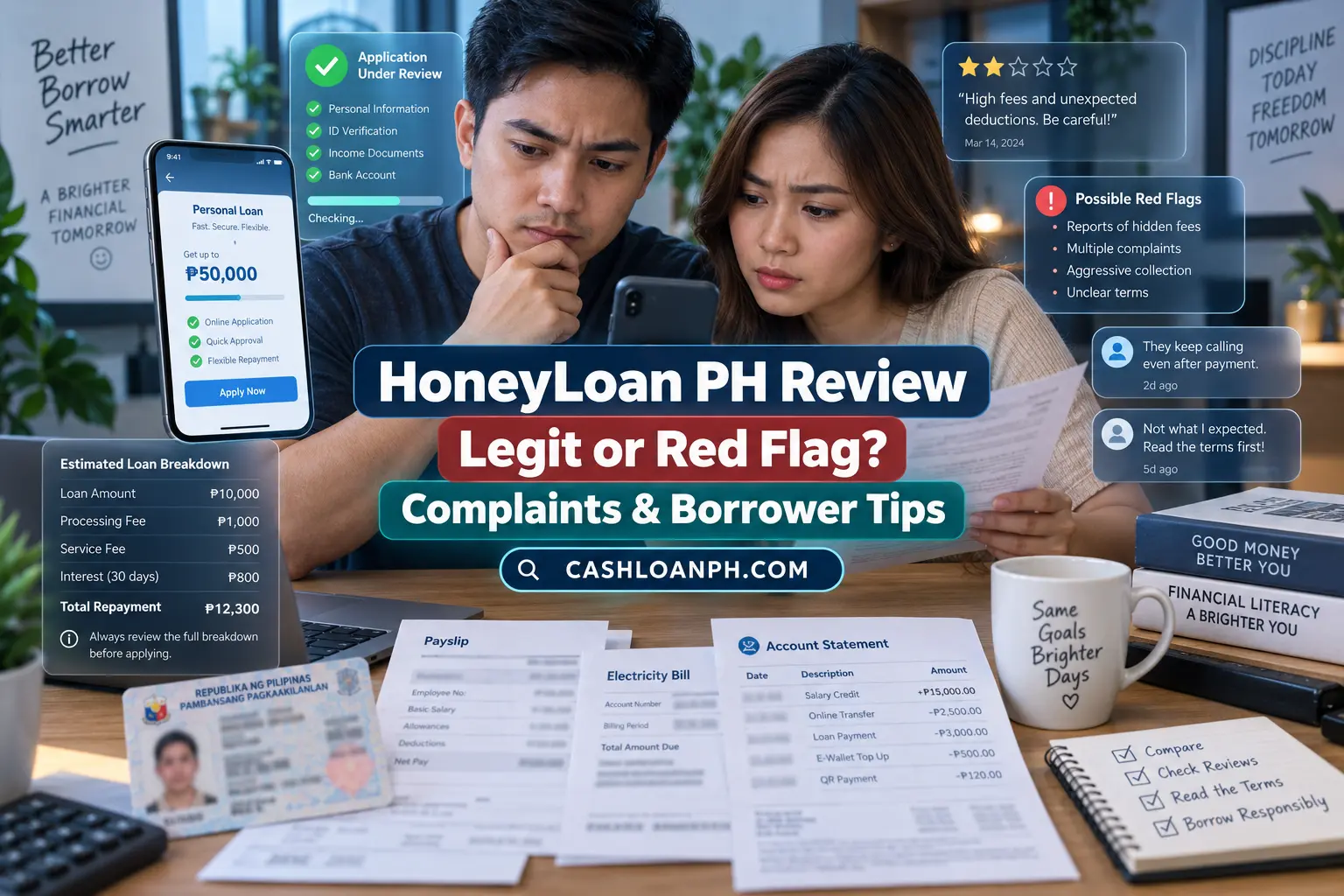
Our September 2026 review found evidence connecting Honey Loan to SEC-registered Warm Cash Lending Corp., but it also found inconsistent public pricing and licensing details across Honey Loan’s website, Google Play and Apple App Store listings, plus recent borrower complaints involving collection calls and repayment visibility. Those issues deserve attention before you accept an offer.
| Question | What our 2026 review found | Borrower takeaway |
|---|---|---|
| Is Honey Loan connected to a registered lender? | Yes. SEC records identify Warm Cash Lending Corp.; earlier SEC OLP records specifically list Honey Loan. | Positive legitimacy signal, but still verify current SEC records before borrowing. |
| How much does it advertise? | Around ₱1,000–₱30,000, depending on borrower status. | Maximum advertised credit is not guaranteed. |
| What public rate is currently shown? | Google Play and the website show 0.4% daily cost / up to 144% APR in a representative product disclosure. | This can become expensive very quickly. |
| Are public disclosures consistent? | No. Apple, Google Play and the website show material differences in rates, terms and CA information. | Save your final Disclosure Statement before accepting. |
| Are there complaints? | Yes. Recent reviewers allege pre-due-date calls and difficulty viewing repayment details; another recent reviewer described professional treatment after being late. | Experiences appear mixed rather than uniformly positive or negative. |
| Can Honey Loan access personal data? | Public app disclosures indicate collection of financial, contact, location, device and other data categories. | Read permissions carefully and refuse unnecessary access. |
| Is unpaid debt automatically a criminal case? | No. Ordinary contractual debt is generally civil. | Do not ignore legitimate debt, but do not panic because of jail threats. |
Is HoneyLoan PH legit and SEC registered in 2026?
Honey Loan has a stronger legitimacy trail than an anonymous or cloned lending app because SEC records connect it with Warm Cash Lending Corp. Still, borrowers should verify the current company and OLP record directly because its public pages show conflicting Certificate of Authority numbers.
An SEC list of registered lending companies dated August 2024 identifies Warm Cash Lending Corp., registration number 2021030009095-02, with Certificate of Authority 3427. Older SEC lists of recorded online lending platforms also associate Warm Cash Lending Corp. with Honey Loan.
Honey Loan’s current Google Play listing also says the operator is Warm Cash Lending Corp. and gives CA No. 3427.
Here is where our verification became less tidy.
Honey Loan’s current website identifies the same SEC registration number but displays Certificate of Authority No. 3472, not 3427. Its Apple App Store description also uses 3472.
That does not prove the lender is unauthorized. A license may be amended and web pages can contain stale or erroneous information. But borrowers should not have to guess.
For that reason, I would verify Honey Loan through the SEC’s current recorded OLP information before sending documents or money instead of treating an SEC logo inside the app as sufficient proof.
This matters even more in 2026 because SEC Memorandum Circular No. 20 introduced strengthened disclosure and market-conduct requirements for lending and financing companies and reopened registration of new online lending platforms from August 1, 2026 under a tighter regulatory framework.
What interest rate and total repayment does Honey Loan advertise in 2026?
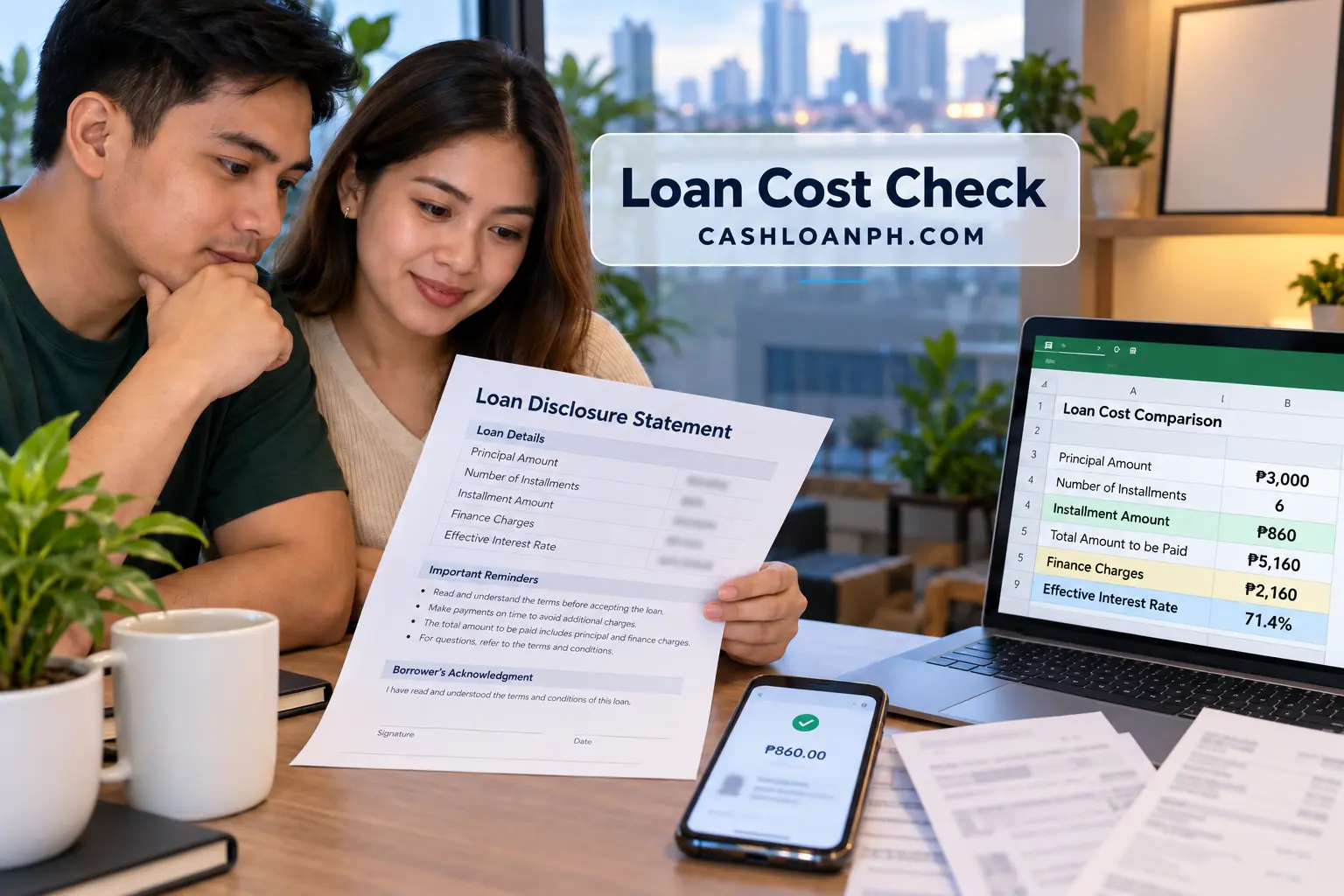
The clearest current Google Play disclosure shows a 0.4% daily cost, a maximum APR of 144%, and a representative ₱3,000 loan costing ₱5,160 over 180 days. That means the advertised example repays ₱2,160 above principal.
The Google Play example states:
| Item | Public example |
|---|---|
| Principal | ₱3,000 |
| Term | 180 days |
| Daily cost rate | 0.4% |
| Stated monthly effective rate | 12% |
| Interest + fees | ₱2,160 |
| Total repayment | ₱5,160 |
| Monthly installment | ₱860 |
| Maximum stated APR | 144% |
This deserves more attention than the phrase “fast online loan.”
A borrower receiving ₱3,000 and returning ₱5,160 is paying 72% of the original principal in financing cost over six months.
There is another analytical issue worth noticing. If ₱3,000 is actually received on day one and the borrower then pays six equal monthly installments of ₱860, a straightforward cash-flow IRR calculation produces a monthly rate of roughly 18%, not 12%.
That does not by itself prove the legally required EIR disclosure is wrong because exact payment dates, contractual cash flows and the regulatory EIR methodology matter. It does mean I would want to see the actual statutory Disclosure Statement before accepting the offer.
Why do Honey Loan’s public interest-rate figures appear inconsistent?
The September 2026 public sources do not present one perfectly consistent product description. Google Play and the website show pricing around 0.4% per day and up to 144% APR, while Apple’s listing contains a substantially lower representative rate.
The difference is not trivial.
Google Play currently shows a representative ₱3,000 loan with a 0.4% daily cost, ₱2,160 in interest and fees over 180 days, and ₱5,160 total repayment.
The Apple App Store description, by contrast, shows a representative ₱3,000 six-month loan with a 0.096% fixed daily interest rate, ₱3,487 total repayment and a maximum APR around 35%–36%.
Loan-term disclosures differ too:
- Honey Loan’s website currently advertises approximately 61–364 days.
- Google Play states 61–180 days.
- Apple’s description refers to repayment reaching approximately 365 days.
For a financial product, that degree of channel inconsistency is a reason to slow down.
The safest rule is simple: ignore the promotional rate once you reach the offer screen. Read the actual Disclosure Statement for your specific transaction.
Check the exact principal, net proceeds, finance charge, EIR, payment schedule, late-payment charge and total amount due before pressing the final confirmation button.
What are the 2026 Philippine interest-rate limits that may apply to a Honey Loan?
For qualifying small, unsecured general-purpose loans of ₱10,000 or less with terms of four months or less, the 2026 framework generally caps nominal interest at 6% monthly, EIR at 12% monthly, late penalties at 5% monthly and total credit cost at 100% of principal.
The effective-interest ceiling was recalibrated for covered loans beginning April 1, 2026.
The important word is covered.
Do not assume the same numerical limits apply to every loan merely because it comes from an online lending app. The small-loan ceilings depend on factors such as:
- whether the loan is unsecured;
- whether it is a general-purpose loan;
- whether principal is ₱10,000 or below;
- whether the term is no more than four months; and
- when the loan was entered into, renewed or restructured.
For a transaction within that scope, the current 2026 EIR limit is particularly relevant because fees cannot simply be renamed to make an expensive loan appear cheap.
A Honey Loan example with a six-month tenor, however, is longer than the four-month threshold for this specific small-loan rate-cap framework. It still remains subject to applicable disclosure, consumer-protection and contract rules.
This distinction is often missing from loan-app reviews that say either “144% APR is automatically illegal” or “any rate is legal because the lender is registered.” Neither shortcut is reliable.
What Honey Loan complaints are borrowers reporting in 2026?
Current public complaints focus mainly on collection communication and repayment visibility, but the evidence is mixed. Individual reviews should be treated as borrower allegations, not as regulatory findings against the lender.
A current Apple App Store reviewer reported in early September 2026 that they had paid in full but had experienced repeated calls and messages even before the payment due date, despite claiming never to have missed a payment.
Another late-August reviewer complained that the repayment function was difficult to locate and that the existing loan and its details were not clearly visible inside the app.
That second type of complaint matters more than it may initially appear.
When somebody owes money, repayment visibility is not merely a user-interface convenience. A borrower should be able to confirm:
- exact balance;
- next due date;
- payment amount;
- payment channel;
- successful payment status; and
- official receipt or confirmation.
A repayment interface that makes those items hard to retrieve creates unnecessary delinquency risk.
Yet the reviews are not one-sided.
Another recent Apple reviewer said they were three days late and described the collection call as professional and accommodating.
That tells us something important: public borrower experiences appear inconsistent.
I would not claim that every Honey Loan borrower is harassed. The available evidence does not support that statement.
I would also not dismiss the negative reports simply because positive ratings exist.
Have harassment allegations involving Honey Loan appeared before 2026?
Yes. A 2023 government FOI record contains a borrower’s harassment and threatening allegation involving Honey Loan and Warm Cash Lending Corp., but the FOI entry itself is not a finding that the allegation was proven.
The complaint stated that the borrower contacted the lender on the due date to explain financial difficulty and alleged being harassed and pressured to settle.
That source needs careful wording.
An FOI request page records what a complainant told the government. It is not the same thing as an SEC adjudication finding Honey Loan guilty of misconduct.
This distinction is essential for a credible review. Borrower complaints are evidence that a problem was reported. They are not automatically evidence that every allegation is true.
Can Honey Loan legally contact your phone contacts about your debt?
A lender cannot freely scrape your contact list and message friends, relatives or coworkers to shame you into paying. Philippine privacy rules specifically restrict excessive contact-list processing and debt collection through third parties.
The joint 2026 DICT-NPC-SEC advisory is particularly direct.
It reiterates that unauthorized, excessive or disproportionate processing of personal data is prohibited and states that contacting people in a borrower’s contact list for debt collection—other than a valid guarantor—is prohibited.
Being a “character reference” also does not automatically make somebody legally responsible for your debt. The NPC has specifically distinguished a character reference from a guarantor.
That matters because fear of embarrassment is one of the most powerful pressure points in digital collection.
If somebody tells you, “Pay tonight or we will message your boss, cousins and entire contact list,” do not assume that possession of your data gives the collector unrestricted authority to use it.
What personal data does the Honey Loan app say it processes?
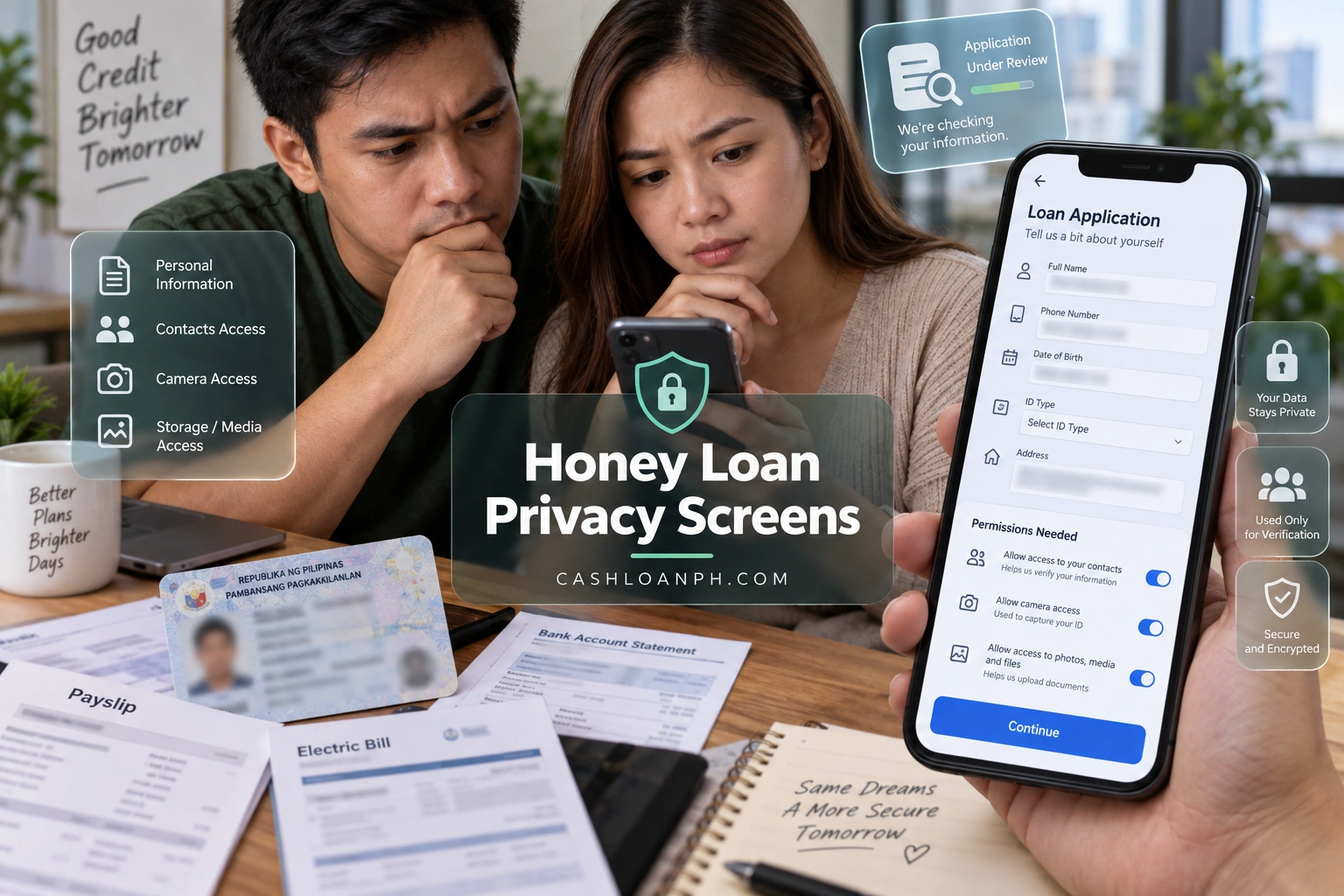
Honey Loan’s app-store disclosures indicate processing of financial, identity, location, contact, device and user-content data, while Google Play also states that certain data types may be shared with third parties. Borrowers should examine every permission rather than granting blanket access.
Apple’s current disclosure identifies categories linked to the user that may include:
- credit and other financial information;
- precise and coarse location;
- name, address, email and phone number;
- photos or videos;
- device identifiers; and
- diagnostic information.
Apple also notes that these privacy disclosures are supplied by the developer and are not independently verified by Apple.
Google Play states that the app may collect location, personal information and several other data categories, may share photos and videos with third parties, encrypts data in transit and permits deletion requests.
Honey Loan’s own privacy notice says Warm Cash Lending Corp. may process information for identity checks, credit-risk management, fraud prevention, collection, legal compliance and reporting to entities such as the Credit Information Corporation where applicable.
None of those disclosures automatically proves misuse.
But they show why an online loan should never be treated like downloading a calculator app. You are creating a financial relationship tied to a substantial amount of personal information.
What application friction should borrowers expect from Honey Loan?
Honey Loan publicly says applicants submit personal information, a valid ID and selfie, and that no guarantor or payslip is required. Approval and disbursement are still subject to verification, so advertised processing times should never be treated as guarantees.
This is an area where many loan reviews make exaggerated promises such as “guaranteed approval in three minutes.”
Real lending operations do not work that way.
Honey Loan says the applicant submits a valid ID and selfie, waits for a decision, and may be contacted if more information is required. Approved funds may then be sent to an e-wallet or a bank account belonging to the borrower.
Common friction in Philippine digital underwriting can include:
- blurry or cropped ID photos;
- glare covering ID text;
- selfie or identity-verification failure;
- differences between the applicant name and bank/e-wallet account name;
- inconsistent address or employment information;
- duplicate accounts;
- fraud-screening flags; or
- credit-history concerns.
Honey Loan does not publicly reveal its scoring thresholds, so anyone claiming to know the exact formula used to approve or reject applications is speculating.
From the lender’s side, the absence of a payslip does not mean there is no underwriting.
For a traditional salaried employee, income stability may be easier to infer from declared employer information and credit history. A freelancer, rider, online seller or other gig worker may have irregular cash flow, which can make affordability harder to assess even when average monthly income looks healthy.
That is one reason a borrower can have income and still receive a small initial limit—or be declined.
What did we actually test instead of pretending to complete a Honey Loan application?
We verified Honey Loan’s live public website flow, current Google Play and Apple listings, pricing disclosures, privacy materials, SEC records and public complaint evidence. We did not create a fake borrower identity or take out debt merely to manufacture a “first-hand” approval story.
The public Honey Loan login currently asks for a Philippine mobile number and requires agreement to its privacy notice and terms before proceeding.
We also compared the company’s live website disclosures against current app-store descriptions and regulator records.
That comparison produced one of the most important findings in this review: the public sources themselves contain inconsistencies involving pricing, loan tenor and Certificate of Authority information.
A responsible review should report that rather than inventing statements such as “our ₱5,000 loan reached GCash in exactly seven minutes.”
Real disbursement speed depends on approval, payment rails, account validation, maintenance windows and fraud controls. “Instant” in marketing language should never be budgeted as a guaranteed settlement time.
What should you do before accepting a Honey Loan offer?
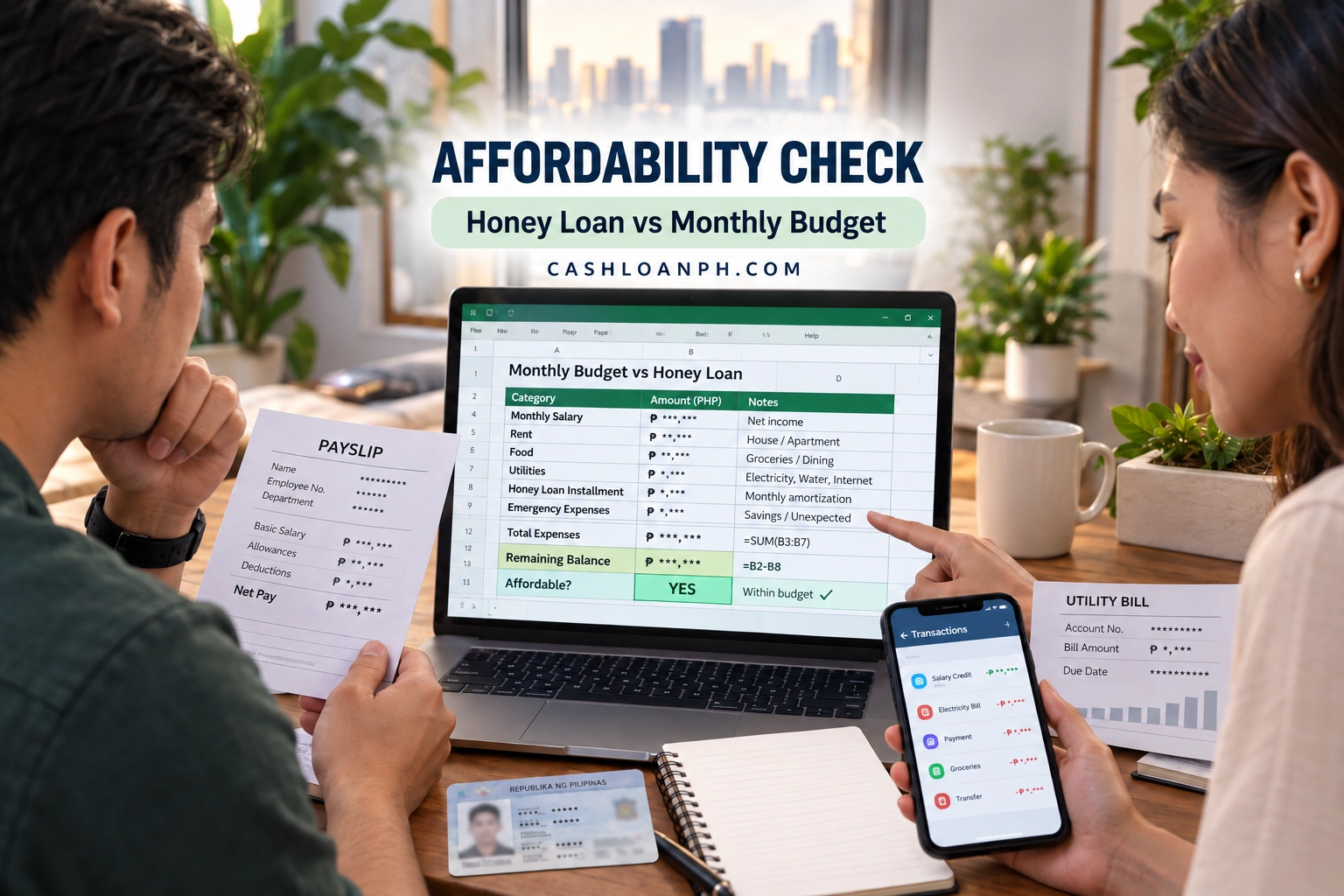
Do not accept the loan until the final disclosure lets you answer four questions: How much cash will I actually receive, how much must I repay, on what dates, and what happens if I am late?
Use the offer screen and Disclosure Statement—not the credit-limit banner.
Before accepting, record:
- Principal amount stated in the contract.
- Net amount actually going to your GCash, Maya or bank account.
- Every service, processing or other charge.
- Effective interest rate.
- Number and amount of installments.
- First and final due dates.
- Late-payment penalty.
- Total amount payable.
- Official repayment channels.
- Loan-agreement and Disclosure Statement copies.
Then test the payment against your bad month, not your good month.
If you normally earn ₱25,000 but some months drop to ₱15,000, use ₱15,000 when judging affordability.
A loan that works only when overtime, commissions or online-selling income are unusually strong is already carrying repayment risk.
What should you do if Honey Loan calls repeatedly before your due date?
Start documenting the pattern rather than arguing emotionally with every caller. Save call logs, messages, payment records and the contract so you can distinguish legitimate reminders from potentially unfair collection conduct.
First, confirm that the caller genuinely represents the lender.
Then reply through an official channel and request written clarification of:
- balance;
- due date;
- reason for the calls;
- collection account reference; and
- available repayment or hardship options.
Honey Loan currently publishes customer-support contact information including (02) 8876-1972 and [email protected].
If communication becomes threatening, humiliating or involves unauthorized disclosure to third parties, preserve the evidence.
SEC rules prohibit unfair collection practices by lending and financing companies, while NPC rules address misuse of personal data. The agencies issued another joint reminder in 2026 after receiving reports involving harassment, intimidation, public shaming and improper data use by online lenders.
What should you do if you cannot pay Honey Loan on time?
Contact the lender before the due date when possible, ask for available restructuring or payment arrangements in writing, and never take another high-cost loan solely to silence today’s collector unless you have calculated the full replacement cost.
The most dangerous pattern I see in small-ticket digital borrowing is not one expensive loan.
It is this sequence:
Loan A becomes due → borrower opens Loan B → Loan B is short → borrower opens Loan C → salary now services three debts instead of household expenses.
That is how a ₱3,000 cash shortage can turn into a multi-app debt cycle.
If you cannot cover the full payment:
- state what you can realistically afford;
- request written account information;
- ask whether restructuring exists;
- keep screenshots of every offer;
- obtain receipts for every payment; and
- avoid paying an unknown personal GCash number sent by a random collector.
The SEC itself advises borrowers to understand interest, fees, due dates and loan agreements, verify registered platforms, avoid unnecessary contact permissions, and obtain proof of full payment.
Can Honey Loan have you arrested simply because you missed payment?
No. Failure to pay an ordinary contractual debt does not by itself allow a lender to imprison you. The Philippine Constitution expressly prohibits imprisonment for debt.
That does not erase the debt.
A legitimate creditor can still pursue lawful collection remedies, demand payment, report credit information where permitted, negotiate settlement, or pursue a civil claim.
The important distinction is between civil non-payment and a separate criminal act.
A collection message implying that police will automatically arrive tomorrow merely because an online installment is late should therefore be treated very cautiously.
Do not respond to fear by paying the wrong person.
Verify the collector, verify the amount and keep records.
When should a borrower consider reporting a Honey Loan collection issue?
Consider escalating when the dispute moves beyond a normal payment reminder into threats, humiliation, unauthorized third-party contact, questionable data use, unexplained charges or refusal to provide basic loan information.
The appropriate channel depends on the problem.
For lending-company conduct and regulatory issues, the SEC has procedures for complaints involving financing and lending companies.
For misuse of personal information, contact-list abuse or privacy violations, the National Privacy Commission is the specialist regulator.
For credible threats of violence or other conduct that may constitute a crime, seek help from the proper law-enforcement authorities.
When reporting, evidence is far more useful than a long angry narrative.
Organize:
- contract and Disclosure Statement;
- screenshots;
- call logs;
- caller numbers;
- collection messages;
- proof of payments;
- names of third parties contacted;
- dates and times; and
- your written complaint to the lender.
That creates a factual timeline regulators can evaluate.
Is Honey Loan worth using in 2026?
Honey Loan appears connected to a real SEC-registered lending company, but I would classify it as a high-cost emergency-credit option that requires careful document checking—not as cheap everyday financing.
The registration trail is a meaningful positive.
So are identifiable support channels, published privacy documents, a functioning website and app-store presence.
The concerns are equally real:
- expensive public pricing;
- inconsistent pricing information across platforms;
- inconsistent CA information;
- varying advertised loan tenors;
- recent complaints about pre-due collection contact;
- a recent complaint involving loan and repayment visibility; and
- extensive personal-data processing typical of digital underwriting.
I would consider a Honey Loan only when the expense is genuinely necessary, the repayment source is already identifiable, and the final loan documents are clear enough that you can calculate the complete cost yourself.
I would not use it to fund lifestyle spending, repay another online lending app without a debt-reduction plan, gamble on future commissions, or cover an expense that repeats every month.
If ₱3,000 today creates a ₱5,160 obligation tomorrow, the question is not simply whether the app approves you.
The better question is whether taking the loan leaves next month’s version of you in a stronger or weaker position.
What is the safest final verdict on HoneyLoan PH review complaints 2026?
Honey Loan does not look like a simple anonymous scam app, but SEC-linked status should not be mistaken for a guarantee of low cost or perfect collection practices. Verify the current registration, compare the signed disclosure against 2026 rules, protect your personal data and borrow only when repayment is realistic.
The strongest borrower protection is not avoiding every lender. Sometimes emergency credit is necessary.
It is refusing to borrow blindly.
Save the Disclosure Statement. Calculate the peso cost. Check the due date against your real payday. Keep your repayment proof. Challenge unauthorized data use. Report abusive collection behavior when evidence supports it.
And if you are already behind, focus first on creating a documented repayment plan rather than opening three more apps to make one collector disappear.
That approach may feel slower than another instant-loan button, but it is far more likely to get you out of debt instead of moving the same shortage from one lender to another.
References
- Securities and Exchange Commission – Registered Lending Companies
Organization: Securities and Exchange Commission Philippines
Resource: List of Registered Lending Companies / Warm Cash Lending Corp. regulatory record
URL: SEC lending-company record - Securities and Exchange Commission – Online Lending Platform Regulation
Organization: Securities and Exchange Commission Philippines
Resource: SEC Memorandum Circular No. 20, Series of 2026 and current lending-company notices
URL: SEC official website - National Privacy Commission – Online Lending Platform Advisory
Organization: National Privacy Commission / DICT / SEC
Resource: 2026 Joint Advisory on Online Lending Platforms
URL: NPC 2026 online-lending advisory - Honey Loan
Organization: Warm Cash Lending Corp.
Resource: Loan Terms, Application Process, Privacy Notice and Support Information
URL: Honey Loan official website - Google Play
Organization: Google / DYNINNO FINTECH HOLDING LIMITED
Resource: Honey Loan: Online Loan App – Current Loan Details and Data Safety Disclosure
URL: Honey Loan on Google Play - Apple App Store Philippines
Organization: Apple / DYNINNO FINTECH HOLDING LIMITED
Resource: Honey Loan PH – Current Product Description, Privacy Information and Borrower Reviews
URL: Honey Loan PH on the App Store - The LawPhil Project
Organization: Arellano Law Foundation
Resource: 1987 Philippine Constitution, Article III, Section 20
URL: 1987 Philippine Constitution

![Kviku Loan PH Review: Loan Infor, Terms, Legitimacy, Application Process, and More [New Update]](https://cashloanph.com/wp-content/uploads/2023/10/kviku-loan-philippines-review-cashloanph-438x246.jpg "Kviku Loan PH Review: Loan Infor, Terms, Legitimacy, Application Process, and More [New Update]")