Last Updated on 09/09/2026 by Nicole Alba
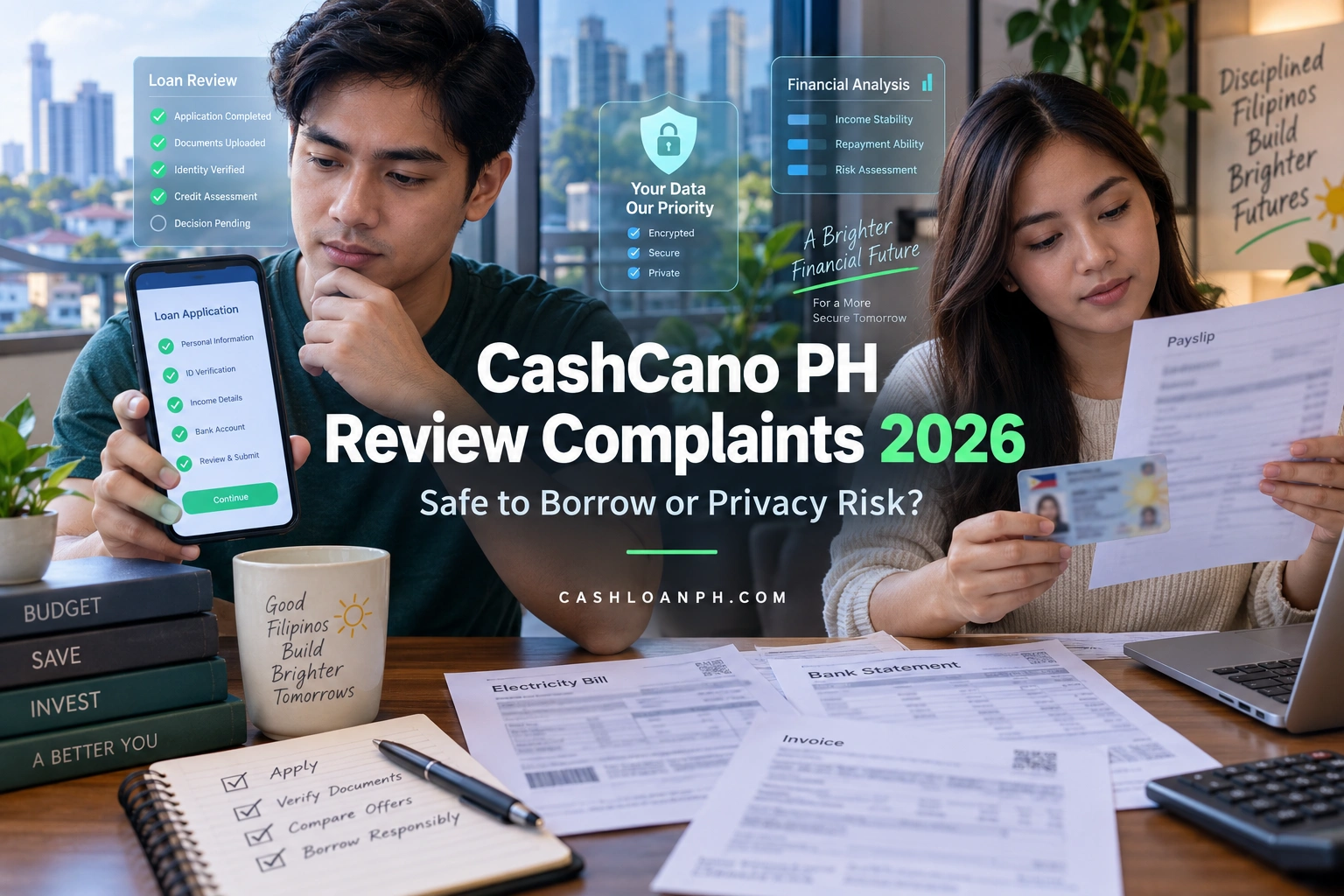
Getting repayment messages before you are ready to pay can make a small online loan feel much bigger than the amount you borrowed. If you are already receiving calls, emails, or warnings from CashCano, the fear can be worse when you are unsure whether the lender is legitimate or what collectors can legally do.
Start with one point that may ease some of that pressure: ordinary unpaid debt does not automatically send a borrower to jail in the Philippines. Article III, Section 20 of the 1987 Constitution states that no person shall be imprisoned for debt. Fraud or another separate criminal offense is a different matter.
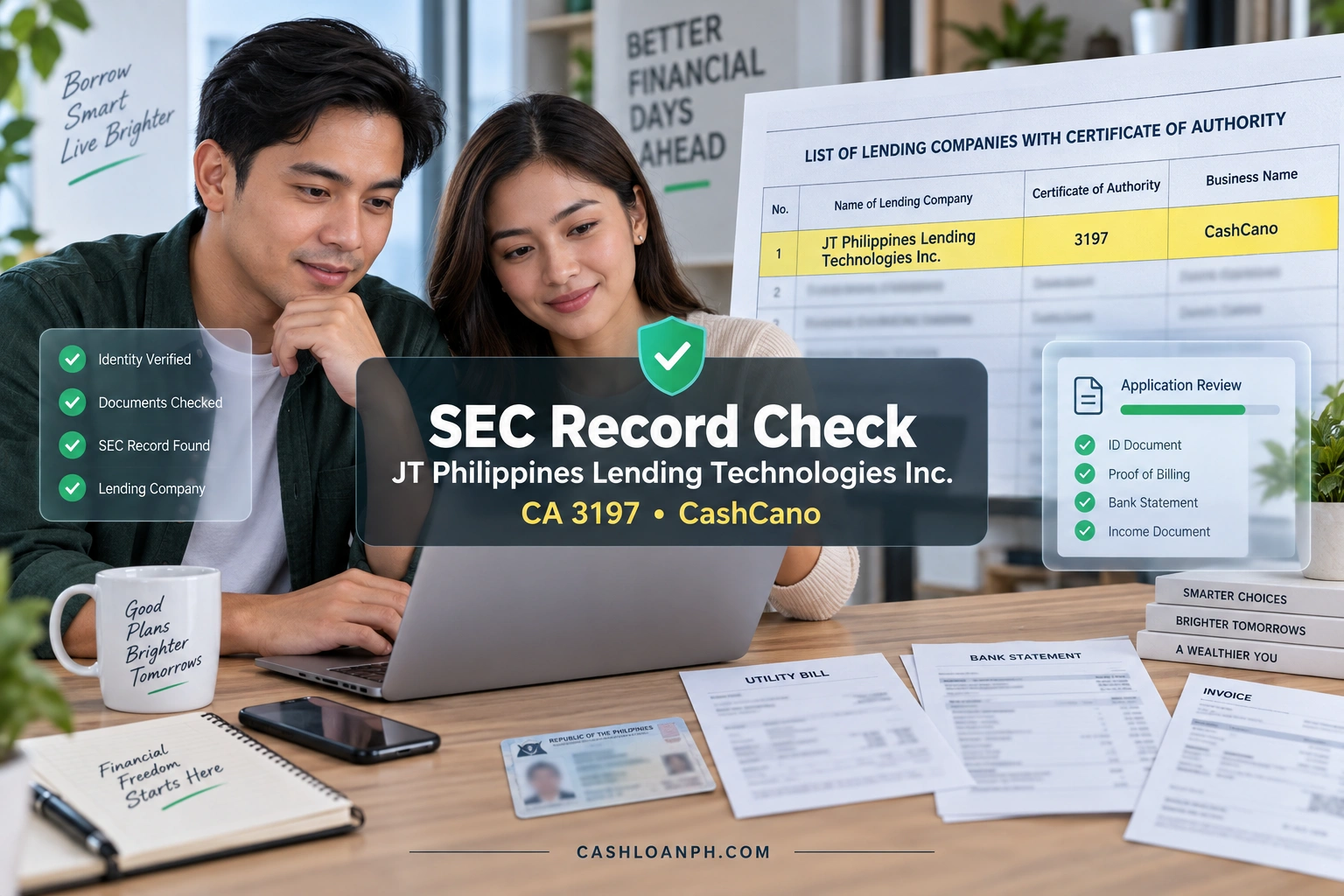
CashCano itself is not an anonymous name with no corporate trail. SEC records connect CashCano to JT Philippines Lending Technologies Inc., SEC Registration No. CS202000182 and Certificate of Authority No. 3197. Yet that is only the beginning of this review. The public CashCano documents we checked contain unusual branding inconsistencies, broad data-processing language and documentation errors that borrowers should examine before giving an app access to their phone.
| Borrower question | What our September 2026 review found | What you should do |
|---|---|---|
| Is CashCano connected to an SEC-registered lender? | Yes. JT Philippines Lending Technologies Inc. appears in SEC records under CS202000182 and CA No. 3197, with CashCano listed among its business names. | Verify the lender name and CA again before accepting a new loan. |
| Does SEC registration mean CashCano is automatically safe? | No. Corporate authorization, platform recording, pricing, privacy practices and collection conduct are separate questions. | Judge the actual loan contract and disclosure statement. |
| Can we verify a current standard CashCano rate publicly? | We could not verify a reliable current public CashCano product table showing standardized principal, tenor and total repayment. | Never rely on an ad or text message. Save the final offer screen. |
| What is unusual about its public documents? | CashCano pages repeatedly refer to Cashtutu and contain other documentation inconsistencies. | Read every document before providing KYC information. |
| What phone data does the published privacy policy describe? | Contacts/SMS-related information, installed apps, location, camera/KYC images, device information, employment, income and emergency-contact information are among the categories described. | Grant only permissions that have a clear legitimate purpose. |
| Can a lender contact everyone in your phonebook to collect? | No. Current NPC guidance prohibits debt-collection contact with people in a borrower’s contacts other than declared guarantors. | Screenshot violations and preserve call/text logs. |
| Are CashCano complaints appearing online? | Yes. Recent borrowers allege frequent texts, calls, pre-due-date pressure and threatening collection language. | Treat reports as warning signals, not proof that every account is handled the same way. |
| Can unpaid CashCano debt automatically put you in jail? | No. Ordinary contractual debt is generally civil. | Do not ignore a valid debt, but do not panic over unsupported jail threats. |
Is CashCano PH actually legit and SEC-registered in 2026?
CashCano has a documented connection to an SEC-authorized lending company. The latest official lending-company list surfaced in our review identifies JT Philippines Lending Technologies Inc. under SEC No. CS202000182 and CA No. 3197, with CashCano among its registered business names.
That is meaningful evidence. It separates CashCano from a loan application whose operator cannot be tied to any Philippine lending company at all.
It should not be stretched into a blanket endorsement.
What exactly do SEC records confirm about CashCano?
SEC records confirm the corporate lending entity and its Certificate of Authority. They do not by themselves certify every loan offer, app build, collection agent, fee schedule or data-processing practice a borrower encounters.
Older official SEC records list JT Philippines Lending Technologies Inc. as doing business under several names including Handy Peso, PesoMaxy, PesoMaxo, PesoMaxey, PesoMacro and CashCano. The company was registered on January 3, 2020, with CA No. 3197.
This distinction matters because borrowers frequently ask only:
“SEC registered ba?”
The better question is:
“Is the company authorized, is this exact platform legitimately connected to it, and does the specific loan being offered to me comply with current disclosure, pricing, privacy and collection rules?”
Those are separate checks.
What does the SEC listing not prove about the current CashCano platform?
A corporate listing does not automatically confirm that every website, APK, app-store listing or payment account using the CashCano name is an authorized channel.
The SEC itself distinguishes lending-company authorization from the disclosure and recording of online lending platforms. Its 2026 regulatory materials continue to maintain separate requirements for OLP disclosure and recording.
During this review, we could directly verify the company’s appearance in SEC lending-company records. We did not find enough current public evidence to confidently tell borrowers that every downloadable CashCano application presently circulating is an SEC-recorded version.
That does not prove a platform is illegal. It means you should verify the exact app, developer and lender details rather than treating a logo as proof.
What did we actually test and verify for this CashCano review?
We reviewed CashCano’s currently indexed public legal pages, current SEC materials, Philippine privacy rules and recent borrower reports. We did not submit someone’s ID or accept a real loan merely to manufacture a first-hand borrowing story.
That limitation matters for E-E-A-T.
A genuine financial review should tell you what was tested rather than write fictional lines such as “our ₱5,000 loan arrived in six minutes” when no transaction occurred.
Our public-page review found that CashCano’s terms and privacy policy are accessible in search even though the main website did not load reliably during one browser check. More importantly, both documents repeatedly describe the platform as Cashtutu, not CashCano.
We therefore cannot responsibly publish supposedly exact CashCano approval times, live disbursement times, loan limits or repayment-channel performance without a reliable current disclosure from the platform itself.
For a borrower, that absence of easily verifiable public pricing is useful information. It means the final in-app disclosure statement becomes even more important.
Why do CashCano’s own public documents raise transparency questions?
The biggest documentation issue is not a rumor from social media. CashCano’s own indexed pages repeatedly use another product name—Cashtutu—and contain legal or jurisdictional references that do not fit cleanly with a Philippine lending document.
These may be drafting or template errors. They still matter because lending documents govern money, personal information and collection rights.
Why does the CashCano-versus-Cashtutu naming mismatch matter?
A borrower should be able to identify clearly who is collecting the data, who is lending the money and which platform the terms govern. Repeated use of another product name makes that harder.
CashCano’s privacy policy identifies JT Philippines Lending Technologies Inc., yet much of the document calls the service Cashtutu. The terms also define the lender as Cashtutu and discuss use of the “Cashtutu software platform.”
Even the published service email uses the Cashtutu domain.
This does not by itself establish fraud. Companies can operate multiple brands. The concern is document hygiene: if the page sits on the CashCano domain, a borrower should not have to guess whether a contract drafted for another brand has simply been copied across.
Why do the legal-reference errors deserve attention?
Legal-document errors do not automatically invalidate a lender, but repeated mistakes reduce confidence that borrowers are receiving carefully maintained, Philippines-specific disclosures.
One particularly noticeable example appears in CashCano’s terms, which refer to “Republic Act No. 10073” as the Data Privacy Act. The Philippine Data Privacy Act is Republic Act No. 10173.
The privacy policy also contains references to the Information Technology Act, 2000, associated with India, and language referring to applicable laws of Sri Lanka, despite the document otherwise presenting a Philippine lending operation.
For a borrower handing over an ID, selfie, employment details, contacts and device information, these are not cosmetic details.
They are reasons to read before tapping “Agree.”
What personal information does CashCano say it may collect from your phone?
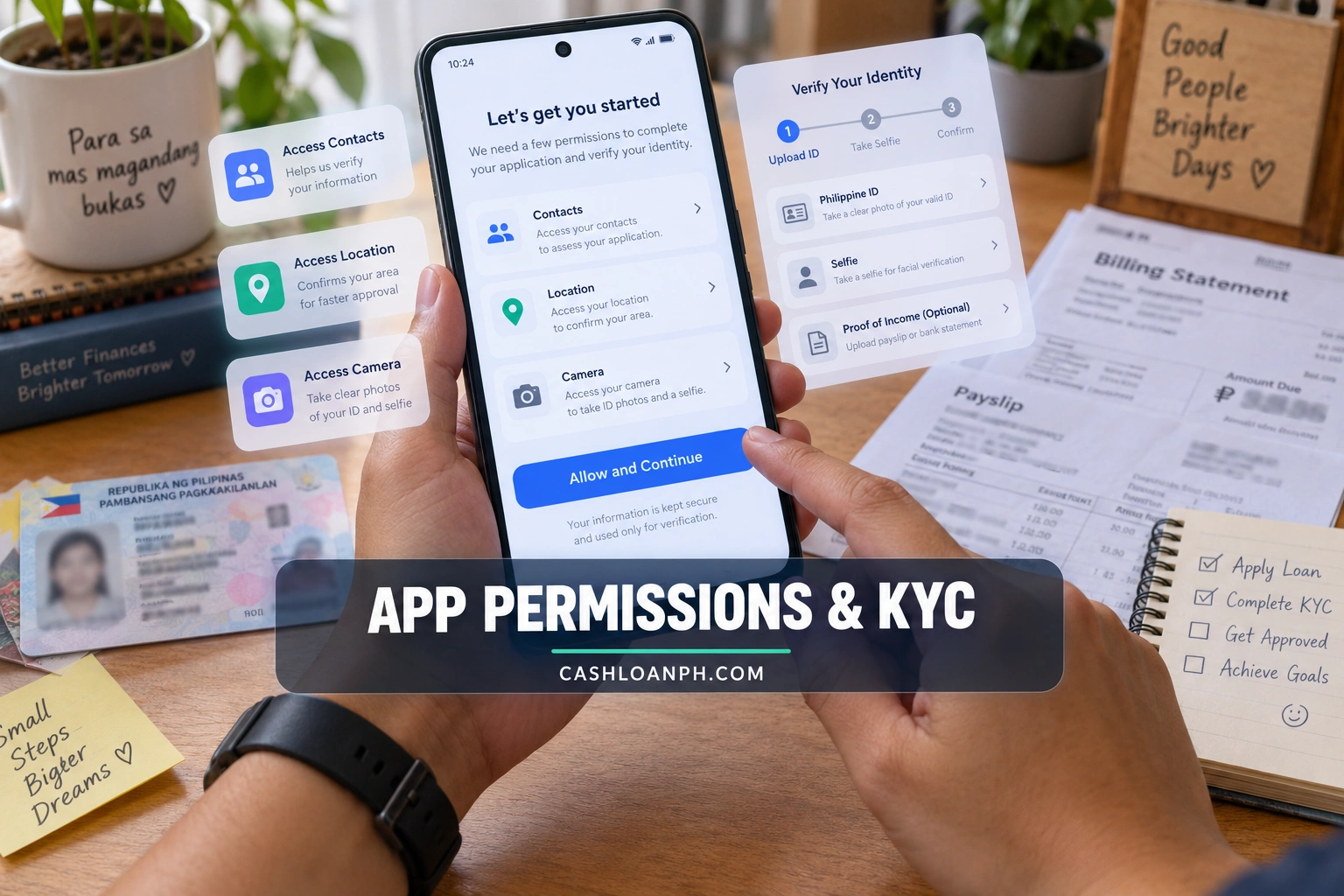
CashCano’s published privacy notice describes access to a broad set of information, including identity, occupation, income, emergency contacts, location, device information, installed apps, camera/KYC images and contact/SMS-related data.
The policy says device information may include hardware and operating-system information and describes installed applications as a credit-risk and fraud-screening input.
It also says location information may be used for loan serviceability and risk decisions.
From an underwriting perspective, this tells us something about how a lender may assess a thin-file borrower. Traditional banks often rely heavily on formal income documentation and established credit history. A mobile lender can try to supplement those signals with device, behavioral, employment and verification data.
That creates a second issue: proportionality.
Collecting data because it is technically available is not the same as having an unlimited legal right to process it.
Can CashCano legally contact everyone saved in your phone?
No lender has a blanket right to use your phonebook as a public debt-collection directory. The March 2026 DICT-NPC-SEC advisory specifically says people in a borrower’s contact list other than declared guarantors may not be contacted for debt collection.
The NPC has also clarified that access to contact information for identity verification or checking information must not become unconstrained, excessive or disproportionate processing. Character references and guarantors are not the same thing.
This is especially important because CashCano’s own privacy policy describes collection of contact information and says supplied personal references may be contacted to verify information.
Verification is one issue.
Using unrelated contacts to shame or pressure you into repayment is another.
Should you approve every permission the CashCano app requests?
No. A permission request appearing on-screen does not automatically make every use of the resulting data lawful or necessary.
The 2026 government advisory explicitly reiterates that unnecessary app permissions and unauthorized, excessive or disproportionate processing are prohibited.
Before giving a loan app access, ask a practical question: why does this permission need to remain active after the task it supports is finished?
Camera access for capturing a KYC document has an obvious function during verification. Continuous access to unrelated personal information is much harder to justify simply by saying it helps risk scoring.
If you already completed repayment, review the app’s remaining permissions and account-deletion options rather than leaving broad access active indefinitely.
What CashCano complaints are borrowers reporting in 2025 and 2026?
Recent public reports mention frequent calls and messages, repayment pressure near or before due dates and intimidating collection language. These are borrower allegations and should not be presented as proven violations by CashCano.
A September 2025 Reddit discussion from a borrower asking about CashCano described repeated texts and calls around the due date. Another commenter claimed that after becoming overdue, communications consisted mainly of emails and texts.
A March 2026 borrower discussing debts across numerous OLAs listed CashCano/CashTutu and alleged harassment or threats from the first several lenders on their list even before due dates. Because multiple lenders were involved, that post cannot establish which exact message came from which collector without supporting records.
Another March 2026 discussion specifically mentioned CashCano and described it as persistent around repayment time.
These reports are useful as risk signals, not verdicts.
Do complaints about legal action mean CashCano has actually filed a case?
No. A text, email or collection message mentioning a “legal department,” “endorsement” or possible case is not the same as receiving an authentic court summons or verified legal filing.
One late-2025 CashCano discussion included allegations involving legal-department language and threatening emails.
Borrowers should not assume every legal-sounding template means a lawsuit exists.
At the same time, do not swing to the opposite extreme and assume a legitimate debt can simply be ignored. A lender retains lawful remedies for collecting valid obligations.
The sensible response is documentation: ask for your account statement, identify the creditor, check the balance and preserve the communication.
When does collection pressure cross a regulatory line?
Threats, public shaming, abusive language, disclosure of debt to unrelated people and threats to take actions that cannot legally be taken can fall within prohibited unfair-collection conduct.
SEC Memorandum Circular No. 18, Series of 2019 governs unfair debt-collection practices by financing and lending companies, and the rule remains part of the regulatory framework referenced in the government’s March 2026 OLP advisory.
That applies even when collection work is outsourced. A legitimate creditor’s right to request payment does not create a right to humiliate a borrower.
How expensive can a small CashCano loan legally be in 2026?
For covered unsecured general-purpose loans of up to ₱10,000 with a tenor of up to four months, the 2026 ceiling is 6% monthly nominal interest and 12% monthly effective interest, with a 5% monthly penalty ceiling and a 100% total-cost cap.
These recalibrated ceilings apply to covered loans entered into, renewed or restructured beginning April 1, 2026.
That date matters.
Older pages discussing the previous 15% monthly EIR ceiling under BSP Circular No. 1133 are no longer the right number for a new covered loan falling under the recalibrated rule. BSP Circular 1133 had previously imposed the 15% EIR ceiling.
What changed for borrowers on April 1, 2026?
The biggest change was the reduction of the monthly effective-interest ceiling for covered loans from 15% to 12%, while the 6% nominal-interest ceiling, 5% late-payment penalty ceiling and 100% total-cost cap remained central borrower protections.
Effective interest matters because processing fees and similar charges can make a loan far more expensive than its advertised interest rate suggests.
A lender advertising “6% interest” is therefore not giving you enough information.
You need to know:
How much money reaches your wallet, how much must you repay, and on what date?
That peso difference often tells a distressed borrower more than an abstract percentage.
Does CashCano publicly show enough current pricing for us to calculate its true cost?
We could not verify a stable current public CashCano price table detailed enough to publish an honest standardized cost calculation. The actual disclosure presented before acceptance should therefore be treated as the controlling borrower-facing evidence.
Historic SEC records showed a 5% monthly figure alongside JT Philippines Lending Technologies Inc., but an old regulator list should not be presented as CashCano’s guaranteed September 2026 offer.
Loan offers may vary by customer, amount, term and underwriting result.
The Truth in Lending Act requires creditors to provide clear written disclosure before consummation of the credit transaction, including the amount financed and finance charge.
That is the screen worth saving.

How should you audit a CashCano offer before pressing Accept?
Ignore the headline credit limit for a moment and audit the actual peso cash flow. The safest loan is not the one with the fastest approval animation; it is the one whose repayment you can explain line by line before borrowing.
Use this borrower audit before accepting:
- Confirm that JT Philippines Lending Technologies Inc. is identified as the creditor or legally responsible lending entity and verify the current Certificate of Authority.
- Record the approved principal, then separately record the amount that will actually reach your bank or e-wallet.
- Identify every processing, service, transfer, verification or other deduction.
- Record the exact total repayment and due date rather than relying on an advertised interest percentage.
- Save the disclosure statement, contract, repayment screen and payment-account details before disbursement.
- Compare the offer with the applicable 2026 ceilings if the loan is an unsecured general-purpose loan of ₱10,000 or less with a tenor of four months or less.
- Check app permissions before uploading your ID and revoke unnecessary permissions when they are no longer needed.
- Never pay a collector through a personal account that cannot be reconciled with your official loan account unless the lender independently confirms the channel.
One small operational habit prevents many disputes: after paying, keep the successful transaction receipt and a screenshot showing the loan account updated to paid or closed.
A bank or e-wallet receipt proves money moved. It does not by itself prove the lender’s loan ledger posted it correctly.
Why might CashCano reject or manually verify some applicants?
CashCano’s terms reserve broad verification rights involving employment, income, residence, external institutions and credit information. A clean ID alone therefore does not guarantee approval.
This is where many borrowers become frustrated.
A rider earning through several delivery apps may have respectable monthly income but no conventional employer HR contact. A freelance designer may receive irregular transfers from several clients. A sari-sari store owner can have strong daily cash flow without a payslip.
From the lender’s perspective, those borrowers can be harder to score than an employee receiving the same salary into one payroll account every two weeks.
CashCano’s published terms say it may verify income, residence, business or employment and conduct checks through credit bureaus or other external sources.
That can lead to manual verification, lower limits or rejection.
Do not falsify an employer, salary or reference to get around the scoring system. A rejection is financially inconvenient; a fabricated application can create a much more serious problem.
What should you do if you are already overdue with CashCano?
Separate the debt from the collection behavior. Verify what you legitimately owe, communicate in writing where possible, preserve evidence and do not borrow from another high-cost OLA merely to silence today’s collector.
This is where debt spirals usually become painful.
Borrowers often start with one ₱3,000 or ₱5,000 loan, then borrow from a second app to settle the first. When the second loan matures, a third app is used.
The problem has stopped being a CashCano problem at that point. It has become a cash-flow insolvency problem.
Start by asking for the principal balance, interest, fees, penalties, payment history and current settlement amount in writing.
If a proposed extension or restructuring is offered, calculate the new total peso cost, not simply the smaller immediate payment.
And remember: the constitutional protection against imprisonment for debt does not erase a legitimate contractual obligation.
What should you do if CashCano collectors harass you or contact unrelated people?
Preserve the evidence first. If the issue involves unfair collection, SEC channels are relevant; if it involves misuse of personal information, contact-list abuse or privacy violations, the NPC has its own complaint process.
Keep screenshots with timestamps, call logs, emails, sender numbers, payment receipts and any messages sent to family, coworkers or unrelated contacts.
Do not crop away information that could later help identify the sender.
The SEC’s current iMessage system includes a complaints route for financing and lending companies, and current SEC guidance advises borrowers to file formal complaints when a lending company may have violated laws under SEC jurisdiction.
For personal-data violations, the NPC accepts complaints from data subjects and provides a formal complaint process.
A March 2026 DICT-NPC-SEC advisory specifically reiterates that using personal data for harassment, unfair collection or contacting persons in a borrower’s contacts other than guarantors is prohibited.
You do not need to win an argument with a collection agent over text.
You need evidence.
Should you borrow from CashCano PH in 2026?
CashCano’s connection to an SEC-authorized lending company is a positive legitimacy signal, but the public-document inconsistencies, extensive data-processing language and complaint reports justify extra caution. I would not accept a CashCano offer without reviewing the exact disclosure statement first.
The most important finding from this review is not “CashCano is legit” or “CashCano is a scam.”
Reality is more useful than either slogan.
JT Philippines Lending Technologies Inc. has a verifiable SEC lending-company record, and CashCano appears as one of its business names. That matters.
But CashCano’s indexed legal documents also repeatedly refer to another platform, contain questionable template language and describe collection of sensitive borrower and device information. Those are valid transparency concerns.
Recent complaint threads should make borrowers alert, not hysterical. They are individual reports, not final SEC or court findings against CashCano.
If you desperately need ₱3,000 tonight, it is easy to focus only on whether an app will approve you.
Try to focus on the question that matters three weeks later:
“After rent, food, electricity, transport and medicine, can I repay this loan from income I already expect to receive?”
If the answer requires another loan app, the loan is probably solving today’s deadline by creating a larger one.
References
- Securities and Exchange Commission – Philippines
Organization: Securities and Exchange Commission
Resource: List of Registered Lending Companies as of August 31, 2024
URL: Official SEC lending-company list - Securities and Exchange Commission – Philippines
Organization: Securities and Exchange Commission
Resource: Lending and Financing Companies – Advisories and Notices
URL: SEC lending-company advisories - Bangko Sentral ng Pilipinas
Organization: Bangko Sentral ng Pilipinas
Resource: BSP Circular No. 1133 – Ceilings on Interest Rates and Other Fees
URL: BSP Circular No. 1133 - Philippine Information Agency
Organization: Philippine Information Agency / SEC Region 7
Resource: 2026 Explanation of Recalibrated Small-Loan Interest Ceilings
URL: 2026 government explanation of lending ceilings - National Privacy Commission
Organization: DICT, NPC and SEC
Resource: 2026 Joint Advisory on Online Lending Platforms
URL: Joint advisory on online lending platforms - National Privacy Commission
Organization: National Privacy Commission
Resource: Amended Guidelines on Processing Personal Data for Loan-Related Transactions
URL: NPC loan-related personal-data guidance - Securities and Exchange Commission
Organization: Securities and Exchange Commission
Resource: MC No. 18, Series of 2019 – Prohibition on Unfair Debt Collection Practices
URL: SEC unfair debt-collection rules - CashCano
Organization: JT Philippines Lending Technologies Inc.
Resource: CashCano Privacy Policy
URL: CashCano published privacy policy - CashCano
Organization: JT Philippines Lending Technologies Inc.
Resource: CashCano Terms and Conditions
URL: CashCano published terms and conditions - The LawPhil Project
Organization: Philippine Government legal-resource archive
Resource: Republic Act No. 3765 – Truth in Lending Act
URL: Philippine Truth in Lending Act - The LawPhil Project
Organization: Philippine Government legal-resource archive
Resource: 1987 Constitution of the Republic of the Philippines
URL: 1987 Philippine Constitution

![Crezu Loan PH Review: Legit? Application Process, Interest Rates, and Contact Information [New Update]](https://cashloanph.com/wp-content/uploads/2023/10/crezu-loan-philippines-review-cashloanph-438x246.jpg "Crezu Loan PH Review: Legit? Application Process, Interest Rates, and Contact Information [New Update]")
![Soscredit Loan PH Review: Loans, Terms, Legitimacy, and Application Process [New Update]](https://cashloanph.com/wp-content/uploads/2023/10/soscredit-loan-philippines-review-cashloanph-438x246.jpg "Soscredit Loan PH Review: Loans, Terms, Legitimacy, and Application Process [New Update]")