Last Updated on 23/09/2026 by Nicole Alba
A loan app can look legitimate, have millions of downloads, and still leave a borrower with the wrong idea about who is lending the money or what the loan really costs. In the Philippines, the more useful question is not simply, “Is this app registered with the SEC?” It is whether the company behind it has the appropriate authority to conduct lending or financing activities, whether the online platform is properly disclosed or recorded, and whether the specific offer shown to you complies with current disclosure and pricing rules.
That distinction matters more in 2026. The Securities and Exchange Commission issued new rules for financing and lending companies and lifted the moratorium on new online lending platforms effective August 1, 2026. New apps do not become legitimate merely because the moratorium ended; the licensed company behind an online lending platform still has to comply with SEC recording, disclosure, prudential, and market-conduct requirements.
| Borrower question | Current finding | Why it matters |
|---|---|---|
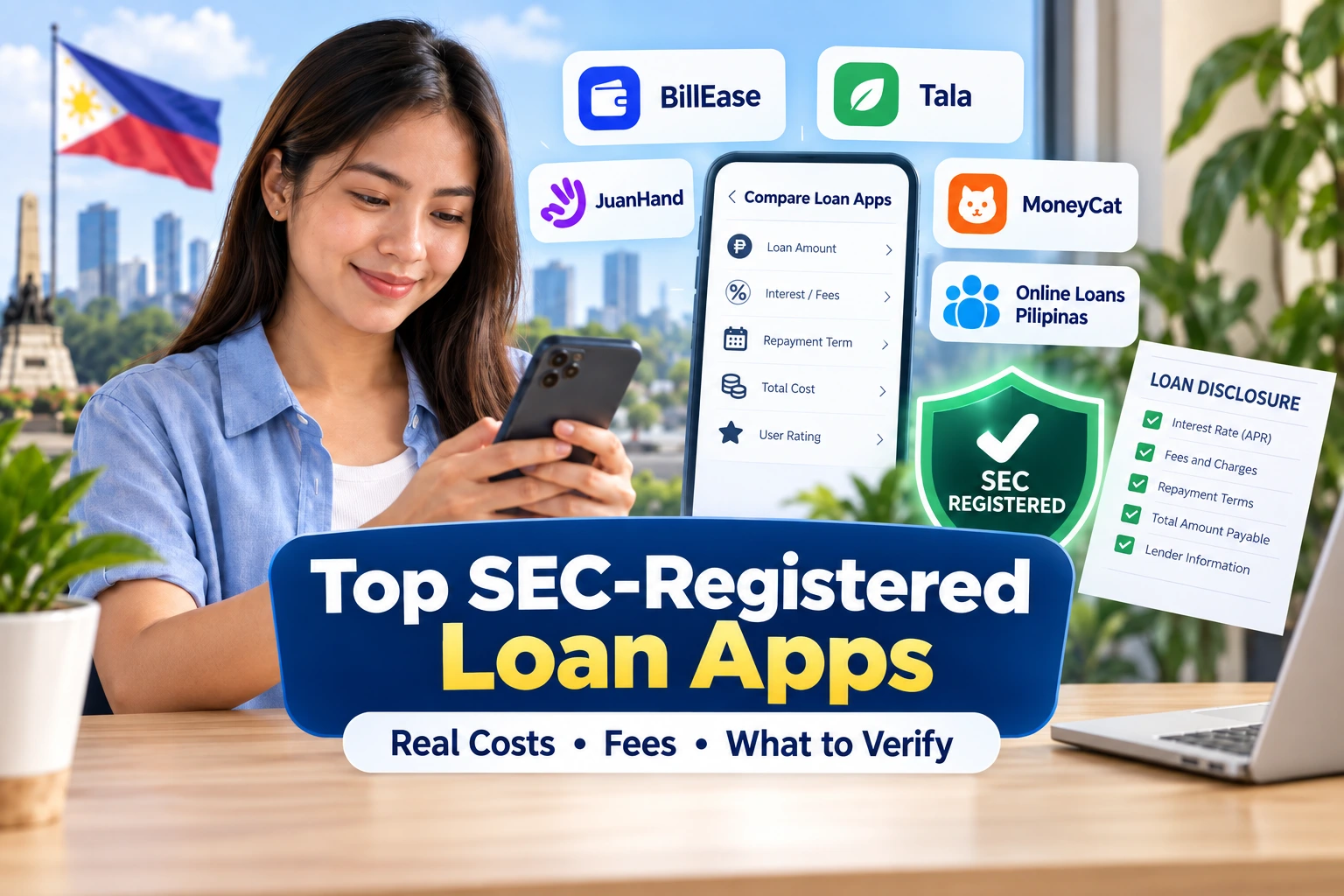
| Is BillEase linked to an authorized company? | BillEase is operated by First Digital Finance Corporation, SEC Registration No. CS201516347, CA No. 1101. | Its legal operator can be identified separately from the BillEase brand. |
| Is Tala linked to an authorized company? | Tala is operated by Tala Financing Philippines Inc., SEC Registration No. CS201710582, CA No. 1132. The company also appears in the SEC financing-company record. | The app name and financing company can be cross-checked. |
| Is JuanHand linked to an authorized lender? | JuanHand is operated by WeFund Lending Corp., SEC Registration No. CS201825672, CA No. 2844. | Verify WeFund, not only the JuanHand logo. |
| Is MoneyCat linked to an authorized company? | MoneyCat identifies MoneyCat Financing Inc., SEC Registration No. CS201953073, CA No. 1254. | Registration does not make its published borrowing cost inexpensive. |
| Who operates Online Loans Pilipinas? | Online Loans Pilipinas Financing Inc., SEC Registration No. CS201726430, CA No. 1181. | The current Play listing identifies the lender and publishes detailed product limits. |
| Does “SEC registered” mean cheap? | No. Current Philippine rules regulate particular classes of loans, but product prices can still vary materially. | Compare the actual Disclosure Statement, not the registration badge. |
| Can an app use your phone contacts for collections? | Philippine privacy regulators prohibit excessive contact-list processing and prohibit contacting people in the borrower’s contact list for debt collection unless they are guarantors. | App permissions deserve the same attention as interest and fees. |
What does “SEC-registered loan app” actually mean in 2026?
A company registration alone is not enough. A borrower should identify the legal financing or lending company, confirm its Certificate of Authority, and verify that the borrower-facing online lending platform has been properly disclosed or recorded with the SEC.
The terminology is easy to misuse. Incorporating a corporation with the SEC is not the same thing as receiving authority to operate as a lending or financing company. Likewise, an app listed in an app store should not automatically be described as “SEC approved.”
SEC Memorandum Circular No. 20, Series of 2026, created the current framework governing financing and lending companies that operate online lending platforms and lifted the previous moratorium beginning August 1, 2026. The SEC also published a 2026 OLP disclosure guide for recording platforms through its iMessage system.
This makes the company-app distinction even more important. The app is essentially the borrower-facing channel. What matters legally is the licensed entity behind it and the status of that particular platform.
The SEC has repeatedly warned borrowers against dealing with unrecorded or unauthorized online lending platforms. Its consumer advisory recommends checking the registered lending or financing company and the recorded online platform before borrowing.
How this review was produced
This is a document-and-disclosure review rather than a claimed hands-on borrowing test. Regulatory records, official company disclosures, current app-store information, published product terms, privacy rules, and representative cost examples were compared. No application outcome, customer-support interaction, approval result, or first-hand borrowing experience has been invented.
“Top” in this review therefore does not mean a score-based ranking from best to worst. These five were selected because their legal operators can be identified and enough current public information exists to make a meaningful borrower comparison.
1. BillEase: clearer installment disclosure, but check the exact service charge
BillEase is operated by First Digital Finance Corporation, a financing company with SEC Registration No. CS201516347 and Certificate of Authority No. 1101. Its current app listing publishes loan amounts, installment terms, service-charge ranges, and a worked cash-loan example.
BillEase currently advertises loan amounts from ₱500 to ₱50,000, installment periods from 2 to 24 months, and service charges ranging from 0% to 10%, depending on the transaction and offer.
One useful feature of its public disclosure is an actual peso example.
For a ₱12,000 three-month cash installment, the listing says the borrower receives the full ₱12,000 without an upfront deduction and repays three installments of ₱4,539.
That produces:
- Principal: ₱12,000
- Total repayment: ₱13,617
- Peso borrowing cost: ₱1,617
- Cost relative to the ₱12,000 principal: approximately 13.5% over the three-month example
The listing breaks each installment into principal, interest, and service charge rather than presenting only a headline interest rate.
What stands out
The useful part is not that BillEase is necessarily “cheap.” It is that the public worked example gives borrowers enough figures to compare the amount disbursed with the amount repaid.
The caution is that BillEase offers several forms of credit. A merchant installment, cash loan, or personalized account offer may not carry the same charges. The disclosure presented immediately before accepting a transaction is more important than a generic example on an app-store page.
2. Tala: identifiable operator, but its current public sample deserves careful reading
Tala operates through Tala Financing Philippines Inc., a licensed financing company with SEC Registration No. CS201710582 and CA No. 1132. Its current Google Play disclosure advertises limits of ₱1,000 – ₱25,000 and personalized processing and service fees.
The current Play listing gives the following personal-credit-line terms:
- Credit limit: ₱1,000 to ₱25,000
- Processing fee: 3.99% to 9.99%
- Daily service fee: 0.23% to 0.43%
- Term: up to 120 days
- Monthly EIR: 11% to 12%
- Maximum disclosed APR: 141.76%
- Late fee after the loan term: 5% of the outstanding balance
There is an important disclosure issue worth noticing. The app listing describes a sample as having a 3.99% processing fee and 0.43% daily service fee, yet its displayed numbers show a ₱99.90 processing fee and ₱140.30 service charge on a ₱1,000 principal over 61 days.
Those figures do not match the percentages in the sample’s introductory sentence:
- ₱99.90 equals 9.99% of ₱1,000, not 3.99%.
- ₱140.30 over 61 days equals approximately 0.23% per day, not 0.43%.
The stated total of ₱1,240.20 is mathematically consistent with ₱1,000 + ₱99.90 + ₱140.30, but the percentage labels attached to that sample appear internally inconsistent.
That does not establish what fee any individual Tala borrower will receive. Tala explicitly says offers are personalized. It does mean borrowers should rely on the actual Disclosure Statement and personalized offer, not try to reconstruct their cost from a generic marketing example.
There is also a difference between Tala’s main website, which still describes repayment flexibility up to 61 days in some pages, and the current Play listing, which states up to 120 days. The in-app contract and disclosure for the specific transaction should therefore control the borrower’s decision.
3. JuanHand: a useful worked example shows how service fees change the real cost
JuanHand is operated by WeFund Lending Corp., SEC Registration No. CS201825672 and Certificate of Authority No. 2844. Its current Google Play listing publishes a ₱2,000 – ₱50,000 range and a worked example that separates interest from a service fee.
The Play listing currently states:
- Loan amount: ₱2,000 to ₱50,000
- Loan term: 91 to 180 days
- Maximum APR: 30%
- Transaction fee: ₱0
The representative ₱10,000 example is more revealing than the headline APR.
For 91 days, JuanHand’s listing calculates:
- Interest: approximately ₱299.17
- Service fee at 10%: ₱1,000
- Total repayment: ₱11,299.17
- Total peso cost: ₱1,299.17
This means the service fee contributes much more to the example’s peso cost than the stated interest itself.
That is exactly why borrowers should not compare apps using the interest-rate headline alone. Processing, service, platform, disbursement, or similar mandatory charges can materially change the effective cost.
JuanHand’s own website also notes that final amount and repayment details are displayed in the app, so the published figures should be treated as examples or ranges rather than guaranteed terms.
4. MoneyCat: clearly identifiable company, but the maximum published cost is substantial
MoneyCat is operated by MoneyCat Financing Inc., which discloses SEC Registration No. CS201953073 and Certificate of Authority No. 1254. Its current website advertises loans from ₱500 to ₱20,000 with repayment periods generally extending several months.
The current MoneyCat website states:
- Amount: ₱500 to ₱20,000
- Typical published term: 3 – 6 months, with its FAQ describing approved terms from 65 to 180 days
- Interest: up to 11.9% per month
- Maximum stated APR: 145%
MoneyCat advertises promotional pricing for some new borrowers, including possible 0% offers. Promotional first-loan pricing should not be treated as the normal cost of repeat borrowing.
The practical issue is the large spread between a promotional offer and the platform’s published maximum pricing. A borrower attracted by “0%” should still check whether any processing, payout, disbursement, or other compulsory charge appears in the actual disclosure and should examine what subsequent loans may cost.
MoneyCat’s terms also disclose collection and processing of information that may include identification data, employment details, income, financial information, credit standing, payment history, and certain biometric information. That makes its privacy policy worth reading before – not after – submitting an application.
5. Online Loans Pilipinas: broad advertised APR range makes the Disclosure Statement especially important
Online Loans Pilipinas is operated by Online Loans Pilipinas Financing Inc., SEC Registration No. CS201726430 and CA No. 1181. Its Google Play listing was updated September 4, 2026 and advertises ₱1,000 – ₱30,000 loans with a wide range of possible costs.
The current listing states:
- Loan amount: ₱1,000 to ₱30,000
- First-time borrower range: ₱1,000 to ₱7,000
- Credit term: 90 to 720 days
- Advertised APR: 0% to 180% maximum
- Advertised disbursement after approval: as fast as five minutes through InstaPay
The platform also gives an example of a ₱10,000 three-month loan with total repayment of ₱14,500, or ₱4,833 per month.
That particular combination deserves careful checking against the borrower’s actual 2026 Disclosure Statement because a ₱10,000 unsecured general-purpose loan with a tenor of up to four months falls within the defined scope of the SEC’s current small-loan price ceilings when entered into, renewed, or restructured from April 1, 2026. The current rules cap nominal interest at 6% per month and effective interest at 12% per month for covered loans.
The presence of a maximum APR of 180% on the app page does not by itself establish a violation, because the platform offers loan amounts and tenors outside the narrow scope of that particular numerical cap. It does reinforce why borrowers should compare the exact size and tenor of their own offer with the applicable rules.
What are the current Philippine interest and fee limits?
From April 1, 2026, SEC Memorandum Circular No. 14 applies specific ceilings to unsecured, general-purpose loans of not more than ₱10,000 and with terms of up to four months. It does not impose the same numerical ceiling on every loan product in the Philippines.
For covered loans, the rules provide:
| Charge | 2026 ceiling |
|---|---|
| Nominal interest rate | 6% per month, about 0.20% per day |
| Effective interest rate including applicable mandatory fees | 12% per month, about 0.40% per day |
| Late/non-payment penalty | 5% per month on the outstanding scheduled amount due |
| Total interest, fees, charges and penalties over the life of the loan | Cannot exceed 100% of the amount borrowed |
The limits apply to covered loans entered into, renewed, or restructured beginning April 1, 2026.
This scope is important. A ₱20,000 six-month loan is outside this particular small-loan numerical ceiling because it exceeds both the ₱10,000 amount threshold and four-month tenor threshold. That does not mean such a loan is exempt from consumer-protection, disclosure, privacy, contract, or other applicable rules.
Which app looks cheapest?
There is no defensible single “cheapest” choice from the public numbers alone because the five products use different loan sizes, tenors, fee structures, promotions, and personalized underwriting. Comparing only APR or only headline interest can produce the wrong answer.
The worked examples illustrate the problem:
| App | Published example or cost indicator | What the borrower should notice |
|---|---|---|
| BillEase | ₱12,000 → ₱13,617 over 3 months | No upfront deduction in this example; total peso cost is visible. |
| Tala | Up to 12% monthly EIR and 141.76% max APR; current sample has inconsistent percentage labels | Read the personalized disclosure rather than relying on the generic sample. |
| JuanHand | ₱10,000 → ₱11,299.17 over 91 days in its example | The ₱1,000 service fee is larger than the example’s interest charge. |
| MoneyCat | Up to 11.9% per month; max APR stated at 145% | Promotional first-loan pricing may differ sharply from repeat-loan pricing. |
| Online Loans Pilipinas | APR range stated as 0% – 180%; ₱10,000/3-month example totals ₱14,500 | Match the exact offer against applicable 2026 pricing limits. |
A more useful comparison is:
Net proceeds = approved loan − upfront deductions
Peso borrowing cost = total repayment − net proceeds
Two loans with the same ₱10,000 approved principal are not financially equivalent if one deposits ₱10,000 while another deducts compulsory charges before disbursement.
Can a registered loan app access your contacts or message your friends?
Registration does not give a lender unrestricted access to your phone. In March 2026, the NPC, DICT, and SEC jointly reiterated that unnecessary permissions, excessive contact-list processing, and contacting people in a borrower’s contacts for debt collection – other than guarantors – are prohibited.
NPC rules require app permissions to be suitable, necessary, and proportionate to the legitimate purpose. Access should not continue simply because a borrower once granted permission.
A practical privacy check before applying is therefore straightforward:
- Read the app’s privacy policy.
- Review requested permissions.
- Question requests for broad contact-list or unrelated device access.
- Check which companies may receive your data.
- Keep screenshots or copies of the permissions and Disclosure Statement you agreed to.
The Financial Products and Services Consumer Protection Act also recognizes rights to fair treatment, disclosure and transparency, data privacy, and timely complaint handling. It prohibits abusive collection practices by financial service providers.
What happens if you pay late?
Late payment can create more than a penalty charge. Depending on the contract and applicable law, it can lead to collection activity and potentially affect credit information. A registered lender is still entitled to pursue a valid debt, but collection practices must remain lawful and respectful.
For covered small loans under the current SEC pricing rule, late and non-payment penalties are capped at 5% per month on the outstanding scheduled amount due, and the 100% total-cost cap includes interest, fees, other charges, and penalties.
That does not make late payment harmless.
The safer question before borrowing is not merely “What is the late fee?” but:
If my salary, remittance, or business income arrives late, can I still make the scheduled payment without taking another loan?
If repayment would require another high-cost app loan, the problem is no longer which platform has the nicer interface; it is whether the debt can be repaid sustainably.
How can you verify a loan app yourself before borrowing?
Use the legal company name rather than trusting the app icon. Verify the lender’s Certificate of Authority, confirm the platform with the SEC, and compare the final Disclosure Statement with the marketing page before accepting the loan.
A useful sequence is:
- Find the corporate name behind the app.
- Check its SEC registration number and Certificate of Authority.
- Confirm that the specific app, website, or online platform is properly disclosed or recorded.
- Make sure you downloaded the official app rather than a clone using a similar name.
- Read the Disclosure Statement before accepting or receiving funds.
- Record the approved principal, deductions, net proceeds, total repayment, due dates, EIR, and late-payment charges.
- Review app permissions and the privacy policy.
- Keep copies of the contract, disclosure, repayment confirmations, and receipts.
The SEC itself advises borrowers to verify the financing/lending company and its online platform and warns against advance-fee scams.
Where can you complain about a loan app?
Complaints against registered financing and lending companies and their online platforms are filed through the SEC iMessage Portal. Data-privacy complaints may be referred to the National Privacy Commission, while unauthorized lenders can be reported to the SEC’s enforcement unit.
Since November 4, 2024, the SEC has required complaints concerning registered financing and lending companies and their online lending platforms to be filed through its iMessage Portal. The SEC asks borrowers to attach supporting documents and ordinarily expects them to have first exhausted the company’s internal complaint process.
The SEC also makes clear that its complaint process does not itself rewrite a borrower’s loan contract, cancel a debt, or automatically declare an interest term void.
For unauthorized access to contacts or other privacy concerns, the National Privacy Commission is the relevant privacy regulator.
Advantages and limitations of these five apps
The meaningful advantages are specific rather than generic.
BillEase publishes one of the clearer worked repayment examples among the five and offers longer installment options. Its drawback is that charges can vary by product and offer.
Tala has an identifiable operator and publishes its EIR, APR, processing-fee range, and daily service-fee range. The current public sample, however, contains arithmetic labels that do not line up with the displayed amounts, making the individualized Disclosure Statement especially important.
JuanHand makes it particularly easy to see how a service fee can outweigh the nominal interest in a representative transaction. That transparency is useful, but it also illustrates why “low interest” does not automatically mean low total cost.
MoneyCat has a clearly identifiable corporate operator and published pricing limits, but its maximum disclosed cost is high enough that repeat borrowers should examine the peso repayment carefully rather than anchoring on promotional 0% messaging.
Online Loans Pilipinas publishes a broad loan range, first-time limits, repayment channels, APR range, and current company credentials. Its wide APR range and representative repayment example make offer-level verification essential.
Who might find these products relevant – and who should be especially cautious?
Online credit may be more manageable for someone who knows exactly where the repayment money will come from, has checked the full peso cost rather than only the monthly installment, and can repay without immediately replacing the debt with another loan.
Extra caution is warranted when:
- the repayment date arrives before regular income;
- substantial fees are deducted before disbursement;
- an “interest-free” promotion is the main reason for applying without checking later charges;
- the borrower already has several app loans;
- repayment depends on taking another loan;
- the app requests disproportionate phone permissions;
- the company name in the Disclosure Statement differs unexpectedly from the company the borrower thought they were dealing with.
FAQ
Does SEC registration guarantee that a loan app is safe?
No. Regulatory status helps establish that there is an identifiable regulated company behind the platform. It does not guarantee inexpensive pricing, approval, perfect customer service, or suitability for a particular borrower. The SEC itself continues to impose disclosure, market-conduct, privacy, and collection requirements on registered firms.
Can a lender guarantee approval?
A marketing statement should not be treated as a binding approval promise. Approval depends on the lender’s underwriting process, and lenders generally do not publicly disclose their complete scoring algorithms.
Is the advertised loan limit what a first-time borrower will receive?
Not necessarily. Online Loans Pilipinas, for example, advertises an overall limit up to ₱30,000 while separately stating that first-time applicants generally fall between ₱1,000 and ₱7,000. Tala also states that terms are personalized.
Can I repay a loan early?
Philippine financial consumer law recognizes a borrower’s ability to prepay loans before maturity, although any applicable prepayment costs must be disclosed. Product-specific procedures should still be checked in the contract.
Should I pay a fee before a lender releases my loan?
The SEC specifically warns borrowers about advance-fee scams and advises consumers to verify the company and online lending platform before transacting.
What should you check before accepting any of these loans?
The regulatory badge should be the start of the review, not the end.
Before tapping Accept, write down six numbers from the actual offer:
1. Approved principal
2. Upfront deductions
3. Net cash received
4. Each payment amount and due date
5. Total repayment
6. Total peso cost
Then check the legal company named in the contract, the effective interest rate, penalties, app permissions, and complaint channel.
If a ₱10,000 offer only puts ₱8,500 into your account but requires repayment based on a ₱10,000 principal plus further charges, compare the cost with the ₱8,500 you actually received, not merely the headline loan amount.
BillEase, Tala, JuanHand, MoneyCat, and Online Loans Pilipinas each have identifiable corporate operators and public regulatory disclosures. That clears an important first hurdle. It does not remove the need to read the transaction-specific Disclosure Statement.
For a borrower, the most useful final test is simple: Do you know exactly how much cash you will receive, exactly how much you must repay, exactly when it is due, and how you will pay it without taking another loan?
If any of those answers is unclear, the offer is not ready to accept.
References
- SEC Memorandum Circular No. 20, Series of 2026
Organization: Securities and Exchange Commission Philippines
Resource: Guidelines Prescribing Prudential, Disclosure, and Market Conduct Requirements for Financing and Lending Companies and Lifting the Moratorium on Online Lending Platforms
URL: SEC MC No. 20, Series of 2026 - SEC Memorandum Circular No. 14, Series of 2025
Organization: Securities and Exchange Commission Philippines
Resource: Recalibrated Ceilings on Interest Rates and Other Fees Charged by Financing Companies and Lending Companies
URL: SEC MC No. 14, Series of 2025 - Financial Products and Services Consumer Protection Act
Organization: Republic of the Philippines / Lawphil
Resource: Republic Act No. 11765
URL: Republic Act No. 11765 - Joint Advisory on Online Lending Platforms
Organization: National Privacy Commission, DICT and SEC
Resource: 2026 Public Advisory on Online Lending Platforms
URL: Joint Advisory on Online Lending Platforms - BillEase App Listing
Organization: First Digital Finance Corporation / Google Play
Resource: BillEase – Buy Now, Pay Later
URL: BillEase Google Play listing - Tala Philippines
Organization: Tala Financing Philippines Inc.
Resource: Tala Philippines official website
URL: Tala Philippines - Tala App Listing
Organization: Tala Financing Philippines Inc. / Google Play
Resource: Tala: Fast Cash Peso Loan App
URL: Tala Google Play listing - JuanHand App Listing
Organization: WeFund Lending Corp. / Google Play
Resource: JuanHand – Online Cash Loan App
URL: JuanHand Google Play listing - MoneyCat Philippines
Organization: MoneyCat Financing Inc.
Resource: MoneyCat Official Loan Product Page
URL: MoneyCat Philippines - Online Loans Pilipinas App Listing
Organization: Online Loans Pilipinas Financing Inc. / Google Play
Resource: Online Loans Pilipinas
URL: Online Loans Pilipinas Google Play listing - SEC Complaints Guidance
Organization: Securities and Exchange Commission Philippines
Resource: Complaints Against Financing and Lending Companies and Online Lending Platforms
URL: SEC complaints guidance