Last Updated on 26/09/2026 by Nicole Alba
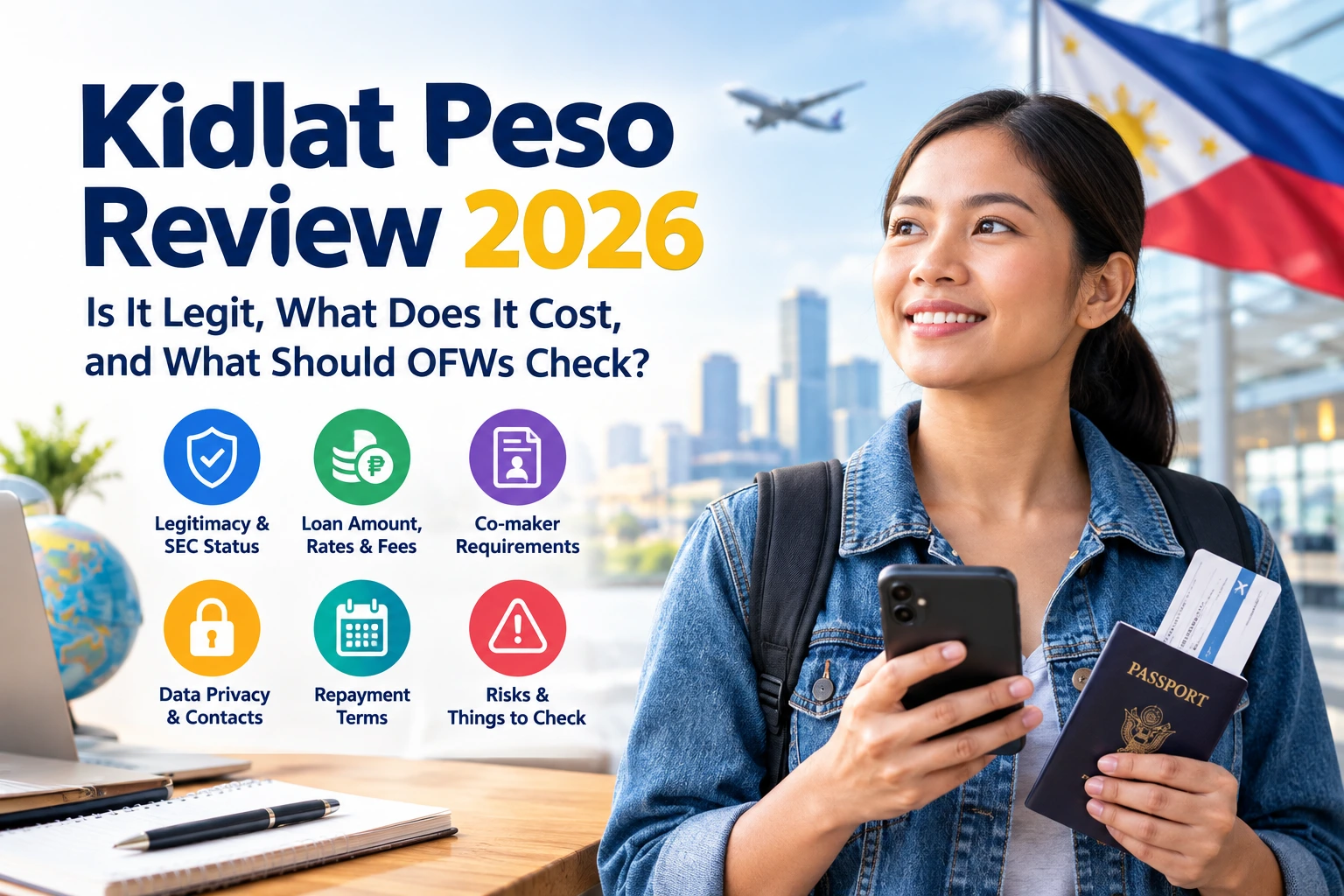
Kidlat Peso is unusual among Philippine online lending platforms because it is marketed specifically to land-based Overseas Filipino Workers (OFWs) and Filipinos preparing to work overseas, rather than to the general consumer-loan market. Its published offer is also larger and longer-term than many small emergency-loan apps: the current Google Play listing advertises ₱10,000 to ₱500,000, repayment terms of 90 to 365 days, and a maximum APR of 30%.
That does not mean every applicant will receive ₱500,000, nor does regulatory registration make a particular loan automatically affordable. The important questions are who actually lends the money, what your individual Disclosure Statement says, how much you will repay in pesos, what responsibilities your co-maker accepts, and what personal data the platform processes.
This Kidlat Peso review is based on current public documentation rather than a simulated borrowing experience. No claim is made here that we personally applied for or received a Kidlat Peso loan. That distinction matters for financial reviews: the supplied editorial standard specifically prohibits inventing applications, approval results, support conversations, screenshots, or other first-hand observations that were not actually documented.
Kidlat Peso is an online lending platform operated by WeFund Lending Corp., which appears in SEC records with Registration No. CS201825672 and Certificate of Authority No. 2844. The current app listing advertises ₱10,000 – ₱500,000 loans, 90 – 365-day terms and a maximum 30% APR, while the official website advertises rates starting at 1.99% monthly. Applicants must meet OFW-focused requirements and provide a domestic co-maker. Before accepting an offer, compare the actual amount released, total repayment, installment dates, late-payment terms and co-maker obligations shown in your own Disclosure Statement rather than relying on headline advertising.
| Borrower question | Current finding | Why it matters |
|---|---|---|
| Who operates Kidlat Peso? | WeFund Lending Corp. | Kidlat Peso is a brand/OLP, not a separate lender identified in the reviewed SEC records. |
| SEC registration | CS201825672 | Confirms the registered corporate entity. |
| Certificate of Authority | No. 2844 | SEC records associate this CA with WeFund Lending Corp. |
| Target borrower | Land-based OFWs/pre-departure OFWs | This is not advertised as a general-purpose app for every Filipino borrower. |
| Advertised amount | ₱10,000 – ₱500,000 | ₱500,000 is a published maximum, not a guaranteed approved amount. |
| Published term | 90 – 365 days | Longer than many short-term OLP products. |
| Published pricing | Maximum APR 30%; website says rates start at 1.99%/month | Your actual offer and Disclosure Statement remain controlling for your loan. |
| Transaction fee | Google Play currently states ₱0 | Other contractual charges should still be checked before acceptance. |
| Co-maker | Domestic co-maker required in published eligibility criteria | Another person may assume financial obligations connected with the loan. |
| Credit reporting | WeFund appears in CIC records | Repayment history may become part of the formal credit-information system. |
| Data collection | Includes identity, employment, income, device and other information | Applicants should review permissions before submitting sensitive information. |
| Phone contacts | Privacy Notice says Kidlat Peso will not access the phone contact list for collection purposes | This is an important privacy commitment in the current policy. |
Is Kidlat Peso legit and properly authorized in the Philippines?
Kidlat Peso has an identifiable Philippine lending-company operator. SEC records identify WeFund Lending Corp. under Registration No. CS201825672 and Certificate of Authority No. 2844, while SEC documentation lists Kidlat Peso among WeFund’s online lending platforms.
Who actually operates Kidlat Peso?
The distinction between the app and the legal company matters.
Kidlat Peso’s website states that the platform is operated by WeFund Lending Corp. Its Service Agreement likewise says that the KidlatPeso website and mobile application are owned and operated by WeFund.
The SEC’s published list of financing and lending companies and their online lending platforms associates:
WeFund Lending Corp. → Cashmore, Juanhand, Junahand and Kidlat Peso
with Registration No. CS201825672 and Certificate of Authority No. 2844.
A more recent SEC list of registered lending companies, dated August 31, 2024, also identifies WeFund Lending Corp. with the same registration and CA numbers.
This is stronger evidence than simply finding an app in Google Play.
It should not, however, be described as the SEC “approving” a particular loan offer. Corporate registration, authority to operate as a lending company, recording of an OLP, and approval of individual loan terms are different concepts.
Who can apply for Kidlat Peso?
Kidlat Peso currently targets land-based Filipino OFWs who are already overseas or preparing for overseas work. Published requirements include being 23 – 55 years old, holding a valid Philippine passport, having proof of employment, and providing a domestic co-maker.
This makes Kidlat Peso structurally different from many general consumer loan apps.
According to its current public materials, applicants should expect the process to involve a passport and employment information. The website describes registration followed by submission of a passport photo and basic information, after which an applicant may be assessed for a credit limit. Withdrawal requires confirmation from both the borrower and co-maker.
The co-maker requirement deserves particular attention. It should not be treated as a simple emergency-contact field. Kidlat Peso describes the co-maker as someone who shares financial obligation, and its Privacy Notice separately discusses collecting the co-maker’s name, contact details, employment information and relationship to the borrower for identity and creditworthiness assessment.
Both parties should therefore read the actual agreement before confirming anything.
How much can you borrow from Kidlat Peso?
The current Google Play listing advertises loans from ₱10,000 to ₱500,000. The ₱500,000 figure is a product ceiling, not evidence that a new applicant will receive that amount.
The official website prominently advertises “up to PHP500,000,” while Google Play supplies the lower bound of ₱10,000.
There is an important distinction between four numbers:
requested amount → approved credit limit → loan principal → actual cash received
These figures should not automatically be assumed to be identical.
The reviewed public material does not establish a guaranteed first-loan limit or a formula showing how much a particular OFW will receive. WeFund’s Privacy Notice says personal data may be used for credit checks, scoring, credit decisions and risk assessment, but it does not publicly disclose the complete proprietary scoring model.
A borrower should therefore treat the ₱500,000 figure as the advertised maximum, not an expected approval.
What does a Kidlat Peso loan really cost?
Kidlat Peso’s Google Play listing currently states a maximum APR of 30%, a ₱0 transaction fee and terms of 90 – 365 days. Its website separately advertises rates starting at 1.99% per month. The exact cost of your loan should be taken from your individual Disclosure Statement before acceptance.
The published ₱40,000 example
The current Google Play listing provides a useful numerical example:
- Principal: ₱40,000
- Term: 180 days
- Annual interest rate used in the example: 23.88%
- Published total interest/service-fee calculation: ₱4,710.58
- Published total repayment: ₱44,710.58
- Published monthly installment: ₱7,451.76
Using those published figures, the peso cost above principal is:
₱44,710.58 − ₱40,000 = ₱4,710.58
That is about 11.78% of the ₱40,000 principal over the stated 180-day period.
This example is more useful than looking only at “1.99% per month,” because borrowers pay pesos, not percentages.
Still, it is only an illustrative example. It does not prove that every applicant will receive a 23.88% annual rate or identical pricing.
Check net proceeds as well as total repayment
Google Play currently states “Transaction Fee: 0.”
That is useful, but borrowers should still inspect the final Disclosure Statement for every charge associated with their particular offer.
Suppose a loan contract says the principal is ₱40,000. The important questions are:
How much enters your account?
and:
How much must leave your account over the full repayment period?
If ₱40,000 is actually released and ₱44,710.58 is repaid, the arithmetic is straightforward.
If any charge is deducted before disbursement, however, the cost relative to usable cash becomes higher. The reviewed public materials do not justify assuming such a deduction, so borrowers should verify the actual disbursement figure rather than inserting an unsupported fee assumption.
Does the Philippine interest-rate cap apply to Kidlat Peso loans?
Philippine rate ceilings under SEC Memorandum Circular No. 3, Series of 2022 do not apply universally to every online loan. The covered category requires an unsecured general-purpose loan of no more than ₱10,000 with a tenor of up to four months, subject to the circular’s other conditions.
This qualification is especially relevant to Kidlat Peso because its advertised range extends to ₱500,000 and its terms extend to 365 days.
SEC MC No. 3 implemented BSP Circular No. 1133. For qualifying covered loans, the framework includes a nominal-interest ceiling of 6% per month and an effective-interest ceiling of 15% per month, among other limits.
But those figures should not be presented as a blanket interest ceiling for every Kidlat Peso loan.
The SEC has explained that the covered-loan conditions must all be satisfied; if a loan falls outside the defined amount or tenor, those particular ceilings do not automatically apply.
For an OFW considering a larger or longer Kidlat Peso offer, the practical safeguard is therefore to read the Disclosure Statement and compare APR/EIR, all charges, net proceeds and total repayment, rather than assuming that a commonly quoted regulatory cap applies.
How fast are approval and disbursement?
Kidlat Peso advertises very fast assessment, but a published marketing claim should not be interpreted as a guaranteed time from application to usable cash. Withdrawal also requires both borrower and co-maker confirmation.
Google Play says an assessment result can be available “in seconds.” The website describes the process as registration, application and withdrawal, with funds sent to the chosen account after the borrower and co-maker confirm.
These statements describe the platform’s advertised process.
They do not establish that every borrower receives spendable funds within seconds.
Identity verification, incomplete information, co-maker confirmation, risk review and the receiving financial institution can all affect the practical timeline. The current public evidence reviewed here does not provide enough verified data to publish an average end-to-end disbursement time.
That is a meaningful distinction for an OFW facing a deadline: credit assessment speed is not necessarily the same thing as settlement speed.
How does repayment work?
Kidlat Peso advertises terms of 90 – 365 days and provides a six-month monthly-installment example. Borrowers should rely on the due dates and repayment instructions in their individual agreement rather than assuming every loan follows the example.
The Service Agreement also discusses linking a bank card and authorizing a cooperating bank or third-party payment organization to use the balance of a linked card when the borrower chooses applicable repayment functionality.
This makes several practical checks important before the first due date:
Confirm the exact installment amount, exact due date, accepted repayment channel and when a payment is considered posted.
Keep payment confirmations.
If a payment is made close to a deadline, do not assume that initiating a transfer and having it posted to the loan account happen at precisely the same time.
What happens if you pay Kidlat Peso late?
The public registration agreement indicates that outstanding obligations can include principal, interest, overdue interest, collection fees and service charges. However, the reviewed public pages do not provide enough information to state one universal late-payment amount for every Kidlat Peso loan. Check your signed Disclosure Statement and loan agreement.
This is an area where guessing is particularly risky.
The Service Agreement specifically says that a user seeking deregistration must first settle outstanding payables, including principal, interest, overdue interest, collection fees and service charges where applicable.
But that wording does not establish the exact late charge for a particular borrower.
Do not accept a loan until you can identify in writing:
- the due date;
- the amount due;
- the applicable late charge or overdue interest;
- how collection-related charges are determined;
- whether the co-maker can be pursued under the agreement; and
- what happens to credit reporting after delinquency.
If those items are unclear, ask for clarification before confirming the offer.
Can Kidlat Peso affect your credit record?
Potentially, yes. WeFund Lending Corp. appears in official Credit Information Corporation records as a submitting entity, and the CIC currently also lists WeFund as an accessing entity.
The CIC’s May 2021 circular specifically named WeFund Lending Corp. among entities submitting live borrower credit data into the CIC database.
The current CIC list of Accessing Entities also includes WeFund.
Kidlat Peso’s Privacy Notice is consistent with this relationship. It states that personal data may be disclosed to credit bureaus and credit-reporting agencies, specifically naming the Credit Information Corporation, and describes borrower rights to dispute erroneous, incomplete or misleading credit information.
That makes repayment behavior more than an app-level issue. Borrowers should assume that formal credit-information consequences are possible where reporting is applicable.
What personal data does Kidlat Peso collect?
Kidlat Peso’s Privacy Notice describes extensive processing that can include identity, employment, income, co-maker information, live photos, SMS-related information, device identifiers, network information and app-usage data. Google Play separately says the app may collect location, personal information and other data categories.
This deserves careful reading because an OFW loan application involves particularly sensitive documentation.
Information you provide
The Privacy Notice lists information including:
- phone number;
- name;
- live photos;
- identification details;
- employment information;
- income information;
- contact details;
- work and agency information; and
- co-maker information.
Device and automatically collected information
With consent, the policy says WeFund may collect camera-access information, SMS details, network data, device information and app-usage details.
It also discloses use of the TrustDecision SDK for fraud-risk identification. The listed device information can include identifiers and technical information such as Android ID, advertising identifiers, MAC address, IP information, Wi-Fi information, device model, running processes, network type and sensor information.
This is materially more information than simply uploading a passport.
Borrowers should therefore read the permissions screen instead of treating permissions as a routine obstacle to clicking “Apply.”
Can Kidlat Peso access your contacts or contact family and friends?
The current Privacy Notice explicitly says Kidlat Peso will not access, collect or use the phone’s contact list, WhatsApp contacts, social-media friends list or other third-party contacts for debt collection, and says it will not contact family, friends or employers through WhatsApp or similar platforms for collection.
The same policy says the borrower’s registered mobile number may be associated with communication platforms such as WhatsApp or Viber for purposes including repayment reminders, OTPs, account updates, marketing and lawful collection communications directed to the borrower.
That distinction matters:
direct communication with the borrower is not the same thing as harvesting the borrower’s contacts and messaging unrelated third parties.
Philippine privacy rules specifically address personal-data processing in loan-related transactions. The National Privacy Commission amended its loan-related data-processing rules through NPC Circular No. 2022-02, covering areas including loan evaluation, granting, collection, account closure, character references and guarantors.
Who can receive your personal data?
Kidlat Peso’s Privacy Notice says personal information may, where applicable, be disclosed to categories including WeFund affiliates, contractors and service providers, collection agencies, credit bureaus, financial-service providers, regulators, business partners, co-makers and parties involved in enforcement or assignment of rights.
The policy also contemplates cross-border processing or storage under specified circumstances.
This does not mean every listed recipient automatically receives every piece of applicant data. It means borrowers should understand the scope of consent before submitting highly sensitive documents.
The policy says personal data and transaction records may be retained for the period needed for the stated purposes or up to ten years where applicable under its described retention framework.
Can you delete your Kidlat Peso account and data?
Account deregistration does not erase outstanding debt. The Service Agreement says borrowers must first settle outstanding obligations before deregistration, while the Privacy Notice recognizes rights including access, correction, objection and erasure/blocking subject to applicable legal grounds and retention requirements.
The Service Agreement says that after liabilities have been settled and the account deregistered, WeFund will delete personal data it possesses except information retained for compliance with applicable laws and regulations.
The Privacy Notice provides a Data Protection Officer contact for exercising privacy rights and recognizes the right to lodge a complaint with the National Privacy Commission.
This is another reason not to interpret an “account deletion” request as a mechanism for cancelling a valid loan obligation.
What are the strongest points and main cautions?
Kidlat Peso has several verifiable characteristics that may be relevant to OFWs.
On the positive side, its legal operator is identifiable; WeFund appears in SEC lending-company records; Kidlat Peso is associated with that operator in SEC OLP documentation; published pricing includes an APR ceiling and a worked peso example; the product offers substantially longer advertised terms than ultra-short microloans; and the current privacy policy expressly addresses contact-list access and third-party collection contact.
The cautions are equally specific.
The ₱500,000 figure is only a maximum advertised amount. The complete scoring methodology is not public. A domestic co-maker is required under the published eligibility criteria. The app processes a broad range of personal and device data. Marketing language about fast assessment should not be confused with guaranteed cash availability. And exact late-payment costs cannot responsibly be stated without the borrower’s specific loan documentation.
Most importantly, a licensed operator can still offer a loan that is too expensive for a particular borrower’s cash flow.
Regulatory identity answers “Who is behind this loan?”
It does not answer “Can I comfortably repay this loan?”
What should an OFW check before accepting a Kidlat Peso offer?
The final decision should be based on the actual Disclosure Statement displayed for your loan – not the ₱500,000 maximum, starting monthly rate or advertised approval speed. Compare the cash you will actually receive against every peso you must repay.
A practical pre-acceptance check is:
- Legal lender: Does the agreement identify WeFund Lending Corp. consistently?
- Approved principal: What amount are you actually borrowing?
- Net proceeds: Exactly how much money will reach your account?
- Total repayment: Add every installment rather than looking only at the monthly rate.
- APR/EIR and charges: Compare the contractual cost with the advertised rate.
- Due dates: Make sure they match the timing of your salary or remittance cash flow.
- Late-payment terms: Identify overdue interest, penalties and collection-related charges before accepting.
- Co-maker liability: Make sure your co-maker understands what they are agreeing to.
- Data permissions: Review SMS, device, camera and other permissions before granting access.
- Repayment source: If repayment depends on taking another loan, the new debt may only postpone the financial problem.
A ₱100,000 approval can look attractive when the immediate need is urgent. The more useful question is whether the household can meet every scheduled payment after rent, food, remittances, transportation and other fixed obligations.
If the answer depends on another loan, compare alternatives before pressing the final confirmation button.
FAQ
Does Kidlat Peso require collateral?
The current public product materials emphasize the OFW eligibility requirements, passport, employment proof and domestic co-maker rather than conventional property collateral. Borrowers should nevertheless read the final agreement for the exact security and co-maker obligations attached to their individual offer.
Is ₱500,000 guaranteed for OFWs?
No. ₱500,000 is the currently advertised maximum loan amount. The public documentation reviewed does not establish a guaranteed first-loan amount or guaranteed approval at that limit.
Does Kidlat Peso have a processing or transaction fee?
The current Google Play listing states Transaction Fee: 0. Borrowers should still inspect the Disclosure Statement for any other applicable interest, service charge, insurance, penalty or contractual fee rather than assuming “zero transaction fee” means zero borrowing cost.
Can Kidlat Peso contact my phone contacts if I am late?
The current WeFund Privacy Notice states that Kidlat Peso will not access or use the borrower’s phone contacts, WhatsApp contacts or social-media friends list for collection and says it will not contact family, friends or employers through those platforms for debt collection.
Can Kidlat Peso report loan information to the CIC?
WeFund Lending Corp. appears in official CIC records as a submitting entity and is also included in the CIC’s current Accessing Entity list. Kidlat Peso’s privacy documentation specifically discusses disclosure to credit-reporting agencies including CIC.
Final Borrower Checklist
Kidlat Peso has a verifiable operator and clearer public product information than an anonymous lending app, but those facts should be the beginning of the review rather than the end of it.
Before borrowing, place five numbers from your actual offer on one page:
approved principal → deductions → net cash received → installment amount × number of installments → total repayment
Then check the due dates, late-payment provisions, co-maker liability and data permissions.
If the numbers remain manageable after your normal living expenses and you can repay without refinancing the debt with another loan, you have the information needed to evaluate the offer on its actual terms.
If the app does not clearly show the net proceeds, complete repayment schedule or charges before acceptance, do not fill those gaps with assumptions. Obtain the Disclosure Statement and clarify the terms first.
For an OFW supporting a household from abroad, that calculation is far more important than the size of the advertised credit limit or the speed of an approval screen.
References
- Securities and Exchange Commission – List of Financing and Lending Companies Registered with the SEC and their Online Lending Platforms
Organization: Securities and Exchange Commission Philippines
Resource: List identifying WeFund Lending Corp. and Kidlat Peso
URL: SEC source document - Securities and Exchange Commission – Registered Lending Companies
Organization: Securities and Exchange Commission Philippines
Resource: List of Registered Lending Companies as of 31 August 2024
URL: SEC registered lending companies list - Kidlat Peso Official Website
Organization: WeFund Lending Corp.
Resource: Kidlat Peso product website
URL: Kidlat Peso official website - Kidlat Peso – Google Play
Organization: WeFund Lending Corp.
Resource: Kidlat Peso-Cash Loan for OFWs
URL: Kidlat Peso on Google Play - Kidlat Peso Service Agreement
Organization: WeFund Lending Corp.
Resource: OFW Registration Agreement / Service Agreement
URL: Kidlat Peso Service Agreement - WeFund Privacy Notice
Organization: WeFund Lending Corp.
Resource: Kidlat Peso / WeFund Privacy Notice
URL: Kidlat Peso Privacy Notice - SEC Memorandum Circular No. 3, Series of 2022
Organization: Securities and Exchange Commission Philippines
Resource: Implementation of BSP Circular No. 1133 on ceilings on interest rates and other fees
URL: SEC Memorandum Circulars page - Credit Information Corporation – Submitting Entities
Organization: Credit Information Corporation
Resource: Letter Circular No. 2021-05, List of Submitting Entities in Production
URL: CIC submitting-entity document - Credit Information Corporation – Accessing Entities
Organization: Credit Information Corporation
Resource: List of Accessing Entities
URL: CIC List of Accessing Entities - National Privacy Commission – Loan-Related Personal Data
Organization: National Privacy Commission
Resource: NPC amends Circular on the processing of personal data for loan-related transactions
URL: NPC loan-data privacy guidance