Last Updated on 12/10/2026 by Nicole Alba
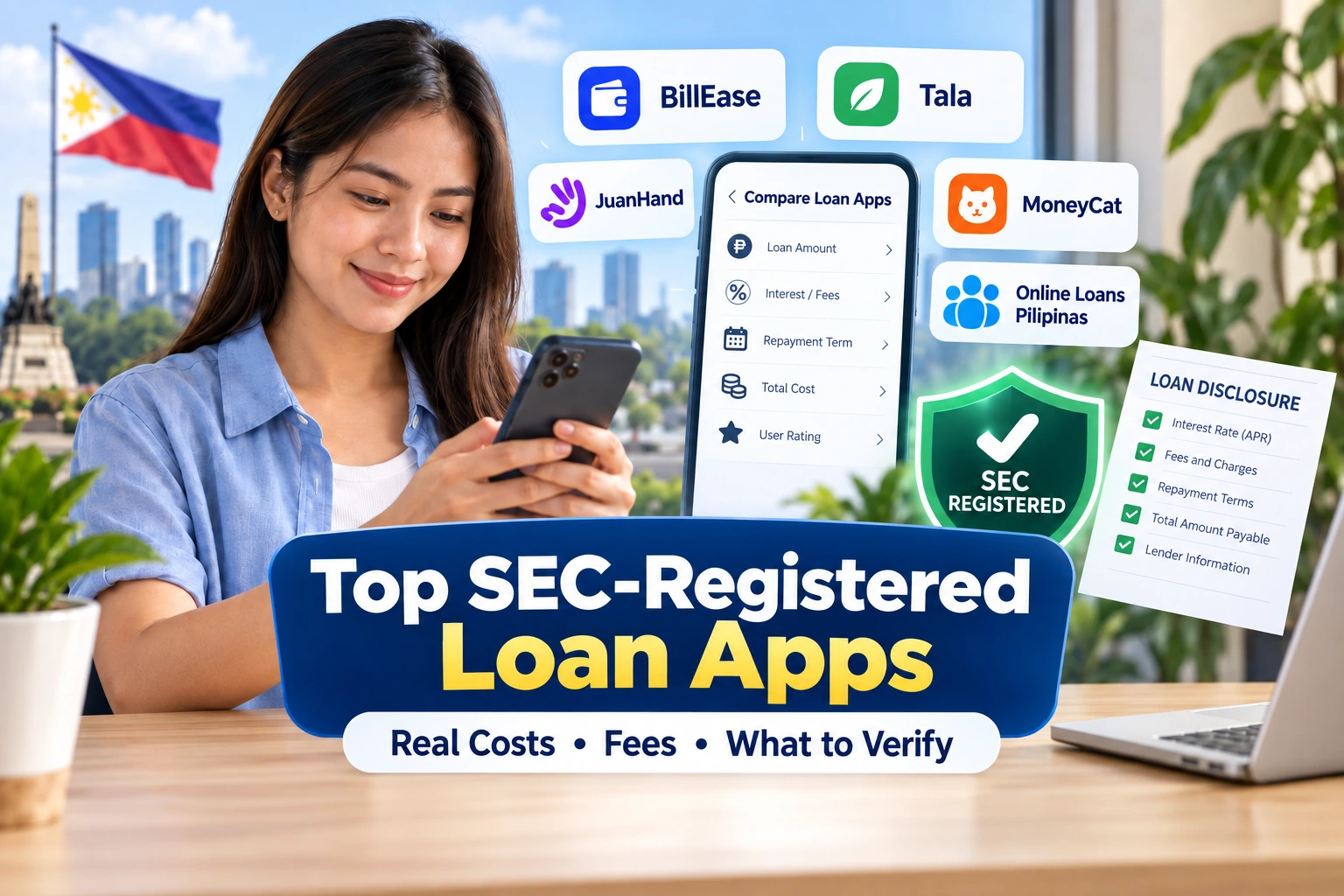
Searching for emergency cash often forces a quick choice between getting funds today and signing a loan contract whose true cost only becomes obvious on the due date. Many Filipino borrowers looking into Online Loans Pilipinas – frequently marketed alongside its short-term consumer brand JuanHand or corporate operator Financing Corporation of the Philippines / Sumulong Financing, Inc. – run into an immediate point of confusion: the consumer brand name on the website or mobile app rarely matches the corporate name appearing on the formal promissory note.
This review examines the public regulatory framework, standard Philippine online lending structures, statutory fee ceilings, and borrower protections that apply when evaluating Online Loans Pilipinas in 2026. Because lending terms, upfront service fee deductions, and corporate platform partnerships change periodically, our analysis relies on established statutory standards under Republic Act No. 3765 (Truth in Lending Act), Bangko Sentral ng Pilipinas (BSP) Circular No. 1133, and Securities and Exchange Commission (SEC) Memorandum Circulars. Where current contract-specific schedules or real-time platform disclosures could not be independently verified from live primary documents at the time of writing, we explicitly state those limitations and show you exactly how to audit your individual Disclosure Statement before accepting an offer.
| Borrower question | Current finding | Why it matters |
| Legal operator & authority | Must hold both a primary SEC Registration Number and a secondary Certificate of Authority (CA) to operate as a Lending or Financing Company, plus SEC registration for its Online Lending Platform (OLP). | Corporate registration alone does not legally authorize a company to issue consumer loans or operate a lending app in the Philippines. |
| Applicable rate caps (Loans ≤ ₱10,000, ≤ 4 months) | Capped by BSP Circular No. 1133 / SEC MC No. 3 (s. 2022) at 0.2% per day (6% per month) nominal interest and 0.5% per day (15% per month) Effective Interest Rate (EIR). | Any processing, service, or verification fee charged on covered small-value loans must fit within the 15% monthly EIR ceiling. |
| Net proceeds vs. principal | Short-term online lenders frequently deduct processing or service fees upfront from the approved principal before disbursing funds. | If ₱1,000 in fees is deducted from a ₱5,000 loan, you only receive ₱4,000 in cash, but your repayment obligation is still calculated on the ₱5,000 face value. |
| First-time borrower limits | Advertised maximum limits (often ₱15,000 to ₱25,000+) rarely apply to new applicants; initial approvals are typically restricted to starter tiers (₱1,000 to ₱5,000). | Relying on the maximum advertised loan amount for an urgent medical or household bill can leave you with a funding shortfall. |
| Late-payment exposure | Late payment penalties on covered small loans are legally capped at 5% per month on the overdue amount; total cost (excluding penalties) cannot exceed 100% of the principal. | Protects borrowers from infinite debt spirals on small loans, though delinquency still triggers collection calls and negative credit reporting. |
| Data privacy & permissions | Under NPC Circular No. 20-01, lending apps are prohibited from harvesting phone contact lists or photo galleries for debt collection or harassment. | If an app requests contact-list access beyond a specifically nominated character reference, it is a major compliance red flag. |
Is Online Loans Pilipinas legitimate and properly authorized in the Philippines?
Legitimacy depends on verifying that the exact corporate entity named on your loan contract holds both an active SEC Certificate of Incorporation and a separate Certificate of Authority (CA) to operate as a financing or lending company. Historical corporate disclosures associate the “Online Loans Pilipinas” brand with Online Loans Pilipinas Financing Inc. (SEC Reg. No. CS201726430, CA No. 1181), though brand licensing and corporate restructuring occur in the Philippine fintech sector.
How to distinguish corporate registration from lending authority
Many borrowers assume that seeing an SEC logo on a website or finding an app on Google Play proves a lender is legally authorized. Under the Lending Company Regulation Act of 2007 (Republic Act No. 9474) and the Financing Company Act of 1998 (Republic Act No. 8556), two distinct approvals are required:
- Primary SEC Registration: This merely establishes the business as a legal corporation. It does not grant permission to lend money to the public.
- Certificate of Authority (CA): This secondary license explicitly authorizes the corporation to engage in lending or financing operations.
- Online Lending Platform (OLP) Registration: Under SEC Memorandum Circular No. 19 (Series of 2019), financing and lending companies must also register their specific mobile apps and websites as approved OLPs and display their Corporate Name, SEC Registration Number, and CA Number prominently on their homepage and advertisements.
Is the website or app the actual lender or a marketing platform?
In the Philippine digital lending market, a consumer-facing website or app often functions either as a direct Online Lending Platform owned by a licensed financing company or as a lead-generation portal that routes applications to third-party lenders.
Before submitting sensitive identification documents or signing an electronic promissory note, check the footer of the website and the top of the Disclosure Statement. If the entity named on the loan agreement differs from Online Loans Pilipinas Financing Inc., cross-check that specific corporate name against the SEC’s current list of Recorded Online Lending Platforms and Financing Companies. Furthermore, remember that regulatory authorization only confirms that the company is an identifiable legal entity – it does not guarantee that the loan offer is affordable or appropriate for your budget.
How does the application and underwriting process actually work?
Applying requires a valid Philippine government-issued ID, an active mobile number, facial biometric verification, and proof of income or employment, with underwriting conducted electronically without physical collateral. While marketing materials often highlight minimal paperwork, actual approval depends on automated identity matching and credit risk scoring.
Who can apply and what documents are typically required?
Standard eligibility criteria for Philippine digital cash loans require applicants to be Filipino citizens aged 21 to 60 (or up to 65 at loan maturity), residing in the Philippines, with a verifiable source of income and an active bank account or verified e-wallet (such as GCash or Maya).
During the digital onboarding flow, borrowers are typically asked to provide:
- One primary government-issued photo ID (e.g., PhilSys National ID, Umid, Passport, Driver’s License, or PRC ID).
- A live selfie or liveness video check (blinking or turning the head) to match the ID photo.
- Employment or income details, which may include company details, payslips, or bank/e-wallet transaction records.
- One or two emergency or character reference contacts.
How underwriting differs across borrower profiles
The lender does not publicly disclose its proprietary credit-scoring model, Weight-of-Evidence (WoE) variables, or automated cut-off scores. However, standard Philippine fintech underwriting evaluates applicants differently depending on their income structure:
- Salaried employees: Often experience smoother automated verification if they can provide a corporate email address, recent payslip, or consistent payroll bank statements.
- Freelancers, gig workers, and self-employed applicants: Frequently face additional underwriting friction. Without a traditional employer HR department or fixed bi-monthly payroll slip, applicants often receive lower initial credit limits or rejections if their e-wallet cash flow appears irregular.
- Applicants with thin or impaired credit files: Because licensed Philippine financing companies report to and query the Credit Information Corporation (CIC) and private credit bureaus (such as TransUnion Philippines or CIBI), an existing unpaid balance on another lending app or credit card can trigger an instant automated decline.
How much can you actually borrow, and why do first-time borrowers receive less?
While promotional banners commonly advertise maximum credit limits ranging from ₱15,000 to ₱25,000 or offering “0% interest” introductory promos, first-time borrowers are routinely approved for much smaller starter amounts, typically between ₱1,000 and ₱5,000.
Advertised maximums vs. starter credit tiers
Digital lenders manage default risk on unsecured loans by using a graduated “credit ladder.” When you apply for the first time, the underwriting system has no internal repayment history for you. Consequently, the system assigns a conservative starter limit – often with a short tenor of 14 to 30 days, or split into two bi-weekly installments. Higher limits and multi-month installment terms are generally unlocked only after a borrower completes multiple on-time repayments.
Evaluating “0% interest” introductory promotions
Online Loans Pilipinas and similar Philippine platforms frequently advertise “0% interest on your first loan” to attract new users. Borrowers should scrutinize the exact contract terms for three common limitations:
- Service or processing fees still apply: A loan may carry 0% nominal interest, yet still charge a one-time processing, platform, or disbursement transfer fee.
- Short repayment window: Introductory free-interest offers are often restricted to very short durations (such as 7 to 14 days) and small principal caps (such as ₱1,000 to ₱3,000).
- Forfeiture upon late payment: If you miss the exact due date by even one day, the promotional waiver is typically voided, retroactively applying standard interest plus late penalties.
What does an Online Loans Pilipinas loan really cost?
Under BSP Circular No. 1133 and SEC Memorandum Circular No. 3 (Series of 2022), unsecured general-purpose loans up to ₱10,000 with tenors of up to four months are subject to a nominal interest rate ceiling of 6% per month (0.2% per day) and an Effective Interest Rate (EIR) cap of 15% per month (0.5% per day). Because live individual fee schedules vary by borrower risk tier and loan amount, you must calculate both the total peso cost and the cost relative to net cash received before accepting an offer.
Why nominal interest hides the real cost of borrowing
Many borrowers look only at the monthly nominal interest rate. However, Philippine online lenders frequently charge non-interest fees – labeled as processing fees, service fees, platform fees, credit assessment fees, or disbursement fees.
Under the Truth in Lending Act (RA 3765), all finance charges must be disclosed in writing prior to loan consummation. Furthermore, for loans covered by the SEC/BSP ceiling (≤ ₱10,000 and ≤ 4 months), the Effective Interest Rate (EIR) – which combines nominal interest plus all mandatory administrative, service, and processing fees – cannot legally exceed 15% per month (0.5% per day). If your loan exceeds ₱10,000 or has a term longer than four months, those specific numerical caps do not automatically apply, making manual cost verification even more critical.
Sample Peso Cost Calculation: Approved Principal vs. Net Proceeds
Because we do not invent live borrowing offers, the table below demonstrates how to audit any short-term ₱5,000, 30-day loan offer operated at the statutory maximum ceilings versus an upfront-deduction structure.
| Cost Component | Scenario A: Fees Added at Maturity (Statutory Max EIR) | Scenario B: Upfront Service Fee Deduction (Statutory Max EIR) |
| Approved Principal (Face Value) | ₱5,000.00 | ₱5,000.00 |
| Loan Tenor | 30 days | 30 days |
| Nominal Interest (6% / month) | ₱300.00 | ₱300.00 |
| Service / Processing Fee (9% / month) | ₱450.00 (paid at maturity) | ₱450.00 (deducted upfront) |
| Net Proceeds (Cash Actually Received) | ₱5,000.00 | ₱4,550.00 |
| Total Amount to Repay on Day 30 | ₱5,750.00 | ₱5,300.00 |
| Total Peso Borrowing Cost | ₱750.00 | ₱750.00 |
| Cost as % of Approved Principal | 15.00% | 15.00% |
| Real Cost Relative to Net Cash Received | 15.00% | 16.48% |
To calculate the real percentage cost relative to the actual cash deposited into your account, use this formula:
$$\text{Effective Cash Cost (\%)} = \left( \frac{\text{Total Amount Repaid} – \text{Net Cash Received}}{\text{Net Cash Received}} \right) \times 100$$
In Scenario B above, even though the lender charges ₱750 in combined interest and fees on a ₱5,000 contract, deducting the ₱450 service fee upfront means you only receive ₱4,550 in usable cash. Paying ₱750 to use ₱4,550 for 30 days equals an actual 30-day cost of 16.48% on the money you actually held in your hand.
How fast is approval and disbursement in practice?
While marketing claims often highlight “instant” or “5-minute” approvals, actual end-to-end disbursement depends on automated KYC success, manual underwriting queues, and interbank or e-wallet settlement rails.
Common friction points that delay approval
Even when an online platform uses automated decisioning, several operational bottlenecks regularly delay applications:
- ID and biometric mismatches: Glare on a laminated ID, low-resolution camera uploads, or discrepancies between how your middle name or suffix appears on your ID versus your application form frequently trigger manual review or outright rejection.
- OTP delivery delays: Network congestion on local telecom networks can cause One-Time Passwords to expire before arrival, locking the application session temporarily.
- First-time manual verification: First-time applicants are far more likely than repeat borrowers to have their applications routed to a human verification queue or to receive a verification phone call during standard business hours (8:00 AM to 5:00 PM).
Why bank and e-wallet transfers can still take hours or days
Once a loan is marked “Approved” inside the platform, the disbursement speed is governed by Philippine payment rails:
- InstaPay (Real-Time): Used for most e-wallets (GCash, Maya) and major commercial banks for transfers up to ₱50,000. While normally near-instant, InstaPay channels undergo scheduled maintenance or intermittent downtime, which can hold funds in a “pending” state for 24 to 48 hours.
- PESONet (Batch Settlement): If a lender routes disbursements via PESONet, transfers are processed in batch cycles on banking days only. Submitting your loan confirmation after the afternoon cut-off time on a Friday, weekend, or Philippine public holiday means the cash will not reach your bank account until the next banking day.
- Account name mismatch: If the name on your receiving bank account or GCash wallet does not exactly match the legal name on your loan application, the disbursement will fail. Worse, some borrowers in the market report that interest begins accruing from the moment the contract is generated, even while a failed transfer is awaiting reversal and re-disbursement.
How does repayment work, and what causes payment-posting issues?
Borrowers typically repay through over-the-counter partner outlets (such as 7-Eleven CLiQQ, Cebuana Lhuillier, or M Lhuillier), e-wallets (GCash, Maya), or online banking bills payment using a contract-specific reference number.
Critical checkpoints when making a payment
To prevent your payment from floating uncredited while late penalties accumulate, verify three operational details every time you pay:
- Dynamic Reference / Lifetime ID Numbers: Confirm whether your payment reference number stays the same for your account or changes with every individual loan contract or installment. Entering an expired contract number at a kiosk or e-wallet bills-payment menu can misroute your funds.
- Third-Party Channel Fees: E-wallets and over-the-counter payment centers typically charge convenience or service fees (often ₱10 to ₱50 per transaction) on top of your loan due amount. Do not deduct this fee from your loan payment; paying even ₱20 less than the exact due amount leaves the contract technically in partial default.
- Settlement vs. Timestamp: While integrated e-wallet payments usually post within minutes, over-the-counter or bank-transfer payments made late in the evening can take up to 24 hours to reflect on the lender’s ledger. Always pay at least one full business day before your due date and take a clear screenshot or photograph of the confirmation receipt showing the reference number, timestamp, and amount.
What happens if you pay late?
For small-value loans covered by BSP Circular No. 1133 (up to ₱10,000 and up to four months), late payment penalties are capped at 5% per month on the overdue amount, and the total cost of the loan (including interest and fees, excluding late penalties) cannot exceed 100% of the principal borrowed.
Statutory caps on penalties and total loan cost
Before 2022, unregulated daily penalty compounding could turn a ₱3,000 Philippine cash loan into a ₱20,000 demand within months. Current regulations establish two legal guardrails for covered small-value short-term loans:
- Penalty Cap: Late payment fees and penalties cannot exceed 5% per month (pro-rated daily where applicable) of the unpaid overdue installment.
- 100% Total Cost Limit: Regardless of how long a loan remains unpaid or gets restructured, the total accumulated interest, fees, and charges (excluding late payment penalties) cannot exceed 100% of the original amount borrowed.
Debt collection rules under SEC MC No. 18 (Series of 2019)
Even when a borrower defaults, the lender and its third-party collection agencies must strictly comply with SEC Memorandum Circular No. 18 (Series of 2019), which prohibits unfair debt collection practices. Collectors are legally forbidden from:
- Using threat of violence, profane, or obscene language;
- Contacting the borrower before 8:00 AM or after 9:00 PM (unless the borrower gave prior consent or the debt is more than 15 days past due under specific reasonable parameters);
- Disclosing or publishing the borrower’s name and debt status on social media or to the public (“debt shaming”);
- Contacting people in the borrower’s phone contact list who are neither guarantors nor co-makers;
- Falsely representing themselves as lawyers, police officers, court sheriffs, or barangay officials, or sending fake court subpoenas.
Civil debt vs. criminal liability in the Philippines
Collection agents sometimes threaten delinquent borrowers with immediate police arrest or imprisonment under Estafa (Article 315 of the Revised Penal Code). Borrowers should understand the constitutional and legal boundary:
- Article III, Section 20 of the 1987 Philippine Constitution explicitly states: “No person shall be imprisoned for debt.” Ordinary inability to pay an online cash loan is a civil liability, not a criminal offense.
- When criminal liability can arise: Criminal charges such as Estafa or violations of Batas Pambansa Blg. 22 (Bouncing Checks Law) apply only when independent criminal elements exist – such as issuing a worthless check, using a fake identity or forged documents to obtain the loan, or committing active deceit at the time of application.
- Real consequences of civil default: While you cannot be jailed simply for losing your job and missing a loan payment, non-payment is not consequence-free. It results in lawful collection communications, escalating late penalties up to statutory caps, potential Small Claims civil court actions for recovery, and negative reporting to the Credit Information Corporation (CIC), which can block you from getting future bank loans, credit cards, auto loans, or mortgages.
How does Online Loans Pilipinas handle your personal data and device permissions?
Under the Data Privacy Act of 2012 (RA 10173) and National Privacy Commission (NPC) Circular No. 20-01, online lending platforms are strictly required to collect only data that is proportional and necessary for credit scoring and identity verification, and are barred from harvesting phonebook contacts or photo galleries for debt collection.
What data is legitimate to collect vs. overreaching permissions
When evaluating the Online Loans Pilipinas web portal or any associated mobile application, distinguish between necessary Know-Your-Customer (KYC) permissions and invasive data harvesting:
- Necessary permissions: Camera access (for taking a photo of your government ID and a live selfie) and basic device/network identifiers (for fraud prevention and session security).
- Prohibited data harvesting: Under NPC Circular No. 20-01, lending apps must not require blanket read access to your phonebook contacts, SMS inbox, social media friends list, or personal photo gallery as a condition for using the app. Even if you list one or two character references on your form, the lender is only permitted to verify your identity or location in accordance with privacy laws – not to harass, shame, or demand payment from your references.
What recurring patterns appear in Philippine borrower reports?
Public user feedback across Philippine app stores, consumer forums, and social media discussions regarding Online Loans Pilipinas and similar short-term cash platforms highlights a sharp divide between borrowers who use short promos for brief liquidity gaps and those who face repayment friction. Because individual online reviews are anecdotal and cannot be verified as statistical averages, they should be read as operational risk signals rather than guaranteed outcomes.
Positive experiences reported by users
- Fast digital onboarding for repeat borrowers: Users who have already completed an initial loan cycle often report that subsequent applications require minimal re-uploading of documents and disburse rapidly via e-wallets.
- Accessible starter credit without a credit card: Borrowers who lack traditional bank credit lines note that automated online verification provides a reachable option when a small, short-term cash shortfall occurs right before payday.
Recurring complaints and friction points
- Disappointment over starter limits and short tenors: Several recent reviewers report applying because of advertised multi-month terms or high limits, only to be offered ₱1,000 to ₱3,000 repayable in 7 to 14 days, or split into rapid weekly/bi-weekly installments.
- Upfront deductions vs. expected cash: Borrowers frequently express frustration when service or processing fees are deducted prior to disbursement, leaving them with less cash than the bill they needed to pay.
- Early and persistent collection reminders: A recurring theme across borrower forums involves receiving automated calls, SMS reminders, and emails starting several days before the actual due date, which heats up rapidly on the morning of the due date.
- Payment-posting anxiety: Some users report technical glitches when logging into their accounts on the due date or delays between paying via a third-party channel and seeing their loan status update to “Cleared.”
What are the main advantages and disadvantages?
Evaluating Online Loans Pilipinas objectively requires weighing its convenience against the structural cost of short-term Philippine fintech credit.
Advantages
- No physical collateral or guarantor required: Applications are underwritten based on personal ID, biometrics, and income data rather than property pledges.
- Digital application and e-wallet disbursement: Eliminates physical branch visits and allows disbursement directly to major Philippine banks or e-wallets when payment rails are operating normally.
- Covered by SEC/BSP small-loan rate caps (for qualifying loans): Loans of ₱10,000 or less with tenors up to four months fall under the statutory protection of BSP Circular No. 1133, limiting effective monthly costs and late penalties.
Disadvantages
- High effective borrowing cost compared to banks or government loans: Even within the legal 15% monthly EIR cap for small loans, short-term fintech loans are dramatically more expensive than SSS/Pag-IBIG calamity or salary loans (typically ~10% per year) or bank personal loans.
- Starter limits and short repayment cycles create rollover risk: Small initial approvals paired with 14- to 30-day repayment windows give borrowers very little breathing room to recover financially before the principal and fees fall due.
- Upfront fee deductions can cause funding shortfalls: If service fees are deducted from the principal at disbursement, the net cash received may not cover your exact emergency expense.
Who may find this loan relevant, and who should look elsewhere?
Short-term digital cash loans are high-cost financial tools designed for very narrow timing gaps, not long-term budget deficits.
This option may be relevant if you:
- Have a verified, guaranteed inflow of cash (such as a confirmed 15th/30th payroll deposit or cleared client invoice) arriving before the exact maturity date;
- Have reviewed the pre-contractual Disclosure Statement and confirmed that the net cash disbursed covers your expense and that you can absorb the total peso cost without cutting into money needed for food, rent, or utilities;
- Can qualify for and strictly adhere to a verified 0% introductory promotion without missing the payment deadline by a single hour.
You should avoid accepting the loan and explore alternatives if you:
- Are borrowing to pay off another online lending app (“tapal system”), which rapidly triggers a multi-app debt spiral;
- Have lost your primary source of income or rely on unpredictable daily earnings that could easily miss a rigid 14- or 30-day deadline;
- Have access to lower-cost institutional credit, such as an SSS Salary Loan, Pag-IBIG Multi-Purpose Loan (MPL), employer salary advance, or cooperative credit line.
Frequently Asked Questions (FAQ)
Can I cancel an Online Loans Pilipinas loan after my application is approved?
Once you enter the final One-Time Password (OTP) or click the electronic acceptance button to execute the promissory note, the disbursement instruction is usually sent immediately to the payment gateway and cannot be canceled inside the portal. If you have not yet signed the electronic contract or entered the confirmation OTP, you can simply abandon the offer or let the approval window expire without penalty.
Does paying off a loan early reduce the interest or service fees?
In most short-term Philippine online cash loans, one-time processing or service fees are non-refundable once the loan is disbursed. Furthermore, many short-tenor contracts calculate the full term’s interest upfront rather than recalculating daily reducing-balance interest upon early settlement. Check your specific loan agreement to confirm whether pre-termination waives unaccrued daily interest or requires paying the full scheduled maturity amount.
How can I request the deletion of my personal data if I decide not to borrow?
Under the Data Privacy Act of 2012 (RA 10173), if you registered an account and never took out a loan – or if you have fully settled all past obligations and your data is no longer required to be retained under anti-money laundering or tax retention laws – you have the right to request account closure and data erasure. Send a formal written request to the company’s designated Data Protection Officer (DPO) using the official privacy email listed in its Privacy Policy, and escalate to the National Privacy Commission (NPC) if the request is ignored.
Where can I file an official complaint against unfair collection or undisclosed fees?
Keep screenshots of your Disclosure Statement, payment receipts, and any abusive messages or call logs, then file a complaint with the appropriate Philippine regulator:
- Securities and Exchange Commission (SEC): File through the SEC i-Message portal or the Corporate Governance and Finance Department (CGFD) for lending/financing company violations, unregistered OLPs, or unfair collection practices under SEC MC No. 18.
- National Privacy Commission (NPC): File a complaint for unauthorized contact-list harvesting, public debt shaming, or misuse of personal information.
- Bangko Sentral ng Pilipinas (BSP): Use the BSP Online Buddy (BOB) if the issue involves a BSP-supervised bank, digital bank, or e-wallet payment channel failure.
Pre-Acceptance Borrower Checklist
Before entering your OTP or clicking “Accept Offer” on Online Loans Pilipinas – or any lending partner it routes you to – pause and run this five-point audit on your screen:
- Verify the exact legal entity: Look at the top of the Disclosure Statement and Promissory Note. Confirm that the corporate name, SEC Registration Number, and Certificate of Authority (CA) Number are explicitly written.
- Check the Net Proceeds line: Do not look only at the “Loan Amount.” Look for “Net Proceeds” or “Amount to be Disbursed.” Confirm that the actual cash hitting your bank or GCash account is enough to solve your problem.
- Calculate the Total Peso Cost: Subtract the Net Proceeds from the Total Amount to be Repaid. Ask yourself plainly: “Is getting this cash today worth paying ₱X out of my next paycheck?”
- Match the due dates to your actual payday: Check whether repayment is a single lump sum in 14/30 days or split into rapid bi-weekly installments. Account for weekend PESONet delays and pay at least 24 hours early.
- Confirm you do not need another loan to repay this one: If paying this loan back on the due date will leave your household without money for essentials – forcing you to reloan immediately – decline the offer and explore an SSS, Pag-IBIG, employer, or family alternative first.
References
- Truth in Lending Act (Republic Act No. 3765)Organization: Official Gazette of the Philippines / Lawphil Project
Resource: Republic Act No. 3765 – An Act to Require the Disclosure of Finance Charges in Connection with Extensions of Credit
URL: https://lawphil.net/statutes/repacts/ra1963/ra_3765_1963.html
- Lending Company Regulation Act of 2007 (Republic Act No. 9474)Organization: Official Gazette of the Philippines / Lawphil Project
Resource: Republic Act No. 9474 – An Act Governing the Establishment, Operation and Regulation of Lending Companies
URL: https://lawphil.net/statutes/repacts/ra2007/ra_9474_2007.html
- Financing Company Act of 1998 (Republic Act No. 8556)Organization: Official Gazette of the Philippines / Lawphil Project
Resource: Republic Act No. 8556 – An Act Amending Republic Act No. 5980, as Amended, Otherwise Known as the Financing Company Act
URL: https://lawphil.net/statutes/repacts/ra1998/ra_8556_1998.html
- Bangko Sentral ng Pilipinas Circular No. 1133 (Series of 2021)Organization: Bangko Sentral ng Pilipinas (BSP)
Resource: Ceiling on Interest Rates and Other Fees Charged by Lending Companies, Financing Companies, and Their Online Lending Platforms
URL: https://www.bsp.gov.ph/Regulations/Issuances/2021/1133.pdf
- Securities and Exchange Commission Philippines – Lending & Financing CompaniesOrganization: Securities and Exchange Commission (SEC) Philippines
Resource: Lending and Financing Companies Information and Advisories Portal
URL: https://www.sec.gov.ph/lending-companies-and-financing-companies-2/
- Data Privacy Act of 2012 (Republic Act No. 10173)Organization: National Privacy Commission (NPC) Philippines
Resource: Republic Act No. 10173 – Data Privacy Act of 2012
- National Privacy Commission Circular No. 20-01Organization: National Privacy Commission (NPC) Philippines
Resource: Guidelines on the Processing of Personal Data for Loan-Related Transactions
- Credit Information System Act (Republic Act No. 9510)Organization: Credit Information Corporation (CIC) Philippines
Resource: Republic Act No. 9510 – Credit Information System Act
URL: https://www.creditinfo.gov.ph/republic-act-no-9510-credit-information-system-act-cisa