Last Updated on 16/10/2026 by Nicole Alba
When unexpected expenses arise, many Filipino workers turn to private online lending apps that charge effective interest rates exceeding 15% per month, simply to avoid the perceived bureaucracy of government loans. However, bypassing the Social Security System (SSS) or the Government Service Insurance System (GSIS) often means leaving thousands of pesos on the table.
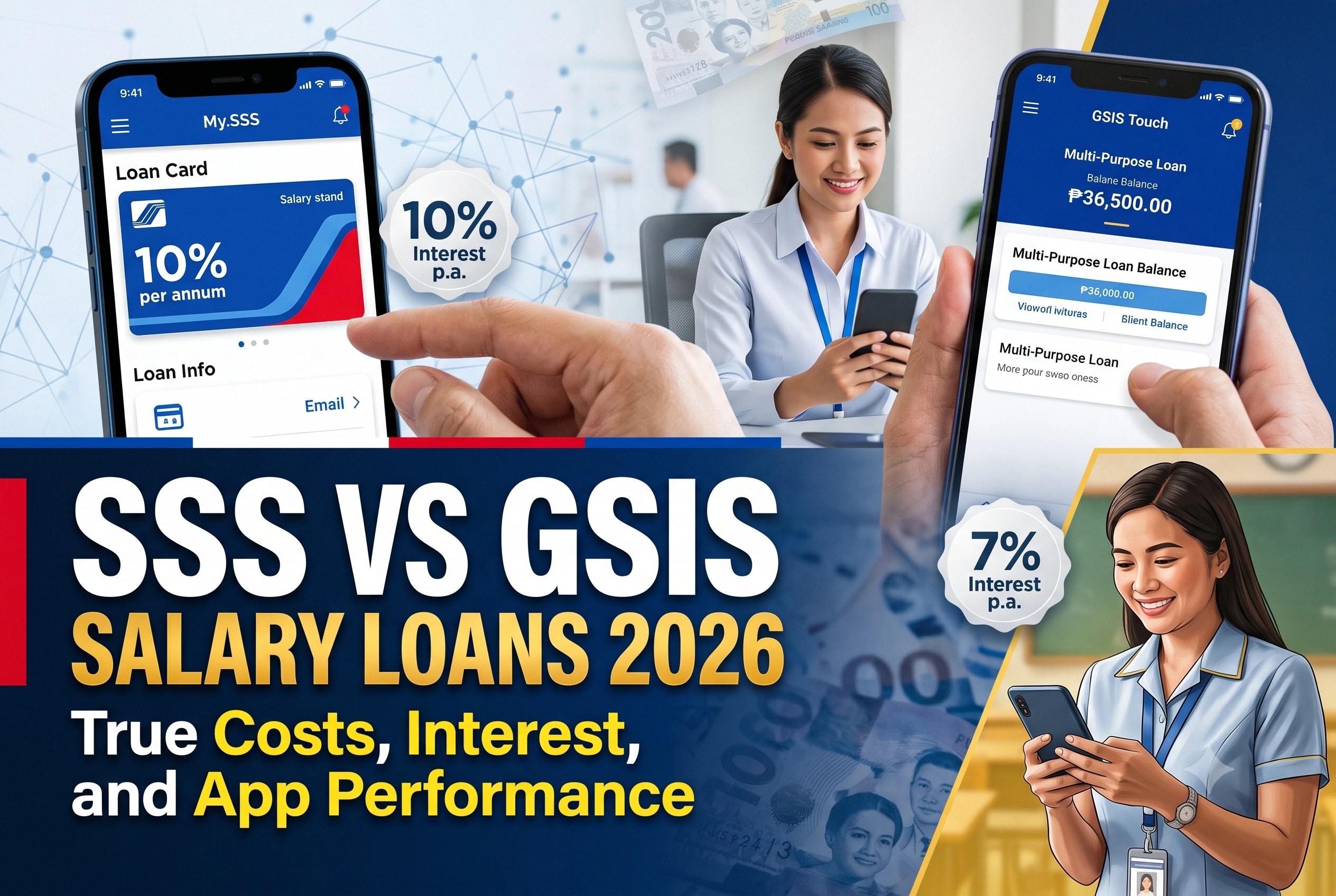
As of 2026, both state-run institutions have heavily digitized their application processes through the SSS Mobile App and GSIS Touch. Yet, digitalization does not automatically mean instant cash. This review investigates the actual costs, disbursement timelines, and hidden operational friction associated with SSS and GSIS lending programs. We analyze the current terms to help private and public sector employees determine exactly how much they can borrow, what gets deducted upfront, and what hurdles stand between an application and actual disbursement.
Summary:
SSS and GSIS salary loans remain the safest and most affordable unsecured credit options in the Philippines. Operating under state mandate, they charge annual interest rates between 7% and 10% – a fraction of private fintech costs. However, approval is not instant. While both institutions offer mobile app applications, actual disbursement depends heavily on employer certification and system stability. Borrowers must also account for upfront service fee deductions and strict contribution prerequisites. While they cannot compete with the same-day speed of aggressive private lenders, the massive savings in interest make SSS and GSIS the mandatory first choice for eligible Filipino workers.
| Borrower question | Current finding | Why it matters |
| Who is the lender? | The Philippine government (SSS for private sector; GSIS for public sector). | Guarantees protection against illegal debt collection and predatory interest rates. |
| What is the interest rate? | 10% per annum (SSS) or around 7% per annum (GSIS). | These are annual rates, making them significantly cheaper than fintech apps that charge monthly. |
| How much is deducted upfront? | SSS deducts a 1% service fee; GSIS deducts advance interest and fees depending on the loan type. | You will not receive the full approved principal amount in your bank account. |
| Do they check credit scores? | No traditional credit check, but eligibility strictly requires a minimum number of posted contributions. | Missing employer remittances will automatically result in a rejected application. |
| How long does disbursement take? | Typically 3 to 7 working days, subject to employer confirmation. | These loans are not suitable for absolute same-day emergency cash needs. |
| What is the penalty for late payment? | 1% per month on the delayed principal and interest. | Unpaid loans accumulate penalties and are eventually deducted from your final retirement benefits. |
Are SSS and GSIS legitimate and better than private lending apps?
Yes. SSS and GSIS are state-run social insurance programs explicitly authorized by Philippine law to manage member funds and provide financial assistance. They offer the lowest interest rates in the country, completely eliminating the risk of unauthorized data scraping, contact harassment, and predatory pricing associated with unregulated apps.
Unlike private fintech companies that operate as separate corporate entities under Securities and Exchange Commission (SEC) guidelines, SSS and GSIS are government institutions. They do not operate for profit in the same manner as a private financing company.
When you borrow from SSS or GSIS, you are essentially borrowing against your own future benefits. Because the ultimate collateral is your own pension or separation pay, the risk to the lender is near zero. This allows them to offer interest rates that no private unsecured lender can match. Furthermore, they are bound by the Data Privacy Act and do not employ third-party collection agencies that threaten borrowers or message their phone contacts.
How much can you actually borrow from SSS and GSIS?
Loan limits are strictly tied to your contribution history and salary profile. SSS members can borrow the equivalent of a one- or two-month salary credit, while GSIS members using the Multi-Purpose Loan (MPL) Plus can access up to 14 times their basic monthly salary.
SSS Salary Loan Limits
The available amount from SSS is not based on your actual monthly paycheck, but on your Monthly Salary Credit (MSC) – the bracket under which your contributions are paid.
- One-month salary loan: Requires at least 36 posted monthly contributions, with 6 contributions within the last 12 months.
- Two-month salary loan: Requires at least 72 posted monthly contributions, with 6 within the last 12 months.
If your employer consistently pays your contributions at the maximum MSC bracket, your maximum loanable amount will reflect that cap.
GSIS Multi-Purpose Loan (MPL) Plus Limits
GSIS offers significantly higher limits for public school teachers, government personnel, and civil servants. Depending on the length of service and Premiumed Periods of Service (PPS), eligible members can consolidate past debts and borrow up to 14 months of their basic salary. However, the exact limit is subject to the General Appropriations Act (GAA) net take-home pay provision, ensuring that loan deductions do not leave the employee with an unlivable monthly take-home amount.
What does a government salary loan really cost?
The cost of borrowing is explicitly capped. SSS charges 10% per annum on a diminishing principal balance plus a 1% upfront service fee. GSIS charges approximately 7% per annum on its MPL Plus, making both options drastically cheaper than commercial alternatives.
Understanding the Net Proceeds
Private lenders often confuse borrowers by marketing a “low” interest rate while hiding massive processing fees. SSS and GSIS are highly transparent, but borrowers must still calculate their net proceeds.
If an SSS member is approved for a ₱20,000 salary loan:
- Approved Principal: ₱20,000
- Service Fee (1%): ₱200
- Net Proceeds Disbursed: ₱19,800
The 10% annual interest is computed on a diminishing principal balance. Over a standard 24-month (two-year) repayment period, the actual interest paid is much less than a flat 10% applied to the entire amount every year. The monthly amortization is clearly stated on the disclosure statement and automatically deducted from payroll.
How fast is the approval and disbursement process?
Government loan disbursement typically takes between 3 to 7 working days. While applications are submitted quickly via the SSS Mobile App or GSIS Touch, funds cannot be released until the employer logs in to their respective portal to certify the loan.
The Employer Certification Bottleneck
The public application flow indicates that SSS and GSIS have largely eliminated paper forms. However, the system requires your employer’s HR or authorized representative to certify the loan application online.
- If your HR department is proactive, certification happens within hours.
- If your employer neglects the portal, the application will eventually expire and cancel itself.
Disbursement Channels
Once certified, neither agency issues checks. SSS utilizes PESONet to disburse funds to your registered UMID-ATM card, UnionBank account, or active e-wallet (such as GCash or Maya). Because PESONet processes transactions in batches, the money usually arrives on the next banking day following final approval. Weekends and national holidays will delay settlement.
What are the main points of friction for borrowers?
Recent borrower reviews and system maintenance logs report recurring issues with mobile app stability, OTP delays, and rejected facial recognition during registration, forcing some users to visit physical branches.
While the financial terms are excellent, the operational friction can frustrate applicants who are accustomed to the fluid user interfaces of modern digital banks. Common hurdles include:
- Unposted Contributions: Employers legally mandate deductions from employee salaries, but sometimes fail to remit them on time. An application will be instantly rejected if the required contributions are not visible in the system.
- App Downtime: The GSIS Touch app and the SSS My.SSS portal undergo frequent maintenance. Users frequently report being locked out during peak hours.
- Data Mismatches: If the bank account name registered on your SSS profile does not perfectly match your actual bank account (e.g., missing a middle initial), the disbursement will bounce, delaying the loan by several weeks while the returned funds are re-processed.
What happens if you pay late?
SSS and GSIS charge a 1% penalty per month on unpaid amortizations. Unlike private lenders, they do not harass contacts or utilize aggressive collection agencies. Instead, accumulated balances are simply deducted from final retirement or separation claims.
The Reality of Government Debt Collection
When a borrower resigns, transfers to the informal sector, or simply stops paying, the monthly amortization goes into default.
- No phone harassment: You will not receive threatening text messages.
- Compounding penalties: The 1% monthly penalty applies to the delayed principal and interest. Over ten or twenty years, a small salary loan can balloon into a massive deduction.
- Final settlement: When you apply for a retirement pension, death benefit, or total disability claim, SSS and GSIS have the legal authority to deduct the outstanding loan balance, plus all accumulated penalties, before releasing the remaining funds.
Who should use these programs, and who should look elsewhere?
Government salary loans are highly relevant to borrowers who:
- Need funds for non-absolute emergencies (e.g., tuition fees, home repairs) and can wait 3 to 7 days.
- Want to minimize borrowing costs.
- Have stable employment with a company that strictly complies with monthly remittances.
A borrower should be cautious or seek alternatives if:
- The cash is needed within 24 hours (e.g., an immediate hospital admission).
- Their employer has a known history of delayed SSS/GSIS remittances.
- They plan to resign within the next few months, as the entire remaining balance may be deducted from their final back pay.
What should you check before applying?
- Check your contribution record: Log into the SSS Mobile App or GSIS Touch first. Verify that your employer has remitted the minimum required contributions.
- Verify your bank account: Ensure your disbursement account is correctly registered and active on the PESONet network.
- Confirm employer participation: Speak to your HR department to ensure they have active access to the employer web portal to certify your application promptly.
References
- Social Security System (SSS)Organization: Republic of the Philippines
Resource: Member Loans – Salary Loan
URL: https://www.sss.gov.ph/sss/appmanager/pages.jsp?page=salaryloans
- Government Service Insurance System (GSIS)Organization: Republic of the Philippines
Resource: Multi-Purpose Loan (MPL) Plus
URL: https://www.gsis.gov.ph/active-members/loans/multi-purpose-loan/
- Social Security System (SSS)Organization: Republic of the Philippines
Resource: SSS Mobile App Information
URL: https://www.sss.gov.ph/sss/appmanager/pages.jsp?page=sssmobileapp