Last Updated on 17/10/2026 by Nicole Alba
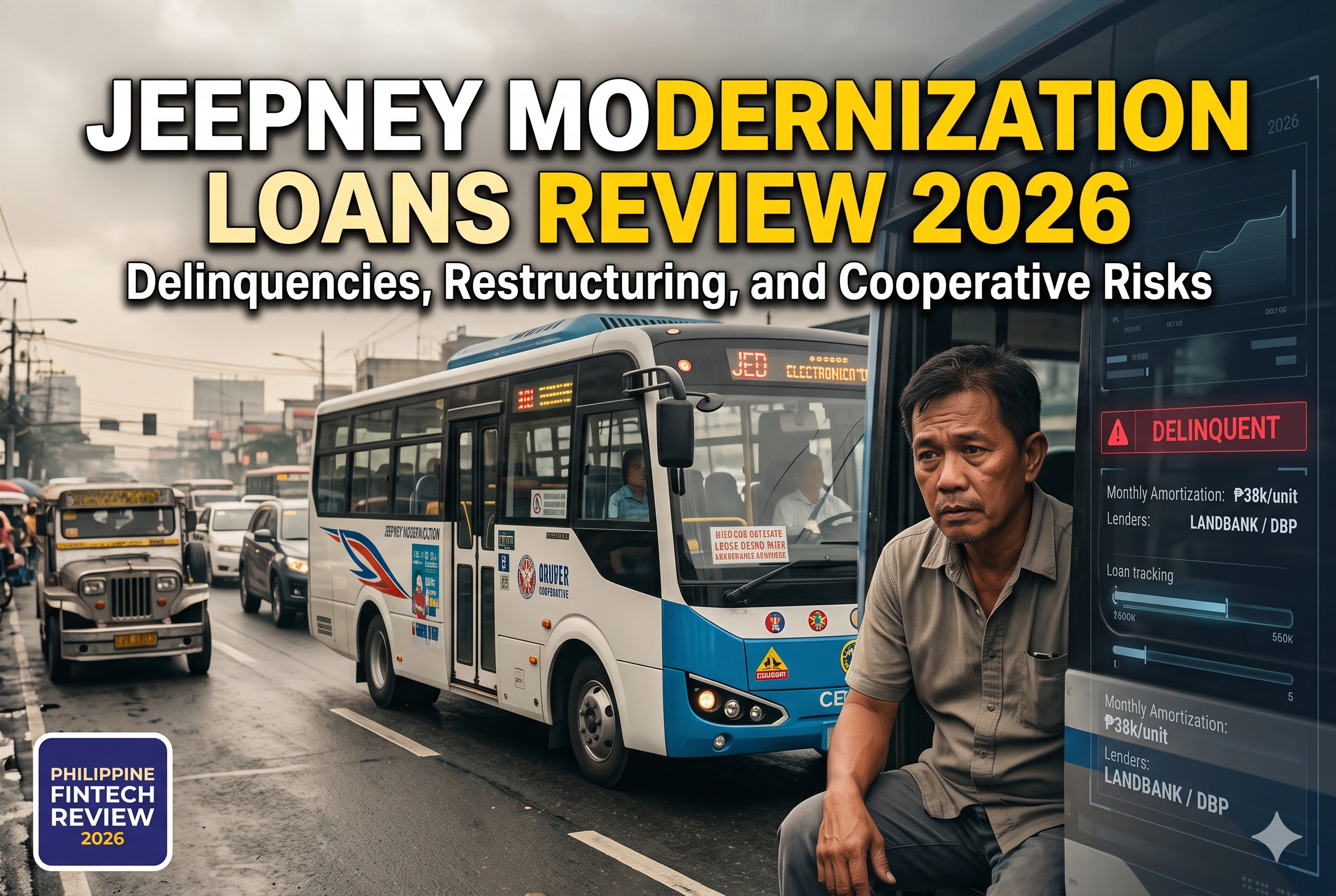
The transition to the Public Utility Vehicle Modernization Program (PUVMP) required transport operators to consolidate into cooperatives and take on massive institutional debt. In 2026, many of these consolidated entities face severe cash flow shortages, struggling to meet the ₱30,000 to ₱40,000 monthly amortizations per modern unit. For cooperative officers and drivers, a delinquent loan is not merely a financial metric – it represents the immediate threat of repossession and the loss of their primary livelihood.
This review investigates the current reality of PUVMP loan delinquencies. We analyze the exact costs of these loans, the operational friction causing cooperatives to default, the legal consequences of missed payments, and the restructuring options available through state-owned banks.
Summary:
Transport cooperatives face escalating delinquency risks on jeepney modernization loans primarily due to a mismatch between route revenues and rigid seven-year amortization schedules. The legal lenders – principally Land Bank of the Philippines (LANDBANK) and Development Bank of the Philippines (DBP) – finance units costing upwards of ₱2.5 million at 6% annual interest. When daily operations fail to generate the necessary ₱1,200 to ₱1,500 per unit just for debt servicing, cooperatives fall into arrears. Distressed cooperatives have options to restructure, usually by extending the loan term, though this significantly increases the total borrowing cost. Operators must carefully calculate whether restructured terms align with the actual mechanical lifespan of the vehicles.
| Borrower question | Current finding | Why it matters |
| Legal Lenders | LANDBANK (SPEED PUV) and DBP (PASADA), alongside select commercial banks. | Cooperatives are dealing with institutional banks governed by strict Bangko Sentral ng Pilipinas (BSP) rules, not informal lenders. |
| Average Loan Cost | ₱2.5M to ₱3M+ per unit, heavily dependent on the vehicle class and manufacturer. | The high principal requires aggressive daily passenger volumes to meet the monthly payment schedule. |
| Standard Tenor | 7 years (84 months). | The relatively short repayment window forces high monthly amortizations. |
| Interest Rate | Typically 6% per annum (fixed for a specified period). | Even at below-market rates, the large principal results in massive total interest costs over the life of the loan. |
| Delinquency Penalty | Usually ranges from 3% to 6% per annum on the amount due. | Penalties compound quickly, turning a temporary cash flow problem into an unmanageable debt spiral. |
| Ultimate Risk | Foreclosure and repossession of the modern jeepney fleet. | Defaulting severs the cooperative’s ability to operate its awarded franchise routes. |
Who legally issues and holds the loans for the Jeepney Modernization Program?
State banks Land Bank of the Philippines (LANDBANK) and Development Bank of the Philippines (DBP) are the primary legal lenders holding these loans, operating through the SPEED PUV and PASADA programs, respectively. Private commercial banks also hold a smaller share of the portfolio.
Unlike consumer microloans, jeepney modernization loans are commercial fleet financing agreements. The Department of Transportation (DOTr) and the Land Transportation Franchising and Regulatory Board (LTFRB) mandate the modernization, but they do not lend the money.
When a transport cooperative borrows funds, they sign a binding corporate loan agreement with a bank. LANDBANK manages this through its Special Package for Environment-Friendly and Efficiently-Driven PUVs (SPEED PUV) program. DBP operates a similar mechanism called the Program on Support Actions for Ride-Sharing and Development (PASADA).
Because these are institutional bank loans, they are subject to BSP regulations regarding non-performing loans (NPLs). When a cooperative stops paying, the bank is legally required to classify the loan as delinquent and initiate recovery protocols to protect the bank’s financial stability.
What does a modern jeepney loan actually cost the cooperative?
A modern jeepney priced at ₱2.8 million requires a 5% equity downpayment. Financed over seven years at an industry-standard 6% annual interest rate, the cooperative must pay approximately ₱38,000 monthly per unit, excluding insurance, maintenance, and fleet management costs.
To understand why delinquencies occur, borrowers must examine the exact mathematical burden of the financing structure.
Assume a cooperative purchases a Class 2 modern jeepney for ₱2,800,000.
The government provides an equity subsidy (which has varied by year and vehicle class, often ranging between ₱160,000 to ₱280,000+).
Even with a generous subsidy and the required 5% cooperative equity, the financed amount frequently exceeds ₱2,300,000 per vehicle.
At a 6% fixed annual interest rate amortized over 7 years (84 months), the monthly payment sits near ₱34,000 to ₱38,000.
Breaking this down daily, assuming the vehicle runs 26 days a month, the jeepney must generate at least ₱1,300 to ₱1,460 a day strictly to pay the bank.
This daily debt boundary does not include:
- Diesel or electricity costs;
- Driver and conductor salaries;
- Cooperative administrative fees;
- Comprehensive insurance;
- Maintenance, tires, and parts replacement.
When route revenues fail to clear this high daily threshold consistently, the cooperative is forced to dip into its reserves. Once reserves are depleted, the loan becomes delinquent.
Why are transport cooperatives falling into delinquency?
Delinquencies primarily stem from a cash flow mismatch. The daily gross revenue of a modern jeepney frequently fails to cover the combined costs of the ₱1,200 daily loan amortization, fuel or charging costs, driver salaries, and unexpected electronic or mechanical maintenance.
Based on public financial disclosures and transport sector reports, several operational frictions drive these defaults:
1. Unrealistic Feasibility Studies
Many cooperatives secured their loans based on pre-approval feasibility studies that projected ideal passenger volumes and minimal traffic. In actual operation, severe congestion limits the number of round trips a unit can complete in a day, directly suppressing revenue.
2. Maintenance Downtime
A standard commercial loan requires payment regardless of whether the vehicle is running. Modern jeepneys feature complex electronic systems, Euro 4 compliant engines, or electric drivetrains. When a unit breaks down, parts often require specialized procurement. A vehicle sitting in a garage for two weeks generates zero revenue but still owes its ₱17,000 bi-weekly bank amortization.
3. Internal Cooperative Management
Transitioning from individual operators to a consolidated fleet management system requires strict corporate accounting. Some cooperatives lack the financial infrastructure to manage multi-million-peso cash flows, leading to misallocation of funds and missed bank deadlines.
What happens when a cooperative misses modernization loan payments?
Missing payments triggers penalty charges, usually ranging from 3% to 6% per annum on the delayed amount, depending on the bank. Persistent default leads to legal demand letters, potential freezing of cooperative bank accounts, and ultimately, repossession of the financed modern jeepneys.
A commercial bank loan agreement includes strict default covenants. If a cooperative misses consecutive payments, the following sequence generally occurs:
- Application of Penalties: The bank applies late payment surcharges. These penalties capitalize, meaning the cooperative now owes interest on top of the unpaid interest and principal.
- Cross-Default Activation: Many cooperatives borrow for fleets of 10 to 15 units at a time. A default on one promissory note can technically trigger a default on the entire fleet’s financing facility.
- Demand Letters: The bank’s legal department issues formal demand letters requiring immediate settlement of the arrears.
- Repossession: Unlike unsecured digital loans, PUVMP loans are heavily collateralized by the vehicles themselves (through a Chattel Mortgage). The bank holds the legal right to foreclose on the mortgage, seize the modern jeepneys, and auction them to recover the outstanding balance.
- Franchise Implications: Without vehicles, the cooperative cannot serve its route, leading the LTFRB to issue show-cause orders and potentially cancel the Certificate of Public Convenience (CPC).
Can delinquent jeepney modernization loans be restructured?
Yes. Both LANDBANK and DBP offer loan restructuring options for distressed cooperatives. These interventions typically involve extending the loan tenor beyond the original seven years to reduce the monthly amortization, though this increases the total interest paid over the life of the loan.
Banks prefer repayment over repossession. Seizing highly depreciated commercial vehicles and selling them at auction usually results in a financial loss for the bank. Consequently, distressed cooperatives can apply for restructuring.
A typical restructuring agreement may involve:
- Term Extension: Stretching the remaining balance from the original 7 years to 9 or 10 years. This lowers the monthly payment to a more manageable level, giving the cooperative breathing room.
- Penalty Condonation: The bank may agree to waive a portion of the accumulated late payment penalties if the cooperative shows good faith by making a substantial lump-sum payment.
- Grace Periods: In severe cases, banks may offer a temporary moratorium on principal payments, requiring the cooperative to pay only interest for six to twelve months while they repair broken units or optimize their routes.
To secure restructuring, the cooperative usually must submit updated financial statements, a clear recovery plan, and a board resolution authorizing the renegotiation.
What are the main advantages and disadvantages of the current financing model?
The model provides essential access to institutional capital at below-market interest rates, supported by government equity subsidies. However, the rigid seven-year repayment structure heavily burdens cooperative cash flow, leaving minimal buffer for operational disruptions or unexpected vehicle downtime.
Verified Advantages
- Low Interest Rates: At approximately 6% per annum, these rates are vastly superior to commercial auto loans or private financing, which frequently exceed 9% to 12%.
- Equity Subsidies: The DOTr subsidy materially reduces the amount the cooperative actually has to borrow, lowering the principal compared to a straight commercial purchase.
- Fixed Terms: The fixed interest rate protects cooperatives from sudden spikes in borrowing costs during inflationary periods.
Verified Disadvantages
- Short Amortization Window: Seven years is a short period to pay off a ₱2.8 million commercial asset based solely on controlled public transport fares.
- Strict Collateral Risk: The chattel mortgage means a temporary operational failure can result in the permanent loss of the physical asset.
- Joint Liability Pressure: The consolidation model forces financially healthy operators within a cooperative to absorb the losses of poorly performing units to prevent a fleet-wide default.
Who bears the ultimate financial risk of a delinquent loan?
The transport cooperative, as the registered legal entity, bears the primary legal and financial liability. However, individual operators and drivers face the secondary risk of losing their livelihood if the cooperative collapses, units are repossessed, and the franchise is revoked.
Legally, the bank pursues the registered cooperative. If the cooperative defaults, its corporate assets are targeted.
However, cooperatives require their officers and board members to sign the loan agreements. Depending on the exact wording of the bank’s surety agreement, cooperative officers may be held jointly and severally liable, meaning the bank could theoretically pursue the personal assets of the signatories if fraud or gross negligence is proven.
For the average driver who surrendered their traditional jeepney franchise to join the cooperative, the risk is not direct bank litigation, but rather absolute unemployment. If the cooperative’s fleet is repossessed, the driver has no vehicle, no franchise, and no income.
What should transport cooperatives verify before signing restructuring agreements?
Cooperatives must verify the new total borrowing cost, the exact revised monthly amortization, any capitalization of unpaid penalties, and whether the extended loan term exceeds the physical lifespan and warranty period of the modern jeepney units.
Restructuring is a financial lifeline, but it is not free. Before signing a revised loan agreement, a cooperative’s board of directors must calculate:
- Total Interest Escalation: How much more in pesos will the cooperative pay over the extended term?
- Asset Lifespan: If a loan is extended to 10 years, will the modern jeepney actually survive 10 years of daily use on Philippine roads? Paying off a vehicle that is permanently broken down in year eight is financially catastrophic.
- Warranty Alignment: Check if the extended loan term outlasts the manufacturer’s warranty for major components like the engine or battery pack.
Conditional Suitability for Restructuring
Restructuring a delinquent PUVMP loan is not the correct path for every struggling cooperative.
Restructuring is highly relevant for a cooperative that:
- Has strong route demand but suffered temporary cash flow issues due to delayed government subsidies or temporary road closures.
- Can prove that lowering the monthly payment by a specific margin will result in positive daily cash flow.
- Maintains a high standard of vehicle maintenance, ensuring the units will survive the extended loan term.
A cooperative should be especially cautious about restructuring if:
- The route is fundamentally unprofitable due to extreme competition from other modes of transport (e.g., tricycles, new rail lines).
- More than 30% of their fleet is non-operational due to irreversible mechanical failures.
- The cooperative lacks basic accounting transparency, meaning the extended time will simply delay an inevitable collapse.In these scenarios, exploring a merger with a larger, better-capitalized cooperative may be a safer alternative to compounding unpayable debt.
Conclusion
The rising rate of jeepney modernization loan delinquencies in 2026 highlights the friction between public transport policy and commercial banking realities. While LANDBANK and DBP offer favorable rates compared to the private market, a ₱2.5 million to ₱3 million debt requires flawless daily execution to service.
For cooperatives currently holding delinquent accounts, transparency with the lending bank is critical. Banks do not want to manage a fleet of repossessed minibuses. Engage the bank early, present realistic revenue data, and negotiate term extensions before penalties compound beyond the point of rescue. Operators must base their restructuring decisions on hard daily cash flow math, ensuring that the revised monthly payment leaves enough room for fuel, driver wages, and the inevitable cost of heavy vehicle maintenance.
References
- Land Bank of the Philippines (LANDBANK)Organization: Land Bank of the PhilippinesResource: SPEED PUV (Special Package for Environment-Friendly and Efficiently-Driven PUVs) Program Guidelines
- Development Bank of the Philippines (DBP)Organization: Development Bank of the PhilippinesResource: PASADA (Program on Support Actions for Ride-Sharing and Development) Financing Facility
URL: https://www.dbp.ph/developmental-banking/infrastructure-and-logistics/dbp-pasada/
- Department of Transportation (DOTr)Organization: Republic of the Philippines Department of TransportationResource: Public Utility Vehicle Modernization Program (PUVMP) Equity Subsidy and Consolidation Guidelines