Last Updated on 28/10/2026 by Nicole Alba
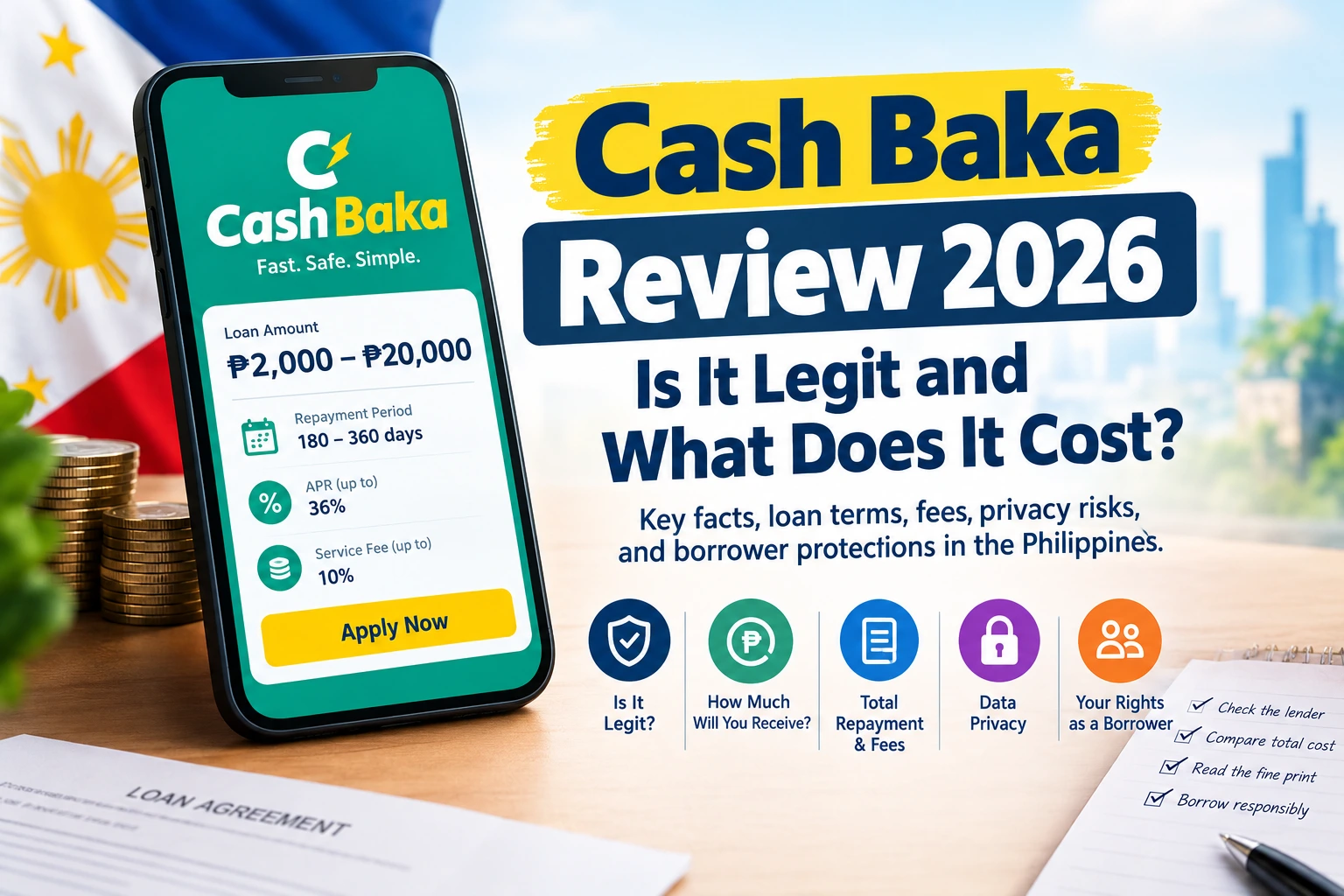
Cash Baka is an online loan application operated by Microdot Lending Corporation, a Philippine lending company listed by the Securities and Exchange Commission (SEC). Its Google Play listing identifies the company, provides its SEC registration number and Certificate of Authority, and advertises loans of ₱2,000 to ₱20,000 with repayment periods of 180 to 360 days. Those details offer a starting point for checking legitimacy, but they do not establish that every offer is affordable or that every application using the Cash Baka name is genuine.
The published pricing deserves particular attention. Cash Baka advertises an annual percentage rate (APR) of up to 36% and a service fee of up to 10%, where applicable. Its own example shows how a ₱2,000 loan can produce only ₱1,800 in net proceeds while leaving the borrower with a stated repayment obligation of ₱2,298.63. The amount received can be lower than the principal the borrower must repay. The actual agreement, including any additional charges and the repayment schedule, must determine whether a particular offer is acceptable.
This review examines Cash Baka’s published loan terms, the operator’s regulatory identity, the arithmetic behind its representative loan example, and the privacy protections applicable to Philippine online lending. It does not claim a hands-on borrowing test, a successful application, or independently verified borrower complaints.
Summary
Cash Baka is listed under Microdot Lending Corporation, SEC registration number CS201951287, with Certificate of Authority number 2921. The SEC’s online lending platform list includes Cash Baka and records that a cease-and-desist order against Microdot Lending Corporation was lifted under SEC En Banc Case No. 09-25-014. This history makes it important to distinguish the company’s current recorded status from any assumption of regulatory endorsement. The app advertises loans of ₱2,000–₱20,000, terms of 180–360 days, an APR of up to 36%, and a service fee of up to 10%. Its sample ₱2,000 loan yields ₱1,800 after a ₱200 fee, with stated repayment of ₱2,298.63. Before accepting an offer, verify the lender, net proceeds, complete repayment schedule, and every contractual charge.
| Borrower question | Current finding | Why it matters |
|---|---|---|
| Is Cash Baka identifiable? | Yes. Its app listing identifies Microdot Lending Corporation. | Confirm the company name against the actual loan agreement. |
| Is it recorded with the SEC? | The SEC’s list of recorded online lending platforms includes Cash Baka. | Recording is not an endorsement of the product or a guarantee of fair treatment. |
| How much can I borrow? | The app advertises ₱2,000–₱20,000. | The actual amount depends on the offer and eligibility assessment. |
| What is the advertised cost? | Maximum APR of 36% and a service fee of up to 10%, where applicable. | The fee may reduce the money received. |
| How much does the example cost? | ₱2,298.63 stated repayment against ₱1,800 net proceeds. | The effective cost relative to cash received is higher than the nominal interest calculation alone suggests. |
| Is approval guaranteed? | No. The app explicitly says applications are subject to assessment. | Do not rely on advertised loan amounts when planning an urgent expense. |
| Is personal data protected? | The listing describes data practices, but actual handling requires separate verification. | Check permissions and the privacy policy before submitting personal information. |
Is Cash Baka a legitimate loan app in the Philippines?
Cash Baka has an identifiable corporate operator and appears on the SEC’s recorded online lending platform list. The operator is Microdot Lending Corporation, with SEC registration number CS201951287 and Certificate of Authority number 2921. These details support identifying the company behind the app, but borrowers should still verify that the application and contract they encounter genuinely belong to that company.
Who operates Cash Baka?
The Google Play listing identifies Microdot Lending Corporation as the developer and operator. It publishes the following company details:
- Legal company name: Microdot Lending Corporation
- SEC registration number: CS201951287
- Certificate of Authority number: 2921
- Online lending platform: Cash Baka
- Official website listed by the developer: cashbaka.net
- Support email listed by the developer: [email protected]
The app’s listing also provides a registered business address in Mandaluyong City and separate developer contact details in Pasig City. Different addresses in a store listing do not by themselves establish wrongdoing, but borrowers should use independently verified corporate information when checking a contract or submitting a complaint.
The developer’s official website is listed as Cash Baka.
What does the SEC record establish?
The SEC’s List of Recorded Online Lending Platforms includes Cash Baka under Microdot Lending Corporation. The record also contains a specific remark: a cease-and-desist order issued against the company was lifted under SEC En Banc Case No. 09-25-014.
That remark is relevant and should not be omitted from a legitimacy assessment. It also should not be misrepresented as proof that the company currently has an active cease-and-desist order: the published entry expressly says the order was lifted.
SEC recording, corporate registration, and authority to operate as a lending company are distinct regulatory concepts. A recorded platform is not automatically SEC-endorsed, and recording does not establish that every loan term is fair, inexpensive, or suitable for a particular borrower.
Verdict on legitimacy: The available official and platform records support identifying Cash Baka with Microdot Lending Corporation. They do not justify an unconditional claim that the service is risk-free. Verify the current company identity, the exact app, and the signed lending documents before proceeding.
What loan amounts, repayment periods, and interest rates does Cash Baka advertise?
Cash Baka’s Google Play listing advertises loans from ₱2,000 to ₱20,000, repayment periods of 180–360 days, a maximum APR of 36%, and a service fee of up to 10%, where applicable. These are published product terms, not a promise that every borrower will qualify for the maximum amount or receive the same rate and fee.
| Product detail | Published information |
|---|---|
| Minimum advertised loan | ₱2,000 |
| Maximum advertised loan | ₱20,000 |
| Repayment period | 180–360 days |
| Maximum advertised APR | 36% |
| Service fee | Up to 10%, where applicable |
| Approval | Subject to eligibility assessment |
| Disbursement timing | No specific time guaranteed |
The app states that applicants may need to be at least 18 years old, provide a valid government-issued ID and active mobile number, and have an eligible bank account or supported disbursement account. These are published eligibility indications, not confirmation that satisfying them guarantees approval.
Are these the current terms for every borrower?
No such conclusion can be drawn from the public listing. It describes the product’s advertised range and a representative calculation, while expressly stating that the actual APR, fees, repayment schedule, and total cost will be presented in the loan agreement and Disclosure Statement.
Live search identified the current Google Play listing, updated on October 12, 2026. However, the public information reviewed does not independently establish the full contractual pricing available to every borrower, nor does it confirm that all applicants receive identical offers.
Treat the displayed loan offer as the relevant starting point. Before accepting, obtain the amount approved, the amount to be disbursed, the due dates, the total repayment amount, and a written breakdown of every deduction and charge.
What does a Cash Baka loan really cost?
The published example produces ₱1,800 in net proceeds from a ₱2,000 principal, while the stated total repayment is ₱2,298.63. The ₱200 service fee is deducted upfront, and the example adds approximately ₱98.63 in interest. The borrower therefore pays ₱498.63 more than the cash actually received.
Cash Baka’s published ₱2,000 loan example
The following figures come from the app’s own representative example, not from an independently completed loan application.
| Cost component | Amount |
|---|---|
| Principal stated in the example | ₱2,000.00 |
| Advertised annual interest rate used in the example | 10% |
| Service fee at 10% | ₱200.00 |
| Net amount disbursed | ₱1,800.00 |
| Calculated interest for 180 days | ₱98.63 |
| Stated total repayment | ₱2,298.63 |
| Total repayment minus net proceeds | ₱498.63 |
Source: Cash Baka’s Google Play listing.
The listing calculates interest using this formula:
Interest = Principal × Annual interest rate × (Days ÷ 365)
For the published example:
₱2,000 × 10% × (180 ÷ 365) = approximately ₱98.63.
The stated total repayment is:
₱2,000 + ₱200 + ₱98.63 = ₱2,298.63.
The net proceeds are:
₱2,000 − ₱200 = ₱1,800.
The borrower consequently incurs a stated cost of ₱498.63 relative to the money received. That represents approximately 27.7% of the ₱1,800 actually disbursed over the stated 180-day period.
This percentage is a simple comparison of the example’s total financing cost with its net proceeds. It is not a substitute for a formally calculated effective annual interest rate, which depends on the timing and structure of repayments.
Why the service fee matters
An upfront deduction changes the amount available to the borrower without necessarily changing the principal shown in the contract.
A person who needs ₱2,000 in cash may receive only ₱1,800 under the published example. If the full ₱2,000 is needed for rent, tuition, medicine, or another fixed expense, the borrower could face a ₱200 shortfall immediately.
The correct comparison is not just the principal against the repayment amount. It is:
Total borrowing cost = Total repayment − Net proceeds received
Use the same calculation with the actual offer before signing.
What about a ₱20,000 loan?
The app advertises a maximum loan amount of ₱20,000, but the public listing does not establish that every applicant can borrow that amount or that every loan attracts the same fee and interest rate.
It would be misleading to multiply the ₱2,000 example by ten and present the result as a guaranteed ₱20,000 offer. Actual pricing, eligibility, deductions, and repayment schedules must come from the individual disclosure statement and contract.
How long does Cash Baka approval and disbursement take?
Cash Baka does not guarantee a specific approval or disbursement time. Its published application process involves creating an account, submitting information, undergoing assessment, reviewing the offer, and accepting the loan agreement. The available listing does not substantiate a guaranteed same-day or instant payout.
The advertised process has seven stages:
- Create a Cash Baka account.
- Complete the required application information.
- Review the available loan options.
- Check the interest, fees, repayment period, and total repayment.
- Submit the application for assessment.
- If approved, review the Disclosure Statement and loan agreement.
- Follow the repayment schedule shown in the app.
An application is not an approval, and an approval is not proof that money has already been disbursed.
The public information reviewed does not establish a verified average processing time, a guaranteed transfer deadline, or a reliable timetable for rejected applications. Applicants should not make time-sensitive financial commitments on the assumption that a loan will arrive by a particular hour.
Is Cash Baka safe for personal information?
The app’s Google Play data-safety section says that the application may collect location, personal information, and four additional data categories. It also indicates that data is encrypted in transit and that users can request deletion. These are developer-provided disclosures on the store listing, not an independent audit of the app’s data handling.
The same listing declares that no data is shared with third parties. That declaration should be read in its stated context: Google Play explains that data-safety information is supplied by developers and may change. It should not be treated as independent proof that no information is ever processed by service providers or other parties under applicable arrangements.
What should applicants check before granting permissions?
Review the permission requests individually. Ask whether each permission is necessary for identity verification, fraud prevention, credit assessment, or another clearly explained lending purpose.
The Philippine National Privacy Commission (NPC), together with other government agencies, reiterated in a March 2026 public advisory that unnecessary app permissions and excessive or unauthorized processing of personal information are prohibited. The advisory specifically addresses the use of borrowers’ contact lists and collection practices that involve contacting people who were not designated as guarantors.
Under the applicable Philippine privacy framework, online lenders cannot simply treat access to a borrower’s entire contact list as unrestricted permission to pursue repayment through friends, relatives, or colleagues. The NPC’s guidance explains that contacting people on a borrower’s contact list for debt collection is prohibited unless they fall within the applicable guarantor exception.
Before applying:
- Read the privacy policy linked from the app’s official listing.
- Check which data categories the app requests and why.
- Do not assume that granting every phone permission is necessary to qualify.
- Save the privacy policy and the loan disclosure presented during application.
- Keep screenshots of unexpected permission requests or questionable collection messages.
- Report suspected misuse of personal information to the appropriate Philippine authority.
These precautions apply regardless of whether the lender has the necessary corporate and lending credentials. Regulatory status does not remove a borrower’s privacy rights.
What happens if you pay Cash Baka late?
The app states that late or missed payments may result in charges under the loan agreement and applicable SEC guidelines. The public listing does not provide enough information to establish a universal late-payment amount or calculate the precise consequences of a missed installment for every borrower.
Before accepting a loan, look for the following provisions in the Disclosure Statement and agreement:
- The exact due dates and payment frequency.
- The amount of each scheduled payment.
- Any late-payment charge and how it is calculated.
- Whether additional charges can accrue after a missed payment.
- How payments are allocated between fees, interest, and principal.
- The process for requesting a payment arrangement.
- The lender’s official channels for reporting an incorrect balance.
Do not rely on a general statement that charges will follow SEC guidelines. The contract must explain the obligations attached to the particular loan, and the lender must comply with applicable rules.
Can a lender contact your friends or relatives over an unpaid loan?
Philippine rules restrict debt-collection practices and the use of personal information. The March 2026 joint public advisory from the Department of Information and Communications Technology, the NPC, and the SEC reiterates that unnecessary processing of personal information and unauthorized contact-list use are prohibited. It also addresses harassment, intimidation, public shaming, and collection outside the permitted guarantor arrangements.
A borrower should distinguish lawful efforts to collect a debt from threats, public humiliation, or unauthorized disclosure of personal information. Preserve messages, call records, payment receipts, and relevant screenshots if collection conduct appears improper.
A complaint should identify the lender and provide specific evidence. An unpaid debt should not automatically be treated as a criminal offense simply because a collection agent threatens legal action; the actual facts and applicable law determine whether any separate offense exists.
What do borrower reviews and complaints say about Cash Baka?
The available research does not establish a reliable pattern of current Cash Baka borrower complaints. The Google Play listing confirms the developer’s identity and published loan terms, but the material reviewed does not provide sufficient verified complaint data to quantify borrower satisfaction, collection disputes, application failures, or disbursement problems.
This limitation matters. A handful of negative reviews would not establish that most borrowers experience the same problem. Likewise, the absence of verified complaints in the sources reviewed would not prove that the lending experience is consistently satisfactory.
A useful complaint assessment would separate four issues:
| Complaint category | Evidence to look for | What it would establish |
|---|---|---|
| Unexpected charges | Loan disclosure, contract, and payment records | Whether the amount charged differs from the agreed terms |
| Delayed disbursement | Application status, approval notice, and transaction records | Whether a specific transfer was delayed |
| Collection conduct | Messages, call logs, and other documented evidence | Whether particular collection actions may violate applicable rules |
| Privacy concerns | Permission records, privacy disclosures, and evidence of unauthorized processing | Whether personal information may have been improperly accessed or disclosed |
Live searches did not establish a sufficiently reliable, independently verified body of recent Cash Baka-specific borrower experiences to support a definitive complaint verdict. This review therefore does not attribute particular allegations to Cash Baka or treat individual anecdotes as representative of its entire customer base.
Prospective borrowers can check the latest reviews on the Cash Baka Google Play listing. Give more weight to detailed accounts that describe dates, contractual terms, and documented outcomes than to unsupported claims or generic praise.
Cash Baka pros and cons
The following assessment is based on the published product information and available regulatory records, rather than a personal borrowing test.
Pros
- Identifiable operator: The app names Microdot Lending Corporation and publishes its SEC registration and Certificate of Authority numbers.
- Recorded lending platform: Cash Baka appears on the SEC’s list of recorded online lending platforms. The record also discloses that a previous cease-and-desist order against the company was lifted.
- Published pricing information: The app lists an advertised loan range, repayment period, maximum APR, service-fee ceiling, and representative repayment calculation.
- Disclosure before acceptance: The developer says borrowers can review the applicable charges and repayment schedule in the Disclosure Statement and loan agreement before accepting an offer.
Cons and limitations
- Upfront deductions can reduce the cash received: The published ₱2,000 example deducts a ₱200 service fee, leaving ₱1,800 available to the borrower.
- The maximum loan is not guaranteed: The advertised ₱20,000 ceiling is subject to eligibility assessment.
- The actual offer may differ from the example: The public listing does not establish the precise rate, fees, or repayment schedule every applicant will receive.
- Processing time is not guaranteed: The app expressly declines to promise a specific approval amount or disbursement time.
- Independent complaint evidence remains limited: The available research does not establish a reliable current picture of borrower satisfaction or the frequency of collection and privacy disputes.
How does Cash Baka compare with Philippine lending alternatives?
A useful comparison should focus on the actual amount received, total repayment, lender identity, and the contractual consequences of late payment—not simply the maximum advertised loan.
Cash Baka’s published range of ₱2,000–₱20,000 and its 180–360-day repayment period provide a starting point for comparing offers. Its representative example also makes the effect of an upfront service fee visible.
Before choosing another lender, apply the same checks:
| Comparison factor | What to verify |
|---|---|
| Legal identity | Exact lending company name and current regulatory credentials |
| Net proceeds | Amount actually credited after deductions |
| Total cost | Total repayment minus the cash received |
| Repayment structure | Number of installments, payment frequency, and due dates |
| Late-payment exposure | Contractual charges and permitted collection practices |
| Data privacy | Requested permissions, privacy policy, and complaint procedures |
| Disbursement | Whether any claimed transfer time is explicitly supported |
Do not assume that a competitor is safer because it advertises a lower interest rate. A lower headline rate can be offset by fees, while a longer repayment period can increase the total amount paid. Compare complete written offers using the same principal, approximate borrowing period, and calculation method.
Frequently asked questions
Is Cash Baka SEC-registered?
Cash Baka appears on the SEC’s list of recorded online lending platforms under Microdot Lending Corporation, SEC registration number CS201951287. Its Google Play listing also identifies Certificate of Authority number 2921. These records support identification of the operator, but SEC recording should not be interpreted as an endorsement of the loan product.
How much can I borrow from Cash Baka?
The app advertises loans ranging from ₱2,000 to ₱20,000, with repayment periods of 180–360 days. The actual amount and terms depend on eligibility assessment and the individual offer.
What is Cash Baka’s interest rate?
The published listing advertises a maximum APR of 36% and provides a representative example using a 10% annual interest rate. The example’s rate is not a guarantee that every applicant will receive the same pricing. Review the APR and complete fee breakdown in the actual Disclosure Statement.
Does Cash Baka guarantee instant approval?
No. The app states that applications are subject to assessment and does not guarantee approval, a particular loan amount, or a specific disbursement time.
Can Cash Baka contact people in my phone’s contact list if I miss a payment?
Philippine privacy and lending rules restrict the unauthorized use of contact lists and prohibit contacting people outside the applicable permitted arrangements for debt collection. The NPC and other government agencies reiterated these protections in their March 2026 advisory. If you suspect a violation, preserve the evidence and consider reporting it to the relevant authority.
Final verdict: Should you use Cash Baka?
Cash Baka has an identifiable corporate operator, a published set of loan parameters, and an entry on the SEC’s recorded online lending platform list. Those are meaningful verification points. They do not settle the more important question: whether the specific loan offer is affordable and whether its terms are suitable for your circumstances.
The strongest practical warning comes from the app’s own example. A borrower receives ₱1,800 but is shown a total repayment of ₱2,298.63. The resulting ₱498.63 cost is substantially more than the interest figure alone suggests because the calculation also includes the upfront service fee.
Use four tests before accepting a Cash Baka offer:
- Affordability: Can you meet every scheduled payment from reliable income without borrowing again to cover ordinary expenses?
- Net proceeds: Does the amount credited cover the expense for which you need the loan?
- Late-payment exposure: Do you understand the contractual charges and the lender’s permitted collection practices?
- Legal identity: Does the agreement name Microdot Lending Corporation, and do its details match the verified lending platform?
If any of these checks fails, do not accept the offer until the issue is resolved. If the amount received is too small or the repayment schedule would strain your budget, compare other documented offers or consider a less expensive source of funds.
The available evidence supports identifying Cash Baka’s operator and understanding its published pricing. It does not justify calling the product risk-free, declaring every offer affordable, or claiming that borrowers will receive a particular approval outcome. The decision should rest on the actual written contract, the net amount received, and the total amount you must repay.
References
- Securities and Exchange Commission Philippines. List of Recorded Online Lending Platforms. Official SEC list identifying Cash Baka under Microdot Lending Corporation and noting the lifting of the company’s cease-and-desist order. SEC List of Recorded Online Lending Platforms
- Google Play. Cash Baka — Microdot Lending Corp. Product listing containing advertised loan amounts, repayment periods, APR, service fee, representative loan calculation, company details, and data-safety disclosures. Cash Baka on Google Play
- National Privacy Commission, Department of Information and Communications Technology, and Securities and Exchange Commission. Public Advisory on Online Lending Platforms. March 2026. Government guidance on unnecessary permissions, unauthorized contact-list processing, harassment, and debt collection. Joint Government Advisory on Online Lending Platforms
- National Privacy Commission. NPC Amends Circular on the Processing of Personal Data for Loan-Related Transactions. Guidance concerning character references, guarantors, and restrictions on contact-list use. National Privacy Commission Guidance