Last Updated on 10/09/2026 by Nicole Alba
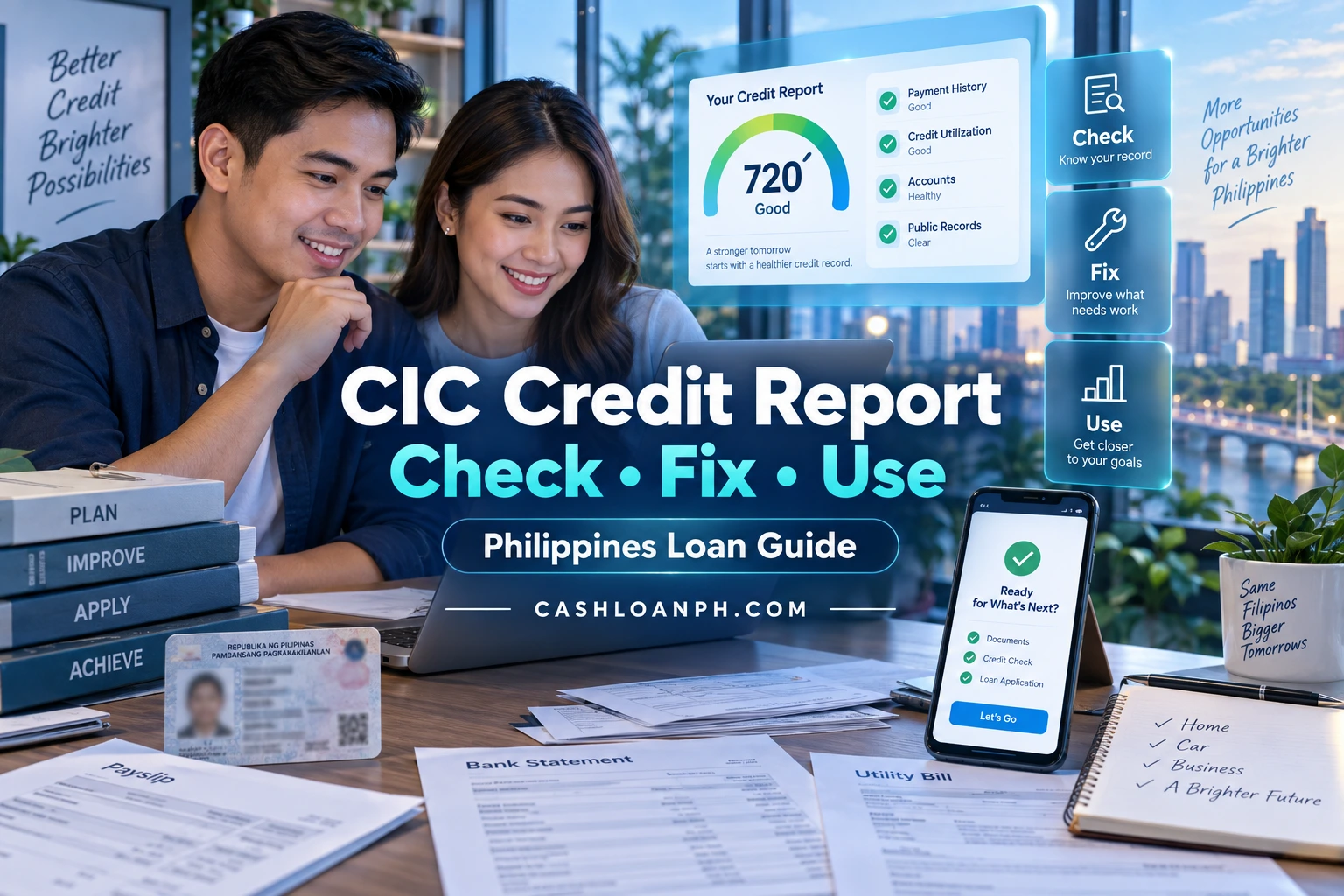
Getting rejected for a personal loan, credit card, motorcycle financing, or online cash loan can feel confusing when the lender gives you little more than “failed credit evaluation.” Many Filipino borrowers immediately assume they have been permanently blacklisted. That is usually the wrong way to think about it.
Your CIC credit report is a record, not a lifetime verdict. It can contain good payment history as well as late payments, outstanding balances, settled accounts, and other credit information submitted by participating institutions. CIC itself is the Philippines’ public credit registry under Republic Act No. 9510.
And if you are worried because you already have unpaid debt, ordinary nonpayment of a civil debt does not by itself mean imprisonment. Article III, Section 20 of the 1987 Constitution states that no person shall be imprisoned for debt or nonpayment of a poll tax. Fraud, bouncing-check offenses, or other independently criminal conduct are different legal issues.
For this 2026 review, I cross-checked CIC’s consumer-access instructions, dispute system, September 2026 lists of participating institutions, data-privacy rules, and regulator complaint channels. One operational issue is worth noting immediately: current CIC pages themselves show different promotional prices for one credit-report channel, so borrowers should verify the final fee shown by the provider before paying.
| Borrower question | Practical answer for 2026 |
|---|---|
| Is CIC a government credit registry? | Yes. CIC is the Philippines’ sole public credit registry established under RA 9510. |
| Does CIC itself give everyone a credit score? | No. Accredited Special Accessing Entities may provide value-added scores based partly on CIC data. |
| Can you request your own report? | Yes. Current channels include Lista PH, CreditMo, CRIF Philippines, and participating CIC D2C Accessing Entities. |
| Can a lender see it whenever it wants? | Access is subject to CIC rules, legitimate purpose, and authorization requirements. |
| Can incorrect information be challenged? | Yes. Disputes are free. A recent report and its 14-digit TRN are normally required for CIC’s online dispute process. |
| Does paying a bad loan erase it immediately? | No. Settled negative information may remain for a statutory period, though the account must be updated to reflect settlement. |
| Does a CIC record guarantee approval or rejection? | No. Lenders combine credit information with affordability, income, fraud, KYC, internal risk rules, and other underwriting factors. |
| Is there a universal Philippine credit-score range? | No single CIC-issued scoring scale exists. Score methodology can vary by accredited bureau or lender. |
What exactly is a CIC credit report in the Philippines in 2026?
A CIC credit report is a consolidated record of credit-related information submitted to the Credit Information Corporation. It helps lenders evaluate repayment history and credit exposure, but it is not itself an approval or rejection decision.
The Credit Information Corporation was created under the Credit Information System Act of 2008, or Republic Act No. 9510. Its job is to receive and consolidate basic credit information and make standardized credit information available under controlled conditions.
The system is much broader than an informal “bad borrower list.” Both positive and negative credit information are part of the legal framework.
If you consistently pay an installment loan on time, that positive behavior can form part of your credit history. If you default, become delinquent, or leave an obligation unsettled, that can also be reflected.
What information can appear inside your CIC credit report?
A CIC report can contain identifying information, credit accounts, loan amounts, outstanding obligations, payment-related information, and other authorized credit data supplied by reporting institutions.
CIC says consumer reports may contain information such as your name, TIN, SSS or GSIS number, residence, employer or business, loan contracts, utility subscriptions, and other obligations CIC is authorized to collect.
The implementing rules also describe an exposure profile that can include the type of obligation, original loan amount, outstanding balance, repayment structure, collateral information where applicable, account opening information, and remaining obligation.
A useful privacy distinction is often missed: confidential bank-deposit information is not automatically part of basic credit data. RA 9510 expressly protects deposit information covered by Philippine bank-secrecy laws unless an applicable written waiver exists.
Is a CIC credit report the same thing as a CIC credit score?
No. CIC maintains the underlying public credit registry; it does not issue the consumer credit score itself. Accredited Special Accessing Entities can provide scoring and other analytical products using CIC information.
This distinction matters because borrowers often say, “My CIC score is low,” when what they are actually viewing may be a score generated by CIBI, CRIF, Island Credit Solutions, or another accredited credit bureau.
CIC’s 2026 information lists six accredited Special Accessing Entities: Advintel, CIBI Information, CRIF, Island Credit Solutions, Juanscore, and TransUnion Philippines. Their products and scoring methodologies need not be identical.
That is why you should not assume that a score displayed in one service has the same scale, cut-off, or underwriting meaning at every Philippine lender.
How can you get your CIC credit report in 2026?
You can currently obtain CIC credit information through several authorized channels, including Lista PH, CreditMo, CRIF Philippines, and participating Accessing Entities under CIC’s Direct-to-Consumer program. You do not normally need to visit CIC’s Makati office personally.
This is one area where old articles are particularly misleading. Some still describe discontinued app arrangements or imply that there is only one place to obtain the report.
Which CIC credit-report access options are available now?
The four channels currently identified by CIC are Lista PH, CreditMo, CRIF Philippines, and CIC’s D2C program through participating Accessing Entities. Fees and whether a score is included can differ.
CIC currently identifies:
- Lista PH, in partnership with CIBI Information;
- CreditMo, in partnership with Island Credit Solutions;
- CRIF Philippines, which accepts credit-report requests through its published contact channel; and
- Direct-to-Consumer through Accessing Entities, where authorized financial institutions can issue individual CIC credit reports.
There is an important pricing warning here.
CIC’s dedicated Lista PH page currently states ₱199 per request, while another live CIC consumer-information page states ₱299 for a limited time for Lista PH. The same general page lists CreditMo at ₱45 for a limited time. Because those official CIC pages are inconsistent, I would not budget based on an article screenshot or an old Facebook post. Check the price shown inside the official provider channel immediately before payment.
That kind of small discrepancy matters to financially stressed borrowers. A trustworthy credit article should flag it rather than quietly choose whichever number looks better.
What should you prepare before requesting your CIC report?
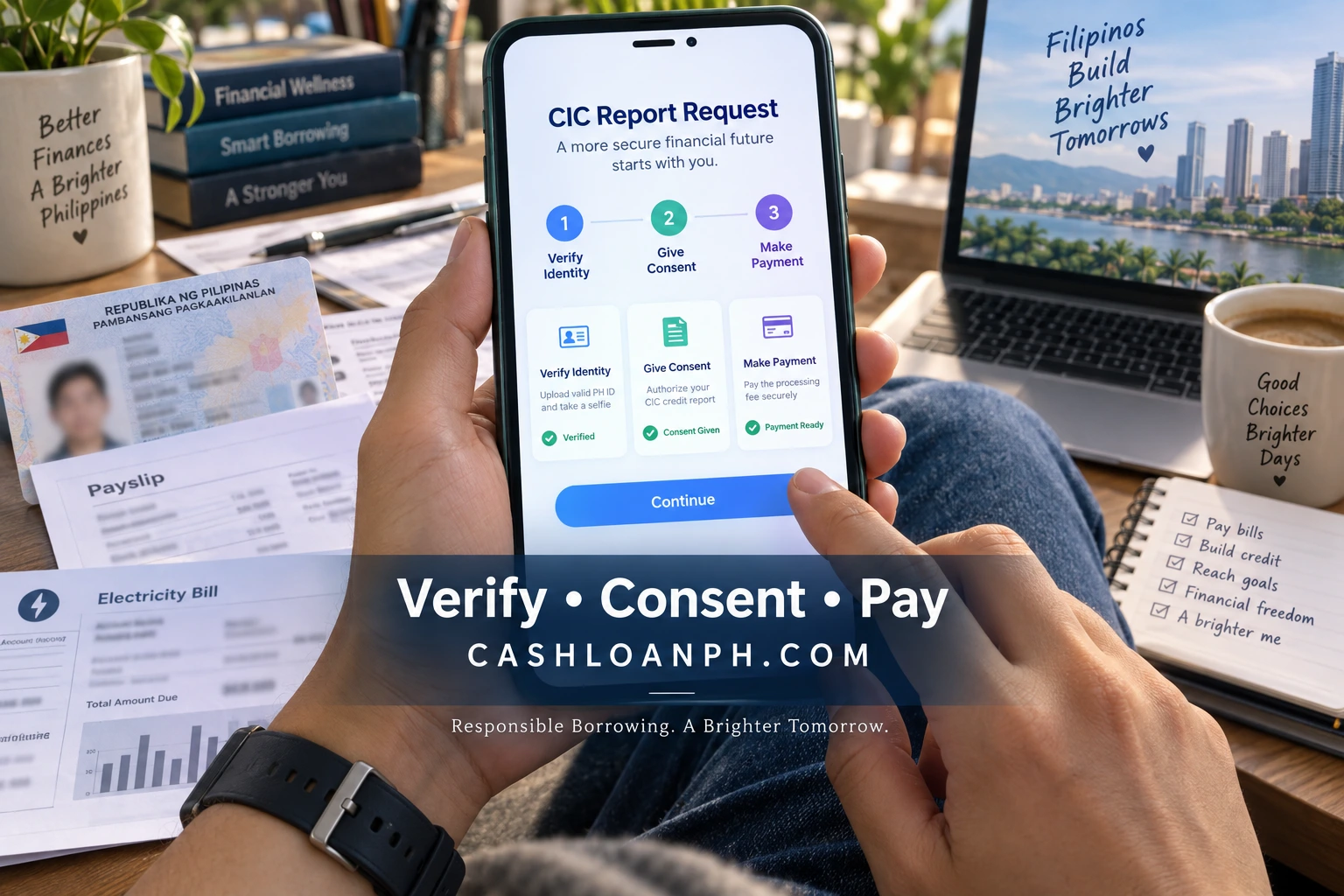
Expect identity verification, one or more valid government IDs, consent to retrieve the CIC record, and a provider-specific service fee. Online identity verification may include a KYC video call.
CIC says online and email-based D2C requests can require copies of one or two valid government IDs. Borrowers are also asked to execute a request or consent form allowing the participating entity to retrieve the CIC report.
CIC’s consumer guidance says identity verification through credit bureaus is conducted online and can include a video call for KYC compliance.
This can create very ordinary friction: an ID photo may be unreadable, your legal name may not match an old loan record exactly, or the information submitted years ago may use a previous address or surname.
I would not interpret a failed identity match as evidence of “bad credit.” Treat it first as an identity-resolution problem and contact the report provider.
How do Philippine lenders actually use a CIC credit report when reviewing a loan?
A lender can use CIC data as one component of underwriting, but approval is usually based on much more than the report alone. Income capacity, existing debt, application consistency, identity risk, lender policy, and internal scoring can all affect the decision.
This explains a frustrating situation borrowers often encounter: one lender rejects an application while another accepts the same person.
A credit report gives the lender information. The lender still decides what risk it is willing to accept.
Which parts of your credit history are likely to concern a lender most?
Recent delinquency, unpaid balances, repeated repayment problems, high existing obligations, and inconsistent credit behavior can raise underwriting concerns. Positive repayment history can work in the opposite direction.
From a risk desk’s perspective, the important question is not simply, “Has this person ever borrowed?”
It is closer to:
Can the applicant handle another monthly obligation without becoming overextended?
A ₱5,000 old settled loan and a ₱100,000 currently delinquent account do not create the same risk picture. Neither does one isolated late payment carry the same meaning as repeated severe delinquency across several lenders.
CIC itself also warns that applying for several loans or credit cards at once can hurt a credit score. The exact effect depends on the score provider and lender model, so there is no honest universal formula such as “three applications reduce your score by 50 points.”
How can gig workers and self-employed borrowers be assessed differently?
Borrowers without traditional payslips may need to establish repayment capacity through alternative evidence such as bank activity, e-wallet flows, invoices, platform earnings, business records, or recurring cash receipts, depending on the lender.
This is where credit history can become particularly valuable.
A salaried employee may submit a Certificate of Employment and payslips. A Grab driver, freelance designer, online seller, farmer, or small sari-sari store owner may have genuine earning capacity without those conventional documents.
In underwriting practice, lenders may compensate by looking more closely at cash-flow consistency, existing debt, repayment history, account activity, and the stability of the borrower’s income source. Requirements vary sharply between institutions.
A thin credit file therefore does not automatically mean “bad borrower.” It can simply mean that the institution has less verified information with which to price the risk.
What should you do if your CIC credit report contains an error?
Do not ignore an incorrect account, balance, status, or personal detail. CIC provides a free Online Dispute Resolution process for incorrect, outdated, incomplete, or missing information.
Errors matter because a lender’s automated system may process what is in the data feed, not the story you intended to tell.
Which CIC credit-report problems can you formally dispute?
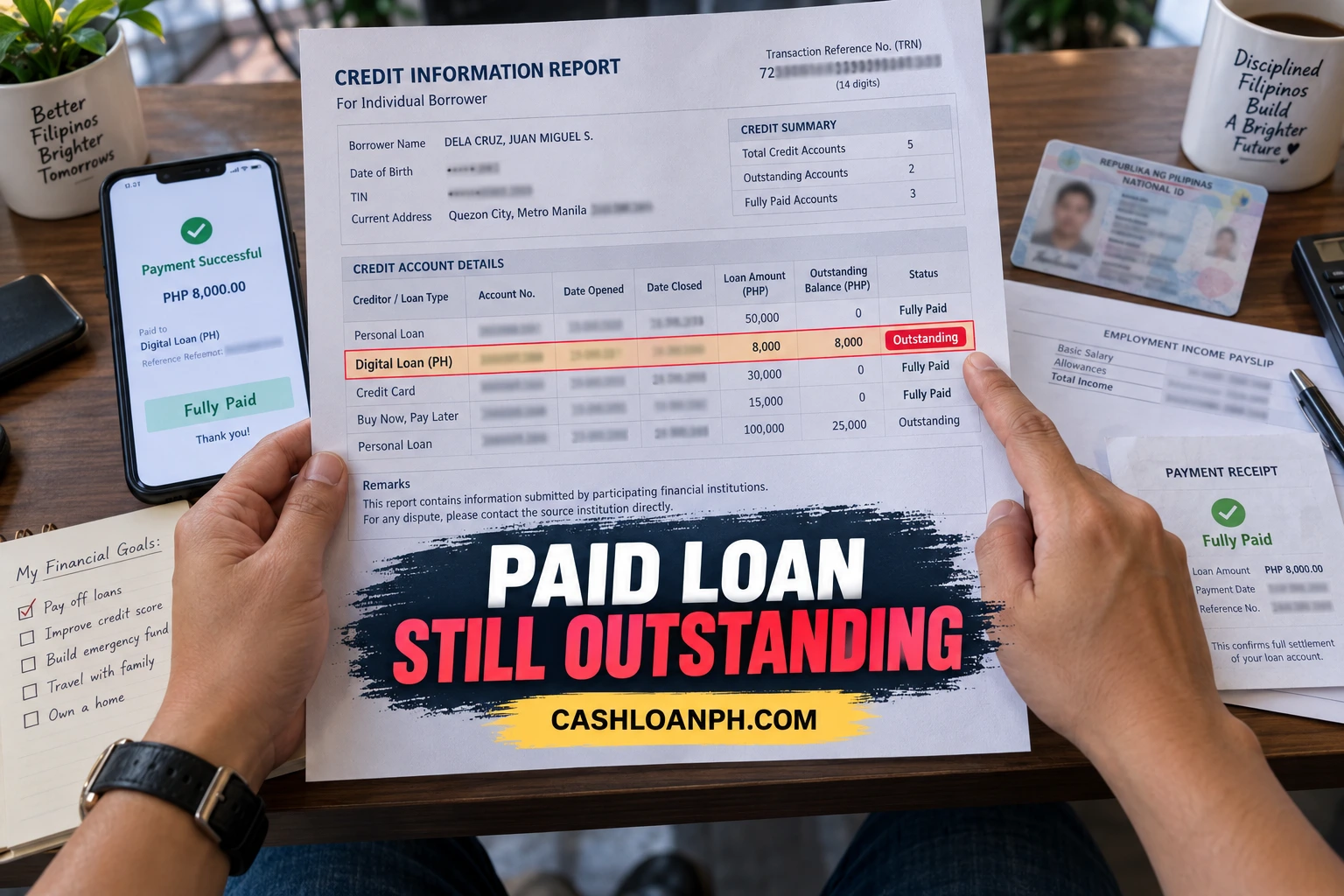
CIC specifically allows disputes involving incorrect or outdated information, missing records from CIC-registered lenders, fully paid loans still shown as outstanding, and qualifying old negative information.
To use the CIC Online Dispute Resolution System, CIC currently says you need the 14-digit Transaction Reference Number, or TRN, from the report, and the report should generally be no more than 30 days old when the dispute is filed.
If your report does not show the TRN, CIC advises contacting the Accessing Entity or credit-report provider that issued it.
How quickly should a CIC credit-report dispute be investigated?
The CISA implementing rules state that CIC shall investigate and verify disputed information within five working days from receipt of the complaint, although correction can still depend on verification and data supplied by the reporting institution.
Do not delete your evidence after filing.
Keep payment receipts, bank or e-wallet transaction confirmations, certificates of full payment, settlement letters, loan account numbers, screenshots, email exchanges, and your dispute reference.
A common borrower mistake is sending only a screenshot saying “paid” without enough information for the lender to match the original account. The more cleanly your evidence links your identity, account, amount, and settlement date, the easier the verification becomes.
How long can negative information stay on a CIC credit report after you pay?
RA 9510 says negative credit information should remain for no more than three years after it has been rectified through payment, liquidation, qualifying settlement, or an applicable court decision – not simply three years from the first missed payment.
That distinction is very important.
Imagine you stopped paying a loan in 2023 but settled it only in July 2026. It would be unsafe to assume that the negative history must disappear merely because the original delinquency began three years ago.
The statutory language ties the retention period to rectification.
The law also states that negative information should be corrected and updated within 15 days from payment, liquidation, or settlement. Separately, the implementing rules require participating entities to provide regular updates within prescribed reporting periods.
In practical terms, “I paid yesterday but the old balance is still visible today” does not automatically prove a reporting violation. If the account remains incorrectly shown after the relevant reporting period, document it and use CIC’s dispute process.
Does the CIC maintain a permanent credit blacklist of Filipino borrowers?
No official CIC rule creates a permanent borrower blacklist in which one missed loan automatically bans a person from future credit. CIC maintains credit information; lenders make their own approval decisions.
This is one of the most persistent myths in Philippine digital lending.
A lender may decline you because of recent delinquency. Another may approve only a smaller amount. Another may ask for additional documentation. A riskier lender may approve but price the loan differently within applicable law and its underwriting policy.
None of these outcomes means CIC itself has issued a universal lifetime ban.
This distinction also explains why paying someone who claims they can “remove your name from CIC” should raise suspicion. Legitimate corrections are handled through proper reporting and dispute procedures, not secret payments to an agent.
Can a loan remain visible after you have completely paid it?
Yes. A legitimate historical account may remain visible even after settlement, but its status should accurately reflect the payment or closure rather than continue showing an unpaid obligation.
A clean credit history does not mean a blank credit history.
For many lenders, a previously borrowed-and-repaid account can be more informative than having no borrowing history at all because it shows actual repayment behavior.
The problem arises when a report says an obligation remains outstanding even though it has been fully settled. CIC expressly identifies fully paid loans still appearing as outstanding as a type of information that can be disputed through its online system.
Can checking your own CIC credit report damage your credit score?
CIC warns about making multiple new credit applications, but its consumer guidance does not say that merely obtaining your own report automatically lowers your score. Do not confuse reviewing your record with repeatedly applying for new debt.
That distinction is useful when preparing for a major application.
Rather than applying blindly to six lenders to see who accepts you, checking your available credit information first may help you identify errors, outstanding balances, or forgotten obligations before another lender evaluates you.
You should still avoid assuming every bureau treats every inquiry identically. Score methodologies are proprietary and can differ.
Who is legally allowed to access your CIC credit information?
Credit information is confidential. CIC states that access is limited to authorized parties and legitimate purposes, with borrower authorization requirements built into the framework.
RA 9510 requires CIC, submitting entities, accessing entities, special accessing entities, and related authorized entities to keep credit information confidential and use it for the declared purpose.
CIC also states that a report authorized for a specific transaction cannot simply be recycled, passed around, sold, or reused for unrelated purposes once that authorized transaction is finished.
What privacy rights matter when lenders use automated credit scoring?
Philippine privacy rules give consumers rights relating to information, access, correction, and transparency about automated processing and profiling involving their personal data.
The National Privacy Commission says individuals have the right to be informed when their information is processed, including the existence of automated decision-making or profiling and meaningful information about how such processing affects them.
NPC rules also treat automated decision-making and profiling as regulated personal-data processing activities.
For digital lending, this matters because an app should not become a black box that harvests excessive information simply because the borrower needs cash.
A March 2026 joint government advisory again warned online lenders against unnecessary, excessive, or disproportionate processing of borrower data, particularly indiscriminate access to contact lists and the use of personal information for harassment.
Can you ask why a lender rejected you after using CIC data?
Yes, in the specific circumstance described by CIC rules: when the rejection relied on a CIC credit report or CIC credit data, the submitting entity has an obligation to disclose the reason for rejection.
This does not mean the lender must reveal its entire proprietary underwriting algorithm.
It does mean borrowers should not automatically accept vague intimidation such as “CIC blacklisted you forever” as an explanation.
Ask clearly whether CIC information was used and what adverse information affected the decision.
How should you improve your credit position before applying again?
Fix factual errors first, bring overdue accounts under control, reduce unnecessary new applications, and apply only for debt you can realistically service. Credit repair is usually a behavior-and-time process, not a paid shortcut.
Start with accuracy.
If the report contains somebody else’s account or an unpaid status on a loan you settled, improving financial behavior will not fix the data error. Dispute the record.
Then look at affordability. Reducing existing debt can improve the amount of income available for another obligation. Avoid borrowing from one app solely to make the minimum payment on another unless you have genuinely calculated that the refinancing lowers your total cost and is sustainable.
Next, give clean repayment behavior time to appear in the reporting system.
CISA requires reporting of both positive and negative information. That means responsible repayment is not wasted simply because you once had a problem account.
For borrowers coming out of a debt cycle, the safest target is not “How do I get approved tomorrow?” It is “How do I reach the point where the next payment fits my real cash flow?”
What should you do if a collector threatens to jail you because of your CIC record?
A CIC entry does not create a criminal sentence, and ordinary debt itself is not punishable by imprisonment under Article III, Section 20 of the Philippine Constitution. Threats should be separated from legitimate collection and legal notices.
Do not interpret this as permission to ignore valid obligations. Creditors can pursue lawful collection remedies, and particular conduct surrounding a transaction can raise separate legal issues.
What debt collectors cannot legitimately do is invent powers they do not have.
The 2026 joint advisory from the NPC, SEC, and DICT reiterates restrictions against harassment, threats, excessive use of personal data, public shaming, and contacting people from a borrower’s contact list who are not authorized guarantors for debt-collection purposes.
If the institution is a BSP-supervised bank or financial institution, complain first through its own consumer-assistance channel; unresolved issues may then be escalated through the BSP Consumer Assistance Mechanism.
For SEC-regulated lending or financing companies, the SEC maintains complaint and monitoring channels for the sector.
If your personal data is unlawfully used or disclosed, the NPC also provides a formal complaint process.
What other CIC credit-report questions should Filipino borrowers ask in 2026?
The most useful questions concern missing records, thin credit files, closed lenders, foreign residents, consent, and what information the report does not contain – not just whether a score is “good” or “bad.”
What does it mean if you have little or no CIC credit history?
A thin or missing credit record does not automatically mean poor credit. It may mean there is insufficient matched credit history from institutions submitting usable information to CIC.
This can affect first-time borrowers, people who previously borrowed informally, or consumers whose past credit providers were not yet properly represented in the registry.
Do not pay a fixer to create a fake credit history. Build legitimate records through lawful credit products you can afford.
Can a foreign national living in the Philippines request a CIC report?
Yes. CIC says a foreigner residing in the Philippines may request a report if they have existing or past loans with Philippine banks or other financial institutions.
Identity matching and available records will still determine what information can be retrieved.
What happens if your old lender was shut down or lost its SEC license?
Closure of a lending company does not automatically erase legitimate credit obligations or its reporting responsibilities.
After the SEC revoked the registrations and lending licenses of hundreds of companies in 2025, CIC specifically reminded affected lending and financing companies that their credit-data reporting duties continued.
Do not assume that “the app disappeared” means your debt record automatically disappears.
Can your savings-account balance appear in a normal CIC report?
Confidential bank deposits are not automatically part of CIC basic credit data. RA 9510 expressly recognizes Philippine bank-secrecy protections absent the applicable written waiver.
A lender may separately ask you to provide bank statements as evidence of income or cash flow. That is different from saying CIC freely exposes your bank deposits.
How can you tell whether a lender actually participates in CIC?
CIC publishes current lists of Submitting Entities and Accessing Entities, so borrowers do not have to rely solely on a lender’s marketing claims.
As of September 8, 2026, CIC had published updated lists of institutions authorized to access CIC information, while its 2026 submitting-entity records continued to be updated through August.
That verification is especially useful before trusting an unfamiliar online lender that claims it “reports directly to CIC.”
What is the safest way to use your CIC credit report before borrowing again?
Treat the report as a diagnostic tool: verify the data, correct errors, examine current obligations, and only then decide whether another loan is affordable. Do not chase approval by submitting applications everywhere at once.
Your credit report is most useful before a crisis, but it can still help when you are already struggling.
If you find an error, document and dispute it.
If the negative information is accurate, focus on resolving the underlying obligation and preserving proof of payment.
If the record is clean but lenders still decline you, examine income stability, debt-to-income pressure, identification issues, application inconsistencies, and lender-specific eligibility rules rather than assuming CIC is secretly blocking you.
And if you need to borrow again, compare the total amount you must repay, not merely the advertised daily rate or the amount landing in your e-wallet.
The goal is not to game a score.
The goal is to create a credit record that accurately reflects your real financial behavior – and to avoid accepting debt that puts you back into the same cycle a month later.
References
- Credit Information Corporation
Organization: Credit Information Corporation
Resource: Credit Information System Act, Republic Act No. 9510
URL: Official RA 9510 resource - Credit Information Corporation
Organization: Credit Information Corporation
Resource: About Your CIC Credit Report
URL: Official CIC credit-report information - Credit Information Corporation
Organization: Credit Information Corporation
Resource: Getting Your Credit Report With Credit Score
URL: Official CIC consumer access guidance - Credit Information Corporation
Organization: Credit Information Corporation
Resource: Online Dispute Resolution Process
URL: Official CIC dispute process - Credit Information Corporation
Organization: Credit Information Corporation
Resource: Special Accessing Entities
URL: Official CIC accredited SAE list - Bangko Sentral ng Pilipinas
Organization: BSP
Resource: Consumer Assistance Channels and Chatbot
URL: BSP Consumer Assistance Mechanism - Securities and Exchange Commission
Organization: SEC Philippines
Resource: Lending and Financing Company Advisories and Notices
URL: SEC lending and financing advisories - National Privacy Commission
Organization: NPC Philippines
Resource: Data Privacy Act of 2012
URL: Official Data Privacy Act resource - National Privacy Commission
Organization: NPC Philippines
Resource: Joint Advisory on Online Lending Platforms
URL: Official 2026 online lending privacy advisory - Department of Trade and Industry
Organization: DTI Philippines
Resource: Republic Act No. 7394 – Consumer Act of the Philippines
URL: DTI Consumer Act resource

![EastWest Bank Exchange Rate Today [Latest Update] October 2026](https://cashloanph.com/wp-content/uploads/2023/05/eastwest-bank-exchange-rate-today-cashloanph-438x246.jpg "EastWest Bank Exchange Rate Today [Latest Update] October 2026")