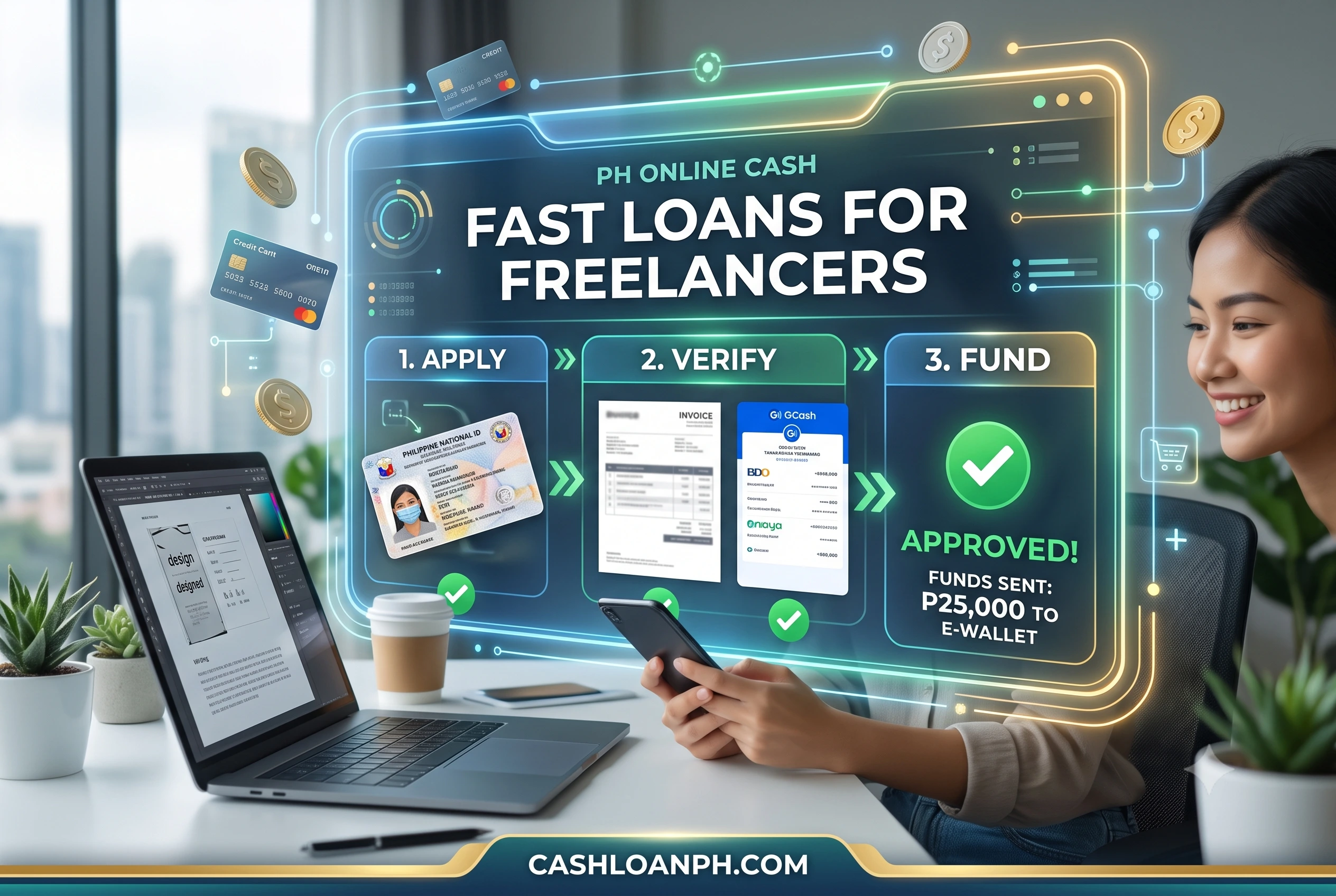
Last Updated on 25/07/2026 by Nicole Alba
You just finished a grueling 40-hour design sprint, or perhaps you just completed fifty rides in the pouring rain. Your client’s payment is delayed by two weeks, but your car needs repairs right now. You open a digital credit app, input your details, and hit a massive wall: the very first requirement is a corporate company ID or a standard HR payslip. The sinking feeling of being invisible to the financial system kicks in. You are earning money—sometimes significantly more than corporate employees—yet the algorithms immediately flag you as “high risk.”
As a fintech analyst who has spent over a decade auditing and testing Philippine digital lending systems from the inside, I see this exact friction point every single day. The system is structurally biased toward traditional nine-to-five jobs, but you can navigate it. Unpaid bills and temporary cash shortages are incredibly stressful, but being rejected by an automated bot does not mean you are out of options. Let us break down exactly how modern underwriting evaluates non-traditional workers so you can get funded without a conventional employer.
Summary: Freelancers and gig workers can secure fast cash loan online approvals by shifting their focus from traditional bank requirements to cash-flow-based fintech platforms. While standard banks require regular payslips and company IDs, digital lenders in the Philippines now utilize open banking APIs and alternative data—such as e-wallet transaction history, Upwork invoices, or Grab partner dashboards—to calculate variable income. To bypass automated rejections, consolidate your varied client payments into a single verified bank account to build a consistent internal credit score. Understanding how algorithms assess gross versus net gig income is the secret to unlocking automated approvals.
Key Takeaways for Gig Worker Loan Approvals
| Lending Platform | Ideal Borrower Profile | Primary Verification Method | Approval Speed |
| Tala | Independent contractors lacking bank accounts | App behavioral data, ID scan | Under 10 minutes |
| GCash (GLoan) | Freelancers paid via e-wallets | Internal GScore (transaction volume) | Instant (if pre-qualified) |
| BillEase | Upwork/Fiverr creatives needing hardware | Open banking (linked bank account) | 1 to 24 hours |
| Maya Credit | Gig workers paying bills digitally | Maya Trust Score (cash-in regularity) | Instant (if pre-qualified) |
Why Do Automated Loan Apps Reject Freelancers and Gig Workers?
Automated apps reject freelancers because their algorithms are trained to read fixed, bi-monthly corporate payroll patterns. When they detect fluctuating deposits or lack a recognizable corporate employer ID, the automated risk engine triggers a default denial for insufficient income stability.
Behind every loan application is a risk-assessment engine. These engines rely on predictable patterns. If a corporate worker receives exactly ₱15,000 every 15th and 30th of the month, the algorithm easily projects their ability to repay a debt. Freelancers, however, might earn ₱50,000 in one week and nothing for the next three. This erratic scheduling confuses legacy optical character recognition (OCR) systems designed to scan structured corporate documents.
How Do Traditional Algorithms View Non-W2 or Unregistered Income?
Traditional algorithms view irregular, non-tax-verified income as highly volatile, assigning it a heavy risk penalty. Unless the income is routed consistently through a partnered bank, the legacy system treats undocumented gig earnings as zero income.
In the Philippines, employees receive a BIR Form 2316, which lenders use as the gold standard for income verification. Without this, traditional banks classify you as having “unverified capacity.” When our team tested legacy bank apps, we found that selecting “Self-Employed” without providing a Department of Trade and Industry (DTI) certificate immediately routed the application to a manual review queue, which almost always ended in rejection.
Can Lenders Use Open Banking APIs to Verify My Upwork or Grab Earnings?
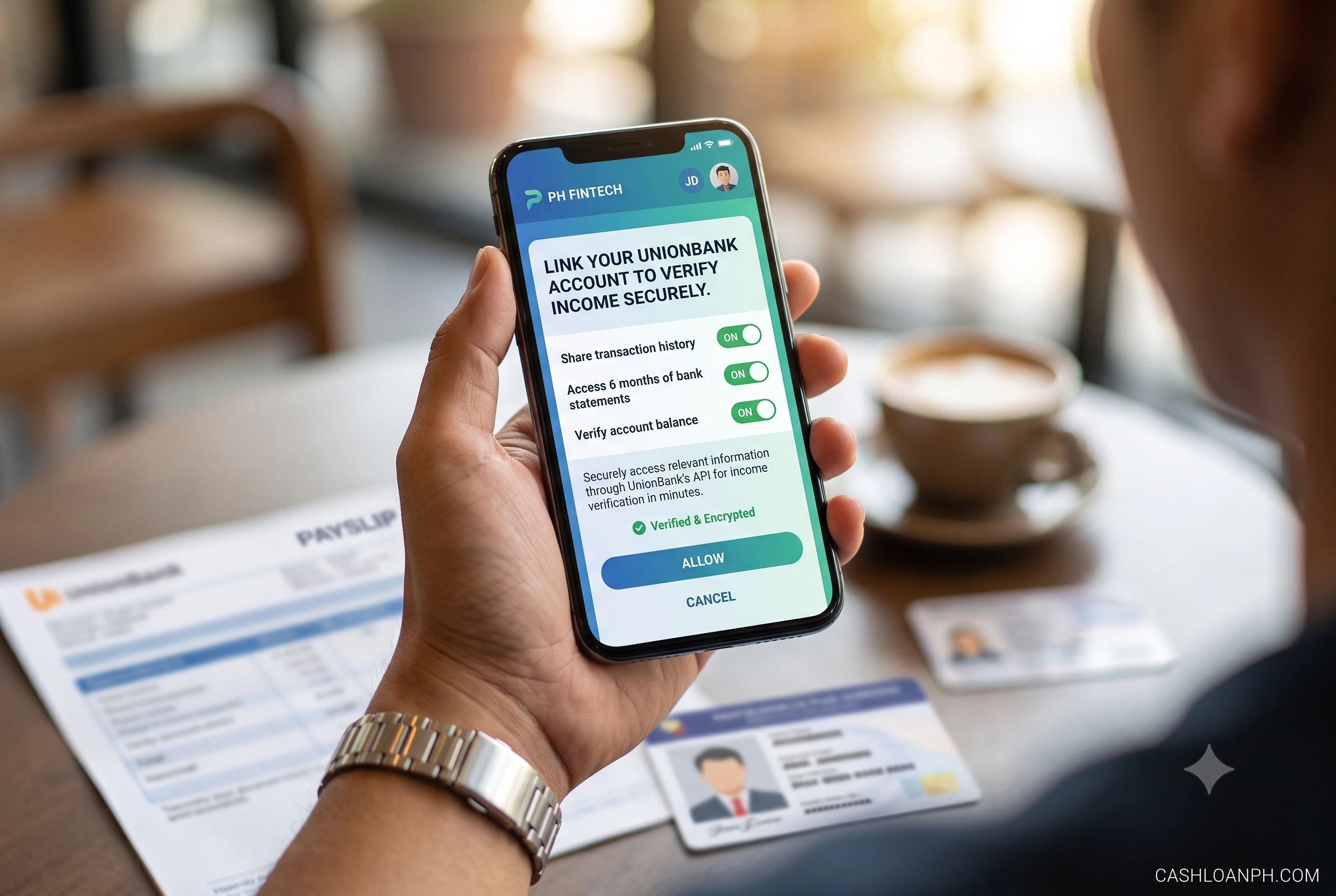
Yes, modern digital lenders now use open banking APIs to directly read your transaction history across linked e-wallets and bank accounts. This bypasses the need for manual pay slips by securely verifying your real-time cash flow and digital platform earnings.
The Bangko Sentral ng Pilipinas (BSP) has been heavily promoting the Open Finance Framework. This allows lending platforms to request read-only access to your primary bank account. Instead of asking you where you work, the app looks at your actual incoming cash flow. If it sees consistent inward remittances from PayPal, Wise, or direct bank transfers tagged as payroll, it approves you based on actual cash flow rather than formal employment status.
What Are the Main Fast Cash Loan Online Platforms That Accept Variable Income?
The main fast cash loan online platforms that accept variable income in the Philippines include GCash (GLoan), Maya Credit, Tala, and BillEase. These fintechs prioritize alternative data like app usage, bill payments, and consistent cash-in patterns over traditional employment records.
Finding a lender that understands the gig economy is half the battle. You must stop applying for traditional salary loans and focus entirely on platforms equipped for cash-flow-based underwriting.
Which Philippine Apps Actually Approve Independent Contractors?
Tala and BillEase consistently approve independent contractors by utilizing in-app behavioral data and alternative credit scoring. They allow users to self-declare as self-employed without requiring a registered corporate employer ID.
In our experience auditing application flows, Tala is particularly forgiving for independent contractors. Their eKYC (Electronic Know Your Customer) process does not force you into rigid employment dropdown menus. We noticed that if you declare your income accurately and grant the app permission to assess your device’s non-personal behavioral data, approval rates remain high. However, a practical warning: if you submit a UMID card with faded edges, the automated OCR will fail, kicking your application into a 24-hour manual review. Always use well-lit, glare-free IDs.
How Does GCash or Maya Evaluate Gig Economy Cash Flow?
GCash and Maya evaluate gig cash flow through proprietary internal scores like GScore and Maya Trust Score. They analyze the frequency of your incoming transfers, bill payments, and average daily wallet balance rather than asking for external income documents.
These e-wallets operate closed-loop ecosystems. If a client pays you via GCash, and you subsequently use that balance to pay your Meralco bill and buy groceries, the algorithm builds a behavioral profile of a responsible, cash-positive individual. It does not matter that you lack an employer; your transaction history proves your liquidity.
How Should I Calculate and Present My Freelance Income to a Lender?
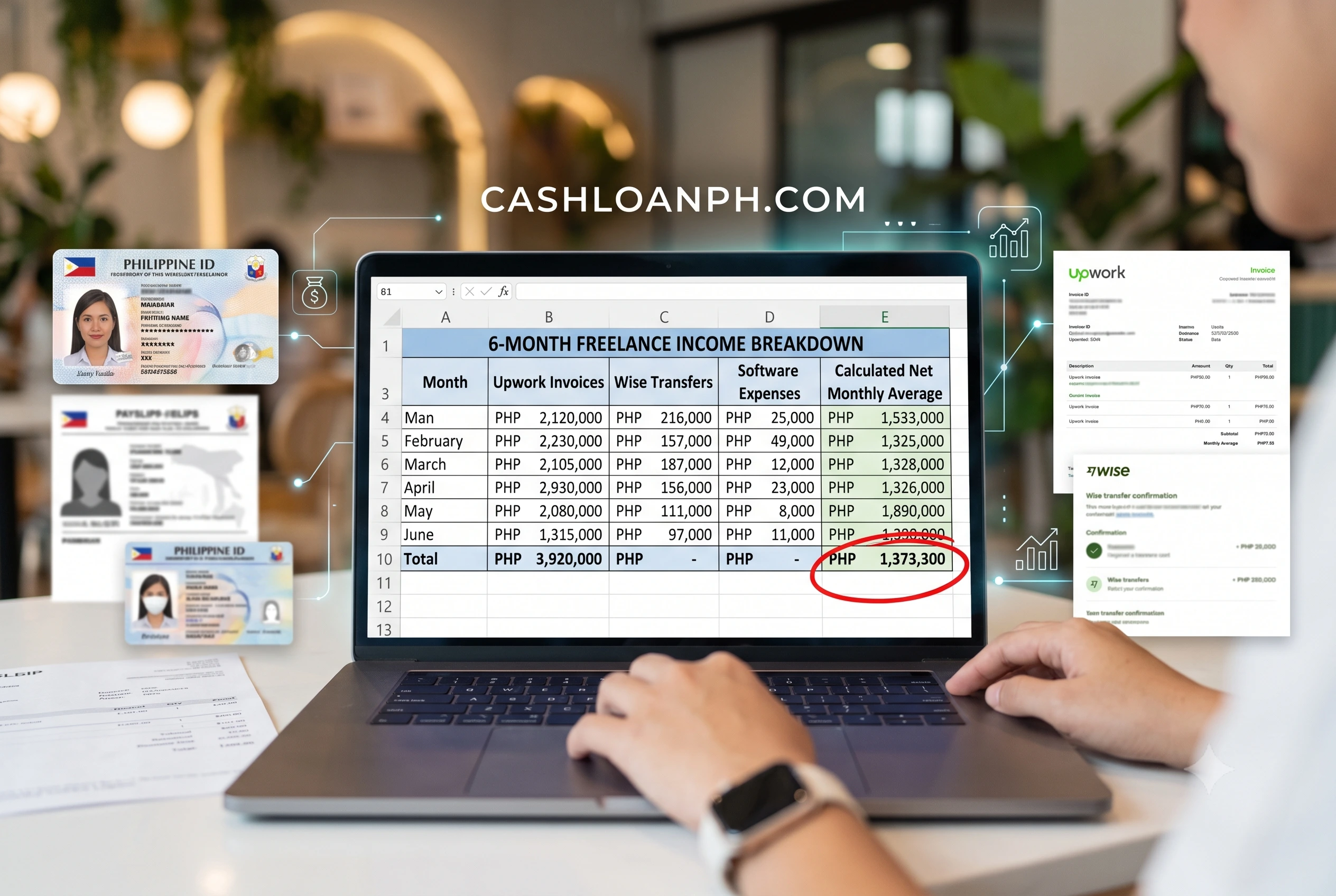
You should calculate your freelance income by averaging your last three to six months of earnings, then deducting business expenses to find your true net income. Presenting this clear average prevents algorithms from flagging high and low earning months as financial instability.
When an app asks for your “Monthly Income,” gig workers often panic. Should you put last month’s massive payout, or this month’s dry spell? The most accurate and safe method is averaging. For formal submissions that require documentation, you might use a standard calculation where $n$ represents the number of months:
What Is the Difference Between Gross Revenue and Net Gig Income?
Gross revenue is the total amount clients pay you, while net gig income is what remains after deducting operational costs like internet, software subscriptions, or vehicle maintenance. Lenders calculate your repayment capacity based exclusively on your net income.
A common mistake rideshare drivers make is declaring their gross daily earnings. If you make ₱3,000 a day driving, but spend ₱1,200 on gas and boundary fees, your actual net is ₱1,800. If you declare the gross amount and the lender demands proof, the discrepancy will trigger fraud alerts within the risk engine. Always declare your net income.
What Count as Valid Proof of Income Documents for Unregistered Freelancers?
Valid proof of income documents for unregistered freelancers include three months of bank statements showing client deposits, signed digital contracts, platform earnings screenshots, and regular PayPal or Wise transfer receipts.
If an app allows manual document uploads, you must provide context. An isolated screenshot of an Upwork balance means very little. When submitting these files, ensure your name, the platform URL, and the date are clearly visible. A highly effective strategy is combining your independent contractor agreement with a corresponding bank statement highlighting the exact matching deposit amounts.
How Can I Stabilize My Cash Flow Profile to Guarantee Approval?
You can stabilize your cash flow profile by funneling all client payments into one specific digital bank account and maintaining a minimum daily balance. This creates a highly visible, consistent financial footprint that alternative risk engines favor.
Many freelancers make the mistake of scattering their earnings. You might receive one payment via PayPal, another through direct deposit to BDO, and a third handed to you in cash. To an algorithmic risk engine, your income looks fragmented and weak.
Does Routing Client Payments Through a Single Digital Bank Help?
Yes, routing all payments through a single digital bank centralizes your financial data, making it easier for open banking algorithms to accurately read your total earning capacity and approve higher credit limits.
Consolidation is your strongest weapon. Choose a digital bank like UnionBank, SeaBank, or GoTyme, and direct all your clients to pay you there. Even if you transfer the money out a few days later, the high incoming volume establishes a solid baseline. When a lending app uses open banking to scan that single account, they immediately see a high-earning, active user.
Do I Need a DTI or SEC Registered Business to Get Approved Fast?
No, you do not strictly need a DTI or SEC business registration for small digital cash loans. While formal registration unlocks larger SME business loans, standard consumer fintech apps rely primarily on personal cash flow verification.
There is a persistent myth among freelancers that you must register as a formal business to access credit. For amounts under ₱50,000 intended to bridge a cash-flow gap, consumer lending apps do not require business permits. They care about your identity verification (KYC) and your recent liquidity.
Are There Safe Alternatives If Mainstream Fintech Apps Deny My Application?
If mainstream fintech apps deny your application, safe alternatives include collateralized pawnshop loans, credit cooperative memberships, or negotiating flexible payment terms directly with your utility providers to free up cash.
Rejections happen. If your cash flow profile is too erratic for even the most forgiving fintech algorithms, do not fall into the trap of illegal, unregistered “shark” lending apps that harass your contacts.
We heavily advise checking the Securities and Exchange Commission (SEC) list of registered lending companies before downloading any unfamiliar app. If you are in a tight spot, remember that unpaid civil debts (like a defaulted fast cash loan) do not carry prison sentences in the Philippines, though they will severely damage your credit score with the Credit Information Corporation (CIC). Take a step back, avoid borrowing to pay off existing debt, and focus on stabilizing your client payments into one traceable account.
References
- Bangko Sentral ng PilipinasOrganization: BSPResource: Open Finance Framework GuidelinesURL: https://www.bsp.gov.ph/Regulations/Issuances/2021/1122.pdf
- Securities and Exchange Commission PhilippinesOrganization: SECResource: List of Registered Online Lending PlatformsURL: https://www.sec.gov.ph/lending-companies-and-financing-companies-2/list-of-recorded-online-lending-platforms/
- Credit Information CorporationOrganization: CICResource: How Alternative Data is Used in Credit ScoringURL: https://www.creditinfo.gov.ph/alternative-data-credit-scoring