Last Updated on 16/11/2026 by Nicole Alba
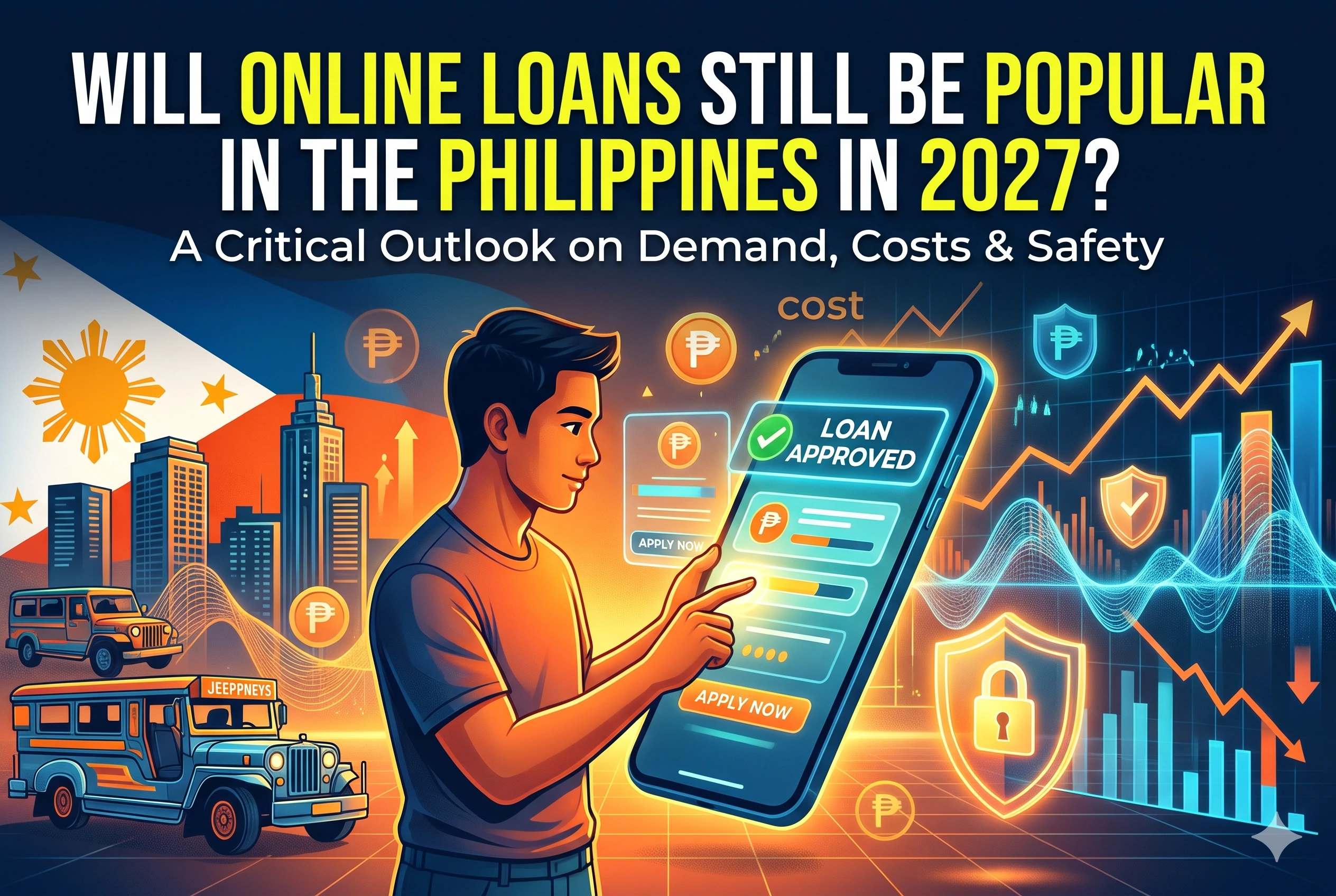
A financial emergency rarely comes at a convenient time. Perhaps your salary is still several days away, a family member needs medical assistance, or an unexpected bill has disrupted your monthly budget. You open your phone, search for a cash loan, and find dozens of online lending applications promising quick access to money.
But is borrowing through these applications still a sensible option? And with financial technology changing rapidly, will online loans remain popular in the Philippines in 2027?
These are reasonable questions, especially for borrowers who have experienced hidden charges, rejected applications, aggressive collection messages, or difficulties receiving approved funds.
One important reassurance: the nonpayment of an ordinary civil debt does not automatically result in imprisonment in the Philippines. Section 20, Article III of the 1987 Philippine Constitution expressly prohibits imprisonment for debt. However, borrowers can still face lawful collection efforts, civil proceedings, and other financial consequences. Separate criminal conduct, when established, is a different legal matter.
Editorial methodology: This article provides a market and regulatory assessment based on official Philippine sources available as of November 16, 2026. It is not presented as a mystery-shopper review. No live loan applications, app approval screens, customer support calls, or individual lender disbursements have been independently tested for this report. Operational observations are presented as practical lending-process analysis rather than fabricated firsthand testing.
| Important consideration | Philippine online lending outlook for 2027 | What borrowers should know |
|---|---|---|
| Market popularity | Likely to remain strong | Digital borrowing remains convenient for urgent financial needs. |
| Smartphone accessibility | Positive | Wider internet and smartphone access support digital financial services. |
| Loan approval | More data-driven | Income consistency, existing obligations, identity verification, and credit information matter. |
| Interest rates | Depends on the product | Applicable interest ceilings cover specific small, short-term loans, not every online loan. |
| SEC regulation | Stronger oversight | SEC MC No. 20, Series of 2026 introduces additional platform and operational requirements. |
| Loan disbursement | Digitally convenient but not guaranteed to be instant | Identity checks, bank processing, and e-wallet issues can cause delays. |
| Borrower privacy | Greater regulatory attention | Unauthorized contact-list harvesting and abusive collection practices are prohibited. |
| Consumer protection | Increasingly important | Borrowers should verify the lender and the specific platform before applying. |
| Overall outlook | Continued relevance with greater scrutiny | Safety, affordability, and transparency should determine borrowing decisions. |
Will online loans still be popular in the Philippines in 2027?
Yes. Online loans are likely to remain a widely used borrowing option in the Philippines in 2027, particularly for short-term personal expenses and borrowers who value convenient digital applications. However, continued demand does not guarantee rapid market growth or universally accessible credit.
Several factors support this forecast.
First, digital financial services have become familiar to Filipino consumers. Many people already use mobile applications to transfer money, receive salaries, pay bills, shop online, and manage everyday financial transactions. Applying for credit through the same digital environment is a natural extension of these habits.
Second, traditional borrowing does not always fit the circumstances of every household. A self-employed worker, delivery rider, online seller, freelancer, or employee without extensive banking documentation may find conventional loan applications difficult to complete.
Third, online lenders can use automated processes to collect application information, perform identity checks, evaluate credit risk, and communicate lending decisions. Properly implemented technology can reduce administrative work and make loan applications more accessible.
There is also an important distinction between online loan popularity and responsible borrowing.
Filipino consumers may appreciate the convenience of digital credit without necessarily wanting to borrow frequently. An application can remain popular because people value having access to emergency credit, even when they do not maintain an outstanding loan.
For 2027, the more realistic expectation is continued demand accompanied by greater competition, more selective underwriting, and stronger attention to regulatory compliance.
What does the latest BSP evidence tell us about online borrowing demand?
The Bangko Sentral ng Pilipinas (BSP) reported that 25% of Filipino adults had outstanding loans in 2025, compared with 45% in 2021. The same survey noted that online lending platforms expanded their reach, showing that digital credit remains relevant despite changing borrowing patterns.
The 2025 Consumer Finance and Inclusion Survey (CFIS) provides one of the most useful official reference points for assessing future borrowing demand.
The survey covered 8,784 completed interviews with adult respondents across the Philippines. Its findings offer a more realistic picture than promotional claims from individual lending applications.
Three findings deserve particular attention.
1. Borrowing participation has declined from its 2021 level.
The BSP reported the following proportions of Filipino adults with outstanding loans:
| Year | Adults with outstanding loans |
|---|---|
| 2017 | 22% |
| 2019 | 33% |
| 2021 | 45% |
| 2025 | 25% |
This decline is important. It suggests that online lending companies cannot assume that every financially connected Filipino consumer will become a borrower.
In the same report, around seven in ten adults perceived taking out any type of loan as a bad idea. That reflects a degree of caution among consumers and indicates that trust, affordability, and repayment capacity will continue to influence borrowing decisions.
2. Online lending platforms have expanded their reach.
Despite lower overall loan participation, the BSP specifically observed that online lending platforms had expanded their reach, particularly among borrowers looking for faster access to credit.
This creates an interesting market condition.
Digital lending can become more accessible as technology improves, even when the proportion of the population carrying outstanding debt decreases.
The important distinction is that the BSP survey does not establish a precise 2027 online loan market share or prove that online borrowing will increase every year.
3. Borrowers care about repayment conditions, not just approval speed.
The BSP’s 2025 survey identified several considerations influencing borrowing decisions:
| Borrowing consideration | Share of borrowers identifying it |
|---|---|
| Fast processing and loan approval | 31% |
| Repayment period | 30% |
| Interest rate | 26% |
| Ease of loan application | 24% |
| Convenience of payment methods | 19% |
| Regular payments and amortization | 16% |
| Loan amount | 15% |
These figures offer an important lesson for lenders entering 2027.
A fast approval process can attract attention, but borrowers also need repayment arrangements that fit their actual income.
For consumers, this means choosing an application based on the full cost and repayment schedule rather than simply selecting the lender advertising the fastest cash release.
Source: BSP 2025 Consumer Finance and Inclusion Survey.
What could the SEC’s 2026 regulatory changes mean for online loans in 2027?
The SEC lifted the moratorium on new online lending platforms effective August 1, 2026, under SEC Memorandum Circular No. 20, Series of 2026. New platform activity is now permitted subject to stronger capital, disclosure, registration, and operational requirements.
This development is particularly significant because it changes the regulatory conditions under which Philippine digital lenders can expand.
Before this change, the SEC had maintained restrictions on the introduction of new online lending platforms through its earlier regulatory framework.
The 2026 circular superseded the previous moratorium while establishing new requirements for financing companies (FCs) and lending companies (LCs).
What does this mean for the average borrower?
1. New lending platforms can enter under regulatory conditions.
The lifting of the moratorium creates opportunities for qualified companies to introduce additional digital lending services.
However, lifting the restriction does not mean every proposed application receives automatic approval.
Companies must comply with the relevant requirements governing their lending operations, platform disclosures, business plans, capitalization, and regulatory authorization.
2. Lending companies face stronger capitalization requirements.
SEC MC No. 20 establishes minimum paid-up capital requirements for newly incorporated companies:
| Company classification | Minimum paid-up capital |
|---|---|
| Financing Company | ₱15 million |
| Lending Company | ₱5 million |
It also establishes separate capital requirements for operating online lending platforms.
For financing companies, the prescribed capital levels start at ₱20 million for one OLP and increase to ₱100 million for up to five OLPs.
For lending companies, the corresponding requirements start at ₱10 million for one OLP and increase to ₱50 million for up to five OLPs.
These provisions are intended to align the number of borrower-facing platforms with a company’s financial capacity, operational complexity, and risk exposure.
Existing companies also receive transitional compliance requirements under the circular.
This is relevant because operating multiple lending applications requires more than a recognizable brand and a downloadable mobile application. It requires adequate financial and operational resources.
3. Borrowers should see clearer platform identities.
Under the 2026 rules, each online lending platform name must be properly registered and disclosed.
A borrower-facing brand should be uniquely associated with a financing or lending company. The responsible company’s identity and SEC registration details must also be disclosed through its borrower-facing channels.
This helps address a longstanding concern in digital lending: consumers sometimes recognize the application name but have difficulty identifying the actual company responsible for the loan.
4. The true cost of borrowing must be disclosed more clearly.
SEC MC No. 20 strengthens Truth in Lending Act (TILA) disclosure requirements.
Before loan confirmation, borrowers must be provided with information including:
- Total approved loan amount.
- Amount actually disbursed.
- Applicable interest rate and effective interest rate, where applicable.
- Other fees and charges.
- Payment dates and corresponding amounts.
- Exact loan duration.
- Other relevant information that can affect the borrowing decision.
The disclosure must be presented clearly and understandably, with an affirmative borrower acknowledgment before confirmation.
A complete electronic copy of the loan disclosure statement must also be provided after acceptance.
For consumers, these provisions are especially useful when comparing two applications that advertise the same loan amount but provide different net proceeds and repayment obligations.
Sources: SEC MC No. 20, Series of 2026 and SEC recorded online lending platforms.
Why might the online loan experience improve without becoming risk-free?
Digital lending technology can make applications easier to complete and decisions faster to process. However, identity verification, credit assessment, payment matching, and fund settlement can still create delays or failed transactions.
The difference between submitting an application and receiving usable money is important.
A consumer may complete an application in a few minutes but still encounter several verification stages.
Here are some practical friction points borrowers should anticipate.
Identity verification can interrupt an otherwise simple application.
Electronic Know Your Customer (eKYC) procedures help lenders confirm that an applicant is the person shown on the submitted identification document.
Typical checks may include:
- Photograph or scan of a valid identification document.
- Selfie verification or liveness checks.
- Personal information matching.
- Mobile number and email verification.
- Additional documentation when identity information cannot be confirmed.
An application may require correction or manual review when the identification image is unclear, personal details do not match, or the system cannot establish sufficient confidence in the applicant’s identity.
A practical example is a borrower whose name appears differently across an identification card, bank account, and e-wallet.
Even a small discrepancy in spelling, name order, or account ownership can create verification friction.
Applicants should use accurate information and submit clear documents rather than repeatedly creating applications with inconsistent personal details.
Income verification can take longer for nontraditional workers.
A salaried employee may be able to provide a recent payslip or employment certificate.
A freelance graphic designer, delivery rider, online seller, or independent contractor may have no equivalent document.
Such applicants may be asked for alternative supporting information, depending on the lender’s underwriting policies.
Approval does not guarantee immediate disbursement.
A lender may approve a loan, but the payout still needs to pass through the relevant payment process.
Possible issues include incorrect account details, an inactive receiving wallet, bank maintenance, transaction limits, or payment-channel interruptions.
Borrowers should not treat an approval notification as proof that the funds have already reached their account.
They should also avoid paying an unknown individual who claims to be able to accelerate the release of an approved loan.
Repayment transactions also require monitoring.
Paying through an official channel does not eliminate the possibility of a posting delay or transaction discrepancy.
Always save the payment confirmation, transaction reference number, amount, date, and recipient details.
Check the lender’s account statement to confirm that the payment has been credited.
This small habit can make a significant difference when a payment is incorrectly recorded as overdue.
How will online lenders assess freelancers and gig workers in 2027?
Lenders are likely to place greater emphasis on verifiable income patterns, existing obligations, and repayment capacity. A traditional employment certificate may not be the only useful source of information, but alternative income documents are not universally accepted.
The growth of freelance work, delivery services, online selling, and other independent income sources creates a specific challenge for digital lenders.
Traditional underwriting often relies on relatively predictable salary payments.
Gig workers, on the other hand, may receive income from multiple sources, with different payment dates and varying monthly totals.
Consider a delivery rider who receives payments several times a week.
His gross monthly earnings may appear sufficient to cover a loan installment. However, actual disposable income must account for fuel, vehicle maintenance, platform deductions, mobile data, household expenses, and other financial obligations.
A lender concerned with repayment risk needs to assess more than the amount of money entering an account.
The same consideration applies to freelancers and online sellers.
A business owner might receive substantial monthly deposits but also have inventory costs, supplier payments, and irregular sales.
What evidence might help establish repayment capacity?
| Borrower category | Potential supporting information |
|---|---|
| Salaried employee | Recent payslips, employment certificate, salary deposits |
| Freelancer | Client payment records, invoices, bank statements |
| Delivery rider | Platform earnings summaries, bank or e-wallet transaction history |
| Online seller | Sales records, payment settlements, bank statements |
| Self-employed professional | Business documents, invoices, financial records |
| Commission-based worker | Commission statements and recurring payment records |
Not every lender accepts every document. The applicant should confirm the specific requirements before submitting an application.
Credit information will also matter.
The 2026 SEC framework requires covered lending and financing companies operating online platforms to comply with Credit Information Corporation (CIC) requirements.
This includes appropriate registration, submission of accurate credit information, and the adoption of documented credit-risk assessment processes.
As credit information becomes more useful to lending decisions, an applicant’s existing repayment history and outstanding obligations may become increasingly relevant.
This does not mean a person with irregular income will automatically be rejected.
It means lenders have reasons to distinguish between someone with variable but consistent earnings and someone whose cash flow is insufficient to support another repayment obligation.
Source: SEC Memorandum Circular No. 20, Series of 2026.
How can you verify whether an online loan application is legitimate in the Philippines?
Check the lending company’s legal identity, SEC authority to operate, and the specific online lending platform recorded with the SEC. Never rely exclusively on an app-store listing, social media advertisement, or company name displayed on a promotional page.
This verification step deserves particular attention in 2027.
The existence of legitimate digital lenders does not mean every application available online is authorized to offer credit.
Fraudulent operators can imitate an established lender’s name, logo, branding, or registration details to make an unauthorized application appear genuine.
The SEC maintains an official list of recorded online lending platforms.
Its published list includes the corresponding financing or lending company, SEC registration number, platform name, and relevant disclosure information.
The version available on October 20, 2026, reflects reporting under SEC MC No. 20, Series of 2026.
A careful borrower should perform the following checks.
Check the actual company behind the application.
Look for the registered legal name rather than relying on the brand name alone.
Check whether the company has the appropriate authority to operate as a lending or financing company.
Verify the exact app or website name.
Compare the borrower-facing application or website against the SEC’s recorded OLP list.
An authorized company name should not be treated as permission for an unrelated application to operate under its identity.
Check the official download source.
Download applications from verified sources and compare the developer identity and official website information.
Be especially careful with download links sent through unsolicited text messages, Facebook comments, private messages, or unfamiliar websites.
Review the privacy notice and loan agreement.
A legitimate borrowing process should explain which personal information is collected, why it is necessary, how it is used, and how the lender handles customer complaints.
Watch for misleading approval promises.
No responsible lender should be assumed to approve every applicant.
Promotional statements such as guaranteed approval regardless of income or credit history should be treated with caution.
The SEC’s public advisories in 2026 also highlight unauthorized online lending activities and the misuse of legitimate companies’ names and credentials.
Remember that registration does not mean a lender has been endorsed by the government as the cheapest or best financial option. It is a regulatory verification step, not a guarantee that every transaction will be problem-free.
Source: SEC List of Recorded Online Lending Platforms.
What should borrowers compare before accepting an online loan in 2027?
Compare the actual amount received, total repayment obligation, interest, applicable fees, due dates, and consequences of late payment. A low advertised interest rate does not necessarily mean the loan is affordable.
A common borrowing mistake is concentrating exclusively on the amount a lender offers.
For example, two applications might advertise a ₱5,000 loan, but their net disbursement and repayment schedules could differ.
One might transfer almost the entire approved amount to the borrower, while another might deduct disclosed charges before releasing the funds.
The amount received is not always the same as the approved loan principal.
A borrower should calculate the actual financing cost before accepting any offer.
Use the following comparison:
| Item | Questions to ask |
|---|---|
| Approved principal | How much am I borrowing? |
| Net proceeds | How much money will actually reach my account? |
| Interest | What rate applies, and how is it calculated? |
| Processing fees | Are there any deductions or additional charges? |
| Total repayment | How much must I pay from start to finish? |
| Loan duration | How many days or months do I have? |
| Payment schedule | What are the exact due dates and amounts? |
| Late charges | What happens if I cannot pay on time? |
| Repayment method | Which official payment channels are supported? |
| Privacy policy | What happens to my personal information? |
What interest rate limits apply to online loans?
Philippine borrowers should be aware that interest rate ceilings do exist for certain small, short-term loans.
BSP Circular No. 1133, Series of 2021, implemented through SEC Memorandum Circular No. 3, Series of 2022, covers unsecured, general-purpose loans offered by lending companies, financing companies, and their online lending platforms when the principal does not exceed ₱10,000 and the loan term is up to four months.
For these covered loans, the prescribed ceilings include:
| Charge | Prescribed ceiling |
|---|---|
| Nominal interest rate | 6% per month |
| Effective interest rate | 15% per month |
| Late payment penalty | 5% per month on the outstanding scheduled amount due |
| Total cost cap | 100% of the amount borrowed |
The effective interest rate includes nominal interest and applicable loan-related fees and charges, excluding late-payment or nonpayment fees and penalties.
The total cost cap applies to the covered interest, other fees, and penalties.
These ceilings should not be incorrectly presented as universal limits for every digital loan in the Philippines.
A larger loan, a longer-term loan, or a loan with a different classification may not fall within the same covered category. Other applicable laws and disclosure requirements still matter.
The safest practice is to read the loan disclosure statement and compare the actual total repayment amount rather than assuming that a familiar percentage applies to every product.
Sources: BSP Circular No. 1133 and SEC MC No. 3, Series of 2022.
How will borrower privacy and debt collection rules affect online lending in 2027?
Borrower privacy and fair collection practices will remain important regulatory issues. Lenders cannot freely harvest contact lists or harass unrelated people to collect a debt, and the 2026 government advisory reinforces these existing protections.
Some borrowers hesitate to apply for online loans because they fear that a missed payment could expose their financial problems to friends, relatives, or colleagues.
These concerns are understandable, given the documented complaints against abusive online lending operations.
The National Privacy Commission (NPC), SEC, and Department of Information and Communications Technology (DICT) issued a joint public advisory on online lending platforms in March 2026.
The advisory reiterates restrictions on unnecessary personal-data processing and unauthorized access to borrowers’ contact lists.
It also explains important distinctions between character references and guarantors.
Character references are not automatically responsible for the loan.
A character reference may be provided for identification or verification purposes.
That designation does not automatically make the individual legally responsible for repayment.
A guarantor is different. A person must expressly agree to assume that obligation, with the required consent, before being treated as a guarantor.
For debt collection purposes, the advisory states that lenders may contact the borrower and the guarantor who has agreed to that role, rather than unrelated people in the borrower’s contact list.
Unnecessary contact-list access is a warning sign.
An application should not demand unrestricted access to personal contacts merely because someone wants to apply for credit.
The regulatory framework also addresses the use of application permissions.
For example, camera or photo-gallery access may be justified for a specified identity-verification purpose. However, permissions should be limited to what is necessary, and borrowers should be able to revoke permissions after the relevant purpose has been fulfilled.
The joint advisory also warns consumers about deceptive consent interfaces, including pre-ticked permissions and designs that make excessive data sharing easier than declining it.
Aggressive collection practices are not acceptable.
The rules prohibit threats, intimidation, public shaming, and other unfair debt-collection methods.
SEC Memorandum Circular No. 18, Series of 2019, remains an important reference for prohibited unfair collection practices.
If a borrower receives threats, messages sent to unrelated relatives, or unauthorized disclosure of personal information, the borrower should preserve the evidence.
Save screenshots, message timestamps, phone numbers, call records, loan agreements, and transaction receipts.
Privacy violations can be reported to the NPC, while complaints involving lending-company conduct can be directed to the SEC through its appropriate complaint channels.
Sources: DICT-NPC-SEC Public Advisory on Online Lending Platforms and NPC Circular No. 20-01.
What should you do if you cannot repay an online loan on time?
Contact the lender through its verified communication channel as early as possible, ask about available repayment arrangements, and keep written records. Missing a payment does not automatically make someone a criminal, but ignoring the obligation can create further financial and legal difficulties.
Financial emergencies can affect anyone.
A borrower may lose employment, experience reduced business income, encounter medical expenses, or receive fewer freelance assignments than expected.
The important thing is to respond responsibly rather than taking another expensive loan to hide the first repayment problem.
Consider these steps.
1. Review the outstanding balance.
Check the original loan agreement, payment history, unpaid principal, interest, and applicable charges.
Do not rely solely on a collection message that demands an amount without explaining its calculation.
2. Contact the actual lender.
Use its official website, application, or verified customer service channel.
Explain the situation and ask whether a payment extension, restructuring arrangement, or another available option exists.
Such arrangements are subject to the lender’s policies and applicable rules; they should not be assumed to be automatic entitlements.
3. Avoid borrowing repeatedly to cover existing debt.
Taking a second short-term loan to repay the first can create a cycle in which new borrowing becomes necessary just to meet previous obligations.
This is particularly dangerous when repayment periods are short and household income is unstable.
4. Preserve all payment evidence.
When making a payment, retain the official receipt and transaction reference.
When communicating with collectors, preserve written records, especially if the conversation includes disputed charges or threats.
5. Understand your legal position.
The Philippine Constitution prohibits imprisonment for debt.
However, this does not erase the obligation to repay a valid loan. A lender may pursue lawful collection and civil remedies, subject to applicable legal procedures and consumer protections.
The Financial Products and Services Consumer Protection Act, Republic Act No. 11765, also establishes rights concerning fair treatment, disclosure, data protection, and complaint handling.
For financial service providers within its scope, the law requires a consumer assistance mechanism for complaints, inquiries, and requests.
When a dispute remains unresolved, consumers can seek assistance from the appropriate regulator.
The BSP generally supervises banks and other BSP-supervised institutions, while the SEC is the primary regulator of lending and financing companies and their online lending platforms.
Source: Republic Act No. 11765.
What is the safest way to approach online loans in the Philippines in 2027?
Online borrowing is likely to remain relevant, but borrowers should prioritize verified lenders, transparent loan disclosures, manageable repayments, and personal-data protection. The best loan is not necessarily the one approved fastest; it is the one whose cost and repayment schedule fit the borrower’s actual financial capacity.
The Philippine online lending market is entering a period of regulatory adjustment.
The SEC’s 2026 framework allows new online lending platforms to enter under prescribed conditions, while strengthening the financial and operational responsibilities of the companies behind them.
This creates opportunities for legitimate providers to develop better digital services.
It also gives consumers more reasons to examine the legal identity, actual loan costs, and data practices of every lending platform they consider.
For borrowers, five practical habits are worth maintaining in 2027:
- Verify the company’s SEC authority and the exact online platform before submitting personal information.
- Compare the amount received against the complete repayment obligation.
- Borrow only when the repayment schedule is consistent with realistic income and essential household expenses.
- Avoid applications requesting unnecessary personal-data permissions or using misleading approval promises.
- Keep copies of agreements, disclosure statements, payment confirmations, and customer service communications.
It is also worth remembering that not every financial problem requires a new loan. Negotiating a payment deadline, using available savings, discussing a temporary family contribution, or arranging a more affordable installment may be safer alternatives.
The outlook for 2027 is continued relevance, not unconditional growth. Online loans will probably remain a convenient financial option for many Filipinos, but borrower confidence will increasingly depend on transparency, regulatory compliance, responsible underwriting, and fair treatment.
A convenient loan should make a difficult financial situation easier to manage, not create a larger problem a few weeks later.
References
- 2025 Consumer Finance and Inclusion SurveyOrganization: Bangko Sentral ng Pilipinas (BSP)Resource: 2025 Consumer Finance and Inclusion Survey. URL: https://www.bsp.gov.ph/Inclusive%20Finance/Financial%20Inclusion%20Reports%20and%20Publications/2025/2025CFISreport.pdf
- SEC Memorandum Circular No. 20, Series of 2026Organization: Securities and Exchange Commission (SEC)Resource: Guidelines Prescribing Prudential, Disclosure, and Market Conduct Requirements for Financing and Lending Companies and Lifting the Moratorium on Online Lending Platforms. URL: https://www.sec.gov.ph/mc-2026/sec-mc-no-20-series-of-2026/
- List of Recorded Online Lending PlatformsOrganization: Securities and Exchange Commission (SEC)Resource: List of Financing and Lending Companies and Their Recorded Online Lending Platforms. URL: https://www.sec.gov.ph/registered-companies-and-partnerships/list-of-recorded-online-lending-platforms/
- BSP Circular No. 1133, Series of 2021Organization: Bangko Sentral ng Pilipinas (BSP)Resource: Ceiling/s on Interest Rates and Other Fees Charged by Lending Companies, Financing Companies, and Their Online Lending Platforms. URL: https://www.bsp.gov.ph/Regulations/Issuances/2021/1133.pdf
- SEC Memorandum Circular No. 3, Series of 2022Organization: Securities and Exchange Commission (SEC)Resource: Implementation of BSP Circular No. 1133, Series of 2021, on Interest Rate and Other Fee Ceilings. URL: https://www.sec.gov.ph/mc-2022/mc-no-03-s-2022/
- Advisory on Online Lending PlatformsOrganization: Department of Information and Communications Technology (DICT), National Privacy Commission (NPC), and Securities and Exchange Commission (SEC)Resource: Public Advisory on Online Lending Platforms, March 2026. URL: https://privacy.gov.ph/wp-content/uploads/2026/03/DICT-NPC-SEC-Public-Advisory-on-Online-Lending-Platforms.pdf
- NPC Circular No. 20-01Organization: National Privacy Commission (NPC)Resource: Guidelines on the Processing of Personal Data for Loan-Related Transactions. URL: https://privacy.gov.ph/wp-content/uploads/2020/10/NPC-Circular-No.-20-01.pdf
- NPC Circular No. 2022-02Organization: National Privacy Commission (NPC)Resource: Amending Certain Provisions of NPC Circular No. 20-01 on Loan-Related Transactions. URL: https://privacy.gov.ph/wp-content/uploads/2023/05/NPC-Circular-No.-2022-%E2%80%93-02-Amending-20-01-Loan-Related-Transactions.pdf
- BSP Financial Consumer Protection FrameworkOrganization: Bangko Sentral ng Pilipinas (BSP)Resource: BSP Regulations on Financial Consumer Protection, Circular No. 1160. URL: https://www.bsp.gov.ph/Pages/InclusiveFinance/FinancialConsumerProtectionNetwork.aspx?ID=1865
- Republic Act No. 11765Organization: Government of the PhilippinesResource: Financial Products and Services Consumer Protection Act. URL: https://lawphil.net/statutes/repacts/ra2022/ra_11765_2022.html
- 1987 Philippine ConstitutionOrganization: Official Gazette of the Republic of the PhilippinesResource: Article III, Section 20 – No Person Shall Be Imprisoned for Debt or Non-Payment of a Poll Tax. URL: https://officialgazette.gov.ph/constitutions/1987-constitution/
- SEC Memorandum Circular No. 18, Series of 2019Organization: Securities and Exchange Commission (SEC)Resource: Prohibition on Unfair Debt Collection Practices of Financing Companies and Lending Companies. URL: https://www.sec.gov.ph/mc-2019/mc-no-18-s-2019/