Last Updated on 04/11/2026 by Nicole Alba
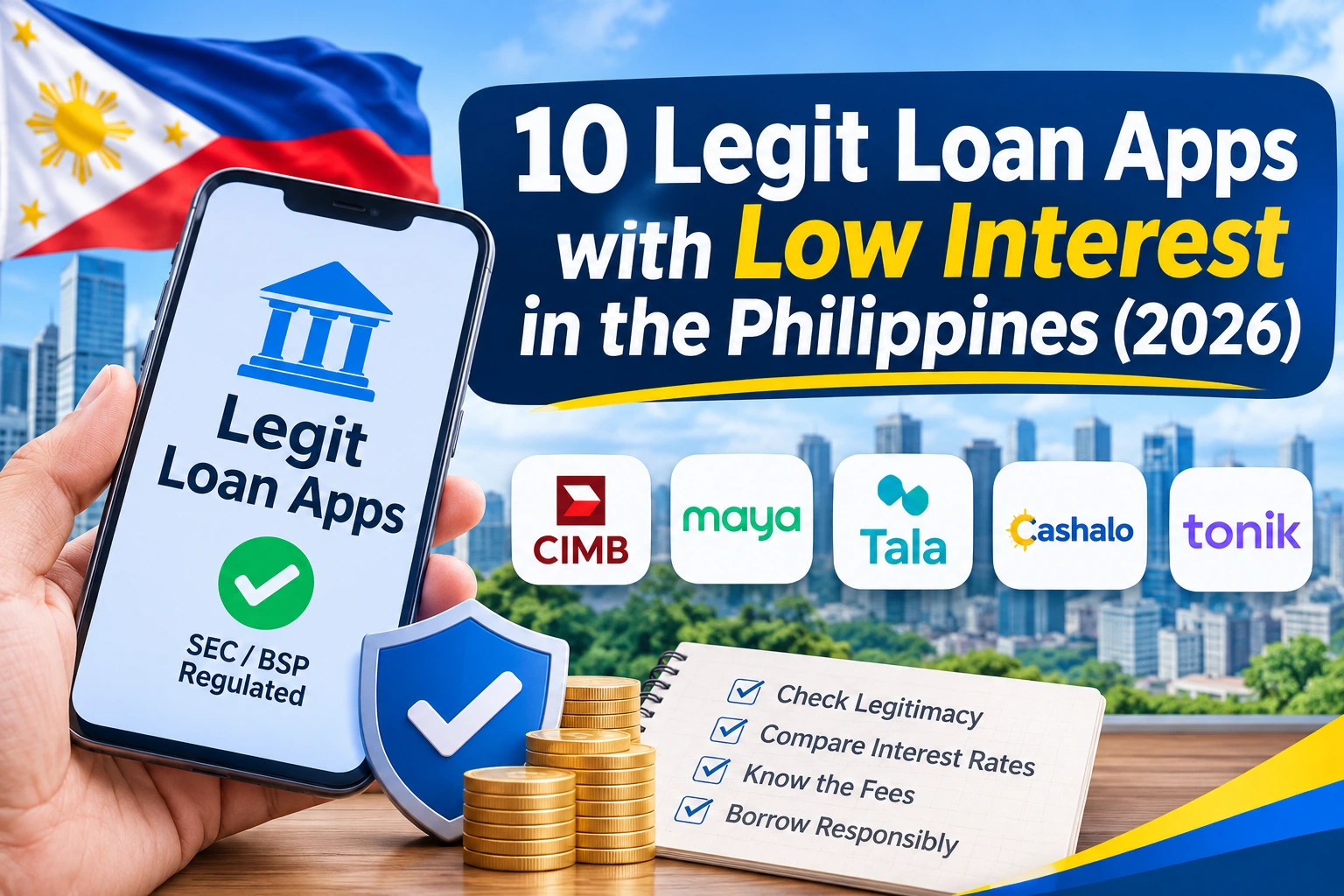
Finding a legitimate loan app with low interest in the Philippines requires more than comparing advertised monthly rates. Borrowers must distinguish between banks supervised by the Bangko Sentral ng Pilipinas (BSP) and lending companies registered with the Securities and Exchange Commission (SEC). These institutions operate under different regulatory frameworks.
Our review identifies CIMB Personal Loan and Maya Personal Loan as particularly interesting options based on their published starting rates. Tala and Cashalo offer alternative digital lending channels, but borrowers should evaluate their individual quotations rather than assume they are cheaper. Actual costs depend on credit assessment, repayment duration, fees, and net disbursement.
| Borrower question | Current finding | Why it matters |
|---|---|---|
| Which option advertises a low rate? | CIMB: 0.83% monthly add-on; Maya: 0.77% monthly add-on | Starting rates are conditional |
| Are these institutions regulated? | CIMB and Maya are BSP-regulated banks | Bank supervision differs from SEC lending-company registration |
| Is Tala a legitimate lending platform? | Tala is recorded under Tala Financing Philippines Inc. | Verify the actual app before applying |
| Does SEC registration guarantee low interest? | No | Legitimacy and affordability are separate issues |
| Are processing fees important? | Yes | Upfront deductions reduce cash received |
| Can loan apps access personal information? | Data access depends on permissions and privacy practices | Review consent before submitting an application |
1. Legit Loan Apps in the Philippines: Regulatory Legitimacy
A legitimate loan app must be connected to an identifiable financial institution with the appropriate regulatory authority. CIMB and Maya operate as BSP-regulated banks, while Tala and Cashalo appear on the SEC’s recorded online lending platform list under their respective financing or lending companies. Registration does not guarantee favorable pricing or approval.
BSP-regulated banks versus SEC-registered lenders
The distinction matters.
BSP-regulated banks
Banks accept deposits and provide lending services under BSP supervision. Their banking activities are governed by banking regulations, consumer protection requirements, and applicable disclosure standards.
The BSP’s digital banking framework includes institutions such as:
- CIMB Bank Philippines
- Maya Bank
- Tonik Digital Bank
- GoTyme Bank
- UnionDigital Bank
- Overseas Filipino Bank
- UNObank
SEC-registered lending and financing companies
These companies provide credit under the Lending Company Regulation Act or applicable financing-company legislation.
They do not automatically become banks simply because their loan products are distributed through mobile applications.
The SEC maintains a list of recorded online lending platforms. The published register identifies the legal entities behind many recognizable lending brands.
Verified lending entities
| Loan app or service | Legal entity | Regulatory category |
|---|---|---|
| CIMB Personal Loan | CIMB Bank Philippines, Inc. | BSP-regulated bank |
| Maya Personal Loan | Maya Bank, Inc. | BSP-regulated bank |
| Tala | Tala Financing Philippines Inc. | SEC-recorded lending company and platform |
| Cashalo | Paloo Financing, Inc. | SEC-recorded financing company and platform |
| Tonik Quick Loan / Credit Builder | Tonik Digital Bank, Inc. | BSP-regulated digital bank |
The SEC register identifies Tala Financing Philippines Inc. under SEC registration number CS201710582 and Paloo Financing, Inc. under CS201800209.
Important verification warning: The SEC has issued advisories concerning fraudulent platforms impersonating legitimate lending companies, including the unauthorized use of Tala’s name and corporate identity. A genuine company’s registration details must never be treated as proof that every app using its name is authorized.
2. Best Legit Loan Apps with Low Interest in the Philippines
CIMB Personal Loan and Maya Personal Loan stand out in this comparison because their published starting monthly add-on rates are below 1%. However, those figures are conditional, and the effective borrowing cost can be higher. Tala and Cashalo are additional options to investigate, but their actual pricing must be established through individual loan disclosures.
2.1 CIMB Personal Loan
Provider: CIMB Bank Philippines, Inc.
Regulatory category: BSP-regulated commercial bank
CIMB is a strong candidate for borrowers comparing personal loans from established digital banking providers.
Its published FAQ states that the Personal Loan monthly add-on rate can start at 0.83%, corresponding to an annual contractual rate of 18%, subject to risk assessment.
Key product information
| Feature | Published information |
|---|---|
| Product | CIMB Personal Loan |
| Starting monthly add-on rate | 0.83% |
| Corresponding annual contractual rate | 18% |
| Approval | Subject to risk assessment |
| Provider | CIMB Bank Philippines, Inc. |
| Regulatory authority | BSP |
Advantages
- Competitive published starting interest rate.
- Offered by a BSP-regulated bank.
- Established digital banking infrastructure.
- Interest pricing is disclosed in the official FAQ.
Disadvantages
- The lowest advertised rate is not guaranteed.
- Credit assessment determines the actual offer.
- The public rate information alone does not establish the complete disbursement cost.
- Borrowers must review the applicable processing fees and repayment schedule.
Who should consider CIMB?
Salaried borrowers and existing banking customers comparing formal personal loan products should include CIMB in their initial shortlist.
The 0.83% figure is attractive, but the final decision should depend on the approved effective interest rate and total repayment amount.
2.2 Maya Personal Loan
Provider: Maya Bank, Inc.
Regulatory category: BSP-regulated digital bank
Maya Personal Loan is another option for borrowers seeking a relatively low published starting rate.
Its published support documentation states a monthly add-on rate starting at 0.77%, equivalent to an effective interest rate (EIR) of approximately 1.40% per month for the specified six-month loan example. The actual rate depends on the individual offer.
Key product information
| Feature | Published information |
|---|---|
| Product | Maya Personal Loan |
| Starting monthly add-on rate | 0.77% |
| Published example EIR | 1.40% monthly |
| Example repayment term | 6 months |
| Approval | Subject to credit evaluation |
| Provider | Maya Bank, Inc. |
| Regulatory authority | BSP |
Advantages
- Low published starting add-on rate.
- Clear distinction between add-on interest and EIR in its support documentation.
- Provided by a BSP-regulated bank.
- Loan information and exact offers are presented through its digital banking platform.
Disadvantages
- The advertised starting rate is not available to every applicant.
- The actual approved amount and interest rate depend on credit evaluation.
- Borrowers must check the exact disclosure statement.
- The published example should not be mistaken for a guaranteed 2026 quotation.
Who should consider Maya?
Borrowers who already use Maya’s banking services can check whether Personal Loan is available in their account.
The key advantage is the disclosed pricing framework. The borrower should still compare the EIR and total repayment against competing bank offers.
2.3 Tala
Provider: Tala Financing Philippines Inc.
Regulatory category: SEC-recorded lending company
Tala operates a digital lending platform aimed at consumers who need access to smaller unsecured loans.
Its presence on the SEC’s recorded online lending platform list provides an identifiable regulatory reference for the genuine Tala platform.
Key product information
| Feature | Finding |
|---|---|
| Product | Tala digital loans |
| Legal entity | Tala Financing Philippines Inc. |
| SEC registration number | CS201710582 |
| Recorded platform | Tala |
| Published universal starting rate | Not independently established |
| Actual pricing | Check individual loan disclosure |
Advantages
- Established digital lending channel.
- Identifiable SEC-recorded lending entity.
- Mobile-based application process.
- An alternative for borrowers who may not qualify for conventional bank credit.
Disadvantages
- Do not assume its pricing is lower than bank personal loans.
- The exact interest and other charges must be checked before accepting.
- Loan eligibility and limits depend on individual assessment.
- Fake applications and unauthorized platforms using the Tala identity are a documented risk.
Who should consider Tala?
Borrowers who need a digital lending alternative and have compared its actual repayment quotation against bank offers may consider the genuine Tala application.
Check the legal entity, app publisher, and official channels carefully.
2.4 Cashalo
Provider: Paloo Financing, Inc.
Regulatory category: SEC-recorded financing company
Cashalo is another established name in the Philippine digital credit market.
The SEC’s recorded platform list identifies Cashalo under Paloo Financing, Inc., with SEC registration number CS201800209.
Key product information
| Feature | Finding |
|---|---|
| Platform | Cashalo |
| Legal entity | Paloo Financing, Inc. |
| SEC registration number | CS201800209 |
| Regulatory category | Financing company |
| Universal low-interest rate | Not independently verified |
| Actual loan charges | Subject to individual disclosure |
Advantages
- Identifiable financing-company operator.
- Established digital credit platform.
- Alternative to traditional bank loan applications.
- SEC-recorded platform identity.
Disadvantages
- Registration does not establish that the loan is inexpensive.
- The actual interest rate must be checked in the loan agreement.
- Additional fees can affect the total repayment amount.
- Borrowers should compare the net proceeds with the contractual principal.
Who should consider Cashalo?
Borrowers who need an alternative financing provider can compare Cashalo’s written quotation with CIMB, Maya, and other regulated options.
It should not automatically rank ahead of a bank loan simply because its application process may be more accessible.
2.5 Tonik Quick Loan / Credit Builder
Provider: Tonik Digital Bank, Inc.
Regulatory category: BSP-regulated digital bank
Tonik is a useful comparison because it demonstrates why regulatory legitimacy and low interest are two different things.
Its published Quick Loan FAQ states a monthly add-on interest rate starting at 4.26%. The FAQ also identifies a PHP500 processing fee, documentary stamp tax of PHP1.50 per PHP200 of the loan amount, and a PHP500 late payment fee.
The bank describes Quick Loan as having evolved into Credit Builder, so applicants should verify the currently offered product and terms.
Key product information
| Feature | Published information |
|---|---|
| Provider | Tonik Digital Bank, Inc. |
| Product reference | Quick Loan / Credit Builder |
| Starting monthly add-on rate | 4.26% |
| Maximum published Quick Loan amount | PHP50,000 |
| Processing fee | PHP500 |
| Documentary stamp tax | PHP1.50 per PHP200 |
| Late payment fee | PHP500 |
| Approval information | Published FAQ indicates up to two days, subject to identity verification |
Advantages
- Provided by a BSP-regulated digital bank.
- Published fee schedule.
- Clear identification of certain additional charges.
- Defined eligibility requirements in its FAQ.
Disadvantages
- The published starting rate is considerably higher than the advertised starting rates from CIMB and Maya.
- Processing fees reduce the amount received.
- Late payment charges increase the cost of missed payments.
- Applicants must verify whether the current Credit Builder offer has different terms.
Who should consider Tonik?
Tonik may be worth considering when its product features and approved terms fit a borrower’s circumstances.
However, borrowers whose main priority is low interest should compare its quotation carefully before accepting.
3. Interest Rate Comparison: Which Loan App Is Cheaper?
The lowest published monthly add-on rates in this comparison belong to Maya and CIMB. Their figures cannot be compared directly with effective interest rates or with products quoting different fees and repayment structures. Always compare the actual EIR and total amount payable.
Published rate comparison
| Provider | Published starting monthly add-on rate | Other disclosed charges | Assessment |
|---|---|---|---|
| Maya | 0.77% | Check individual disclosure | Strong low-rate candidate |
| CIMB | 0.83% | Check individual disclosure | Strong low-rate candidate |
| Tonik | 4.26% | PHP500 processing fee, DST and late fee | Higher-cost comparison |
| Tala | Not established | Check individual disclosure | Quote-dependent |
| Cashalo | Not established | Check individual disclosure | Quote-dependent |
These are published starting figures, not guaranteed personal offers.
Why add-on interest can be misleading
A monthly add-on rate is calculated against the original principal throughout the stated repayment period.
The borrower may repay part of the principal every month, but the add-on calculation does not necessarily decrease with the outstanding balance.
An effective interest rate provides a more meaningful way to assess the timing and cost of cash flows.
Consider a simplified illustration.
A borrower receives a PHP50,000 loan with a 0.83% monthly add-on rate over six months.
Monthly Interest = PHP50,000 × 0.83%
Monthly Interest = PHP415
Total Interest = PHP415 × 6
Total Interest = PHP2,490
Total Repayment = PHP50,000 + PHP2,490
Total Repayment = PHP52,490
Estimated Monthly Payment = PHP52,490 ÷ 6
Estimated Monthly Payment = PHP8,748.33
This illustration assumes no additional charges and does not represent an actual approved CIMB offer.
Why the advertised loan amount may not equal the cash received
Processing fees, documentary stamp tax, insurance charges where applicable, and other disclosed deductions can reduce the amount disbursed.
Net Proceeds = Approved Principal − Upfront Fees − Other Disclosed Deductions
For example, Tonik’s published fee schedule identifies a PHP500 processing fee and documentary stamp tax of PHP1.50 per PHP200 of the loan amount.
For an illustrative PHP50,000 loan:
Documentary Stamp Tax = PHP50,000 ÷ PHP200 × PHP1.50
Documentary Stamp Tax = PHP375
Net Proceeds = PHP50,000 − PHP500 − PHP375
Net Proceeds = PHP49,125
The borrower receives PHP49,125 before any other applicable deductions, while the contractual repayment obligation is determined by the approved loan agreement.
This distinction is critical. A PHP50,000 advertised loan does not necessarily mean PHP50,000 reaches the borrower’s account.
4. SEC Interest Rate Caps and Borrower Protection
SEC registration and interest-rate restrictions are separate protections. Lending and financing companies must comply with applicable SEC rules, including relevant interest and fee ceilings. Borrowers should also examine the Truth in Lending disclosures because a compliant lender can still offer a loan that is financially unsuitable.
Applicable interest-rate regulation
The SEC implemented interest-rate ceilings for covered lending and financing companies and their online lending platforms through Memorandum Circular No. 3, series of 2022, implementing BSP Circular No. 1133.
The SEC subsequently issued Memorandum Circular No. 14, series of 2025, addressing recalibrated ceilings on interest rates and other fees charged by financing and lending companies.
The regulatory framework is relevant when evaluating:
- Interest charges.
- Effective interest rates.
- Processing fees.
- Other applicable loan charges.
- Penalties and collection-related costs.
The exact ceiling applicable to a particular loan depends on the product classification and the operative regulatory provisions.
Do not assume that the same interest cap automatically applies to every bank loan, credit line, installment product, or lending-company loan.
What borrowers should check
Before signing an agreement, request a complete disclosure showing:
- Approved principal.
- Amount actually disbursed.
- Nominal interest rate.
- Effective interest rate.
- Total interest payable.
- Processing fees.
- Documentary stamp tax, where applicable.
- Late payment penalties.
- Repayment dates and installment amounts.
- Total amount payable.
The Truth in Lending Act requires relevant credit-cost disclosures. A lender should provide enough information for the borrower to understand the actual financial obligation.
Is SEC registration enough to prove an app is legitimate?
No.
A registered company can be impersonated by an unrelated application, website, social media account, or individual.
The SEC has specifically warned consumers about fraudulent lending platforms using the identity of legitimate companies, including Tala Financing Philippines Inc.
A proper verification process includes checking:
- The company’s exact registered name.
- Its SEC registration and authority to operate.
- The online lending platform recorded under that entity.
- The application’s publisher.
- The official website and contact information.
The name of the app alone is insufficient.
5. Loan Approval Requirements and Underwriting
Approval depends on the lender’s credit assessment, identity verification, and product eligibility rules. A bank may offer a lower starting rate but reject an applicant who does not meet its underwriting requirements. An SEC-registered lender may offer another route, but approval does not guarantee affordable credit.
What lenders typically evaluate
Although individual underwriting models are not fully public, borrowers should expect some combination of the following:
| Assessment factor | Why lenders consider it |
|---|---|
| Identity verification | Confirms the applicant’s identity |
| Income | Measures repayment capacity |
| Employment | Helps establish income stability |
| Credit history | Indicates previous repayment behavior |
| Existing debt | Measures current financial commitments |
| Banking activity | May help establish financial capacity |
| Application consistency | Helps detect inaccurate information |
Bank loan versus digital lending application
A bank personal loan and an app-based lending product can have different eligibility requirements.
A bank may place greater emphasis on documented income, banking history, employment, and credit assessment.
A digital lending company may use a different underwriting model, depending on its approved business operations and available information.
However, a faster application process should not be confused with easier or safer borrowing.
How to improve approval prospects
Borrowers can take several practical steps:
- Submit accurate personal information.
- Use valid identification documents.
- Provide verifiable income information when required.
- Avoid applying for several loans simultaneously.
- Pay existing debts on schedule.
- Review outstanding obligations before requesting additional credit.
Never pay an individual an advance fee in exchange for a promised approval.
A legitimate loan approval should be supported by an identifiable lender and documented contractual terms.
6. Privacy, Data Security, and Collection Practices
A legitimate lending application must handle personal information according to applicable Philippine data protection requirements. Borrowers should review requested permissions, privacy notices, and collection policies. SEC registration does not authorize harassment, public shaming, or unrestricted access to a borrower’s contacts.
Personal information collected by loan applications
Depending on the product, a lending application may request:
- Full name.
- Residential address.
- Mobile number.
- Government-issued identification.
- Employment information.
- Income information.
- Bank account or e-wallet details.
- Other information required for identity verification and credit assessment.
Not every data request is necessary for every loan.
Borrowers should question permissions that appear unrelated to the stated purpose of the application.
Contact-list access and privacy concerns
One of the most serious concerns associated with digital lending is the misuse of borrowers’ personal information.
An applicant should not assume that an application needs unrestricted access to their phone contacts, photographs, or other private information.
The Data Privacy Act of 2012 establishes requirements for processing personal information, including transparency, legitimate purpose, and proportionality.
A lender’s privacy notice should explain:
- What information is collected.
- Why the information is needed.
- How it will be used.
- Whether information is shared with third parties.
- How long information is retained.
- How borrowers can exercise their data privacy rights.
Illegal debt collection practices
Borrowers have rights even when they fail to repay a loan.
A lender cannot treat overdue payments as permission to threaten, intimidate, humiliate, or publicly expose a borrower.
Examples of unacceptable collection conduct include:
- Threatening violence.
- Publishing private debt information to shame a borrower.
- Harassing unrelated family members or contacts.
- Using misleading legal threats.
- Sending abusive or threatening messages.
- Misusing personal information for debt collection.
Borrowers experiencing these practices should preserve messages, call records, screenshots, and other relevant evidence.
Complaints involving lending-company conduct can be directed to the SEC. Personal data misuse can also be reported through the appropriate National Privacy Commission channels.
What to do when a loan app threatens you
- Preserve all relevant messages and evidence.
- Identify the legal lending entity.
- Request a written breakdown of the outstanding balance.
- Keep records of payments already made.
- Submit a complaint to the appropriate regulator if the lender violates applicable rules.
- Avoid paying money to unofficial collection agents or personal accounts without verifying the payment channel.
A genuine outstanding debt should be addressed through legitimate repayment arrangements. Harassment is not a lawful substitute for collection procedures.
7. Pros and Cons of Using Legitimate Loan Apps
Legitimate digital lending products can improve access to credit and reduce application friction, but they do not eliminate borrowing costs or repayment risks. The strongest candidates in this comparison are the providers with identifiable regulated entities and publicly disclosed pricing information.
| Advantages | Disadvantages |
|---|---|
| Applications can be submitted digitally | Approval is not guaranteed |
| Some products advertise competitive interest rates | Starting rates may differ from approved rates |
| Bank and lending-company operators can be independently checked | Fraudulent apps can impersonate genuine providers |
| Loan charges can be disclosed before acceptance | Upfront fees can reduce net proceeds |
| Digital records can help track repayment | Missed payments can create additional costs |
| Multiple providers allow comparison | Applying to several lenders can increase debt exposure |
Which provider offers the strongest overall value?
Based on the available published pricing and regulatory information:
- Maya: Attractive starting add-on rate and useful EIR disclosure.
- CIMB: Attractive starting rate with a clearly identified BSP-regulated banking provider.
- Tala: An identifiable SEC-recorded lending platform, but actual pricing requires individual verification.
- Cashalo: An identifiable financing-company operator, but borrowers need a written cost quotation.
- Tonik: A regulated digital bank with a disclosed fee schedule, although its published Quick Loan rate is comparatively high.
These are comparative findings, not guarantees of product suitability or loan approval.
8. How to Choose a Loan App with Low Interest
The cheapest loan is the one that delivers sufficient cash at the lowest total repayment cost without creating an unaffordable monthly obligation. Compare net proceeds, effective interest, repayment frequency, and penalties rather than selecting an application based on its advertised monthly add-on rate.
Step 1: Verify the lender
Start with the relevant regulator.
For banks, use the BSP’s verification resources.
For lending and financing companies, check the SEC’s official records and recorded online lending platform list.
Step 2: Compare the actual cash received
Suppose two providers approve the same PHP20,000 principal.
| Cost component | Provider A | Provider B |
|---|---|---|
| Approved principal | PHP20,000 | PHP20,000 |
| Processing fee | PHP200 | PHP500 |
| Other upfront deductions | PHP100 | PHP200 |
| Net proceeds | PHP19,700 | PHP19,300 |
Provider A delivers PHP400 more cash, despite both offers having the same approved principal.
This does not establish that Provider A is cheaper overall. The interest and total repayment must also be compared.
Step 3: Compare the total repayment
Use this calculation:
Total Borrowing Cost = Total Repayment − Net Proceeds
For example:
| Item | Amount |
|---|---|
| Net proceeds | PHP19,700 |
| Total repayment | PHP22,000 |
| Total borrowing cost | PHP2,300 |
The borrower pays PHP2,300 above the cash actually received.
This is more useful than looking at the advertised interest rate alone.
Step 4: Check affordability
Calculate the monthly installment and compare it with take-home income after essential expenses.
A loan payment should not interfere with:
- Rent or housing payments.
- Food and household expenses.
- Electricity and water.
- Transportation.
- Education expenses.
- Existing debt obligations.
- Emergency savings.
If repayment depends on taking another loan, the proposed borrowing amount is already too high.
Step 5: Review the loan agreement
Do not accept an offer until you understand:
- The actual approved interest rate.
- The repayment schedule.
- The amount received.
- All upfront charges.
- Late payment penalties.
- Early repayment conditions.
- Data privacy provisions.
- Official repayment channels.
Save a copy of the signed agreement and disclosure statement.
9. Final Borrower Decision Framework
A loan should solve a temporary financial problem without creating a larger one.
Use the following decision framework before accepting an offer.
| Borrower situation | Recommended approach |
|---|---|
| Stable income and good credit history | Compare CIMB and Maya first |
| Existing Maya banking customer | Check the actual Personal Loan offer |
| Existing CIMB customer | Request a personalized loan quotation |
| Limited access to traditional bank credit | Compare Tala and Cashalo disclosures |
| Considering Tonik | Evaluate its higher published add-on rate and upfront fees |
| Already struggling with repayments | Avoid taking another high-cost loan |
Three conditions for accepting a loan
1. The lender is verifiable.
The legal entity and lending platform must match the appropriate regulatory records.
2. The total repayment is affordable.
The monthly installment must fit comfortably within disposable income after essential expenses and existing debt payments.
3. The borrowing cost is transparent.
The borrower must know the net proceeds, effective interest rate, total repayment, and applicable penalties before accepting the agreement.
A low advertised rate is not sufficient. A legitimate lender is not necessarily an inexpensive lender. A fast approval is not necessarily a good financial decision.
For Philippine borrowers in 2026, CIMB Personal Loan and Maya Personal Loan deserve early consideration based on their published starting rates. Tala and Cashalo remain alternatives worth evaluating through their individual written quotations.
The final choice should be the offer that meets the borrower’s actual funding requirement with the lowest verified total cost and a repayment schedule that can be maintained without additional borrowing.
References
Securities and Exchange Commission (SEC)
- List of Recorded Online Lending Platforms
- SEC Memorandum Circular No. 3, Series of 2022 – Interest Rate Ceilings
- SEC Memorandum Circular No. 14, Series of 2025 – Recalibrated Interest Rate and Fee Ceilings
- SEC Advisory – Fraudulent Platforms Using Tala’s Identity
- SEC Lending and Financing Company Advisories
Bangko Sentral ng Pilipinas (BSP)
Official lender documentation
- CIMB Bank Philippines – Personal Loan Interest Rates
- Maya – Personal Loan Interest Rate
- Maya – Effective Interest Rate
- Tala Philippines
- Cashalo
- Tonik Bank – Quick Loan Fees and Interest Rates
Editorial disclosure: Interest rates and fees are based on the cited published documentation, not guaranteed individual offers. Product availability, eligibility, and contractual terms may change. Borrowers should obtain the latest disclosure statement directly from the lender before accepting credit.