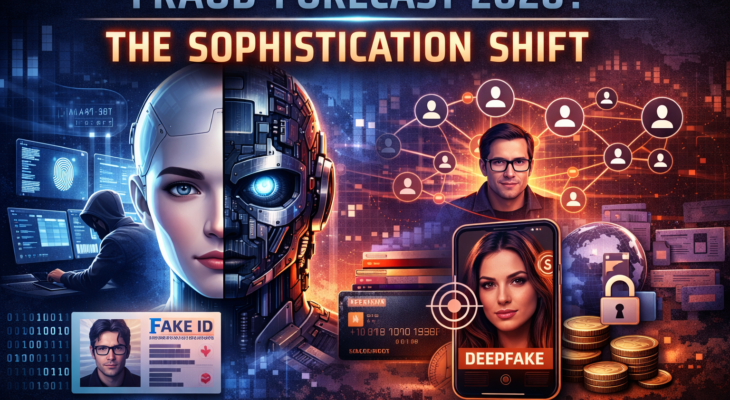
The global fight against identity fraud is entering a new era-one defined not by sheer volume, but by precision, intelligence, and automation. While overall fraud attempt rates appeared to stabilize in the past year, the reality beneath the surface tells a far more complex story.
What we are witnessing is a structural transformation in how fraud is executed. Criminal networks are no longer relying on crude document edits or mass bot submissions. Instead, they are deploying AI-powered systems capable of adaptive learning, real-time manipulation, and full-spectrum attack execution.
This is the Sophistication Shift-a decisive pivot from noisy, low-effort fraud to fewer but significantly more damaging attacks. Businesses that rely on static verification, one-time ID checks, or legacy anti-fraud systems are entering a period of heightened vulnerability.
Let’s explore what lies ahead. 👇
The Core Shift: From High Volume to High Precision 🎯
Global identity fraud rates moderated to around 2.2% in the previous year. At first glance, that seems like progress.
It isn’t.
The decline in overall numbers masks a sharp escalation in complexity. Sophisticated fraud-combining synthetic identities, social engineering, deepfakes, and telemetry manipulation-has surged dramatically year-over-year. By the coming year, these advanced tactics are expected to dominate the threat landscape.
Simple fraud attempts such as poorly edited documents or obvious bot patterns are increasingly filtered out by modern systems. What remains are highly curated attacks designed to bypass multiple layers of defense.
Fraudsters are thinking long-term. They are investing in infrastructure. They are running operations like startups.
And AI is their workforce.
Key Fraud Trends Shaping the Year Ahead 🔥
Autonomous AI Fraud Agents: The Rise of Self-Operating Attack Systems 🤖
One of the most alarming developments is the emergence of autonomous AI fraud agents.
These are not just scripts or bots. They are intelligent systems that can execute an entire fraud attempt without human supervision.
Adaptive Strategy in Real Time
These agents can dynamically adjust tactics based on the defenses they encounter. If one verification layer fails, they pivot. If behavioral flags are triggered, they modify activity patterns.
They operate with what experts describe as adaptive persistence.
End-to-End Fraud Execution
A single AI fraud agent can:
- Generate a synthetic identity profile
- Produce forged supporting documents
- Create deepfake liveness verification videos
- Manipulate device telemetry signals
- Submit loan or credit applications
- Manage mule accounts for fund extraction
All within a coordinated chain.
Learning From Failure
Using reinforcement learning models, these systems analyze unsuccessful attempts and refine future attacks. Every failed submission becomes training data.
Fraud is becoming iterative and intelligent.
Industrialized Deepfakes and Synthetic Media 🎭
Deepfake technology is no longer experimental. It is industrial.
Real-Time Interactive Deepfakes
The shift is moving from pre-recorded video clips to live, responsive avatars capable of reacting during identity verification checks.
They blink naturally. They shift facial micro-expressions. They respond to prompts like “turn your head” or “smile.”
Visual verification layers are now among the most vulnerable components of digital onboarding.
Scalable Synthetic Video Generation
Next-generation text-to-video systems enable fraudsters to render realistic video content from simple prompts. Lighting, shadows, and background realism have reached a level that challenges human detection.
Why Liveness Checks Are Under Pressure
Liveness systems traditionally rely on detecting unnatural movement or pre-recorded playback. But AI-generated real-time rendering eliminates many of those red flags.
Fraudsters can now simulate presence.
Networked Synthetic Identities: Fraud in Clusters 🌐
The days of isolated fake profiles are fading.
Fraud operations are building identity ecosystems.
Identity Clusters
Instead of creating a single synthetic identity, attackers develop clusters of interconnected personas. These identities:
- Interact with each other on social platforms
- Provide mutual references
- Establish transaction histories
- Reinforce credibility signals
The result is a web of legitimacy that is far harder to detect.
Professionalized Money Mule Networks
Money mule networks are scaling rapidly. Organized rings use AI tools to manage thousands of mule accounts that mimic authentic user behavior.
Transactions are structured to blend into high-volume environments such as fintech apps and payment platforms.
This makes financial tracing significantly more complex.
Contextual Evasion: Telemetry Tampering 📡
Fraud is no longer just about forged content. It’s about forged context.
Attackers are targeting the environment around the transaction.
Manipulating Device Signals
SDKs, APIs, and device fingerprinting tools are being reverse-engineered. Fraudsters manipulate device data so systems believe an authentic user session is taking place.
Emulator Farms and Virtual Environments
Large-scale emulator farms simulate unique devices at scale. Proxy networks and virtual machines hide repeat fraud attempts behind rotating digital identities.
The appearance of a “fresh user” can now be manufactured on demand.
Industry-Specific Fraud Forecasts 📊
iGaming 🎰
Deepfake liveness attacks are becoming routine. Operators are shifting toward cross-session behavioral monitoring and continuous tracking to detect anomalies over time rather than at a single login point.
Financial Services 💳
Fraud is concentrating around high-value products such as personal loans and credit lines. Applications are increasingly supported by synthetic employment histories, AI-generated pay stubs, and polished documentation.
High precision. High impact.
E-commerce 🛒
While overall fraud rates may appear stable, chargeback abuse continues to drive losses. Fraudsters are expected to automate dispute filings at scale, exploiting return and refund systems.
Online Media & Dating ❤️
Romance scams and emotional manipulation campaigns are being amplified by AI-generated personas and synthetic voice cloning.
Victims are no longer interacting with poorly written scripts. They are engaging with dynamic, responsive identities.
Regional Outlooks 🌍
United States & Canada 🇺🇸🇨🇦
These markets exemplify the Sophistication Shift. Overall fraud rates remain relatively low, but deepfake activity has surged dramatically.
Attackers are targeting high-value financial products and well-established digital ecosystems.
Asia-Pacific (APAC) 🌏
APAC is becoming a laboratory for fraud innovation.
Mature economies are seeing increasing sophistication despite falling attempt volumes. Meanwhile, rapidly digitizing markets face rising fraud attempts due to expanding online adoption.
Africa 🌍
Organized, AI-enabled fraud rings are replacing isolated scam operations. In digitally advanced markets, deepfake integration into fraud playbooks is accelerating.
Cross-border fraud coordination is expanding.
The Future of Defense: Continuous Identity Assurance 🔐
The era of “check once, trust forever” is ending.
Identity verification must become continuous, dynamic, and adaptive.
Behavioral Biometrics
Instead of relying solely on documents, systems will increasingly analyze:
- Typing rhythm
- Mouse movement
- Navigation patterns
- Transaction timing
- Session consistency
Behavior is harder to fake than a face.
Non-Document Verification
Direct integration with verified government or state-backed data sources reduces reliance on uploaded documents-one of the most easily forged elements in AI-driven fraud.
Unified Risk Intelligence Teams
Organizations are expected to merge compliance, fraud prevention, and cybersecurity into integrated risk intelligence units. Fraud cannot be treated as a siloed problem.
It must be managed across the entire customer lifecycle.
Matching AI With AI ⚔️
The fraud environment ahead is adversarial and algorithmic.
Businesses that rely on static rule engines or manual review processes will struggle. The only viable strategy is deploying adaptive AI models capable of learning and responding at the same speed as the threats they face.
Fraudsters are automating.
Defenders must automate smarter.
The coming year will not be defined by how many fraud attempts occur-but by how intelligent they are.
Those who recognize the Sophistication Shift early and invest in continuous identity assurance, behavioral analytics, and AI-driven defense will remain resilient.
Those who do not may find that the quiet decline in fraud volume was merely the calm before a far more precise storm.
Source: The report: “Identity Fraud Report 2025-2026“

![5 Legit Loan Apps With Low Interest [February 2026]](https://cashloanph.com/wp-content/uploads/2023/04/feature-image-cashloanph-438x246.jpg "5 Legit Loan Apps With Low Interest [February 2026]")