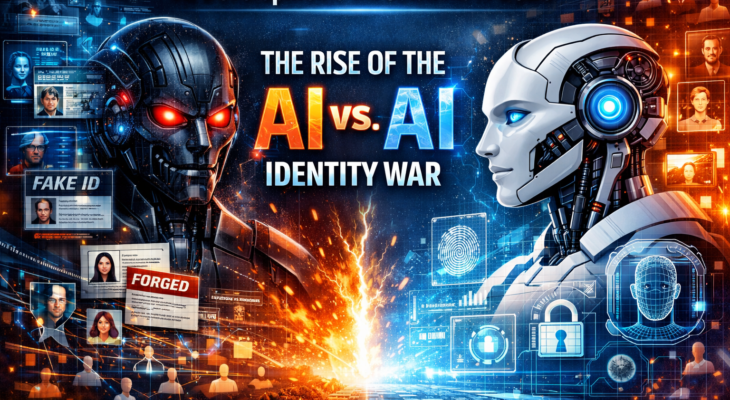
The global identity fraud landscape has entered a new chapter. What used to be isolated scams run by small groups has transformed into industrial-scale, AI-powered operations. Fraud is no longer manual. It’s automated, adaptive, and frighteningly intelligent.
By 2026, we are witnessing what experts call a “Sophistication Shift” – a moment when artificial intelligence stops being just a supporting tool and becomes the primary engine behind large-scale digital deception. Fraudsters now deploy AI systems capable of thinking, adjusting, and executing complex attack chains without human supervision.
But here’s the twist: the same technology empowering criminals is also strengthening defenders. We are now living in an era defined by AI vs. AI – where advanced defensive intelligence battles equally advanced malicious automation.
Let’s explore how this shift is unfolding and what solutions are emerging to counter it.
The Sophistication Shift: How AI Became the Core Engine of Fraud 🚀
Fraud used to rely on static tactics: stolen IDs, simple phishing emails, poorly edited fake documents. That era is over.
In 2026, fraud is dynamic. It adapts. It learns from failed attempts. It scales globally in seconds.
What changed?
Generative AI systems matured dramatically. Text-to-video models now produce hyper-realistic faces. Large language models generate perfectly structured fake documents. Autonomous agents simulate user behavior across entire platforms.
Fraud is no longer a one-step event – it’s a full operational pipeline powered by intelligent systems.
Autonomous AI Fraud Agents: The Silent Operators 🤯
The biggest wave reshaping 2026 is the emergence of autonomous AI fraud agents.
These are not simple bots. They are self-operating systems capable of:
- Generating synthetic identities
- Producing deepfake verification videos
- Submitting forged documentation
- Mimicking realistic behavioral telemetry
- Adjusting strategies in real time when blocked
Imagine a system that detects a failed identity verification attempt and instantly rewrites its approach – modifying lighting in a deepfake video, slowing typing speed to appear more human, or rotating IP addresses dynamically.
These agents orchestrate entire fraud chains without human supervision.
The most alarming part? They scale effortlessly. What once required dozens of fraud operators can now be executed by a single AI-powered system running thousands of simultaneous identity attempts.
Industrialized Deepfakes: From Static Clips to Interactive Avatars 🎭
Deepfake technology has evolved beyond short, pre-recorded videos.
Advanced text-to-video engines now generate:
- Realistic facial micro-expressions
- Natural eye movement
- Dynamic lighting reflections
- Adaptive emotional responses
Fraudsters can deploy interactive deepfake avatars capable of responding during live liveness checks. Instead of uploading a static video, the avatar can blink on command, move its head, and adjust facial expressions in real time.
These systems exploit weaknesses in traditional liveness detection methods that rely on simple movement prompts.
Deepfakes are no longer amateur edits. They are cinematic-grade simulations indistinguishable to the untrained eye.
Networked Synthetic Identities: Fraud as a Social Ecosystem 🌐
Another major shift is the rise of networked synthetic identities.
In the past, fraudsters created isolated fake profiles. Now, they create clusters.
These identities interact with one another across platforms:
- Leaving reviews
- Connecting on social media
- Sharing transaction history
- Building digital reputations collectively
This networked structure increases credibility. A synthetic identity backed by a web of supporting accounts appears legitimate.
It’s not just about creating one fake person anymore – it’s about constructing an entire artificial community.
AI-Assisted Document Forgery at Scale 📄⚡
Document fraud has reached industrial levels.
Generative AI tools can now:
- Replicate official ID templates
- Recreate utility bills
- Mimic government document layouts
- Match font spacing and alignment precisely
- Generate jurisdiction-specific formats
The alarming factor isn’t just realism – it’s volume.
AI enables thousands of document variations to be generated instantly, reducing pattern detection and increasing success rates.
Traditional document-based verification systems struggle to keep up.
The AI vs. AI Solution Landscape 🛡️
The good news? Defense is evolving just as quickly.
Security leaders are abandoning static verification systems in favor of continuous, adaptive intelligence frameworks.
Fraud prevention is no longer a one-time checkpoint. It’s an ongoing risk assessment process embedded throughout the user lifecycle.
Behavioral AI & Biometrics: Shifting Focus from Documents to Behavior 🧠
Instead of asking, “Does this document look real?” companies are now asking, “Does this user behave like a human?”
Behavioral AI analyzes:
Onboarding Flows
- Suspiciously fast form completion
- Inconsistencies between typing and pasted data
- Unrealistic interaction timing
- Device-switch anomalies
AI agents may generate perfect documents, but they often reveal themselves through unnatural behavior patterns.
In-App Navigation Patterns
Systems monitor:
- Mouse dynamics
- Swipe pressure and rhythm
- Typing cadence
- App navigation sequences
Human behavior has subtle randomness. Bots often lack that organic unpredictability.
Behavioral biometrics transforms identity verification into a dynamic behavioral fingerprint.
Multi-Modal Verification: Fighting Deepfakes with Layered Defense 🎥🎙️📱
Single-channel verification is no longer enough.
To counter advanced deepfakes, companies now deploy multi-modal verification systems that simultaneously analyze:
- Vision (skin texture, facial muscle micro-movements)
- Audio (voice tone, breathing cadence, emotional consistency)
- Device telemetry (camera attestation, sensor validation, hardware integrity)
A fraudster might fake one channel convincingly.
But maintaining consistent authenticity across three or more channels simultaneously? That’s exponentially harder.
Multi-modal systems create friction for fraud while remaining seamless for legitimate users.
Document-Free Verification: The Fastest-Growing Defense Model 📊
One of the most significant trends of 2026 is the explosive growth of document-free (non-doc) verification.
Instead of uploading IDs, users verify their identity by securely connecting to:
- Government databases
- National identity registries
- Financial records
- Telecom authentication systems
This approach eliminates the document forgery attack vector entirely.
Adoption has surged dramatically year-over-year because it reduces fraud exposure while improving user experience.
Fewer uploads. Fewer manual reviews. Stronger trust signals.
Structure-Aware AI Models: Detecting Logical Inconsistencies 🔍
Defensive AI systems are becoming smarter at analyzing document logic, not just appearance.
These models verify:
- MRZ checksum validation
- Jurisdiction-specific date formats
- Issuing authority alignment
- Expiry date plausibility
- Address consistency
A document might look flawless visually – but if its internal logic fails validation rules, it gets flagged instantly.
Structure-aware AI doesn’t just look at pixels. It understands format integrity.
Unified Risk Intelligence Units: The End of Silos 🏢➡️🤝
In 2026, organizations are dismantling the traditional divide between compliance teams and fraud teams.
Instead, they are forming Unified Risk Intelligence Units powered by AI-native platforms.
These units oversee:
- Onboarding verification
- Transaction monitoring
- Account lifecycle management
- Suspicious behavior escalation
- Regulatory reporting
By integrating fraud detection and compliance workflows, companies reduce blind spots and respond faster to evolving threats.
The future belongs to organizations that treat risk as a continuous intelligence process, not a checkbox exercise.
Why Continuous Intelligence Is the New Standard 🔄
Static checks fail in a world of adaptive AI fraud.
The new model relies on:
- Real-time behavioral scoring
- Device fingerprinting updates
- Cross-platform identity correlation
- Adaptive risk thresholds
- Ongoing anomaly detection
Identity verification is becoming a living system – one that learns continuously and updates dynamically.
Fraudsters evolve daily. Defensive AI must evolve faster.
Final Thoughts: The Identity War Has Only Just Begun ⚔️
The “Sophistication Shift” is not a temporary spike. It marks a structural transformation in how fraud operates globally.
Autonomous AI agents, interactive deepfakes, networked synthetic ecosystems, and large-scale document forgery represent a new industrial era of digital deception.
But we are not defenseless.
Behavioral biometrics, multi-modal verification, document-free identity checks, structure-aware AI, and unified risk intelligence systems are reshaping the defensive frontier.
The battle ahead will not be human vs. machine.
It will be machine vs. machine.
And the organizations that invest in adaptive, AI-native verification ecosystems today will define the trust standards of tomorrow. 🌍✨
Source: The report “Identity Fraud Report 2025-2026“




![10 Fast Cash Loan Apps Philippines in 15 Minutes [Latest Update]](https://cashloanph.com/wp-content/uploads/2023/05/fast-cash-loan-apps-philippines-cashloanph-438x246.jpg "10 Fast Cash Loan Apps Philippines in 15 Minutes [Latest Update]")