Last Updated on 18/03/2026 by Nicole Alba
When you need quick cash in the Philippines-whether for emergencies, tuition, home repairs, or business capital-you’ll likely choose between a Pag-IBIG Multi-Purpose Loan (MPL) and a bank personal loan. Both options are widely available, but they differ significantly in interest rates, requirements, flexibility, and accessibility.
This comprehensive guide breaks down everything you need to know so you can confidently choose the right loan for your financial situation. 🚀
What Is a Pag-IBIG Multi-Purpose Loan (MPL)? 🏠
The Pag-IBIG MPL is a short-term cash loan offered by the government through the Home Development Mutual Fund (Pag-IBIG). It’s designed primarily for members who need financial assistance for various personal needs.
Key Features of Pag-IBIG MPL
- Interest rate: Around 10.5% per year
- Loan term: 1 to 3 years (12-36 months)
- Loanable amount: Up to 80% of your total Pag-IBIG savings
- Eligibility: Active member with at least 12 monthly contributions
- Repayment: Salary deduction or voluntary payments
💡 One unique advantage: Part of the interest you pay is returned as dividends, making it more cost-effective in the long run.
What Is a Bank Personal Loan? 🏦
A bank loan is a private lending option offered by commercial banks in the Philippines. It provides flexible financing but typically comes with stricter approval requirements.
Key Features of Bank Loans
- Interest rate: Around 15%-35% per year
- Loan term: Usually 1 to 5 years
- Loanable amount: ₱20,000 up to ₱2 million or more
- Eligibility: Based on income, employment, and credit score
- Processing time: Often faster than government loans
💡 Banks are ideal for borrowers who need larger amounts and have strong financial credentials.
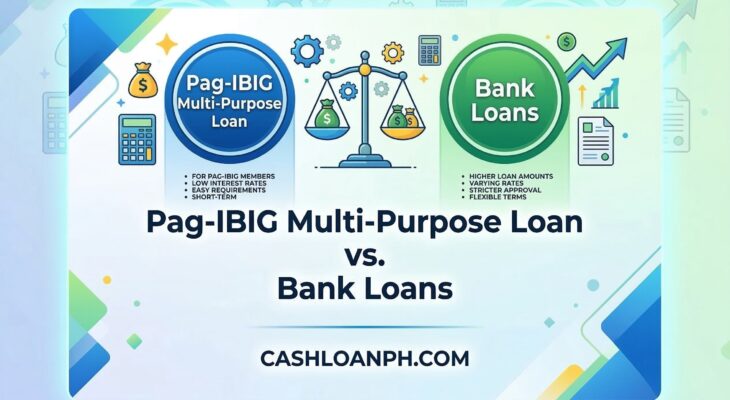
Pag-IBIG MPL vs. Bank Loans: Quick Comparison ⚖️
| Feature | Pag-IBIG MPL | Bank Loan |
|---|---|---|
| Interest Rate | ~10.5% annually | 15%-35% annually |
| Loan Amount | Up to 80% of savings | ₱20K-₱2M+ |
| Loan Term | Up to 3 years | Up to 5 years |
| Approval Requirements | Membership-based | Credit & income-based |
| Processing Speed | Moderate | Faster |
| Accessibility | Easier | Stricter |
👉 Clearly, Pag-IBIG loans are more affordable, while bank loans offer more flexibility and higher borrowing limits.
Advantages of Pag-IBIG MPL 🌟
Lower Interest Rates 💸
Pag-IBIG MPL offers significantly lower interest compared to banks, making it one of the most affordable loan options in the Philippines.
- Around 10.5% annually vs. up to 35% in banks
This means smaller monthly payments and less total interest paid.
Easier Approval Requirements ✅
You don’t need a high credit score. As long as you:
- Are an active member
- Have enough contributions
…you can qualify much more easily than with a bank.
Flexible Use of Funds 🛠️
You can use MPL for almost anything:
- Medical emergencies
- Tuition fees
- Home repairs
- Small business capital
Short-Term Commitment ⏳
With a maximum term of 3 years, borrowers can quickly repay their loan and avoid long-term debt.
Disadvantages of Pag-IBIG MPL ⚠️
Limited Loan Amount 💵
You can only borrow based on your savings (up to 80%), which may not be enough for major expenses.
Membership Requirement 📋
Non-members cannot apply, and new members must meet contribution requirements.
Processing Time May Vary 🐢
While improving through digital services, processing can sometimes take longer compared to private banks.
Advantages of Bank Loans 🚀
Higher Loan Amounts 💰
Banks can lend significantly more, making them ideal for:
- Large emergencies
- Business expansion
- Major purchases
Faster Approval ⚡
Many banks can approve loans within days if your documents are complete.
Longer Repayment Terms 📆
With up to 5 years repayment, monthly payments can be lower despite higher interest rates.
More Loan Options 🎯
Banks offer different types of loans:
- Personal loans
- Salary loans
- Credit lines
This gives borrowers more flexibility.
Disadvantages of Bank Loans ❌
Higher Interest Rates 📈
Bank loans can be expensive, especially for borrowers with average credit scores.
Strict Requirements 🔍
You’ll need:
- Stable income
- Good credit history
- Complete documentation
Approval is not guaranteed.
Risk of Higher Total Cost ⚠️
Longer terms and higher interest can lead to significantly higher total repayment amounts.
When Should You Choose Pag-IBIG MPL? 🤔
Choose Pag-IBIG MPL if:
✔️ You are an active Pag-IBIG member
✔️ You need a small to medium loan
✔️ You want lower interest rates
✔️ You prefer simpler approval
👉 This is perfect for everyday financial needs and emergencies.
When Should You Choose a Bank Loan? 🏦
Choose a bank loan if:
✔️ You need a large loan amount
✔️ You have a good credit score
✔️ You want fast approval
✔️ You can handle higher interest rates
👉 Best for major expenses like business or large purchases.
Real-World Insight: Which Saves More? 💡
In most cases:
- Pag-IBIG MPL = Lower cost overall
- Bank loan = Higher flexibility but more expensive
Government-backed loans typically offer:
- Lower processing fees
- More stable rates
- Better accessibility for average earners
Meanwhile, banks excel in:
- Speed
- Loan size
- Premium financial services
Expert Tips Before You Borrow 🧠
1. Borrow Only What You Need
Avoid overborrowing-even if you qualify for more.
2. Compare Monthly Payments
Don’t just look at interest rates-check total repayment cost.
3. Check Additional Fees
Banks may charge:
- Processing fees
- Late payment penalties
4. Plan Your Repayment Strategy
Make sure your monthly income can comfortably cover payments.
Final Verdict: Pag-IBIG MPL vs. Bank Loans 🏁
There’s no one-size-fits-all answer-but here’s a simple way to decide:
👉 Go for Pag-IBIG MPL if you want affordability, simplicity, and lower risk.
👉 Go for Bank Loans if you need bigger funds, faster processing, and more flexibility.
For most Filipinos-especially first-time borrowers-Pag-IBIG MPL is the safer and more budget-friendly choice. But if your financial capacity allows it, a bank loan can open doors to larger opportunities.
Conclusion 💬
Choosing between Pag-IBIG MPL and bank loans ultimately depends on your financial goals, urgency, and capacity to repay. Both options have their strengths, and understanding their differences can help you avoid unnecessary debt and make smarter financial decisions.
Before applying, always evaluate your needs, compare offers, and ensure that your loan aligns with your long-term financial health. 💡